Many factory wastewater systems are commissioned with a rotary ceramic membrane package but without a defined backwash routine and without a specific flux‑loss threshold that triggers acid cleaning. When permeate flow starts to drift, operators are forced to guess whether the decline is normal variability or a signal that scale is consolidating—and the guess is expensive in both directions. The plant either spends too many shifts on aggressive chemical cleanings that multiply downtime and acid‑handling burden, or it defers acid cleaning so long that irreversible deposits cut membrane capacity permanently. Defining the operating‑control backwash procedure and the acid‑CIP release condition before startup is what turns that guess into a controlled recovery decision.
Define what online backwash is expected to remove
Online backwash is an operating control, not a deep‑cleaning step. It applies a short reverse flow to dislodge loose solids that have built up as a cake layer on the membrane surface during normal filtration. The purpose is to keep the filtration resistance within the operating band, not to restore a membrane that has accumulated scale, chemically bonded organic foulants, or compacted deposits that backwash flow cannot shear off.
The practical limit matters because operators who treat backwash as a cure for all flux loss will keep cycling it after it has stopped working, allowing harder deposits to consolidate. Conversely, treating a backwash‑recoverable flux dip as a CIP trigger wastes chemical and shutdown resources. The evidence from ceramic flat‑sheet and tubular installations confirms that backwash is performed periodically to remove surface solids, but it does not rewrite the foulant layer chemistry.
Backwash removes loose cake, not scale or chemically fixed deposits.
The operator’s decision is therefore to use backwash as the primary ongoing solids‑control action while watching for a point at which backwash alone no longer returns flux to the baseline. That point defines when the cleaning strategy must shift.
Reserve acid CIP for stronger recovery conditions
Acid CIP should be reserved for conditions where backwash fails to deliver acceptable flux recovery, not scheduled as a routine maintenance cycle. The chemical inertness of ceramic membranes across pH 0–14 allows the use of strong acids or bases when needed, but this capability is a material property that enables aggressive recovery, not an automatic cleaning schedule. Using acid CIP as a routine substitute for backwash multiplies chemical exposure, neutralisation workload, wastewater disposal complexity, and the total time the system is offline.
The operator’s judgment is whether the flux loss has moved from an operating variation—where backwash restores performance—to a condition where deposits require chemical attack. Evidence for this shift should come from trend data: consecutive backwash cycles that do not bring permeate flow back into the site‑defined recovery band. Without that evidence, a premature CIP consumes handling resources and a delayed CIP allows scale or compacted organic films to harden into a layer that even aggressive cleaning may not fully remove.
Acid CIP is a recovery step, not a routine maintenance tool.
Compare uptime benefits with chemical handling burden
The two cleaning modes present a direct engineering trade‑off that every site must evaluate against its own production schedule and chemical safety capacity. The table below captures the main differences, but the decision is never just a matter of selecting the row that looks better.
| Aspect | Online Backwash | Acid CIP |
|---|---|---|
| Uptime impact | Minimal interruption; performed during normal operation | Requires shutdown, isolation, and recovery time |
| Chemical handling burden | No or low chemical addition | Involves strong acid/alkali; requires safe storage, dosing, and PPE |
| Chemical compatibility | Not reliant on membrane chemical resistance | Relies on ceramic membrane pH 0–14 inertness for aggressive cleaning |
| Isolation and disposal | No system isolation; slight waste change | Needs system isolation, neutralisation, and planned disposal |
| Flux recovery depth | Removes loose surface solids; limited flux gain | Can remove scale, organic deposits, and deeper foulants |
| Suitable when | Routine solids removal; operating control | Sustained flux loss or evidence of deposits backwash cannot remove |
A plant that prioritises continuous availability will lean heavily on online backwash, but that choice is sustainable only if the feed composition and backwash frequency keep fouling reversible. If the solids stream carries scaling precursors or sticky organics, the backwash‑only route eventually produces a slow loss of capacity that quietly raises lifecycle cost without a single dramatic failure event. On the other hand, a plant that acid‑CIPs too readily may minimise permanent fouling risk but at the cost of regular isolation, neutralisation, and disposal planning that strains the maintenance budget and exposes the team to strong chemicals more often than necessary.
The friction is that without a pre‑commissioned release condition, the site tends to drift toward whichever mode feels safest in the moment—often the one that avoids an immediate shutdown—and that drift sets the real operating cost.
The uptime‑versus‑chemicals choice only remains a controlled trade‑off when the plant defines exactly what flux behaviour triggers the move from backwash to CIP.
Prevent routine fouling from becoming shutdown cleaning
The most expensive pattern in industrial membrane operation is not a single cleaning error; it is the slow, undetected transition from routine fouling to a consolidated deposit that can only be removed by a prolonged shutdown cleaning. The table below frames the risk of relying on one cleaning mode alone and the balanced approach that keeps both options available but properly gated.
| Cleaning approach | Risk if sole reliance | Balanced preventive measure |
|---|---|---|
| Backwash-only routine | Gradual deposition of scale or compacted solids that backwash cannot remove | Add flux monitoring; define CIP release condition before irreversible fouling sets in |
| CIP used as routine | Excessive downtime, chemical exposure, and disposal burden | Reserve CIP for strong recovery; use backwash as primary operating control |
| Integrated practice | – | Backwash programme plus site-defined flux-loss threshold; activate CIP only when threshold is exceeded |
Backwash‑only routines often work well for months, and that success can lull operators into believing a CIP release trigger is unnecessary—right up until the flux curve bends sharply downward and even multiple backwash cycles cannot recover the baseline. By that point, the deposit has often changed character: what was a loose cake has become a compacted scale or a polymer‑like film that requires much longer chemical contact time and may leave a permanent permeability loss. The alternative failure mode, using CIP as routine, erodes the maintenance budget and creates a chemical‑handling record that EHS auditors will question.
The corrective measure is not to favour one mode permanently, but to commission the system with a clear monitoring rule: backwash is the operating control, and an acid CIP is released only when flux data show that backwash alone no longer returns performance to the agreed recovery band. The trigger must be defined in writing, agreed with the equipment supplier, and visible to operators at the HMI or daily log, so that routine fouling does not silently become a shutdown event.
Set flux-loss triggers for each cleaning mode
Flux‑loss triggers are planning criteria that convert operator observation into an action, and they must be adapted to the site’s own baseline data. The table below shows example trigger conditions, but these are not universal standards; they are decision‑support figures that the plant owner and process engineer must calibrate to the specific feed quality, production schedule, and membrane performance history.
| Cleaning mode | Flux-loss trigger condition | What to confirm | Risk if action delayed |
|---|---|---|---|
| Online backwash | Time- or volume-based interval, or minor flux decline within normal operating range | Permeate flow trending; owner to set site-specific trigger point | Solids consolidation, requiring more aggressive cleaning later |
| Acid CIP | Failure to recover baseline flux after consecutive backwash cycles | Flux data showing lack of recovery; operator to confirm release condition | Irreversible fouling or scale formation, prolonged shutdown |
The important judgment is not the exact number in the table but the principle that two distinct trigger levels are needed: a routine backwash trigger that keeps daily cleaning disciplined, and a CIP release trigger that is invoked only after consecutive backwash cycles fail. If a plant has only a time‑based backwash interval and no defined flux‑recovery failure point, the CIP decision will be made under pressure when production is already affected, and the tendency will be to delay cleaning until capacity loss is severe. That delay is what allows irreversible fouling to take hold.
A site that defines these triggers before commissioning removes the need for guesswork when the flux begins to move. The triggers should be documented as part of the operating envelope, reviewed during the performance test, and reassessed whenever feed composition changes significantly.
A site without a flux‑loss release condition is guessing, and the guess becomes expensive once scale consolidates.
Verify recovered flux after every cleaning change
Verification after a cleaning event is the only way to know whether the effort restored membrane capacity or merely masked a worsening condition. The table below gives example verification points, but the acceptance basis must be defined by the site using its own clean‑membrane performance data from commissioning.
| Cleaning step | What to verify | Measurement record | Acceptance basis |
|---|---|---|---|
| After online backwash | Flux returns to baseline operating range | Permeate flow rate immediately post-backwash | Site-defined recovery band; acceptable if within normal variation |
| After acid CIP | Flux recovery to or beyond clean membrane target | Pre- and post-CIP flux test after neutralisation and rinse | Comparison to clean membrane specification or baseline commissioning data |
After an online backwash, the operator checks whether permeate flow returns to the baseline operating range. This is a quick verification that the cake was primarily loose solids and that the membrane is still operating within normal variability. After an acid CIP, the check is more fundamental: flux should recover to or above the clean‑membrane target documented during initial start‑up. Without that pre‑CIP baseline comparison, a partial recovery can be misinterpreted as a successful cleaning, and the plant will continue running with a membrane that has permanently lost capacity.
The verification record also protects the maintenance team when questions arise about membrane life or cleaning frequency. It shows whether each CIP delivered the expected flux recovery or whether the membrane was already degrading before the cleaning was performed. This record converts a subjective “the membrane looks better” judgment into a defendable operating decision.
The practical stakes of skipping verification are highest when the plant is trying to decide between another CIP and a membrane replacement. Without flux recovery data after previous cleanings, that capital decision lacks the evidence it needs.
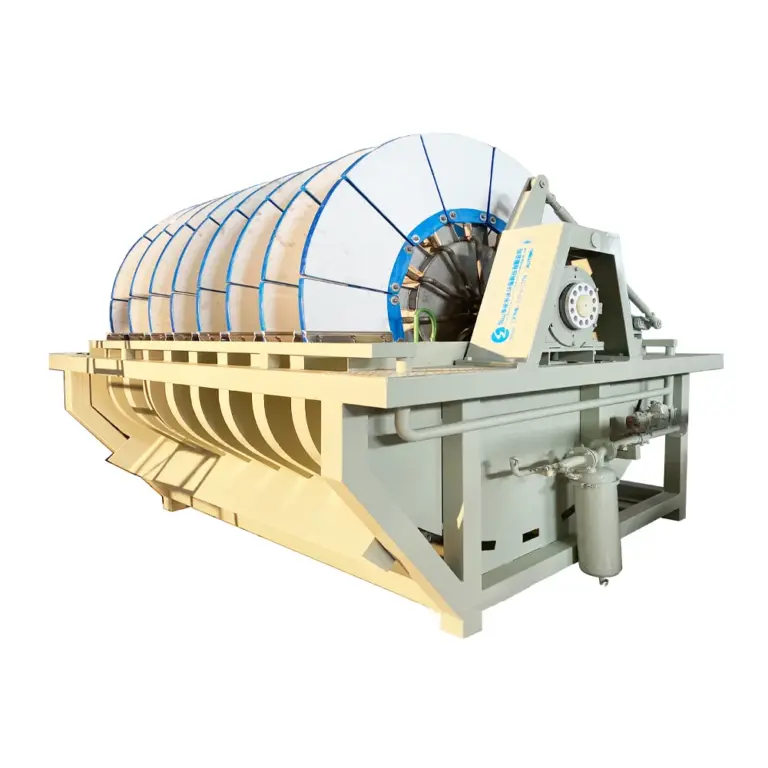
A rotary ceramic membrane system will drift toward instability if it lacks a backwash routine with a defined failure point and a CIP trigger that is released, not assumed. The most consequential engineering decision is not which acid to use or what backwash pressure to set; it is whether the plant, before startup, documents the flux‑loss threshold that forces the move from operating control to strong recovery. When that threshold is absent, the plant will cycle between too much chemical cleaning and too little, and the total cost of downtime, chemical consumption, and lost membrane capacity will accumulate regardless of the hardware quality. Defining the backwash programme, the acceptance band for flux recovery, and the CIP release condition turns that cycle into a controllable maintenance process, and commissioning is the right time to put those rules in place.
Frequently Asked Questions
Q: What if our feed stream contains high concentrations of scaling salts that backwash never removes?
A: Online backwash is designed to dislodge loose particulate cake, not mineral scale. If the feed is dominated by scaling precursors, backwash alone will not maintain flux—the system will require more frequent acid CIP or upstream softening and antiscalant dosing to keep scale from consolidating on the membrane surface.
Q: How do we actually calibrate the CIP release flux-loss threshold for our specific plant?
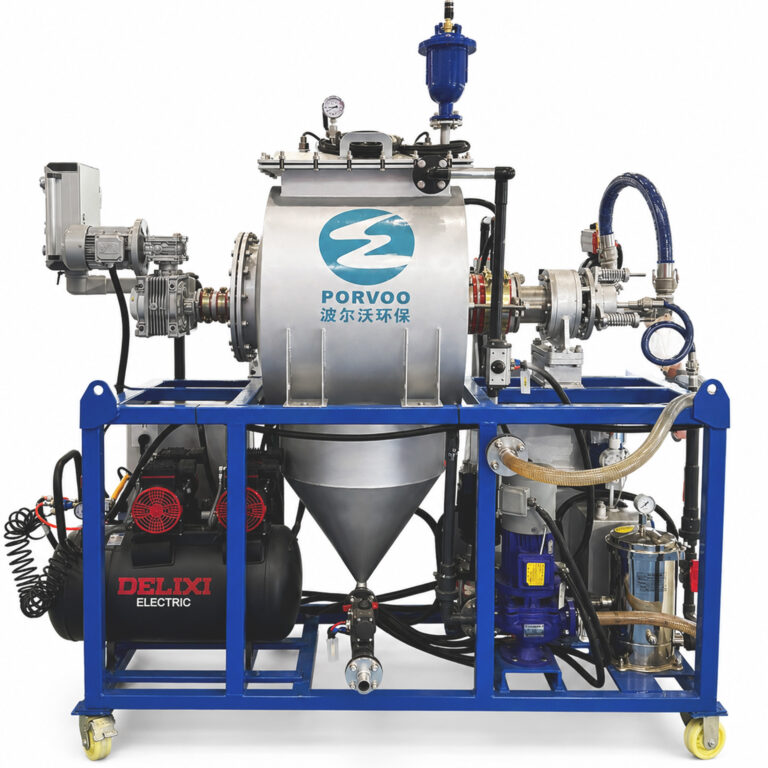
A: Begin by recording the clean-membrane flux during commissioning. After each backwash cycle, note the stabilized flux. When consecutive backwash events fail to return flux to within a site-defined recovery band (e.g., 90–95% of the clean baseline), that failure pattern becomes the CIP release condition. Working with your system supplier—such as the technical team behind Porvoo’s Rotary Ceramic Membrane Concentration System—to validate the threshold during startup ensures the trigger reflects your actual feed variability.
Q: Does the backwash vs. CIP framework change if we are using polymeric membranes instead of ceramic?
A: Yes, significantly. Polymeric membranes have narrow pH and chemical tolerance limits, so the strong-acid CIP enabled by ceramic’s pH 0–14 inertness may not be feasible. Backwash still controls surface solids, but the CIP strategy must be restricted to compatible chemicals and milder conditions, and irreversible fouling risk rises if aggressive recovery steps are unavailable.
Q: Can we use a chemically enhanced backwash instead of a full CIP to reduce downtime?
A: Chemically enhanced backwash (CEB) with low-concentration acid or oxidizer can extend the interval between full CIP cycles by loosening early-stage scaling or organic films. However, CEB does not replace a full acid CIP when hard scale or compacted bonded deposits have already formed; it is a supplementary tactic, not a substitute for the recovery cleaning triggered by sustained flux loss after standard backwash fails.
Q: Is a flux-triggered CIP strategy worth the monitoring effort for an intermittently operated batch plant?
A: For small batch plants with long idle periods and consistent feed, a schedule-based CIP with post-cleaning verification may be simpler and adequate. But if feed quality varies greatly between campaigns, a flux-triggered release still guards against irreversible fouling during active runs. The choice hinges on the cost of early membrane replacement versus the overhead of maintaining trend data—plants with lower-value waste streams often accept a fixed-CIP schedule, while those processing high-fouling streams benefit from trigger-based control.