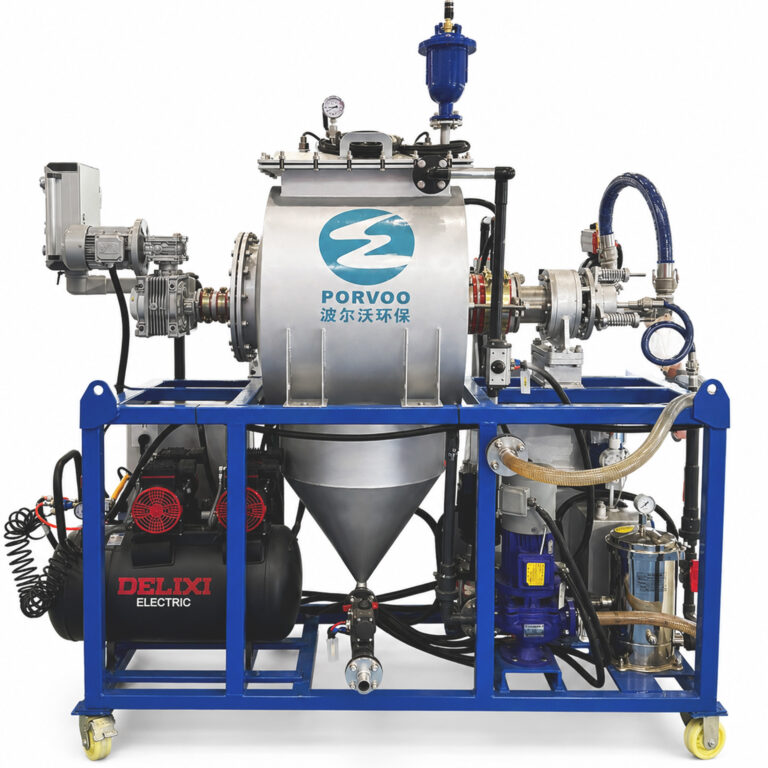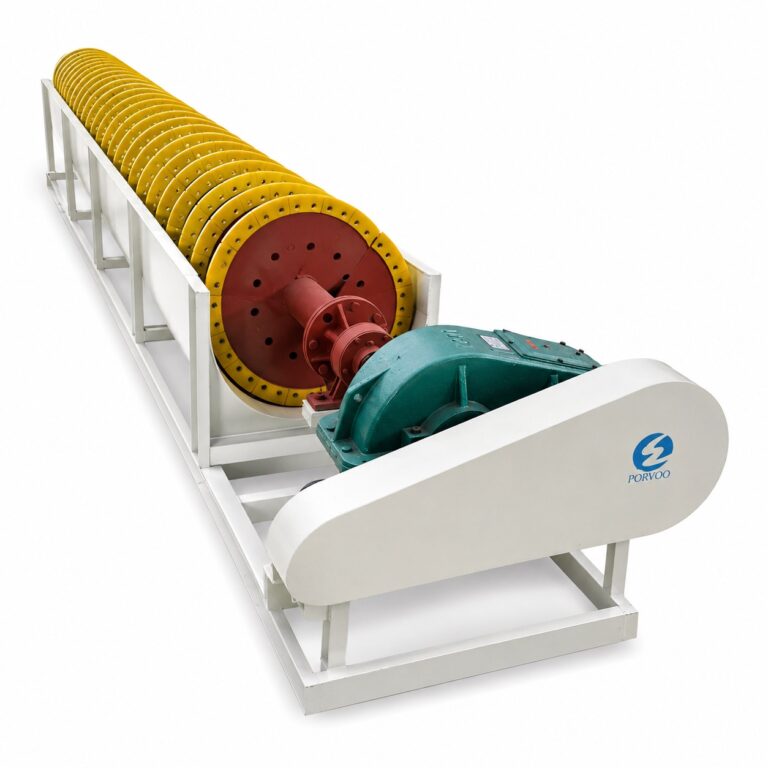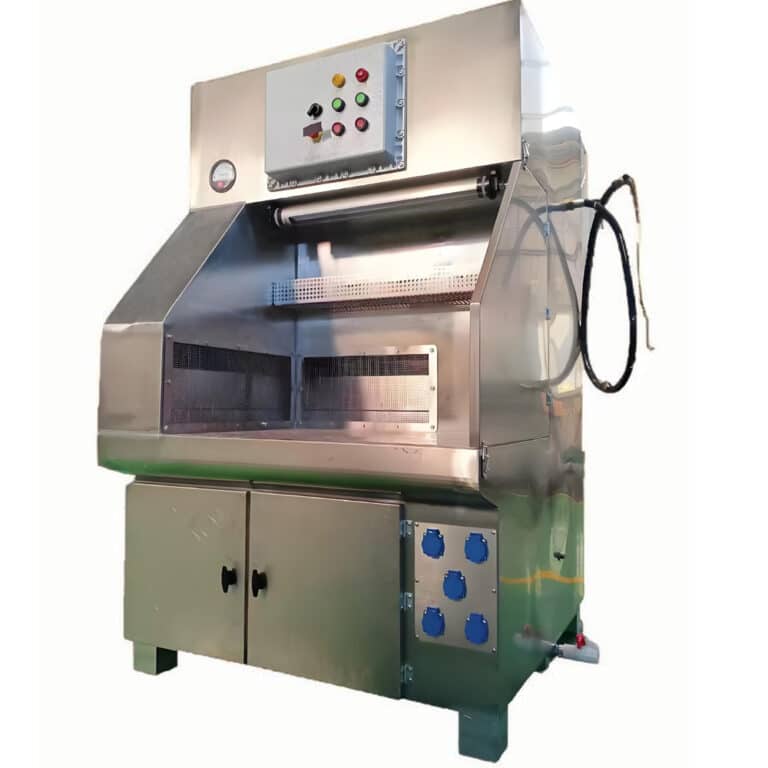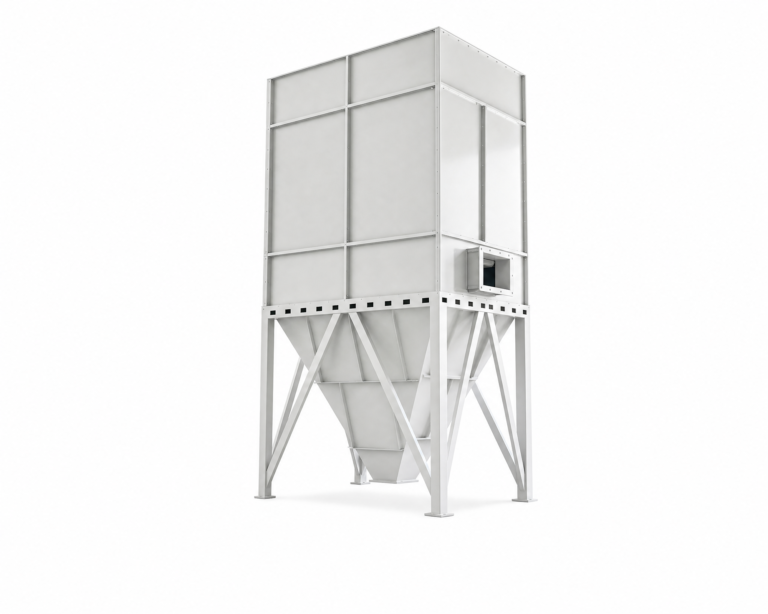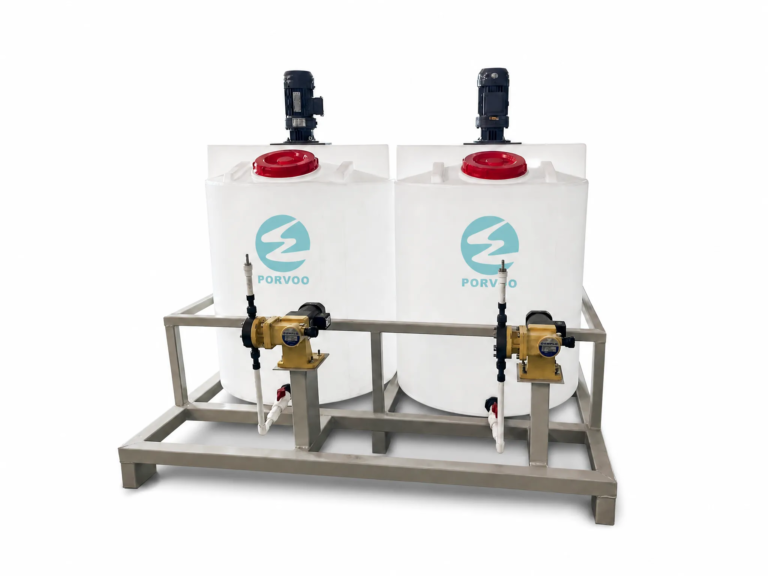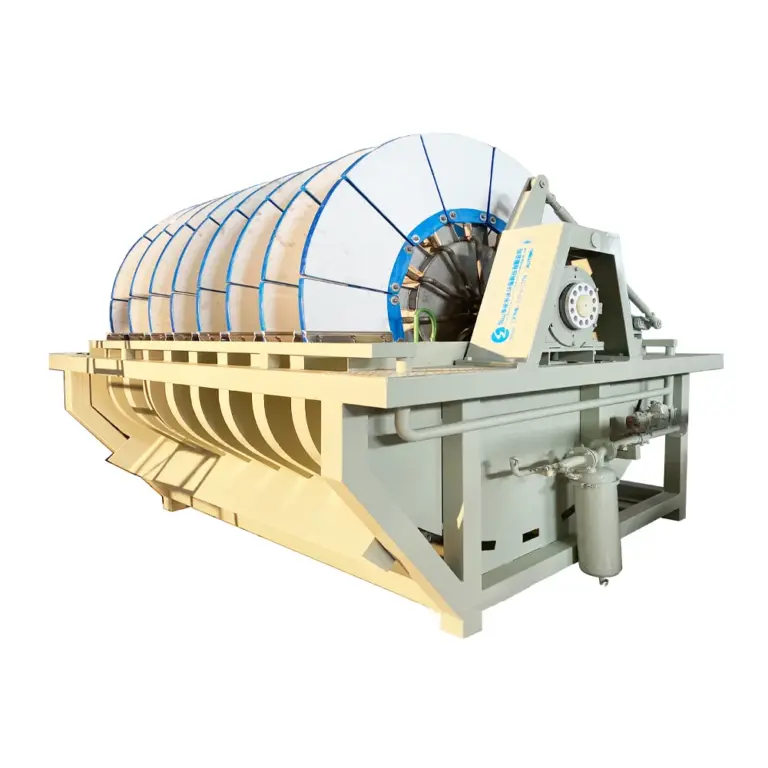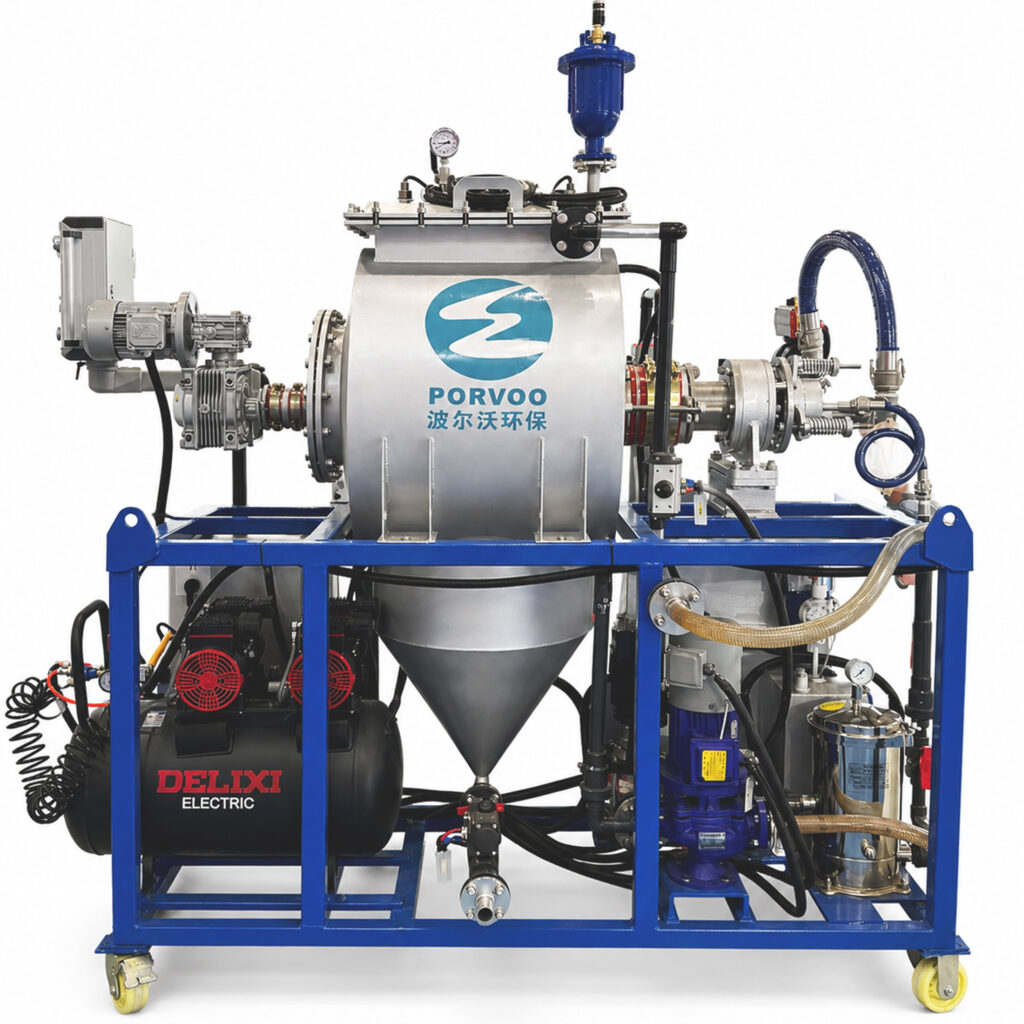
El sistema rotativo de concentración por membrana cerámica de PORVOO separa las aguas residuales diluidas del esmaltado en dos corrientes útiles: agua de proceso reutilizable y esmalte concentrado que puede devolverse directamente al proceso de esmaltado.
En el interior de un recipiente presurizado funcionan varios discos de membrana cerámica que giran a baja velocidad. La presión positiva en el lado de alimentación y la extracción asistida por vacío en el lado del permeado generan una presión transmembranaria total de 3-4 bar.
Este proceso también se conoce comúnmente como «recuperación de esmalte», y la misma tecnología de membrana cerámica rotativa se aplica igualmente a la recuperación de barbotina y engobe en la producción de baldosas cerámicas y artículos sanitarios.
Las aguas residuales típicas del esmaltado, que contienen aproximadamente un 0,5 % en peso de sólidos, pueden concentrarse hasta alcanzar un 15-30 % en peso sin necesidad de añadir coagulantes, floculantes ni aditivos de filtración.
Principales ventajas
- Recuperación del esmalte para su reutilización directa en la producción
- Generar agua de proceso reutilizable
- No se ha descargado la torta de filtración
- No se utilizan coagulantes ni floculantes durante la concentración
- Retrolavado automático en línea
- Recubrimientos de membrana seleccionables con un espesor de hasta 5 nm
- Capacidad adaptada a cada línea de producción
Dejad de tratar el valioso esmalte como lodos residuales
Las aguas residuales de esmaltado se generan habitualmente durante el lavado de los molinos de bolas, el funcionamiento de las cabinas de pulverización, la limpieza de los equipos y el enjuague de la línea de esmaltado.
En un proceso convencional de tratamiento de aguas residuales, esta corriente diluida se mezcla con productos químicos de tratamiento, se deja sedimentar y, finalmente, se convierte en lodos. Se pierden valiosas materias primas para esmaltes, mientras que la fábrica debe asumir los costes de la dosificación de productos químicos, la gestión de los lodos, el prensado en filtro y la eliminación.
El sistema PORVOO transforma este proceso.
En lugar de considerar el esmalte como un contaminante, este sistema concentra los sólidos en suspensión del esmalte en un flujo de material bombeable. Una vez alcanzada la concentración deseada, el esmalte recuperado puede descargarse y devolverse al proceso de esmaltado original.
El permeado puede reutilizarse como agua de proceso siempre que su calidad cumpla los requisitos de la operación de producción prevista.
Dos flujos recuperados a partir de una sola entrada de aguas residuales
Concentrado de esmalte recuperado
Las aguas residuales del esmalte diluido entran en el sistema con una concentración de sólidos de aproximadamente 0,5 % en peso.
El agua atraviesa las membranas cerámicas, mientras que las partículas de esmalte permanecen en el recipiente de concentración. La concentración de sólidos aumenta gradualmente hasta alcanzar el nivel deseado de 15-30 % en peso.
El lodo concentrado sigue siendo bombeable. No se convierte en una torta de filtración seca y puede devolverse directamente al proceso de producción de lodo correspondiente.
Agua de proceso reutilizable
El líquido que atraviesa la membrana se recoge a través de los canales internos de los discos cerámicos y se evacua por el eje giratorio hueco.
Una parte del permeado pasa por un filtro de pulido específico y se reutiliza para el retrolavado automático de las membranas. El resto del permeado puede reutilizarse como agua de proceso, de acuerdo con los requisitos de producción de la fábrica y los criterios de calidad del agua establecidos.
Cómo funciona el sistema
1. Alimentación directa de aguas residuales del esmaltado
El agua de lavado de los molinos de bolas o los efluentes de las cabinas de pulverización, recogidos por separado, pueden introducirse directamente en el sistema.
El proceso de concentración no requiere coagulación, floculación ni sedimentación química antes de la filtración por membrana.
2. Filtración de doble presión
Las aguas residuales del esmaltado se almacenan en un depósito a presión positiva que contiene varios discos de membrana cerámica.
Una bomba de vacío independiente genera una presión negativa en el lado del permeado. La combinación de la presión en el lado de alimentación y el vacío en el lado del permeado genera una presión transmembranaria total típica de entre 3 y 4 bar.
Esta diferencia de presión impulsa el agua desde el exterior de cada disco de membrana hacia sus canales internos de permeado.
3. Rotación de la membrana a baja velocidad
Los discos de membrana cerámica giran a baja velocidad durante el funcionamiento.
La rotación ayuda a:
- Mantener los sólidos del esmalte en suspensión
- Distribuye el alimento de manera uniforme por toda la superficie de las membranas.
- Reducir la acumulación localizada de sólidos
- Mantener unas condiciones de filtración más estables
- Evitar la formación prematura de una capa superficial gruesa
4. Separación por membrana «de fuera hacia dentro»
El fluido de alimentación permanece fuera de los discos de membrana cerámica.
El agua y los componentes de tamaño inferior al de la capa de separación seleccionada atraviesan la membrana. Las partículas de esmalte retenidas permanecen en el recipiente y se van concentrando progresivamente.
El permeado fluye a través de la estructura de soporte porosa hacia los canales de drenaje internos y sale por el eje hueco.
5. Retrolavado automático en línea
Una parte del permeado se filtra mediante un filtro específico y se reutiliza como medio de retrolavado.
El retrolavado se produce durante el funcionamiento y consiste en invertir el flujo a través de la membrana para eliminar el material depositado en la superficie y los poros de la misma.
Los ciclos de retrolavado se pueden programar in situ. Como opción de control personalizada, se ofrece la activación automática basada en la presión diferencial o en el caudal.
6. Descarga de concentrado
El sistema funciona como un concentrador por lotes.
Cuando el esmalte alcanza la concentración de sólidos requerida, el material concentrado se extrae y se devuelve al proceso de esmaltado correspondiente.
¿Por qué membranas cerámicas?
Los discos de membrana utilizan un soporte cerámico con una capa de separación con recubrimiento nanométrico.
El soporte cerámico tiene un tamaño nominal de poro de aproximadamente 2,0 µm. Se pueden seleccionar diferentes recubrimientos de membrana en función del material de alimentación, el objetivo de separación y la calidad requerida del permeado, con tamaños de poro disponibles de hasta 5 nm.
Esta estructura de membrana configurable permite que el sistema equilibre:
- Retención de partículas
- Calidad del permeado
- Flujo de filtración
- Rendimiento en materia de concentración
- Requisitos de limpieza
Los ensayos de alimentación sirven para determinar el recubrimiento adecuado de la membrana y las condiciones de funcionamiento para cada aplicación.
Torta sin filtro: concentración en lugar de deshidratación
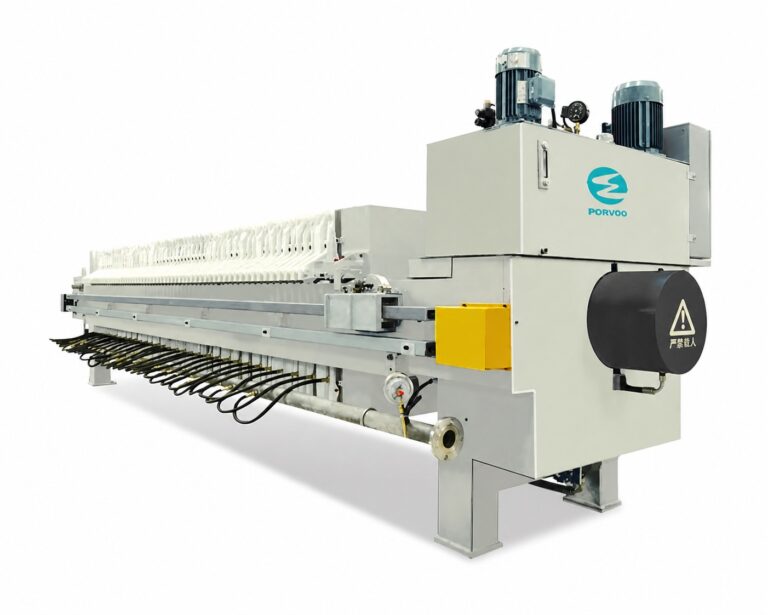
Este sistema no es un filtro-prensa y no está diseñado para producir una torta seca.
Su finalidad es eliminar el agua, reteniendo al mismo tiempo los sólidos en un concentrado fluido y bombeable.
| Resultado del proceso | Tratamiento convencional de lodos | Concentración por membrana en PORVOO |
|---|---|---|
| Objetivo principal | Tratamiento de aguas residuales y gestión de lodos | Recuperación y concentración de materiales |
| Dosificación de productos químicos | Requisitos habituales | No se utilizan coagulantes ni floculantes durante la concentración |
| Rendimiento sólido | Lodos deshidratados o torta de filtración | Concentrado bombeable |
| Recuperación del esmalte | Se suele eliminar como lodos mixtos | Se ha reanudado el proceso de acristalamiento |
| Caudal de agua | Requiere tratamiento antes de su reutilización | Permeado apto para la reutilización adecuada como agua de proceso |
| Limpieza de membranas | No aplicable | Retrolavado automático en línea del permeado |
| Modo de funcionamiento | Varias fases de tratamiento | Concentración por lotes integrada |
Aplicaciones verificadas de recuperación de esmalte
Agua de lavado del molino de bolas
Recuperar los sólidos residuales de esmalte procedentes del lavado de los molinos de bolas, en lugar de verterlos al sistema general de tratamiento de aguas residuales y lodos.
Efluentes de la cabina de pulverización
Concentra el exceso de esmalte y el agua de lavado procedentes de las zonas de aplicación del esmalte para que se reincorporen al proceso de esmaltado correspondiente.
Agua de limpieza para la línea de esmaltado
Recuperar los sólidos del esmalte del agua de limpieza de los equipos y de la línea de producción, recogida por separado.
Las diferentes formulaciones de esmalte, colores y flujos de aguas residuales deben mantenerse separados cuando el concentrado recuperado se destine a su reutilización directa en la producción.
Aplicaciones más allá de la recuperación de esmalte
El mismo principio de concentración puede aplicarse a otros flujos de aguas residuales industriales utilizando equipos independientes y específicos.
Estas corrientes no deben mezclarse con las aguas residuales de esmaltado destinadas a la recuperación de materiales.
Aguas residuales del pulido de cerámica
Eliminar el agua reutilizable y reducir el volumen que se envía al tratamiento químico convencional, la sedimentación y el prensado por filtro.
Aguas residuales industriales con alto contenido en sólidos»
Pre-concentrate suspended solids before an existing wastewater or sludge-treatment process.
Viscous Food-Processing Wastewater
Potential applications include wastewater containing sticky or difficult-to-filter suspended material.
Food-processing applications require feed testing and project-specific confirmation of wetted materials, hygienic design, cleaning procedures, and process requirements.
Other Process Suspensions
The system can be configured for other concentration duties where the objective is to recover water, reduce wastewater volume, or retain valuable suspended solids.
Suitability must be confirmed through feed characterization and filtration testing.
Reduce the Load on Conventional Wastewater Treatment
For wastewater streams where the concentrate cannot be returned to production, the system can be installed before the conventional treatment process.
The membrane system first removes reusable water and reduces the wastewater to a smaller concentrate volume.
Only the concentrated stream then enters:
- Chemical dosing and flocculation
- Sedimentación
- Filter pressing
- Sludge handling or disposal
This reduces the hydraulic volume handled by downstream equipment and allows the existing wastewater-treatment system to focus on a smaller, more concentrated stream.
Automatic Backwashing and Periodic CIP
Automatic permeate backwashing reduces routine membrane cleaning and helps maintain filtration performance during operation.
The standard system allows the backwash cycle to be programmed on site. Custom automation can trigger backwashing according to differential pressure, permeate flow, or other operating conditions.
Periodic acid cleaning is still required to restore membrane performance when necessary.
In the standard configuration, operators prepare the acid-cleaning solution and initiate the cleaning cycle. Automated CIP preparation and control can be supplied as a customized option.
The system should therefore be described as automatically backwashed, not maintenance-free.
Technical Parameters
| Parámetro | Standard Description |
|---|---|
| Product type | Rotary ceramic membrane concentration system |
| Primary application | Glaze wastewater concentration and recovery |
| Modo de funcionamiento | Batch concentration |
| Membrane configuration | Multiple low-speed rotating ceramic membrane discs |
| Vessel configuration | Positive-pressure filtration vessel |
| Permeate extraction | Independent vacuum pump |
| Filtration direction | Outside-in |
| Typical total TMP | 3–4 bar |
| Ceramic support pore size | Approximately 2.0 µm |
| Separation layer | Selectable nano-coated membrane |
| Finest available pore size | Down to 5 nm |
| Typical glaze feed solids | Approximately 0.5 wt.% |
| Target concentrate solids | 15–30 wt.% |
| Concentrate form | Flowable, pumpable glaze concentrate |
| Backwash medium | Polished permeate |
| Backwash control | Field-programmable cycles |
| Custom backwash control | Differential-pressure- or flow-based triggering |
| Periodic membrane cleaning | Ácido CIP |
| Standard CIP operation | Operator-prepared and operator-initiated |
| Capacidad de tratamiento | Customized to feed properties and production volume |
| Process additives | No coagulants, flocculants, or filter aids during concentration |
Actual performance depends on feed composition, viscosity, temperature, particle-size distribution, selected membrane coating, and target concentration.
System Engineering and Customization
Each system is configured according to the customer’s process rather than selected only by nominal flow rate.
PORVOO evaluates:
- Wastewater source
- Daily and hourly feed volume
- Initial solids concentration
- Target concentrate solids
- Particle-size distribution
- Feed viscosity and temperature
- Required permeate quality
- Intended concentrate reuse route
- Required membrane area
- Backwash control strategy
- Servicios disponibles
- Installation space
- Automation requirements
Pilot or sample testing may be required for new materials and high-viscosity applications.
Preguntas frecuentes
Does the system produce a filter cake?
No. The system produces a flowable concentrate rather than a discharged, dewatered filter cake.
Can recovered glaze be reused directly?
Yes. When the glaze wastewater is collected separately and kept within the corresponding formulation or production stream, the concentrate can be returned directly to the glazing process.
Are flocculants or coagulants required?
No coagulants, flocculants, or filter aids are added during the membrane concentration process.
Periodic acid cleaning is required for membrane maintenance and should not be confused with chemical dosing into the wastewater.
How is the membrane cleaned during operation?
Polished permeate is automatically reversed through the membrane during online backwashing. The standard backwash timing can be programmed on site.
Is manual cleaning completely eliminated?
Routine manual membrane-surface cleaning is reduced by online backwashing. However, periodic acid CIP requires operator preparation and initiation in the standard configuration.
Can the permeate be reused?
Yes, the permeate can be reused as process water where its measured quality meets the requirements of the intended operation.
Can different wastewater streams be mixed?
Different streams should use separate collection and dedicated treatment systems.
Glaze wastewater intended for direct glaze recovery must not be mixed with polishing wastewater, domestic wastewater, or unrelated industrial streams.
Can the system handle food-processing wastewater?
Potentially, subject to feed testing and confirmation of hygienic design, wetted materials, cleaning requirements, and the intended use of the recovered streams.
Is this system only for glaze recovery, or can it handle slip and engobe as well?
A: The rotary ceramic membrane technology is not limited to glaze. It performs equally well on slip (casting slip) and engobe recovery, since the separation mechanism relies on particle size and viscosity handling rather than the specific material chemistry. Many customers refer to this application broadly as glaze reclamation across their glazing, slip-casting, and engobe lines.
How is the system capacity selected?
Capacity and membrane area are engineered according to feed properties, daily wastewater volume, target concentration, and required batch time.
Recover the Material You Already Paid For
Glaze wastewater does not have to become disposal sludge.
PORVOO can configure a rotary ceramic membrane concentration system that recovers glaze for production reuse, returns water to suitable plant operations, and reduces dependence on conventional chemical sludge treatment.
To evaluate your application, please provide:
- Wastewater source
- Daily wastewater volume
- Current solids concentration
- Target concentrate solids
- Glaze type or other suspended material
- Required process-water quality
- Available installation space and utilities