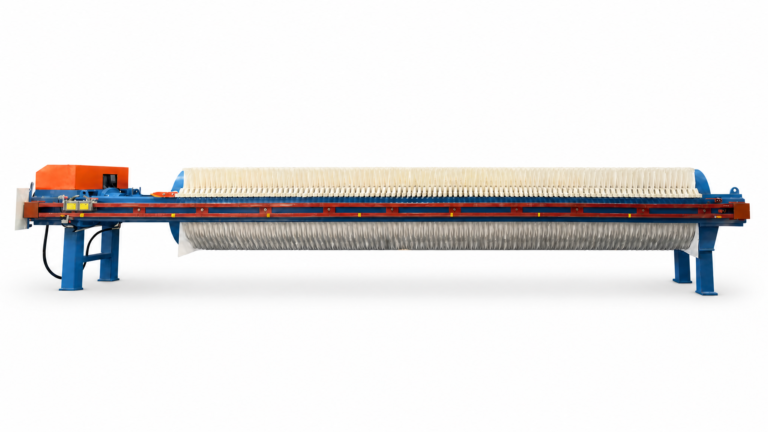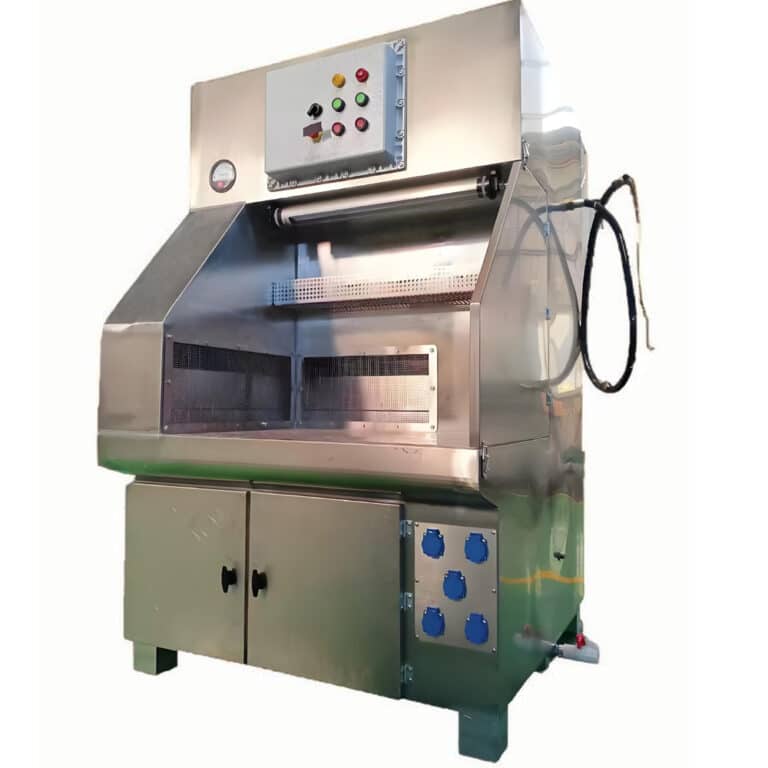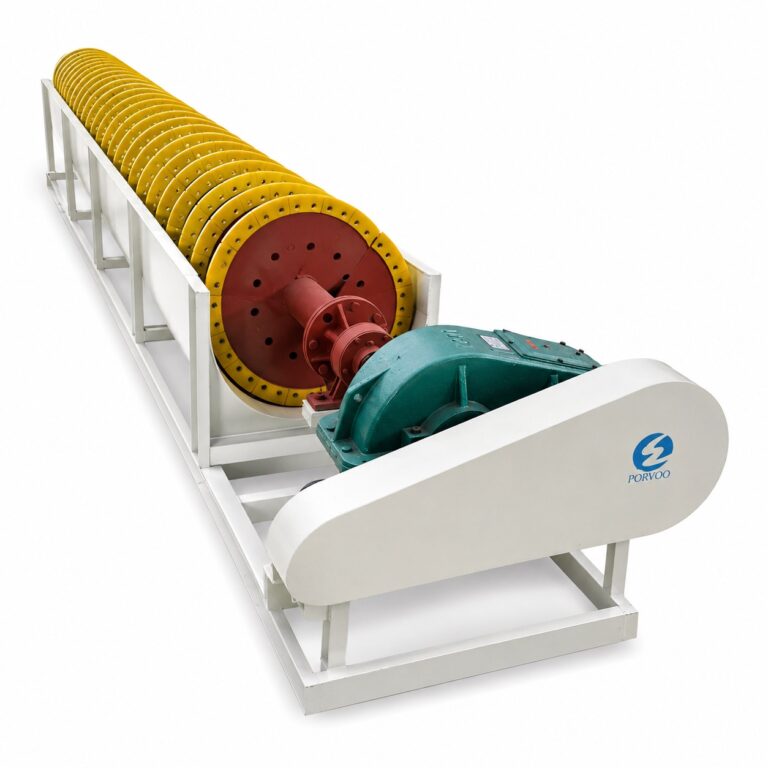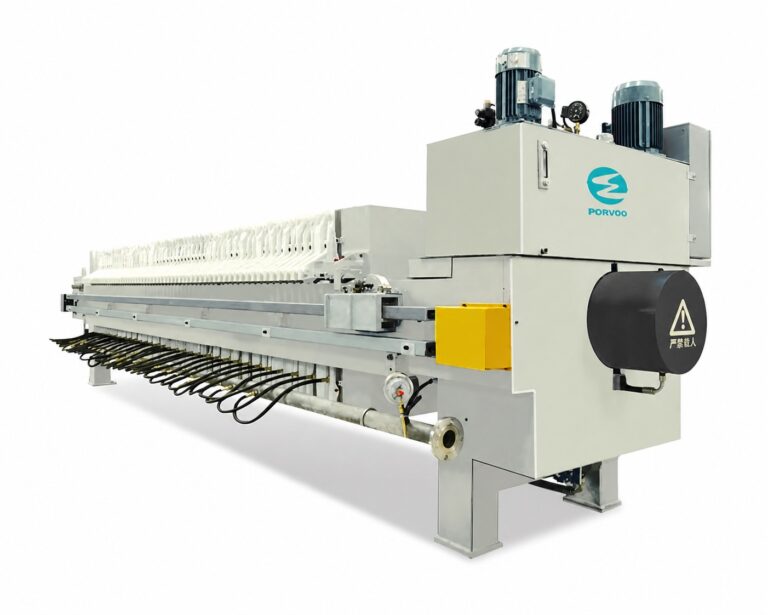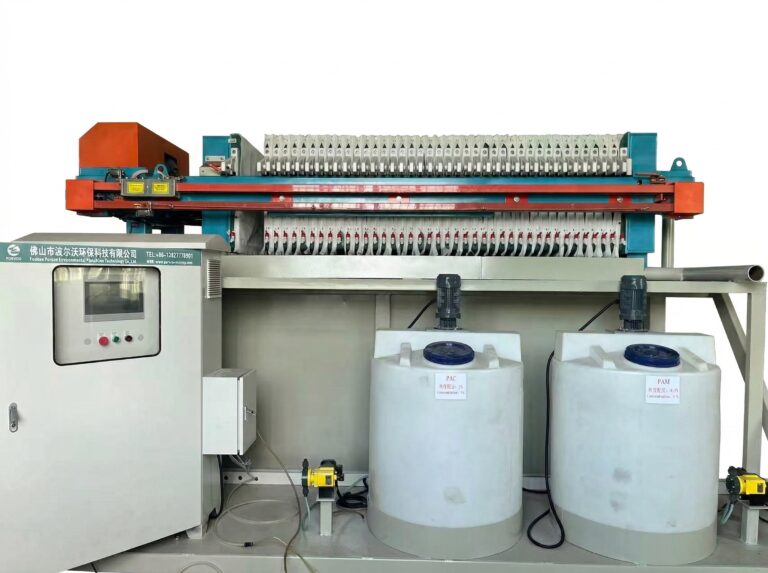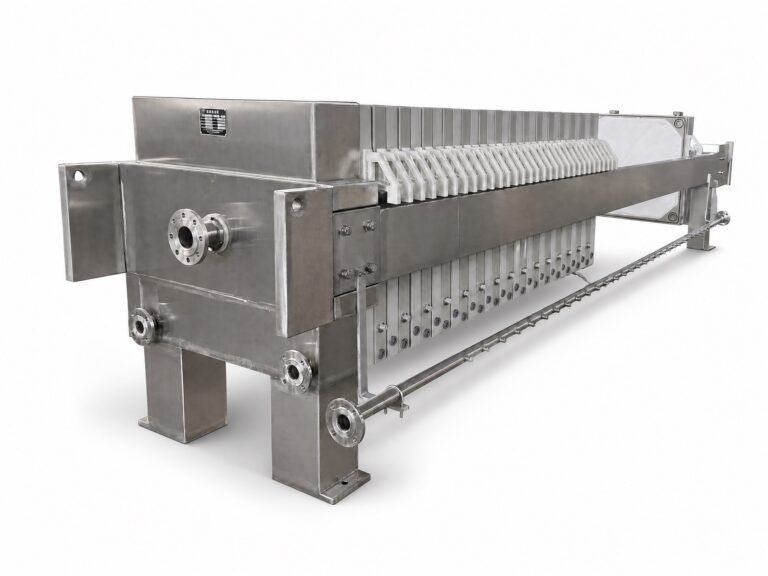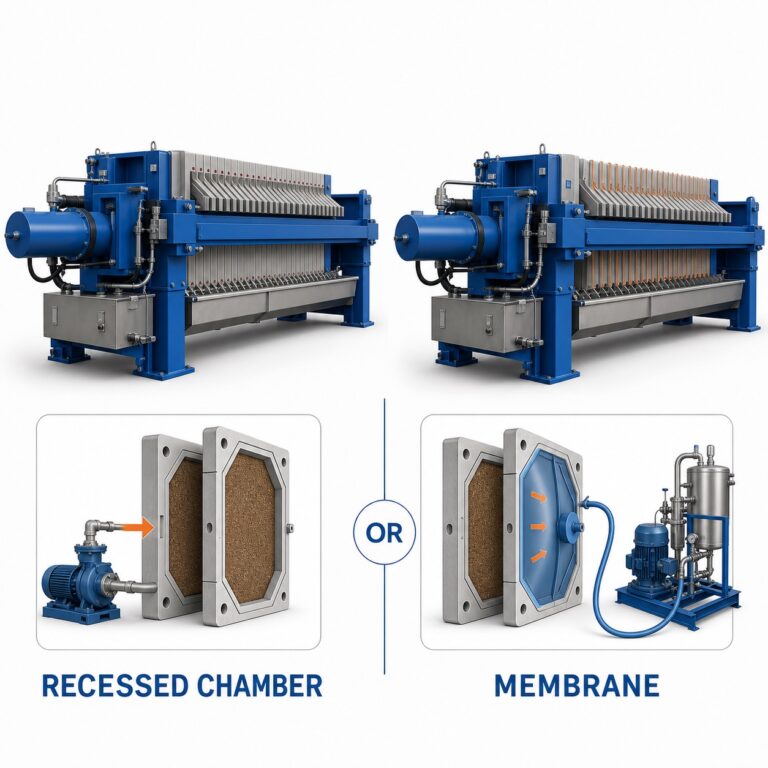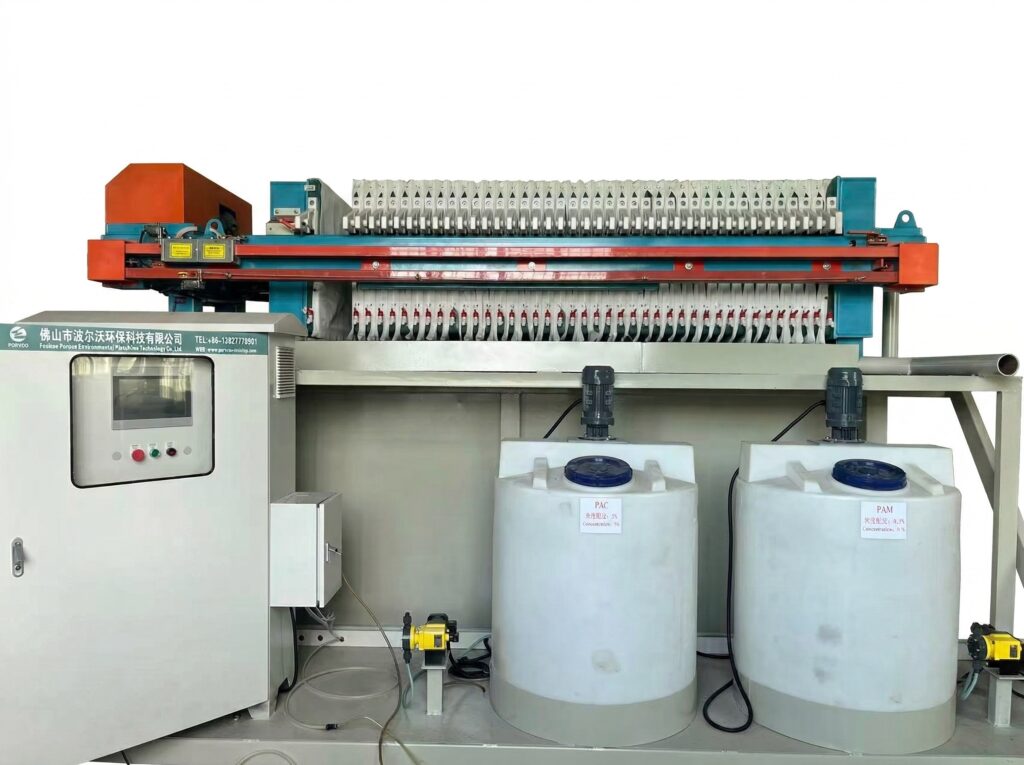
A recessed chamber filter press separates a pumpable slurry into filtrate and filter cake by feeding it under pressure into fixed-volume chambers. Matching recessed plate faces create each chamber, filter cloth retains the solids, and liquid passes through the cloth to the filtrate outlets.
This is the comparatively straightforward filter-press configuration to evaluate when pressure filtration alone can meet the required cake condition and batch cycle. Final selection still depends on the slurry, the filtration objective, operating schedule, available space and required level of handling automation.
Check your sludge for a chamber filter press or review the industrial filter press selection guide.
What Is a Recessed Chamber Filter Press?
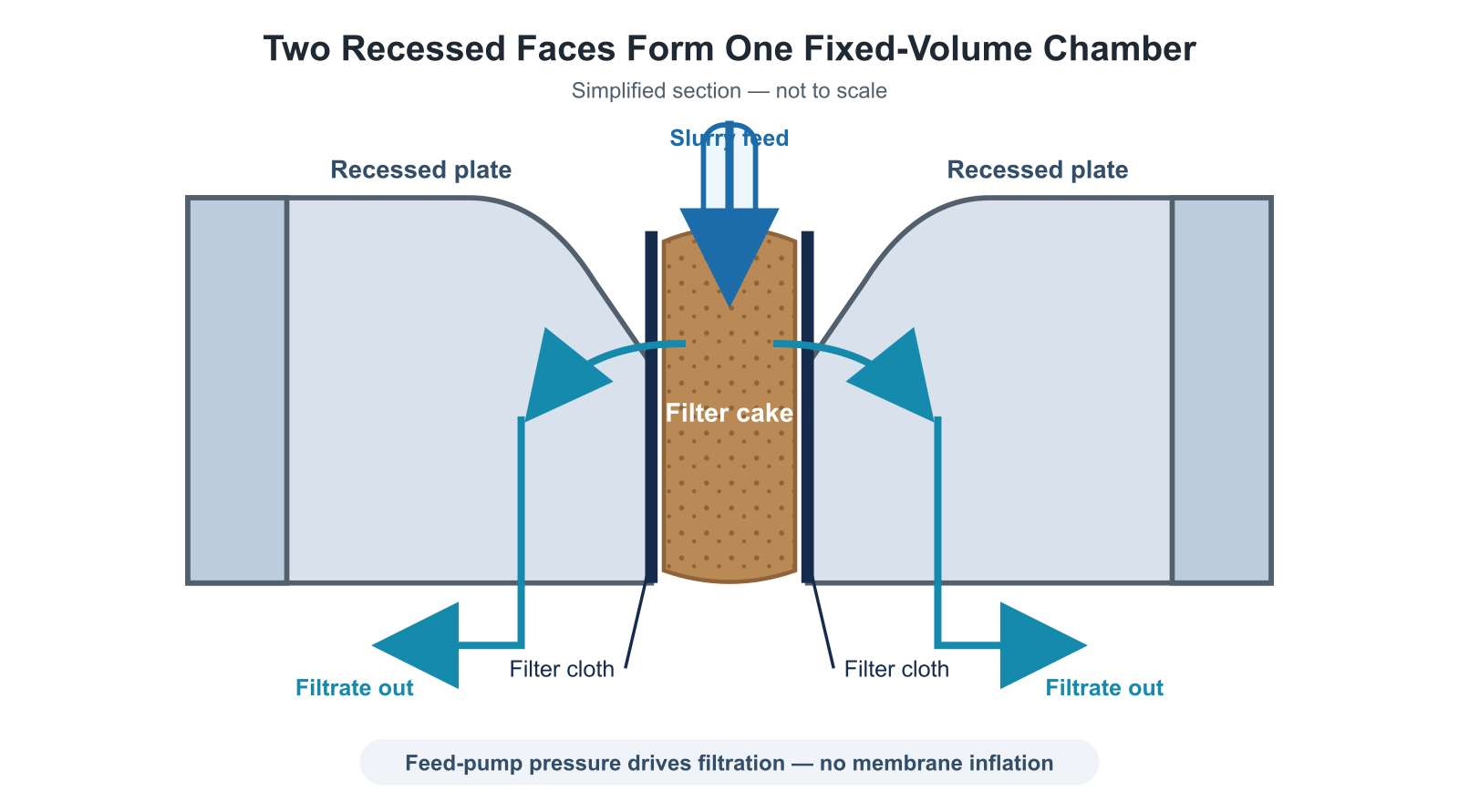
Each filter plate has a recessed filtration face. When the plate pack is closed, two adjacent recesses form a fixed-volume chamber. Filter cloth covers the drainage surface on each plate. Slurry enters the closed chambers, solids collect on the cloth, and filtrate passes through the cloth and plate drainage paths to the discharge system.
This construction is different from a traditional plate-and-frame press, where separate hollow frames are installed between flat plates. A recessed chamber press does not use those separate frames. Its normal dewatering action also does not use membrane inflation: pressure is supplied by the slurry feed pump while the hydraulic closing system keeps the plate pack sealed.
When a Chamber Filter Press Is the Right Choice
A chamber press is a strong starting point when the process needs batch pressure filtration without a secondary squeeze system. It may be suitable when the slurry forms a permeable, releasable cake and the required filtrate quality, cake handling condition and production schedule can be reached during the feed-and-filtration stage.
Conditions that support a chamber-press evaluation
- The feed can be conditioned and pumped consistently into a closed plate pack.
- Standard pressure filtration can meet the required cake handling or disposal condition.
- The batch cycle can fit the available operating hours and upstream storage arrangement.
- A fixed-volume chamber and comparatively simple plate construction are preferred.
- The site does not require a separate cake-squeeze stage to reach its process target.
When to compare another configuration
If the target cannot be reached reliably by pressure filtration alone, or if cake condition and cycle constraints justify an additional dewatering stage, compare the process against a membrane filter press. That decision should be based on representative slurry testing and total system requirements, not on the product name alone.
Recessed Chamber Filter Press Operating Sequence
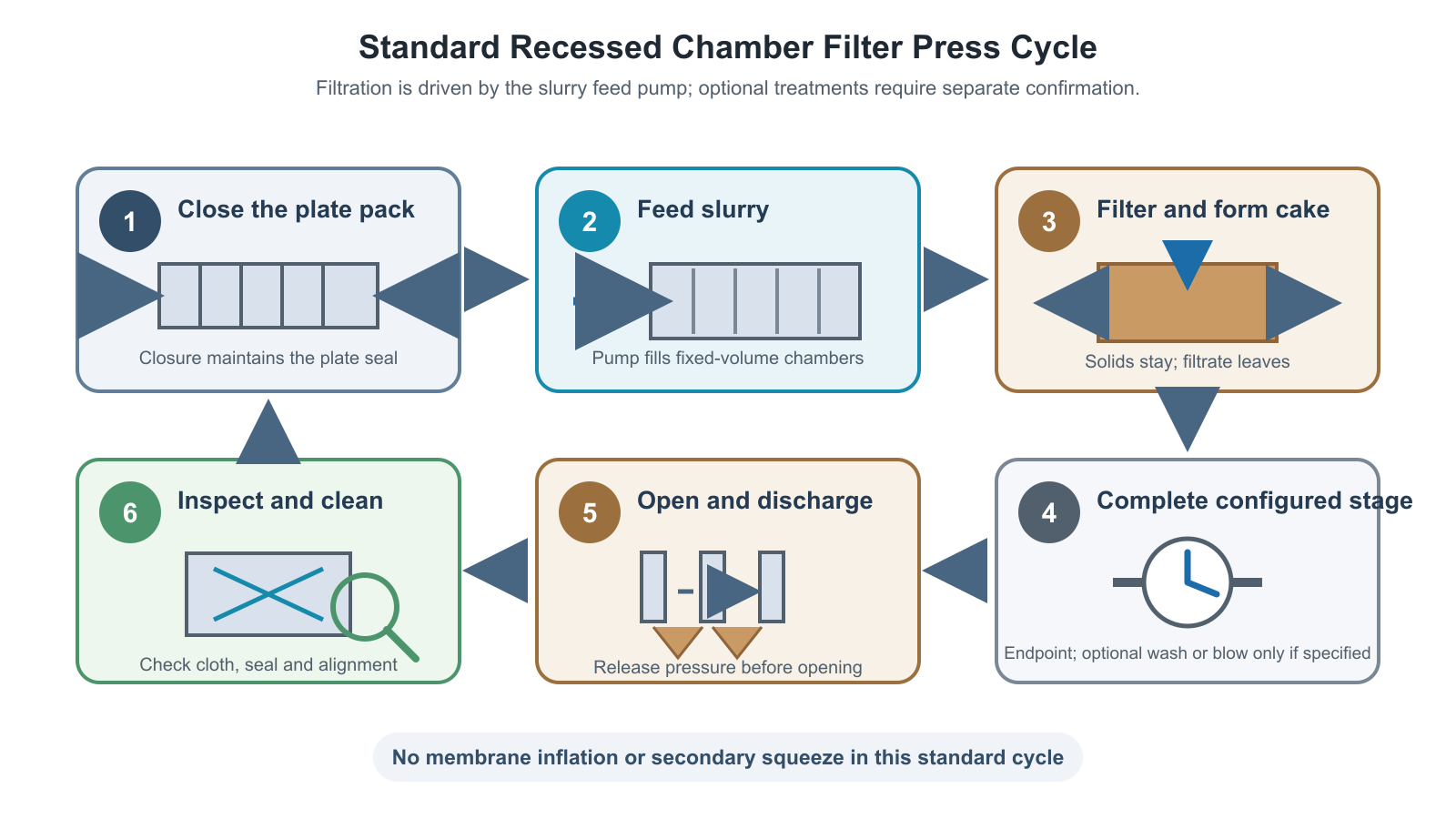
- Close and secure the plate pack. The closing system brings the plates together and maintains the sealing force required by the press design.
- Feed the slurry. The feed pump fills the fixed-volume chambers through the configured feed passage.
- Filter and form the cake. Liquid passes through the filter cloth and drainage surface while retained solids build from both sides of each chamber. Filtrate flow normally declines as cake resistance increases.
- Finish the configured filtration stage. The endpoint may be controlled by validated pressure, time, filtrate-flow or other process criteria. Optional cake washing, core blow or air blow belongs here only when specified for the application.
- Open the press and discharge the cake. After feed pressure is safely released, the plates separate and the cakes are removed or allowed to fall into the collection system.
- Inspect and clean. Operators check cloth condition, sealing surfaces, plate alignment and filtrate behavior before the next cycle. Cloth washing may be manual or automated according to the supplied configuration.
Recessed Plates, Cloths and Filtrate Discharge
Plate recess and chamber depth
The plate recess determines the available chamber volume and nominal cake thickness. A deeper chamber is not automatically better: cake permeability, filling uniformity, discharge behavior and the required cycle must be evaluated together. Plate size, chamber depth and plate count should be selected from process data and, where needed, filtration tests.
Feed arrangement
Slurry may enter through a center or corner feed passage according to the selected plate and process design. The feed route must distribute slurry through the closed plate pack without confusing the slurry circuit with the separate filtrate passages.
Open or closed filtrate discharge
With open discharge, filtrate from individual plates can be observed at external outlets, which can help operators identify a cloth-retention problem. With closed discharge, filtrate is collected through internal ports and routed to a manifold. The correct arrangement depends on containment, observation, piping and site requirements.
Sealing and filter-cloth selection
Recessed plates may use non-gasketed sealing surfaces or a caulked-and-gasketed arrangement, subject to the plate design offered for the project. Cloth material, weave, air permeability, surface finish and attachment method must suit the particle behavior, filtrate objective, temperature and chemical environment. These choices affect clarity, cake release, cleaning frequency and service life.
Machine Configuration and Automation Options
Recessed chamber construction defines the plate technology; it does not define the automation level. A chamber press may be configured with manual, semi-automatic or automatic handling functions. PORVOO must confirm which functions and combinations are available for the selected machine.
| System area | Base function | Configuration decisions |
|---|---|---|
| Frame and closure | Supports and seals the plate pack for filtration | Structural format, hydraulic package, guarding and safety interlocks |
| Plate pack | Creates fixed-volume recessed chambers | Plate size, count, recess depth, feed position, material and sealing style |
| Filter cloth | Retains solids and passes filtrate | Material, weave, permeability, finish and attachment |
| Feed and filtrate circuits | Deliver slurry and collect separated liquid | Pump type, piping, valves, instruments, open or closed filtrate routing |
| Plate handling | Opens the pack for cake discharge | Manual or automatic plate shifting and cake-release assistance |
| Cleaning and collection | Supports cloth condition and material handling | Cloth washing, drip trays, cake collection or conveyor interface |
| Controls | Coordinates the supplied operating functions | Local controls, instruments and PLC/HMI scope |
Performance Depends on the Slurry and the Complete Cycle
No responsible chamber-press selection can be made from flow rate alone. Cake moisture, filtrate clarity, filling time, filtration time and discharge behavior depend on interacting process conditions.
- Slurry source, solids concentration and daily solids load
- Particle-size distribution, shape, compressibility and permeability
- Conditioning chemistry and mixing history
- Feed-pump curve, pressure ramp and endpoint control
- Plate size, chamber depth, plate count and filling distribution
- Filter-cloth medium, condition and cleaning practice
- Temperature, pH, solvent content and material compatibility
- Available operating hours, batch storage and cake-discharge time
Representative filtration testing is recommended when prior data do not establish cake formation, filtrate quality and release behavior. Any stated capacity or cake result should be tied to the tested slurry and the defined operating conditions.
Application Fit Is Defined by Slurry Behavior
Recessed chamber presses are considered for industrial and water-treatment slurries that can form a stable cake under pump-pressure filtration. Industry labels alone do not prove suitability. A useful application review identifies the solids load, liquid phase, particle behavior, conditioning method, required filtrate quality, cake destination and batch schedule.
Typical evaluation contexts include industrial wastewater sludge, stone- or ceramic-processing slurry, mineral washwater solids and precipitated metal-bearing sludge. The slurry still needs to demonstrate suitable cake formation, filtrate quality and release behavior. For a broader technology comparison, see industrial filtration equipment.
Installation, Operation and Maintenance
Plan the interfaces
- Provide a controlled feed source and a pump selected for the changing flow and pressure demand of the cycle.
- Route filtrate so operators can sample, observe or contain it as required by the selected discharge design.
- Allow access for plate movement, cloth replacement, manifold service and safe inspection.
- Provide sufficient clearance below or beside the press for cake discharge, collection and removal.
- Coordinate drainage, wash-water handling, guarding, platforms and lockout points with the site layout.
Protect plate-pack condition
Before closing, keep sealing surfaces free from residual cake and confirm that plates and cloths are aligned. During operation, investigate abnormal leakage, uneven filtrate, cloudy filtrate or incomplete filling instead of compensating with an unapproved pressure change. After discharge, inspect cloth attachment, blinding, damage and plate sealing areas at the interval defined for the slurry and duty.
Maintain the complete feed-and-filtration system
Maintenance scope includes more than the press frame. The feed pump, valves, instruments, filtrate lines, hydraulic closure, plate-shifting equipment and safety devices all affect repeatable operation. Consumables and critical spares should be defined from the final plate, cloth, pump and automation configuration.
Chamber or Membrane?
| Decision factor | Recessed chamber press | Membrane press |
|---|---|---|
| Primary dewatering stage | Feed-pump pressure filtration | Initial feed-pump pressure filtration |
| Additional cake squeeze | Not part of the standard chamber mechanism | Included as a later, separately controlled stage |
| Typical reason to evaluate | Required cake and cycle can be reached with conventional pressure filtration | An additional dewatering stage may create process value |
| Utilities and components | No squeeze-medium system for the plate pack | Additional squeeze components and controls are required |
| Selection evidence | Representative slurry behavior, required cake condition, filtrate objective, cycle target and total operating cost | |
Use the full filter press selection guide for the broader configuration decision, or review how a membrane press adds a secondary squeeze stage.
Technical Data to Define for Your Chamber Press
The final proposal should state the following values and clearly separate standard equipment, optional equipment and application-dependent performance.
| Field | What the final offer should state |
|---|---|
| Press and plate designation | Model, plate format and recessed chamber construction |
| Filtration area and chamber volume | Configured values for the selected plate count and chamber depth |
| Maximum allowable feed conditions | Pressure, temperature, chemistry and material limits |
| Feed and filtrate arrangement | Feed position, port sizes, manifold and open/closed discharge design |
| Materials of construction | Frame protection, plate, cloth, piping and wetted-component materials |
| Installed functions | Closure, plate shifting, cleaning, drip management, cake handling and controls |
| Application result | Capacity, cycle and cake/filtrate results tied to stated feed and test conditions |
| Dimensions and service clearances | General arrangement, operating envelope, maintenance access and cake-drop clearance |
Frequently Asked Questions
Is a recessed chamber filter press the same as a traditional plate-and-frame press?
No. A recessed chamber press forms each chamber between two matching recessed plate faces. A traditional plate-and-frame press forms chambers with separate hollow frames between plates. The terms are sometimes mixed in general market language, but they should not be treated as the same technical construction.
Does a recessed chamber press squeeze the cake with the hydraulic closing cylinder?
No. The hydraulic closing system keeps the plate pack closed and sealed. Dewatering inside a standard recessed chamber press is driven by the slurry feed pump as filtrate passes through the cloth.
Is every recessed chamber filter press fully automatic?
No. Recessed chamber describes the plate construction. Automatic plate shifting, cloth washing, valves, pumps, cake handling and PLC/HMI control are separate configuration choices.
What determines cake moisture and cycle time?
Important factors include feed solids, particle permeability and compressibility, conditioning, feed-pump behavior, cloth selection, chamber depth, filling distribution, filtration endpoint and discharge time. Results must be tied to a defined slurry and operating conditions.
What information is needed to select a chamber press?
Provide the slurry source, solids concentration, daily slurry and solids load, particle behavior, pH, temperature, chemical composition, operating hours, target cake condition, filtrate objective, available utilities, site constraints and required handling automation. A representative sample may be needed for testing.
Request a Chamber Press Selection
Send your process conditions so the plate pack, feed system, cloth, filtrate arrangement and operating functions can be evaluated together. Include any current dewatering result and explain what must improve.
- Slurry source and composition
- Flow, daily volume, solids concentration and operating hours
- Particle behavior, pH, temperature and chemical compatibility
- Required filtrate quality and cake handling condition
- Available utilities, footprint and discharge clearance
- Required manual or automatic handling functions