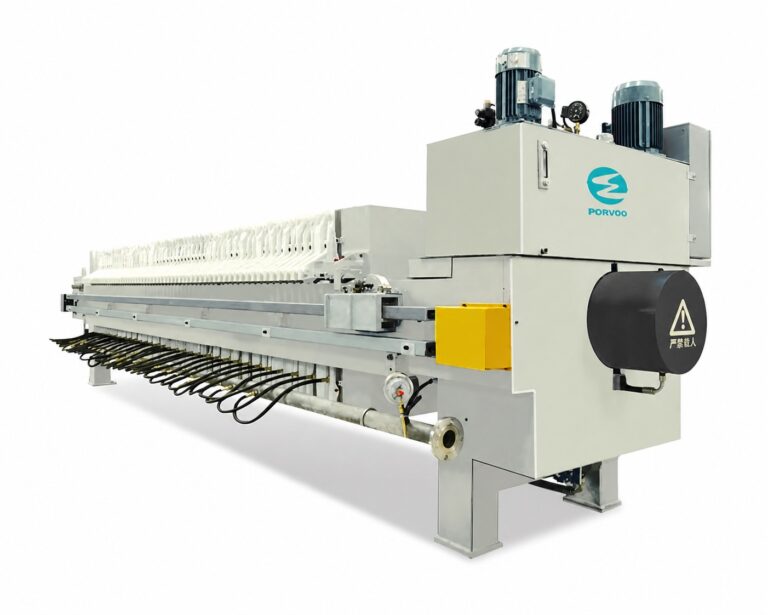
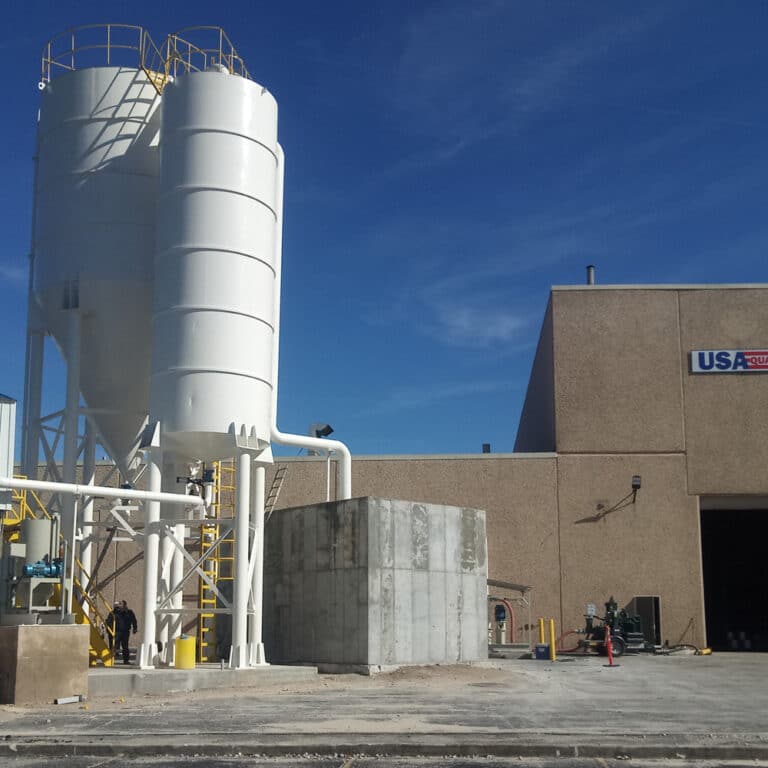
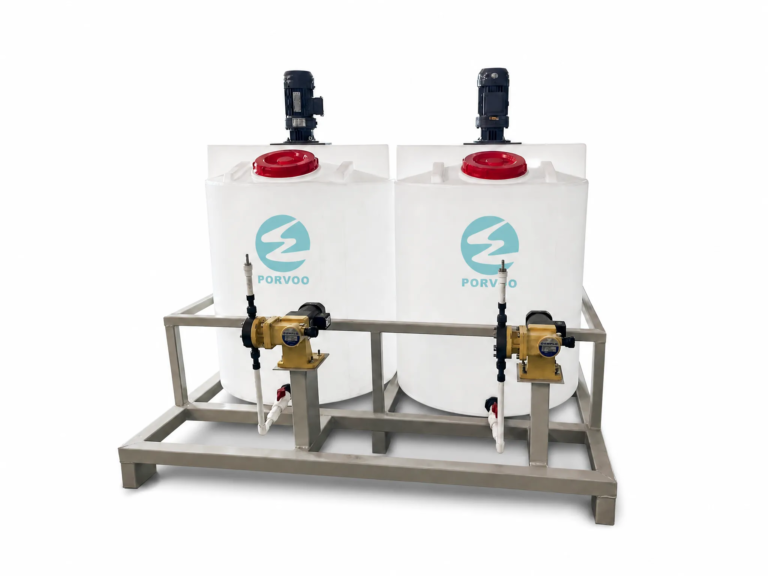
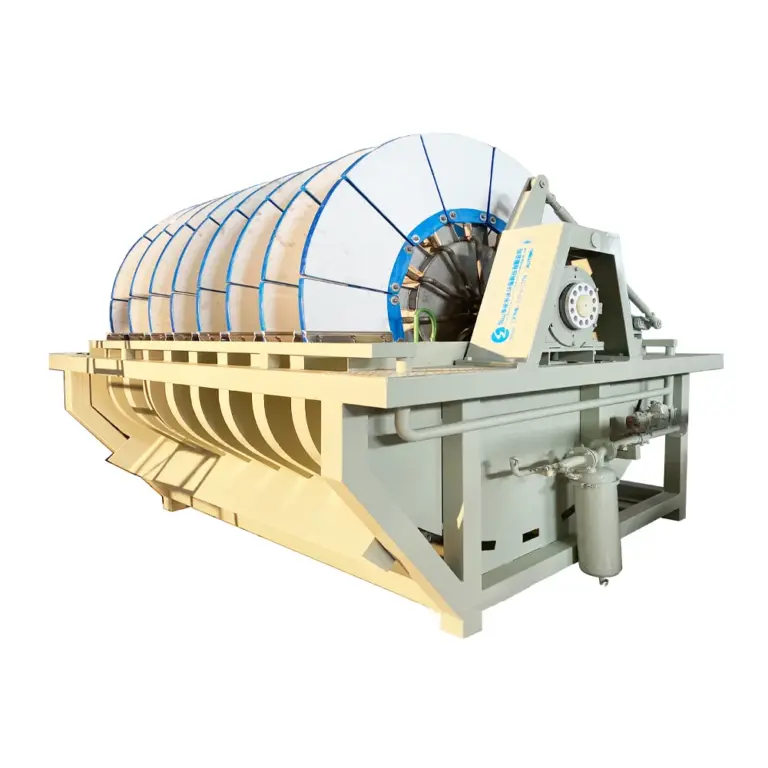
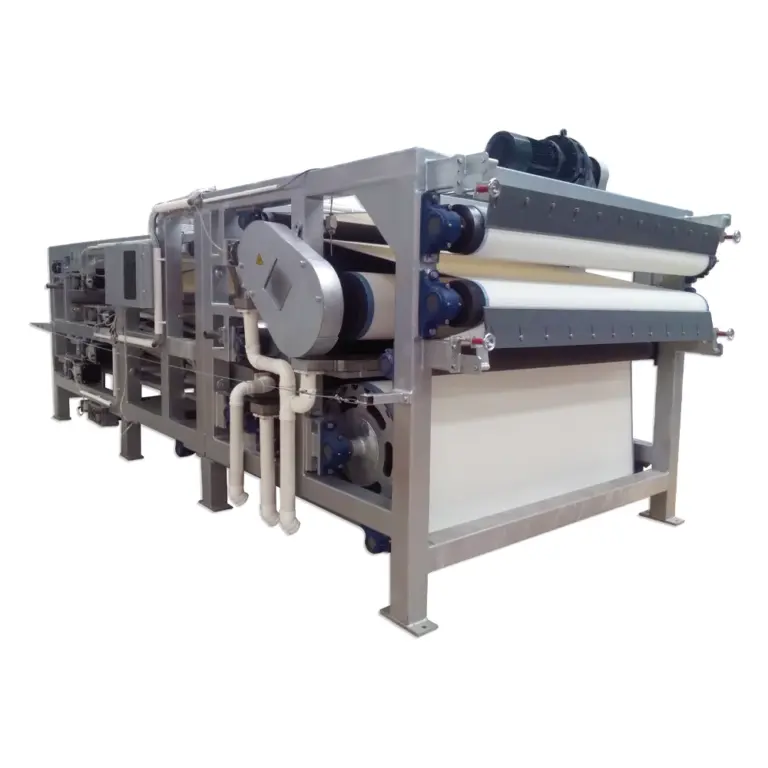
PORVOO develops project-configured filter press systems for food and beverage production, from product-contact solid-liquid separation to byproduct and wastewater sludge dewatering. The first selection question is whether the filtrate, filter cake, or both will return to a saleable product stream.
This page helps define the process boundary, compare filter press types, select a preliminary configuration band, and prepare the data required for engineering review. Final materials, dimensions, operating conditions, hygiene provisions, and performance targets are confirmed for the specific project.
Product-Contact Filtration or Waste-Sludge Dewatering?
| Process path | Typical objective | Configuration priority |
|---|---|---|
| Direct product-contact filtration | Recover a filtrate or cake that returns to an edible product, ingredient, or downstream production process. | Define the complete wetted boundary, product-compatible materials, seals, filter cloth, connections, retained-product control, and cleaning procedure. |
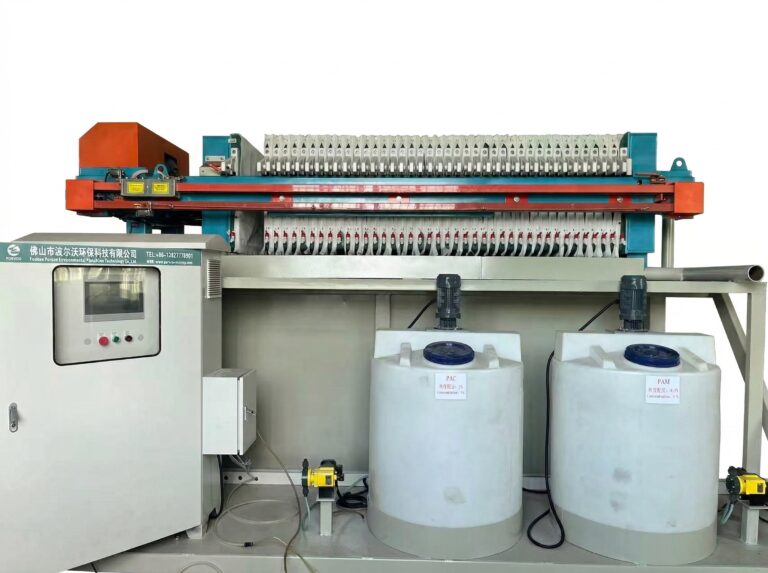
| Byproduct or wastewater sludge dewatering | Dewater process residue, wash-water solids, dissolved-air-flotation sludge, biological sludge, or another non-product stream. | Prioritize dewatering behavior, corrosion resistance, containment, cake discharge, washdown, operator protection, and the disposal or recovery route. |
If either separated phase may return to production, identify it as product contact until the hygienic boundary has been reviewed. Equipment intended for wastewater service should not automatically be specified as a hygienic product-contact system.
Which Filter Press Type Fits the Process?
| Press type | Consider it when | Points to verify |
|---|---|---|
| Plate-and-frame | The process requires flexible frame depth, smaller or specialty batches, or a process-specific plate-and-frame arrangement. | Manual handling, sealing surfaces, product hold-up, cleaning access, cloth installation, and required cake thickness. |
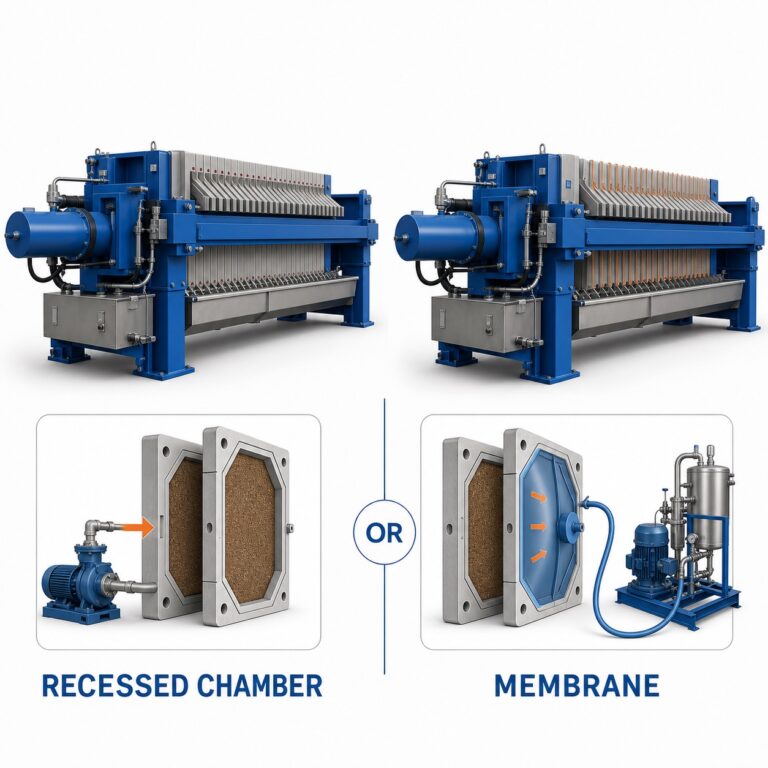
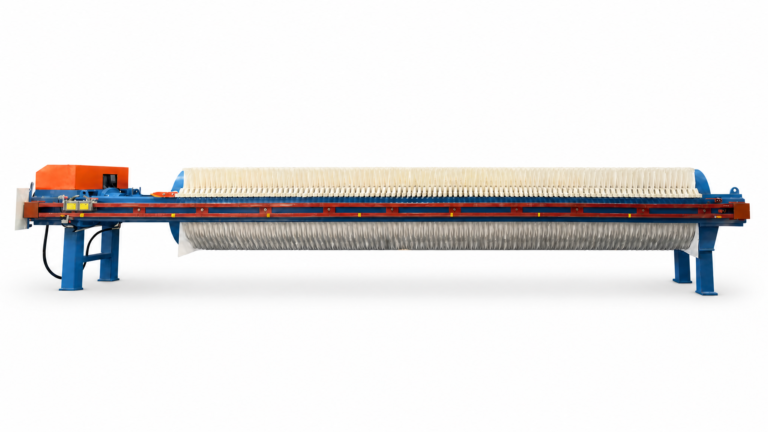
| Recessed chamber | A general-purpose chamber press is needed for solids capture, ingredient recovery, byproduct processing, or sludge dewatering. | Fixed chamber depth, feed behavior, cake release, filtrate route, cycle time, and manual or automatic plate shifting. |
| Membrane | A secondary squeeze stage may improve liquid recovery or cake handling when the cake is compressible. | Squeeze medium and pressure, membrane compatibility, cleaning sequence, additional controls, and whether material testing supports the expected benefit. |
A membrane press is not automatically the best option for every food or beverage slurry. The decision depends on solids loading, filtration resistance, cake compressibility, cleaning requirements, cycle time, and the commercial value of additional liquid recovery.
Preliminary Configuration Bands
The following bands combine published market examples for preliminary discussion. They are not PORVOO model names, standard ratings, confirmed supply limits, or performance commitments. Final plate size, plate count, filtration area, chamber volume, operating pressure, and automation scope require engineering confirmation.
| Discussion band | Published plate-size reference | Published filtration scale | Published chamber and cake reference |
|---|---|---|---|
| Compact | Approximately 470–630 mm | Small published units are commonly described by chamber capacity rather than filtration area. | Approximately 1–10 ft³ (28–283 L); cake depth depends on the selected plate arrangement. |
| Standard | Approximately 870–1,000 mm | Approximately 30–120 m² | Approximately 460–1,777 L; published cake-thickness examples are around 30 mm. |
| Large | Approximately 1,250–1,500 mm | Approximately 100–500 m² | Approximately 1,468–7,187 L; published cake-thickness examples are around 30–35 mm. |
| High-Capacity | Approximately 2,000 mm | Approximately 500–1,000 m² | Approximately 9,686–19,788 L; published cake-thickness examples are around 40 mm. |
Published examples in the Standard through High-Capacity bands list filtration pressures up to approximately 0.6 MPa. This is a market reference, not a PORVOO operating guarantee. The permitted pressure must be coordinated with the feed pump, closing system, plates, seals, piping, instruments, and actual filtration behavior.
Filter press size cannot be determined from liquid flow alone. Dry-solids loading, filtration rate, chamber filling, cake formation, optional washing or membrane squeezing, opening time, and available operating hours determine the required area and chamber volume.
Food-Contact and Operating Configurations
Food-contact provisions apply to the defined product path. Each option must be evaluated against the product, cleaning method, operating temperature, customer standard, and required documentation. Listing an option does not establish certification or regulatory compliance.
| Configuration area | Options to evaluate | Selection basis |
|---|---|---|
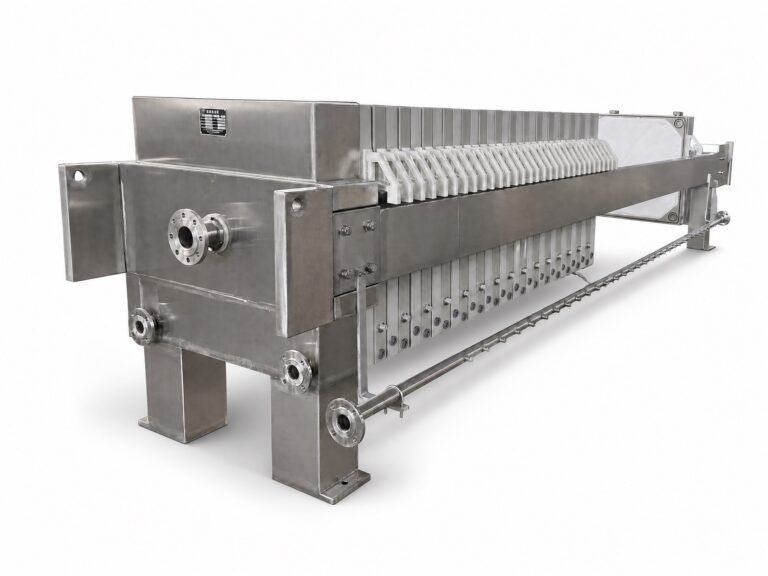
| Wetted construction | 304, 316, or 316L stainless steel for selected parts, polypropylene filter plates, and process-compatible elastomers. | Product composition, pH, chlorides, temperature, cleaning chemicals, corrosion risk, and the exact product-contact boundary. |
| Plate sealing and connections | Sealed or CGR polypropylene plates and sanitary tri-clamp connections where required. | Leak containment, filtrate routing, product recovery, cleaning access, operating pressure, and the plant connection standard. |
| Filter cloth | Cloth material, nominal retention grade, weave, surface finish, and cake-release characteristics selected for the slurry. | Particle distribution, filtrate target, compatibility, temperature, cleaning method, blinding tendency, and expected service cycle. |
| Feed system | A process-compatible diaphragm pump or another suitable feed pump with pressure and flow control. | Wetted materials, cleanability, shear sensitivity, viscosity, solids concentration, required pressure profile, and available utilities. |
| Cleaning | Manual washdown, automatic cloth washing, clean-in-place evaluation, or assessment for hot-water or steam cleaning. | Compatibility of plates, cloth, membranes, seals, instruments, and connections with the required time, temperature, chemicals, flow, and pressure. |
| Automation and handling | Automatic plate shifting, feed-pump control, cloth washing, liquid-collection flaps, cake carts or discharge interfaces, guarding, and interlocks. | Cycle frequency, labor plan, cake behavior, available space, downstream handling, operator access, and the plant safety specification. |
Information Required for Filter Press Selection
- Stream identity: product or slurry name, process origin, and whether the filtrate, cake, or both return to a saleable product.
- Production basis: batch volume, batches per day, hourly or daily slurry volume, operating hours, and expected production variation.
- Solids and material behavior: feed-solids concentration, dry-solids load, density, viscosity, particle-size information, settling behavior, compressibility, stickiness, oil content, and abrasiveness.
- Operating conditions: temperature, pH, relevant sugars, oils, salts, cleaning residues, available feed-pump information, and allowable inlet-pressure limits.
- Required result: how filtrate quality will be evaluated, whether the cake is a product or waste, desired cake-handling condition, recovery priority, and any result that must be demonstrated through testing.
- Cleaning and product contact: proposed cleaning sequence, chemicals, water temperature, hot-water or steam requirements, allergen or cross-contact controls, and customer material standards.
- Utilities and installation: electrical supply, compressed air, water, automation level, control-system interface, available footprint, access height, drainage, and cake-discharge method.
- Testing and documentation: representative samples, existing filtration results, required material records, food-contact declarations, inspection documents, and project-specific standards.
Send the available process data, intended product-contact boundary, and any representative sample or existing test result through the page inquiry form or directly to PORVOO. This information allows the engineering team to discuss the appropriate press type, preliminary size band, materials, cleaning approach, automation options, and testing requirements.
Frequently Asked Questions
Can one filter press handle both edible product and wastewater sludge?
It should not be assumed. Shared use requires a review of contamination risk, physical segregation, cleanability, changeover procedures, filter-cloth management, and the plant’s validation requirements. Dedicated equipment may be necessary when the two hygienic boundaries cannot be reliably separated.
Is 316L stainless steel required for every food and beverage application?
No single material is correct for every process. Product chemistry, chlorides, temperature, cleaning chemicals, corrosion risk, contact time, and the customer’s material standard determine whether 304, 316, 316L, polypropylene, or another compatible material should be evaluated.
Will a membrane filter press always produce a drier cake?
A membrane squeeze can improve liquid removal for some compressible cakes, but the result depends on cake structure, chamber filling, squeeze conditions, filter-cloth condition, and cycle time. A sample test or existing filtration result is needed before setting a project-specific cake-moisture target.
Does a lower-micron filter cloth guarantee clearer filtrate?
No. Filtrate quality also depends on particle distribution, cake formation, cloth weave and surface finish, feed conditions, conditioning aids, bypass control, and when quality is measured during the cycle. An unnecessarily restrictive cloth may reduce flow or blind rapidly.
Can the press connect to an existing clean-in-place or steam-cleaning system?
Potentially, but the complete cleaning circuit must be reviewed. Temperature, pressure, chemicals, flow path, drainage, dead spaces, seals, cloth, plates, membranes, valves, and instruments all affect suitability. Steam or hot-water capability should not be assumed from stainless-steel construction alone.
Why is daily slurry volume not enough to select the press size?
A filter press is sized around dry-solids loading and the complete filtration cycle, not only liquid volume. Streams with the same daily volume may require different areas and chamber volumes because of solids concentration, filtration resistance, cake thickness, washing or squeezing steps, discharge time, and available operating hours.