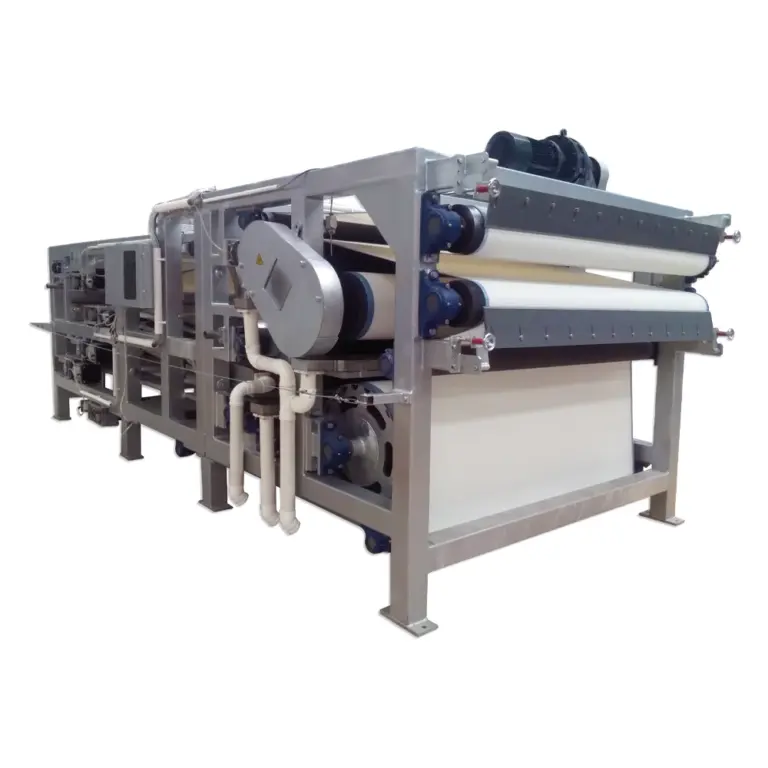
Two filter press suppliers test the same slurry and return different cake moisture and cycle time numbers. Before either result can justify a procurement decision, someone has to determine whether the two tests actually measured the same thing. A filter press supplier test report looks authoritative on its face, but headline numbers from different test setups are not automatically comparable, and ranking them without checking the underlying basis can lead to selecting the wrong press configuration for the project.
Feed-Lot Equivalence Before Any Supplier Ranking
| Feed factor | Comparable basis to verify | Boundary when the basis differs |
|---|---|---|
| Slurry source and lot | The same source and lot, or a documented difference | Keep the ranking conditional on the documented difference |
| Storage | Storage history for each tested sample | Treat an undocumented or different history as unresolved comparability |
| Mixing | Mixing condition before and during sampling or testing | Interpret each result only on its stated mixing basis |
| Settling | Settling before sampling and feeding | Record the difference before comparing headline results |
| Conditioning | Conditioning used for each supplier test | Compare results separately unless the conditioning basis is aligned |
A test result only describes the slurry that was actually fed into the press during that test. If two suppliers tested material from different lots, different storage durations, or different mixing and settling states, their results describe two different feed conditions rather than two performance levels of the same material. Slurry is not a fixed, stable substance between the time it is generated and the time it is tested. Solids can settle out of suspension, particle flocs can break down or reform under agitation, and chemical or biological changes can occur in storage that alter how the material responds to pressure and filtration. A slurry sample drawn and tested immediately after generation can behave differently from the same source material tested after a holding period, even where no conditioning chemical was added.
This matters most where the buyer is comparing cake dryness or cycle time as if they were pure measures of press performance. A press that achieves a lower cake moisture on a well-settled, consistently mixed feed is not demonstrating superior dewatering capability if the competing supplier tested a feed that had been left to stratify or was fed without equivalent mixing. The equipment variable and the feed variable are both present, and separating them requires knowing what each supplier actually tested.
Where a project involves chemical conditioning before the press — coagulant or flocculant dosing, pH adjustment, or polymer addition — the conditioning recipe itself becomes part of the feed-lot basis. Two suppliers using different conditioning dosages or different conditioning hold times before feeding are not testing the same input even if the raw slurry source was identical. The buyer’s task is not to assume equivalence but to request documentation of source, storage history, mixing condition, settling time, and conditioning approach for each report, and to treat any undocumented difference as an open question rather than a resolved comparison. Where that documentation is incomplete, the ranking between suppliers should be held as conditional rather than final, because the apparent performance gap may reflect feed variability rather than press capability.
Press Configuration and Cloth Differences to Normalize
| Configuration element | Basis to align across reports | Comparison boundary |
|---|---|---|
| Press type | The press type used for each test | Keep results conditional on press type when the types differ |
| Chamber and effective area | Chamber basis and effective filtration area | Do not compare area-dependent results as though the test bases were identical |
| Filter cloth | The cloth used in each test | Keep cloth differences visible when interpreting separation results |
| Feed sequence | The sequence used to feed the press | Compare cycle results only on a documented sequence basis |
| Pressure-flow path | The reported pressure and flow path through the test | Do not rank headline metrics without accounting for a different path |
| Cycle endpoint | The condition used to end each cycle | Align the endpoint before comparing cycle-level results |
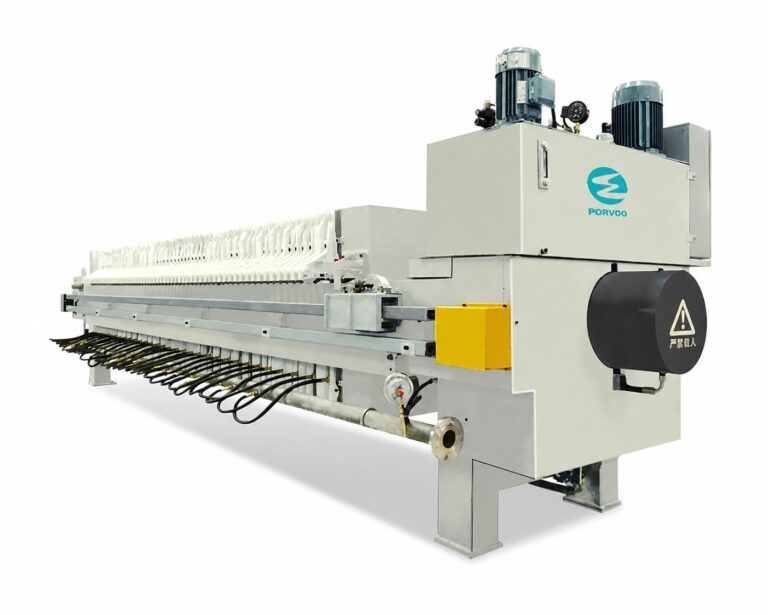
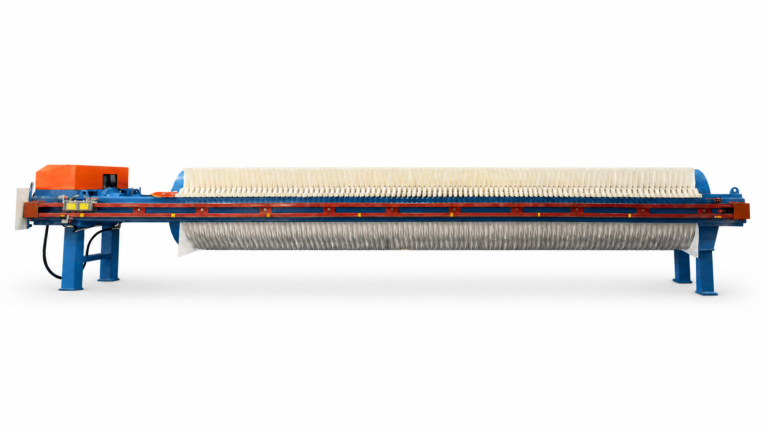
Once feed equivalence is established or at least documented, the next layer of comparison is the equipment and operating configuration used to generate each result. A filter press’s reported throughput, cycle time, and cake outcome are functions of its chamber design, effective filtration area, cloth selection, and the sequence in which feed is introduced — not properties of the slurry alone. Two presses processing the same feed under different configurations can legitimately produce different results without either supplier’s equipment being superior; they were simply configured differently for the test.
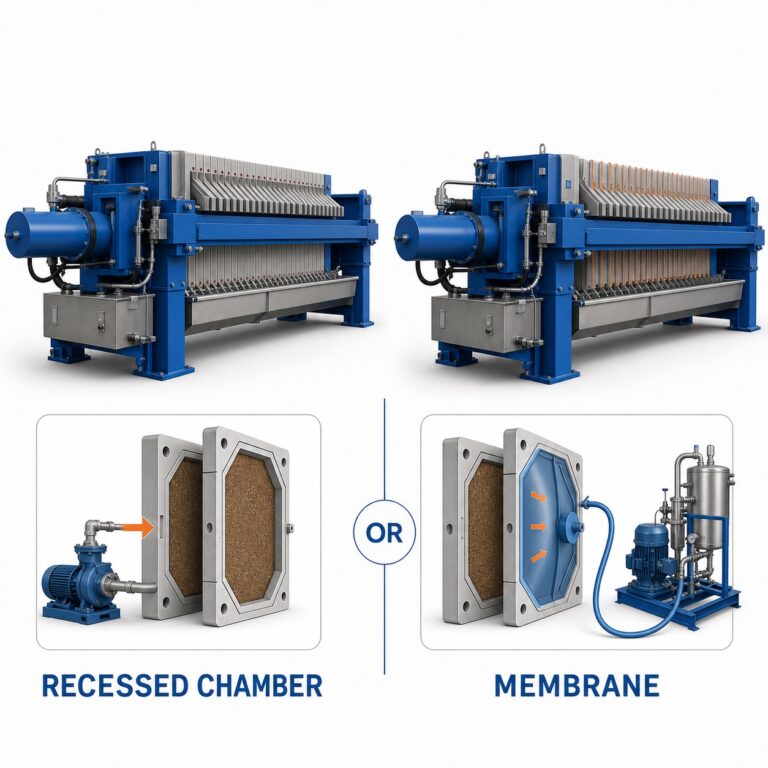
Chamber type and effective filtration area set the baseline for how much slurry can be processed per cycle and how the pressure is distributed across the filtration surface. A recessed chamber configuration and other chamber geometries carry different relationships between chamber volume, filtration area, and achievable cake thickness. If one supplier tested with a larger effective area relative to feed volume, their reported cycle time may reflect that area advantage rather than a difference in filtration mechanism. Comparing cycle times without normalizing for effective area treats a configuration choice as if it were a performance finding.
Filter cloth selection affects filtrate clarity, cake release, and blinding behavior over repeated cycles. A cloth chosen for fine particle retention can produce clearer filtrate but a different pressure buildup pattern than a cloth selected for faster drainage. Where suppliers do not disclose which cloth was used, a difference in reported filtrate clarity cannot be attributed to the press mechanism with confidence.
Feed sequence and the pressure-flow path through the test — how quickly pressure was ramped, whether flow was staged, and how the cycle was controlled — also shape the result. A slower, staged feed can produce a different cake structure than a rapid fill, independent of the slurry itself. Before accepting a headline comparison, the buyer should ask each supplier to state press type, chamber and area basis, cloth used, feed sequence, and pressure-flow path, and should treat any unstated element as a normalization gap rather than assume the tests were run on equivalent terms.
Cake and Filtrate Methods, Units, and Sampling Points
| Measurement dimension | Cake result to check | Filtrate result to check | Comparison use |
|---|---|---|---|
| Method | Named cake measurement method | Named filtrate measurement method | Compare results only where the relevant methods are aligned or their difference is explicit |
| Unit | Unit reported for the cake result | Unit reported for the filtrate result | Normalize like results to a common unit before ranking |
| Sampling point | Where the cake sample was taken | Where the filtrate sample was taken | Apply the result only to the documented sampling point |
| Calculation basis | Basis used to calculate the cake value | Basis used to calculate the filtrate value | Keep unlike calculation bases out of a direct numerical ranking |
| Run inclusion | Included, excluded, or interrupted runs behind the cake value | Included, excluded, or interrupted runs behind the filtrate value | Keep the reported value tied to the runs that produced it |
Even where feed and configuration are aligned, the reported cake and filtrate values depend on how those values were measured, where the sample was taken, and how the number was calculated. A cake moisture figure is not a single, universally defined quantity; it depends on the drying method used to determine moisture content, the point in the cycle where the cake sample was drawn, and whether the stated value represents an average across the cake or a value from a specific location within it. Cake near the feed inlet can differ from cake near the discharge edge, and a sampling point chosen at one location will not necessarily represent the full chamber.
Filtrate quality carries the same dependency. A filtrate clarity or suspended-solids figure depends on the analytical method applied, the unit of measurement, and when in the cycle the sample was drawn — early filtrate during cake formation typically differs from filtrate collected once the cake has built and begun acting as its own filtration medium. GB/T 30176-2013, the national standard for filter performance measurement methods, establishes relevant measurement approaches for throughput and separation verification in filtration equipment, and where a supplier references a named standard method, that reference gives the buyer a basis to check whether both reports used comparable procedures rather than assuming they did.
Calculation basis is a further variable: a cake moisture percentage can be calculated on a wet-mass basis or a dry-mass basis, and these produce different numbers from the same physical cake. A filtrate concentration can be reported as an instantaneous reading or as a cycle-average, and the two are not interchangeable. Where one supplier’s report does not state which basis was used, the number cannot be placed on the same axis as a competing report that does state its basis, even if the units appear identical at first glance.
The buyer’s working principle here is that a number without its method, unit, sampling point, and calculation basis is not a comparable data point — it is a claim awaiting context. Requesting that context from each supplier, and keeping any unresolved figure out of a direct numerical ranking, protects the comparison from treating methodological difference as performance difference.
Cycle Endpoints, Excluded Runs, and Operator Interventions
| Report condition | Evidence the comparison needs | Treatment in the comparison |
|---|---|---|
| Cycle endpoint | The stated condition that ended the cycle | Compare cycle metrics only where endpoint bases are aligned |
| Interrupted run | Which runs were interrupted and how they were treated | Keep interrupted runs distinct from completed-cycle evidence |
| Excluded run | Which runs were excluded and the stated basis for exclusion | Do not rank a headline result without retaining its exclusion boundary |
| Operator intervention | Any intervention recorded during the test or cycle | Keep the result conditional on the documented intervention |
A reported cycle time or cake condition describes a specific run, and runs can end for different reasons: a fixed time limit, a pressure plateau, a flow-rate cutoff, or an operator’s judgment that the cake had reached a workable state. Where two suppliers used different endpoint conditions, their cycle times are not measuring the same event. A press stopped at a fixed pressure target can report a different cycle time than one stopped once flow rate dropped below a working threshold, even on identical feed and equipment, because the two tests were answering different questions about when the cycle was “done.”
Test programs also generate runs that do not complete as planned — interruptions from mechanical adjustment, feed supply issues, or other operational events during the test. How a supplier treats these runs matters to the comparison. A report that quietly excludes an interrupted or underperforming run from its headline average is presenting a selectively filtered dataset, whereas a report that discloses the exclusion and its basis gives the buyer the information needed to judge whether the exclusion was reasonable. Neither treatment is inherently wrong, but an undisclosed exclusion removes the buyer’s ability to evaluate it.
Operator intervention during a cycle — manual adjustment of pressure, manual initiation of cake discharge, or other hands-on steps — can also shape the result in ways that an automated or unattended cycle would not reproduce. The EPA’s Recessed-Plate Filter Press fact sheet identifies the feed pump, chamber, cloth, filtrate, cake, cycle, and discharge as interacting elements of a filter press test and comparison, and operator involvement sits across several of these interfaces; its documentation in a report tells the buyer whether the result reflects how the press would run under routine, less-attended operation or under closer operator attention during the test itself. That fact sheet’s scope is specific to municipal biosolids applications, and its dimensions should inform what to check rather than be treated as a numeric benchmark for a different slurry type.
The buyer’s task across this section is not to disqualify any particular endpoint or intervention practice, but to require that each report disclose what ended each cycle, which runs were excluded or interrupted, and what intervention occurred, so the comparison can be qualified accordingly rather than treated as a clean head-to-head result.
Scale-Up Logic and Remaining Design Responsibility
| Evaluation item | What the supplier report should make explicit | Decision boundary |
|---|---|---|
| Scale-up logic | How the test basis leads to the proposed design basis | Do not treat a test result as a design conclusion without the stated connection |
| Design responsibility | The supplier’s stated design responsibility after the test | Keep unstated or unresolved responsibility open in the evaluation |
| Remaining uncertainty | Conditions or questions the test did not resolve | Carry the uncertainty into the technical and commercial comparison |
| Proposed acceptance test | The later test proposed to verify project performance | Check whether the verification path addresses the remaining uncertainty |
A test run, however well normalized, describes the test’s own scale and duration. Translating that result into a proposed production-scale press size, chamber count, and cycle schedule requires a scale-up argument, and suppliers can differ meaningfully in how explicit and how defensible that argument is. One supplier may present a test result alongside a stated method for how chamber count, plate area, and cycle frequency were derived from the test data; another may present the same category of test result with the production design simply asserted, without showing the connecting logic. The test result and the design conclusion are not the same thing, and a buyer evaluating two proposals should look for the reasoning that bridges them rather than accepting the stronger-looking test number as proof of the stronger-looking full-scale design.
Design responsibility is the related question of what each supplier is committing to after the test. Where a supplier states that it carries design responsibility for translating test results into a sized press for the project, that commitment is different from a report that presents test data without a stated responsibility for the resulting equipment sizing. An unstated responsibility should be treated as an open item in the evaluation rather than assumed in the buyer’s favor.
Remaining uncertainty is also worth naming directly rather than treating test data as conclusive. Slurry composition can vary across a production run in ways a single test lot does not capture; a proposed acceptance test at commissioning is one way suppliers address this gap, by committing to verify performance against the actual production-scale feed rather than resting entirely on the earlier bench or pilot result. Where a supplier proposes such a verification step, it indicates the test report is being treated as a design input rather than a final performance guarantee. The project information the buyer supplies — the feed characteristics, flow conditions, and site constraints behind the original request — becomes the basis against which that proposed acceptance test and the associated design sizing are reviewed during configuration and quotation.
Comparison Record for Technical and Commercial Evaluation
| Evaluation area | Supplier A record | Supplier B record | Evaluation outcome |
|---|---|---|---|
| Feed-lot basis | Source, lot, storage, mixing, settling, and conditioning | Source, lot, storage, mixing, settling, and conditioning | Comparable, conditional, or unresolved |
| Press and cloth basis | Press type, chamber, effective area, cloth, feed sequence, and pressure-flow path | Press type, chamber, effective area, cloth, feed sequence, and pressure-flow path | Aligned or kept as separate test bases |
| Cake and filtrate basis | Methods, units, sampling points, and calculation bases | Methods, units, sampling points, and calculation bases | Metrics accepted for comparison or left unresolved |
| Cycle and run basis | Cycle endpoint, excluded runs, interrupted runs, and operator interventions | Cycle endpoint, excluded runs, interrupted runs, and operator interventions | Dataset accepted, qualified, or not directly comparable |
| Scale-up and responsibility | Scale-up logic, design responsibility, and remaining uncertainty | Scale-up logic, design responsibility, and remaining uncertainty | Difference carried into the supplier evaluation |
| Acceptance-test path | Proposed acceptance test | Proposed acceptance test | Verification basis selected or left open |
Bringing feed-lot basis, configuration basis, measurement basis, cycle and run treatment, and scale-up reasoning together into one record is what converts a set of supplier test reports into a usable comparison. Without that consolidation, a buyer risks carrying forward a headline number from one report and a different headline number from another, each shaped by a different undisclosed condition, and treating the gap between them as a performance difference rather than a methodological one.
Where the feed-lot, configuration, and measurement bases are closely aligned across two reports, a numerical comparison on cake moisture, filtrate quality, or cycle time carries more weight, and the remaining evaluation can focus on scale-up logic and proposed verification. Where those bases diverge and the divergence is documented, the comparison should be treated as conditional — informative about each supplier’s own test, but not a direct ranking of one press configuration against another. Where the divergence is undocumented, the result should be held open until the missing information is obtained, rather than used to rank suppliers.
This record also serves a commercial function alongside the technical one. A procurement or engineering team comparing quotations needs to know not just which supplier reported the better number, but which supplier’s report rests on a basis close enough to the project’s actual feed and operating conditions to be trusted as a sizing input. A recessed chamber filter press and a membrane filter press, for instance, can produce different cake and cycle results on identical feed because membrane plates apply additional squeeze pressure after initial filtration, and a comparison that does not note which press type generated which number is not comparing configurations on equal terms — it is comparing a configuration choice as if it were a performance outcome. Where the project’s dewatering requirement and the acceptance test proposed by each supplier are both recorded alongside the technical data, the evaluation can reach a decision based on what each report actually demonstrated rather than on the strongest unexamined headline figure, and the resulting record gives both the technical reviewer and the commercial buyer a shared basis for selecting between the proposals.
Frequently Asked Questions
Q: Can I rank suppliers by the best headline cake, filtrate, or cycle result?
A: Only when the underlying feed, press configuration, measurement basis, and cycle endpoint are comparable. If any of these differ, keep the ranking conditional and state which difference could have influenced the reported result.
Q: What should I do if suppliers did not test the same slurry lot?
A: Treat the reports as separate test bases until differences in source, storage, mixing, settling, and conditioning are documented. Use those differences to define the unresolved comparison and, if needed, the conditions for a follow-up test.
Q: How should I handle reports that use different press types or filter cloths?
A: Keep each result tied to the configuration that produced it. Compare the routes as distinct tested options, then decide which configuration difference must be resolved before using the results for a common project decision.
Q: What should I request when a reported value does not show how it was obtained?
A: Request the method, unit, sampling point, calculation basis, cycle endpoint, and the treatment of excluded or interrupted runs. Until that basis is clear, record the value as unresolved rather than placing it in a direct numerical ranking.
Q: Does a favorable supplier test result establish the full-scale design choice?
A: No. The report should explain how the test basis connects to the proposed design, who retains design responsibility, what uncertainty remains, and how a later acceptance test will verify the project-specific result.
Q: How should unresolved test differences affect the commercial evaluation?
A: Carry each unresolved difference into the side-by-side decision record with its responsible party and proposed verification step. This preserves the limits of the evidence and prevents a conditional test result from being treated as a settled acceptance outcome.