A filter press test result only means something once the reader knows what feed produced it. Two slurries reported at the same percent solids can behave differently in the same press, and two samples from the same tank can test differently if one settled before it was drawn. Before comparing cycle times, cake dryness, or filtrate clarity across tests, the question is whether the feed itself was measured and prepared the same way each time.
Why the Solids Basis Changes the Test Load
Feed solids concentration sets how much slurry volume must pass into the chamber before it fills, and how much liquid still has to leave once it does. A feed reported on one solids basis will load the chamber differently than the same material reported on another basis, even where the underlying slurry is identical, because the reported number changes how much solid mass is assumed to be present per unit of feed volume. This is why the measurement basis has to travel with every test result rather than being treated as a fixed property of the material.
Where feed solids are measured by a filtration-based method such as ISO 11923, the result reflects suspended solids retained on a glass-fibre filter under stated conditions, and that method carries its own stated interferences. A reading taken under one preparation or interference condition is not directly comparable to a reading taken under another, even when both are reported as “percent solids.” This matters for test comparison because a difference in measured solids between two tests can originate in the measurement step itself rather than in the slurry.
The consequence for chamber loading is direct. A higher reported solids content implies a shorter fill time and less liquid to displace per chamber volume, which changes the pressure-flow curve and the point at which the press reaches a terminal condition. A lower reported solids content implies the opposite. If the test record does not state how solids were measured and on what basis, a reader comparing two results cannot separate a genuine difference in the feed from a difference introduced by measurement.
The buyer’s task before weighing any other result is to confirm how feed solids were determined for each test being compared, whether the same method and preparation applied in each case, and whether the reported figure represents the feed as it will actually be pumped to the press or a portion handled differently. Where this basis is not stated, the chamber-filling and liquid-removal implications of the reported solids figure cannot be trusted across tests, regardless of how similar the cake or filtrate results appear.
Particle Distribution Effects on Cake and Cloth Behavior
Particle size distribution can influence how a cake builds inside the chamber, how the filter cloth responds over repeated cycles, and how filtrate clears as the cycle progresses. A feed weighted toward finer particles can pack differently against the cloth than one weighted toward coarser particles, and that packing difference can affect how readily liquid passes through the forming cake. None of this establishes a fixed direction of effect that applies across all slurries; the actual behavior depends on the specific material, and it has to be established on the slurry being tested rather than assumed from particle size category alone.
Where a feed contains a wide spread of particle sizes, the finer fraction can lodge within the void spaces created by larger particles, changing the permeability of the cake as it builds. Where a feed is more narrowly distributed, the cake structure may be more uniform, but uniformity does not by itself indicate whether the cake will be more or less permeable than a wider distribution would produce. The direction of this effect is a property of the material under test, not a general rule that transfers from one slurry to another.
Cloth blinding follows a related but distinct logic. A cloth can blind when fine particles embed in the weave rather than remaining in the cake, and the tendency toward this depends on how the particle distribution interacts with the specific cloth construction used in the test. A cloth that performs one way with one feed’s fine fraction may perform differently with another feed’s fine fraction, even if both feeds carry a similar overall solids figure. This is why a particle distribution finding from one slurry cannot be assumed to predict cloth behavior for a different slurry tested on different cloth.
Filtrate clarity and the pressure-flow response during the cycle are the observable signals through which these particle-distribution effects show up, but the signals have to be read as a set rather than individually, since cake structure, cloth condition, and filtrate behavior are linked outcomes of the same forming process.
Pressure-Flow and Filtrate Signals to Track Together
| Signal | Comparison question | Evidence boundary |
|---|---|---|
| Pressure-flow response | Was the response obtained with the same feed-solids basis, sample preparation, cloth, chamber, and test sequence? | It supports comparison of the tested slurries; the direction of any particle-distribution effect must be established on the actual slurry. |
| Filtrate behavior and clarity | Was filtrate behavior tracked under the same comparison basis as pressure and flow? | It does not by itself establish a treatment guarantee or legal limit. |
| Cake buildup | Was cake formation assessed under the same cloth, chamber, and sequence? | It is one part of the comparison and should be interpreted with pressure-flow and filtrate signals. |
A single reading from a filter press test, taken alone, does not establish whether the press is behaving as expected for that feed. Pressure and flow move together during a cycle, and filtrate behavior reflects what is happening at the cloth and cake interface as that pressure-flow relationship develops. Reading one signal without the others can suggest a conclusion that the full set does not support.
Where pressure rises while flow drops sharply, this can indicate that the cake is approaching a state where it resists further liquid passage, but whether that state reflects normal cake maturation or an earlier-than-expected restriction depends on how the cake and cloth are behaving in parallel. Filtrate that remains clear through this stage points toward one interpretation; filtrate that carries solids through the same stage points toward another. Neither signal alone settles the question.
The condition that governs how these signals should be read is whether they were captured under matching test circumstances. A pressure-flow curve from one test is only informative relative to a curve from another test if both used the same feed-solids basis, the same sample preparation, the same cloth, the same chamber, and the same test sequence. Where any of these differ, an apparent difference in pressure-flow response may originate in the test setup rather than in the feed.
This is also where the limits of particle-distribution reasoning apply directly: a pressure-flow pattern that looks consistent with a finer or coarser distribution in one slurry does not confirm that the same pattern means the same thing in a different slurry, because the direction of a particle-distribution effect has to be established on the material actually tested. Filtrate clarity carries a parallel limit. A clear filtrate reading supports comparison between the tested conditions, but it does not by itself establish a treatment guarantee or a compliance outcome, since filtrate behavior in a bench or pilot test is one observation within a larger treatment context that project-level evidence would need to confirm separately.
The practical task is to treat pressure-flow response, filtrate clarity, and cake buildup as one connected record for each test run, and to ask, before comparing across runs, whether all three were captured under the same comparison basis.
Paired Test Records Needed for a Fair Comparison
| Comparison record | What it protects in the comparison | Decision boundary |
|---|---|---|
| Feed-solids measurement and reporting basis | Chamber loading and the amount of liquid that must leave | The basis must travel with every result. |
| Sample preparation | Comparison between samples | Use the same preparation basis before attributing a difference to the feed. |
| Filter cloth | Cloth-blinding and filtrate-behavior comparison | Keep the cloth the same across paired tests. |
| Plate chamber | Chamber-filling comparison | Keep the chamber the same across paired tests. |
| Test sequence | Pressure-flow, filtrate, and cake comparison | Use the same sequence across paired tests. |
| Storage or pumping segregation condition | Whether the laboratory portion represents plant feed behavior | Record segregation because the portion may overstate or understate plant behavior. |
A comparison between two filter press tests is only as good as the records that accompany each one. Where a buyer wants to know whether a change in result reflects a real difference in the feed or a difference in how the test was run, the test records need to show that everything except the variable being studied was held constant.
The feed-solids measurement and reporting basis comes first, because it determines the assumed chamber loading and the volume of liquid the press must remove. Sample preparation follows closely, since how a sample is drawn, settled, or agitated before testing can change what reaches the press even when the source material is the same. A test comparison that holds the feed constant but varies preparation is not actually isolating the feed as the variable.
The filter cloth and the plate chamber used in each test need to match as well, because cloth construction affects blinding behavior and chamber geometry affects fill time and pressure distribution independently of the feed itself. A result obtained on one cloth or chamber configuration does not transfer cleanly to a comparison against a result obtained on a different one, even where the feed is identical.
Test sequence matters for the same reason pressure-flow and filtrate signals need to be read together: the order and timing of pressure application, hold periods, and any intermediate steps shape the pressure-flow and filtrate record, so a sequence difference between two tests can produce a result difference that has nothing to do with the feed.
One further condition deserves explicit recording rather than assumption: whether the feed fractions segregate during storage or pumping before reaching the press or the sample point. Where segregation occurs, a laboratory portion drawn from the same tank as the plant feed may not represent the plant feed’s actual particle distribution or solids concentration, because settling or stratification can concentrate certain fractions in some parts of a tank or line and not others. Recording this condition protects against assuming that a bench or pilot result, run on an unsegregated or differently segregated sample, predicts how the full-scale feed will behave. This is the kind of project-specific condition that a buyer preparing data for configuration or quotation review would need to disclose, since it directly affects how a test result should be weighted against expected plant performance.
Limits on Transferring One Feed Result to Another
A result obtained on one feed does not transfer to another feed simply because the two slurries come from related processes or look similar in storage. The particle distribution, solids basis, and segregation behavior of one material can differ from another even within the same general material category, and any of those differences can change cake buildup, cloth response, or pressure-flow behavior in ways that a shared process origin does not predict.
Where two feeds share a solids concentration but differ in particle distribution, the cake structure and cloth interaction may differ in ways the solids figure alone does not reveal. Where two feeds share a similar particle distribution but differ in solids concentration, the chamber-filling and liquid-removal behavior may differ even though the particle-level behavior is similar. Transferring a result across either of these boundaries without re-testing assumes that the untested variable does not matter, which the test record cannot support unless it was specifically designed to isolate that variable.
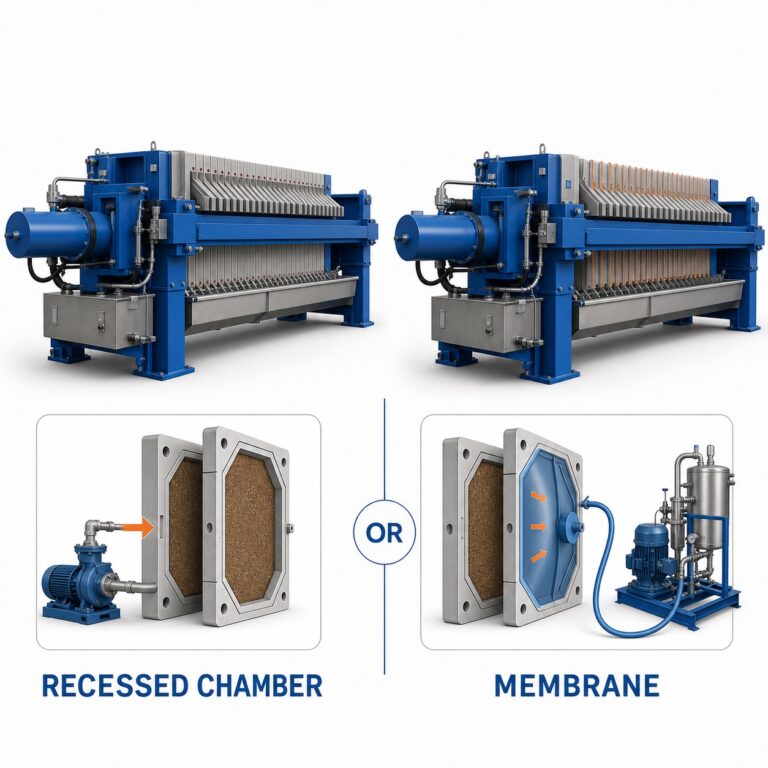
This is also why test records from a different scope should not be read as predictive of industrial slurry performance. Reference material such as the EPA’s recessed-plate filter press fact sheet describes the feed-pump, plate-chamber, cloth, filtrate-removal, and cake-discharge interfaces that are common across recessed-plate press applications, and it supports understanding the route mechanics and the dimensions along which bench or pilot tests get compared. It does not supply numeric results or chemical-conditioning outcomes that apply outside the municipal biosolids scope it addresses, and its findings should not be carried into an industrial slurry context as though they were project-specific evidence.
The practical boundary is this: a project team can use a prior test result to decide what to test next, what paired records to hold constant, and what signals to track together, but it cannot use that prior result as a substitute for testing the actual feed intended for the project. Where the feed, its solids basis, its particle distribution, or its segregation behavior differs from what was previously tested, the only way to know whether the earlier result still applies is to run the comparison on the current material under matching test conditions, with the solids basis, sample preparation, cloth, chamber, and sequence all held the same as the baseline being compared against.
Frequently Asked Questions
Q: What information should stay attached to every filter press test result?
A: Record the measured feed-solids value and its reporting basis with the result. Also retain the sample preparation, filter cloth, plate chamber, test sequence, and any known storage or pumping segregation so later comparisons use the same basis.
Q: When can a laboratory slurry portion be treated as representative of plant feed?
A: Treat it as representative only after checking how the feed behaves during storage and pumping. If fractions segregate, document the condition and test a portion that reflects the relevant plant feed rather than assuming one laboratory sample captures it.
Q: How should particle-size effects be evaluated without assuming the outcome?
A: Compare the actual slurries under the same solids basis, sample preparation, cloth, chamber, and test sequence. Track cake buildup, cloth behavior, pressure-flow response, and filtrate behavior together because the direction of the effect must be established by the test.
Q: Does clearer filtrate by itself establish that a treatment requirement is met?
A: No. Filtrate clarity is a useful comparison signal, but it does not by itself establish a treatment guarantee or legal limit. Define the project-specific acceptance requirement separately and evaluate the test result against that requirement.
Q: What should be checked first when two filter press tests give different results?
A: First confirm that feed-solids measurement, sample preparation, cloth, chamber, and test sequence were matched. Then check for storage or pumping segregation before attributing the difference to feed characteristics or filter press behavior.