Stone fabrication waste rarely arrives at the dewatering stage as a uniform slurry, which means the choice between a gravity-bag route and a recessed-plate filter press cannot be settled by comparing equipment specifications alone. A fabrication shop that generates slurry in irregular batches, with floor space constrained by an existing layout, faces a different decision than one running continuous production with a dedicated utility area. The question is not which method dewaters stone slurry, but which method fits the batch pattern, space, and disposal path this specific site already has.
Waste Conditions and Batch Basis That Frame the Choice
| Project condition | Basis to define before comparing routes |
|---|---|
| Representative stone slurry | Use slurry representative of the project rather than transferring results from another material. |
| Batch quantity | Define the quantity that must be handled on the project’s batch basis. |
| Solids variability | Identify the variability the selected route and representative trial must address. |
| Available floor area | Establish the space available for the complete installed and operating scope. |
| Required filtrate handling | Define how the resulting filtrate must be handled. |
| Dewatered material form | Define the form that can be transported or disposed of for the project. |
Before any comparison between a gravity-bag route and a recessed-plate press is useful, the project needs to establish what it is actually dewatering and on what basis. Stone fabrication slurry varies in solids content and particle character depending on the cutting or polishing operation generating it, and a route selected around one representative sample can behave differently when the slurry composition shifts. This is why representative stone slurry, not a generic waste characterization, has to anchor the comparison from the start.
Batch quantity matters because both routes handle discrete volumes rather than continuous flow, but they accumulate and release that volume differently. A gravity-bag route fills and drains on its own schedule tied to bag capacity, while a recessed-plate press cycles through fill, pressurization, and discharge as a mechanical sequence. Where batch quantity is small and irregular, the fixed installed footprint of a press competes against the flexible, add-as-needed nature of bags. Where batch quantity is large and repeating, the press cycle’s predictability becomes the more relevant comparison point.
Solids variability changes how forgiving either route is to swings in slurry character. A route that assumes consistent solids loading may need adjustment in filling method, bag working load, or press cycle timing when the actual slurry deviates from that assumption. This is a project condition to confirm before committing to either route’s stated handling approach, not an assumption to carry forward from a supplier’s general literature.
Available floor area determines whether the complete installed and operating scope of a route can actually be accommodated. Bags require space for filling, drainage as the cake builds, staging before lifting, and a transport path to the vehicle or disposal point. A press requires space for the press structure itself, the feed pump, plates and chambers, and the area needed for regular fill-and-unload attention. Floor area assessed only around the primary vessel, whether bag or press, tends to undercount the space the full operating sequence needs.
Required filtrate handling and the form in which dewatered material can be transported or disposed of are the two threads that carry through the rest of the comparison. A site with an existing filtrate discharge path evaluates both routes differently than one without it, and a site with disposal arrangements suited to a bagged solid evaluates cake discharge differently than one set up for loose or containerized cake. These are project-specific answers, not properties of either dewatering method in isolation.
Referenced Gravity-Bag Route: Filling, Drainage, Space, and Working Load
The gravity-bag route, as described in manufacturer reference material such as WINKLER’s sludge dewatering bags and dewatering boxes, works on a straightforward principle: slurry is filled into a permeable bag, water drains through the bag fabric under gravity while solids remain retained, and the bag continues to hold and concentrate solids as filling continues or as sequential batches are added. The mechanism depends on the bag’s permeability matching the particle size distribution of the slurry closely enough that fines do not pass through in significant quantity while free water drains reasonably.
Filling method affects how consistently the bag builds cake. If slurry is introduced faster than the bag can drain, the working bag geometry changes, and the effective capacity per bag may not match the nominal rating. This is a condition to test with representative slurry rather than assume from a generic fill rate, since stone fabrication slurry’s drainage behavior depends on the fines fraction present.
Drainage as the cake builds is not a constant-rate process. Early in the fill, free water drains readily because the developing solids layer offers little resistance. As solids accumulate, the same layer becomes the primary resistance to further drainage, and the rate falls. This means the total time a bag needs before it reaches a workable solids condition is a function of how the slurry’s solids concentrate over the fill, not a fixed duration that transfers from one slurry to another.
Space requirements follow from the fact that bags occupy a footprint for their full fill-and-drain cycle, and that footprint has to include drainage runoff collection beneath and around the bag, not just the bag’s plan area. Where multiple bags are staged in sequence to keep pace with batch generation, the space calculation multiplies accordingly.
Bag working load is a structural property: a filled bag carries a load determined by its retained solids and residual moisture, and that load has to be within what the bag material and any support structure or dewatering box are rated to hold. Where slurry solids content runs higher or lower than the reference conditions the manufacturer material describes, the resulting working load shifts, which is a reason to confirm rather than assume the bag’s rated capacity applies directly to a given stone slurry.
Lifting, Transport, Single-Use Bags, Filtrate, and Disposal Questions
Once a bag reaches a workable condition, the project faces a set of linked handling questions that do not arise, in the same form, with a press. A filled bag has to be lifted, which means the site needs lifting equipment matched to the filled bag’s load and a physical path from the drainage area to that equipment. Where the drainage area was chosen for its convenience to the slurry source rather than its access to lifting equipment, this becomes a coordination issue the project has to resolve, not a detail that resolves itself once bags are in use.
Transport route follows lifting: the filled bag has to move from where it was lifted to wherever it is loaded for disposal or further handling, and that route needs to accommodate the bag’s load and dimensions without obstruction. A site with a direct path to a loading area faces a different transport question than one where filled bags have to move through production space.
Single-use bags introduce a recurring supply question absent from a press route. Each filled and removed bag requires a replacement before the next batch can be processed, which means the project has to establish a supply arrangement and confirm that bag availability does not become the limiting factor in dewatering throughput. This is a procurement and inventory question as much as a technical one.
Filtrate, the water that drains from the bag, has to go somewhere, and where it goes depends on the site’s existing water handling. If the filtrate can return to a process water system or a treatment step already in place, the bag route integrates relatively simply. If it cannot, the site needs a defined path for filtrate before the bag route is workable at all, and this determination has to come from the project’s own water handling capability, not from an assumption drawn from the manufacturer reference material’s general description of drainage.
Disposal arrangements for the filled, dewatered bag material close the sequence. Some disposal paths accept bagged solid waste directly; others require the bag to be opened and the material handled loose or repackaged. The disposal path available to a given site determines whether the bag format is a convenience or an added handling step, and this is a question to resolve with the actual disposal contractor or facility the project uses, not with a general assumption about bagged waste acceptance.
Recessed-Plate Press Scope From Feed Pump to Cake Discharge
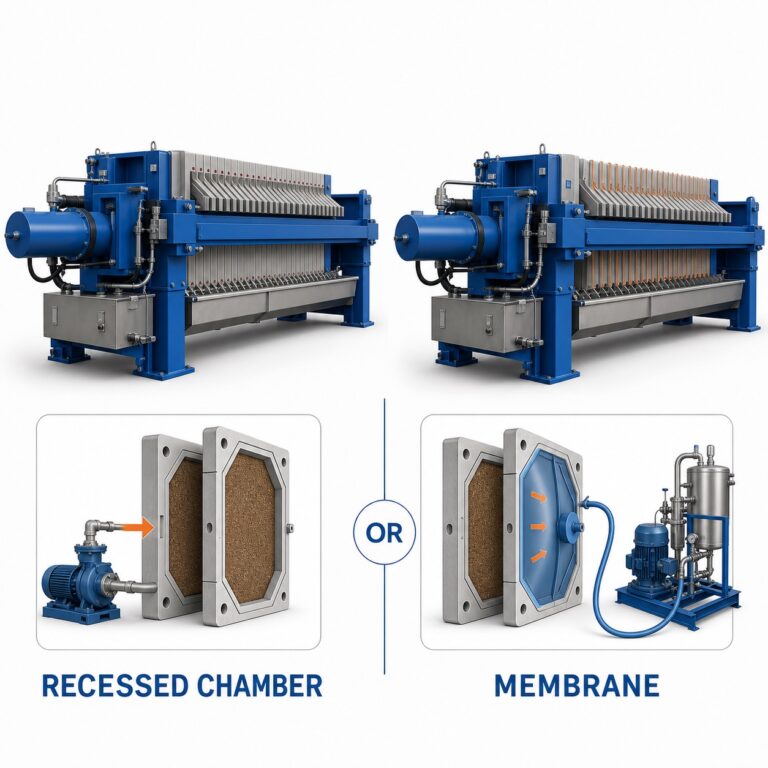
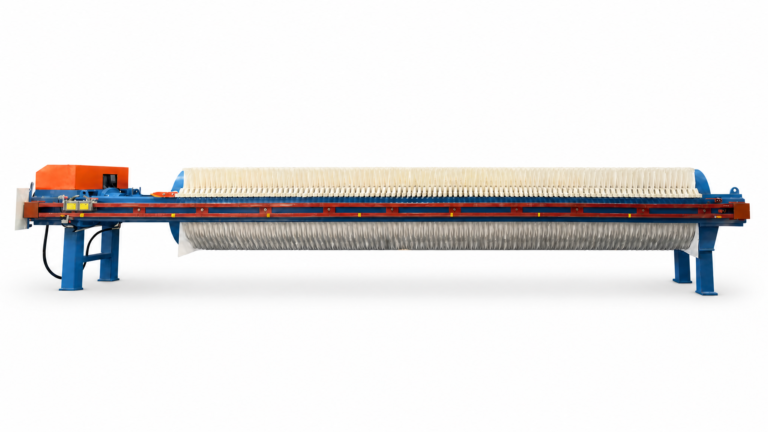
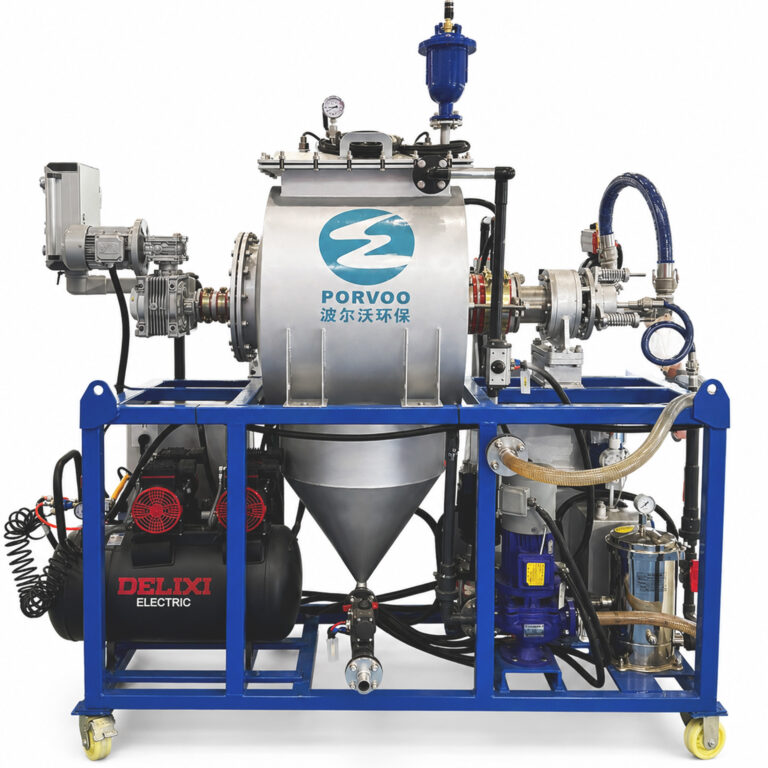
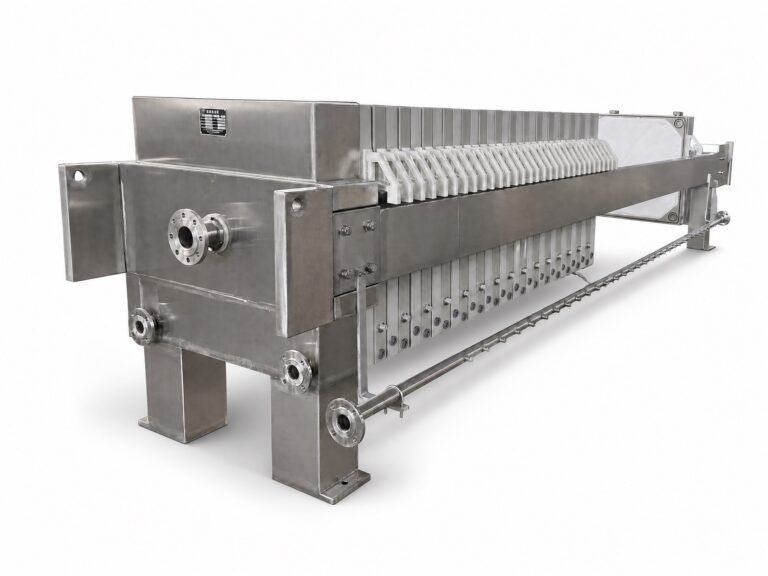
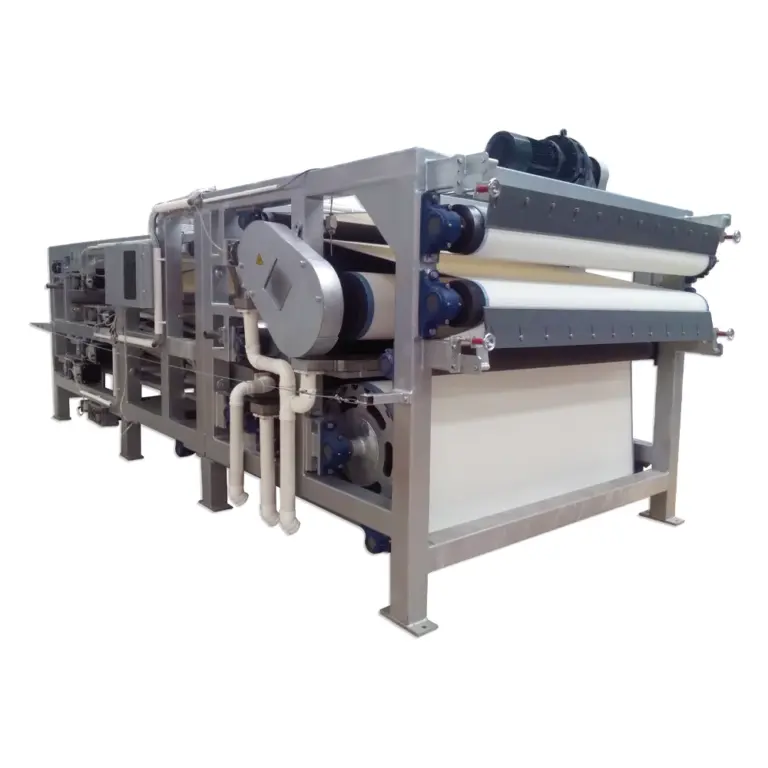
A recessed-plate filter press works on a different mechanism: slurry is pumped under pressure into a series of chambers formed by recessed plates, filter cloth mounted on each plate retains solids while filtrate passes through the cloth and out through drainage channels in the plates, and pressure is maintained until the chambers fill with dewatered cake. The press cycle then opens, the plates separate, and cake discharges from each chamber, generally as a stackable dewatered cake shape rather than a loose slurry.
The feed pump is not incidental to this mechanism; it is what generates and sustains the pressure driving filtration, and its capacity and pressure rating have to match the press’s chamber volume and the slurry’s filtration characteristics. Where the pump cannot sustain adequate pressure for the slurry’s particle size and concentration, the press cycle extends or the cake may not reach a consistent condition across all chambers, which is a reason feed pump matching is a design input, not an afterthought.
Plates and chambers define how much slurry the press can process per cycle, and the number of plates installed sets the press’s per-cycle capacity. Filter cloth mounted on the plates is the actual filtration medium, and its permeability and condition govern how cleanly filtrate separates from solids and how easily cake releases at discharge. Filter cloth is also a wear item within the press’s operating scope, meaning it needs periodic attention distinct from the structural components of the press.
Filtrate removal is designed into the plate and chamber assembly, with filtrate exiting through internal channels to a collection point, which the project then has to connect to whatever downstream filtrate handling the site uses. Cake discharge, at the end of the cycle, requires the plates to separate and the cake to release cleanly enough to fall or be removed without excessive manual intervention, a release behavior that depends on both the filter cloth condition and the cake’s own cohesion.
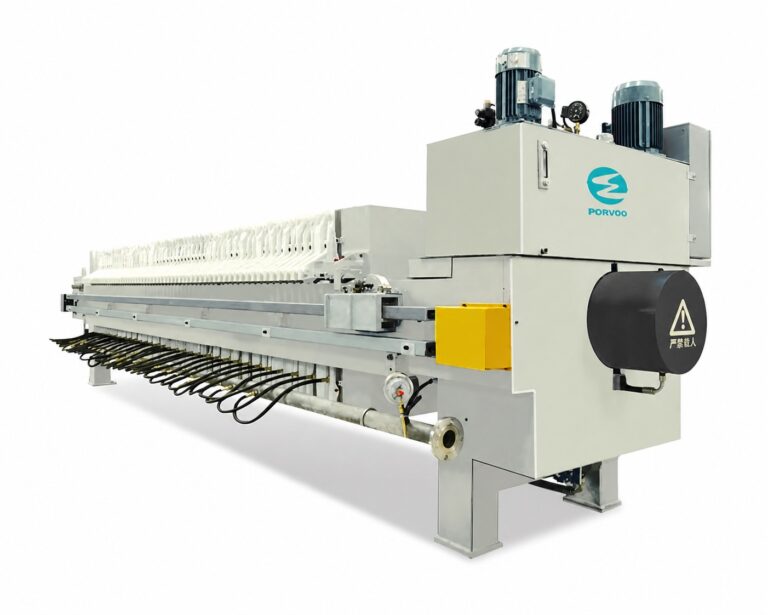
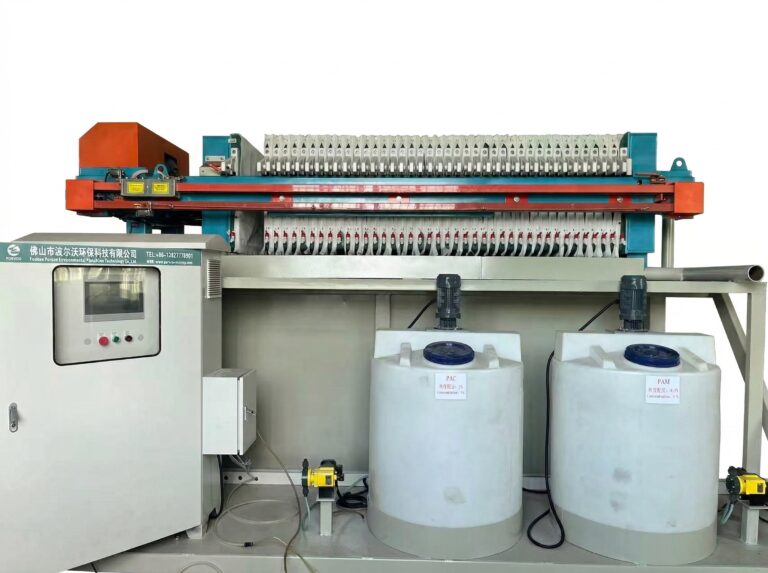
Structural support for the press assembly is a fixed installation consideration, since the press frame, plates, and hydraulic or mechanical closing mechanism carry substantial load and require a foundation or mounting suited to that load, unlike the more flexible siting a bag-based drainage area allows. Regular fill-and-unload attention, referenced in EPA’s recessed-plate filter press fact sheet describing municipal biosolids press operation, is part of the press’s operating scope in any application, though the fact sheet’s specific cycle times and biosolids-specific findings do not transfer to stone slurry without a representative trial of the actual material. Porvoo’s recessed chamber filter press equipment is configured around this same feed-pump-to-cake-discharge scope, with plate count, cloth selection, and pump sizing set against the project’s own slurry characteristics rather than a generic press specification.
Operating Scope Compared Without a Presumed Labor or Cost Winner
| Comparison dimension | Referenced gravity-bag route | Recessed-plate press | Decision boundary |
|---|---|---|---|
| Operating basis | Batch quantity, filling method, and drainage that changes as cake builds | Press cycle with regular fill-and-unload attention | Establish route timing with representative stone slurry rather than a universal time assumption. |
| Installed scope | Bag placement and the space needed for filling, drainage, lifting, and transport | Feed pump, plates and chambers, filter cloth, filtrate removal, cake discharge, and structural support | Compare the complete project scope, not an isolated bag or press item. |
| Load and material movement | Bag working load, lifting equipment, transport route, and the filled bag | Cake discharge followed by the project’s transport or disposal route | Confirm the project-specific form in which dewatered material can be moved and disposed of. |
| Filtrate handling | Drainage and the required handling of filtrate | Filtrate removal and the required handling of filtrate | Set any filtrate-quality acceptance only after a representative trial. |
| Recurring operating inputs and attention | Filling, drainage as cake builds, lifting, transport, single-use bag supply, and disposal arrangements | Regular fill-and-unload attention and filter cloth within the press scope | Do not presume that either route has lower labor or cost. |
| Cost comparison | Include the complete installed and operating scope, including single-use bags and handling arrangements | Include the complete installed and operating scope, including press components and operating attention | The supplied references do not establish a universal cost advantage for either route. |
Comparing these two routes fairly means comparing their complete installed and operating scope rather than a single component from each. A bag’s purchase cost is not the full cost of the bag route, just as a press’s equipment cost is not the full cost of the press route. Each route carries an operating basis, an installed footprint, a load-and-material-movement sequence, a filtrate path, and recurring inputs that together determine what the route actually requires from the site.
The operating basis differs in kind, not just degree. The bag route operates on a batch-and-drain timing that changes as each bag’s cake builds, meaning its throughput is not a fixed rate but a function of how solids concentrate over the fill. The press route operates on a repeating cycle with defined fill and unload attention at each cycle’s end. Neither timing basis is established without a representative trial of the project’s own stone slurry, since drainage behavior in one slurry does not predict drainage or cycle behavior in another.
Installed scope diverges in a way that space planning has to account for directly. The bag route needs filling, drainage, lifting, and transport space distributed across its handling sequence. The press route concentrates its footprint into the press structure and its immediate feed and discharge area, but that structure is fixed and requires structural support the bag route does not.
Load and material movement follows a similar pattern of difference rather than a clear efficiency advantage for either side. The bag route’s filled bag becomes the unit of load and movement, governed by bag working load and lifting equipment. The press route’s cake discharge becomes the unit of load and movement, governed by the project’s own transport or disposal route once cake leaves the press.
Recurring operating inputs are where the labor and cost question actually lives, and where no universal winner exists in the supplied evidence. The bag route recurs through filling, drainage monitoring, lifting, transport, single-use bag replenishment, and disposal arrangement, each a discrete recurring task. The press route recurs through fill-and-unload attention each cycle and filter cloth upkeep within its own scope. Whether one recurring pattern demands more labor or cost than the other depends on batch frequency, site layout, and disposal logistics specific to the project, none of which either route’s general description settles on its own. A site preparing this comparison for a supplier conversation supplies these operating and site details, including batch pattern, floor area, and disposal path, as the information a quotation review for either a filter press or a recessed chamber press configuration would need in order to size the equipment correctly rather than by generic capacity assumption.
Representative Stone-Slurry Trials Before Cake, Timing, or Filtrate Commitments
| Potential commitment | Route applicability | Evidence boundary |
|---|---|---|
| Cake condition | Gravity-bag and recessed-plate routes | Do not set the commitment before a representative stone-slurry trial. |
| Drainage time | Gravity-bag route | Do not transfer a universal drainage time from the manufacturer reference; establish it with representative stone slurry. |
| Press-cycle time | Recessed-plate press | Do not transfer cycle timing from municipal biosolids guidance; establish it with representative stone slurry. |
| Filtrate-quality acceptance | Gravity-bag and recessed-plate routes | Do not promise an acceptance result before representative stone-slurry trials. |
Every comparison drawn so far describes mechanism and scope, not outcome, because outcome depends on how a specific stone slurry actually behaves under each route, and that behavior is not established by either the manufacturer reference material or the biosolids fact sheet on their own. WINKLER’s bag and dewatering box material describes a gravity-bag reference route in general terms; it does not establish a drainage time, a cake condition, or a filtrate quality result for stone fabrication slurry specifically. EPA’s recessed-plate press fact sheet describes municipal biosolids press mechanics, interfaces, and representative testing as a concept, but its cycle times and performance findings are scoped to biosolids, not stone slurry, and do not transfer by category resemblance alone.
This means cake condition, whether from a bag or a press, is a commitment that a representative trial of the project’s own stone slurry has to establish before it is stated as an expectation. Cake behavior depends on particle size distribution, fines content, and the specific dewatering mechanism applied, all of which vary between waste streams even within the broad category of stone fabrication waste.
Drainage time for the bag route and press-cycle time for the recessed-plate route are similarly not values to carry over from either reference source. The manufacturer material’s drainage description and the fact sheet’s cycle description both apply to their own documented material and configuration; applying either timing figure to an untested stone slurry substitutes assumption for evidence at the point where evidence is most needed for planning batch throughput and space allocation.
Filtrate-quality acceptance, whether the resulting water can return to a process system, requires discharge, or needs further treatment, depends on what the filtrate actually contains after passing through a bag or a press cloth with this specific slurry. Neither reference source offers a filtrate quality result applicable to stone fabrication waste, which means any acceptance standard the project sets has to follow from its own trial results, not from a route’s general description of filtrate removal. Running representative stone slurry through the candidate route, at a scale sufficient to observe drainage or cycle behavior and to sample resulting cake and filtrate, gives the project the specific evidence that determines cake condition, timing, and filtrate handling before those figures enter a purchase decision, an operating plan, or a disposal arrangement commitment.
Frequently Asked Questions
Q: Can a gravity bag be selected by bag capacity alone?
A: No. The project comparison should also cover the filling method, bag working load, space for drainage, lifting equipment, transport route, single-use bag supply, filtrate handling, and disposal arrangements.
Q: How should limited floor area be evaluated when comparing the two routes?
A: Compare the space needed for the complete operating setup. A gravity-bag route needs room for placement, filling, drainage, lifting, and transport, while a recessed-plate press needs space for its feed pump, press structure, filtrate removal, cake discharge, and regular loading and unloading work.
Q: Does either route automatically have lower labor or cost?
A: No universal winner can be assumed. Compare the full installed and operating scope, including single-use bags and material handling for the gravity-bag route, and press components, filter cloth, structural support, and fill-and-unload attention for the recessed-plate press.
Q: How does the required form of dewatered material affect the choice?
A: Define the form that the project’s transport and disposal arrangements can accept. Then assess the filled-bag handling route and the press-cake discharge route against the required lifting, movement, and disposal steps.
Q: Can the filtrate be accepted based on the dewatering route alone?
A: No. Define how the project must handle the filtrate and what acceptance condition applies, then use representative stone-slurry trials to establish whether either route can meet that condition.
Q: What should be confirmed in a representative trial before making a commitment?
A: Confirm cake condition and filtrate quality for both routes, drainage behavior for the gravity-bag route, and cycle timing for the recessed-plate press. The trial slurry should represent the project’s material and solids variability.