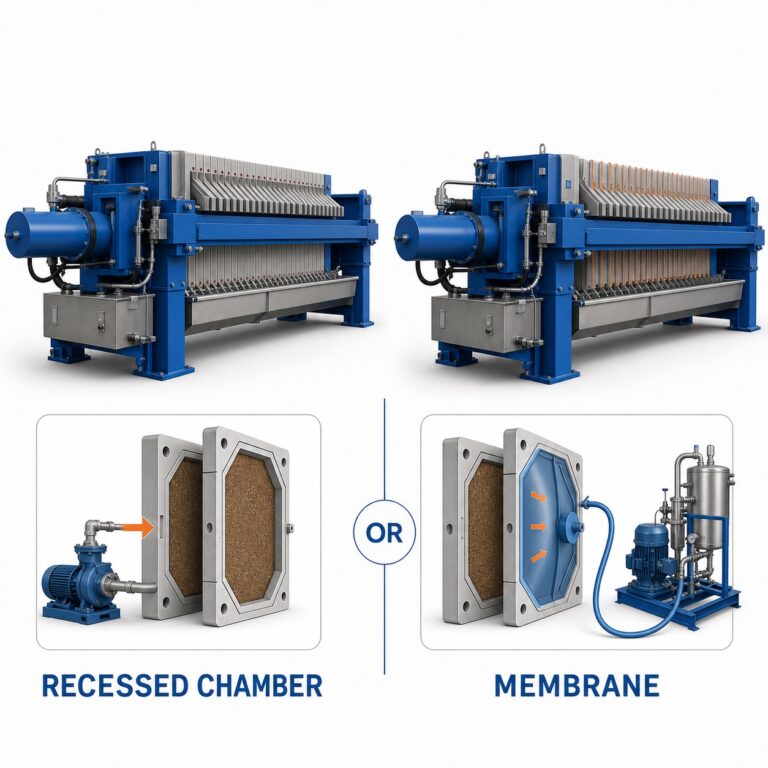
When a recessed-chamber filter press repeatedly leaves cake clinging to the same plates instead of releasing cleanly, the question is not which setting to change first but what the sticking pattern is already telling the operator. Changing cycle time, pressure, or cloth before that pattern is understood risks masking the cause rather than finding it.
What a sticking pattern reveals before settings change
| Observation to map | Qué grabar | Next inspection focus |
|---|---|---|
| Placas | Plate positions that retain cake and whether the same positions recur | Cloth and plate condition at the affected positions |
| Faces | Affected plate faces and whether the same faces recur | Cloth surface, cleanliness, seams, attachment, and plate condition on those faces |
| Edges | Edge locations that retain cake and whether the pattern repeats | Cloth seams and attachment at the affected edges |
| Sections | Press sections where cake remains and whether the same section recurs | Cloth and plate condition across the affected section |
A sticking problem rarely affects every plate in the same way at the same time. Where cake clings to the same plate positions cycle after cycle, the cause is more likely tied to something fixed at those positions: a cloth condition, an attachment detail, or a plate surface issue local to that part of the press. Where sticking shifts between positions or appears without a consistent location, the cause is more likely tied to something that changes between cycles, such as feed condition, conditioning, or how the press is filled and opened.
This distinction matters before any adjustment is made, because a configuration change that addresses a fixed-location cause will not resolve a cycle-to-cycle cause, and the reverse is also true. Recording which plates, faces, edges, or sections retain cake, and whether that pattern repeats, converts a vague complaint into a specific inspection target. Without that record, the next inspection has no starting point and may examine the wrong component or the wrong variable entirely.
The level of detail in this mapping also determines how useful it is later. A plate-by-plate record is more informative than a general note that “some plates stick,” because it lets the inspector compare affected and unaffected positions side by side under otherwise similar conditions. If the same face sticks on multiple plates, that points toward something common to that face across the press, such as how cloth is mounted or how that face is cleaned, rather than something unique to one plate. If the pattern instead follows edges, the attachment and seam area at those edges becomes the more relevant focus.
This mapping step also protects against a common misstep: adjusting the press based on the most recent cycle’s behavior rather than the pattern across several cycles. A single cycle’s sticking location can reflect a one-off condition in that particular feed batch, while a repeating pattern across cycles reflects something structural to the press or to a recurring operating practice. Only the repeating pattern justifies a configuration or equipment-level response.
Cake dryness and release as separate observations
Cake dryness and cake release are often discussed as if they were the same symptom, but they describe different mechanisms and can respond to different causes. Dryness concerns how much liquid remains in the cake at the end of the cycle; release concerns whether the cake separates cleanly from the cloth and plate surface once the chamber opens. A cake can be adequately dry and still stick, and a cake can release cleanly while remaining wetter than intended. Treating them as one symptom risks solving the wrong problem.
This separation matters directly when cycle time or pressure is being considered as an adjustment. Extending cycle time or raising pressure is a response aimed at dryness: it changes how much liquid is driven out of the cake before opening. If the underlying issue is release rather than dryness, a longer or higher-pressure cycle may produce a drier cake that still will not separate from the cloth, because the mechanism holding the cake in place was never addressed. The sticking problem has not moved anywhere; it has simply been obscured behind a cycle change that looks like progress on a different metric.
Conversely, where dryness is the actual limiting factor, adjustments aimed at release, such as changes to opening procedure or discharge practice, will not produce the dryness improvement the project needs, even if they incidentally make cake easier to remove.
Before changing either variable, the practical step is to observe and record both outcomes independently for the same cycles: what the cake’s dryness looked like, and separately, whether and how it released at the mapped positions. Where dryness is acceptable but release fails at specific positions, the investigation belongs with the cloth, plate, and attachment condition at those positions. Where dryness itself is inconsistent across the press, the investigation belongs further upstream, with feed preparation and the press’s filling and pressure profile. Conflating the two observations into a single “cake problem” removes the information needed to tell these two situations apart, and it is this separation, not a cycle-time change, that determines what happens next.
Cloth, plate, and attachment checks at affected positions
| Inspection area | What to document at the affected position | Decisión sobre la que informa |
|---|---|---|
| Cloth surface and cleanliness | The observed surface condition and cleanliness | Whether cloth condition should be addressed before media replacement or feed-preparation changes |
| Seams and attachment | The observed condition at seams and attachment points | Whether the mapped sticking pattern coincides with a seam or attachment condition |
| Estado de la placa | The observed plate condition at the same mapped position | Whether plate condition aligns with the sticking location before configuration changes |
Once sticking positions are mapped and dryness has been assessed separately from release, the physical inspection can be targeted to those specific positions rather than performed generally across the press. Three areas are relevant at each mapped position: the cloth surface and its cleanliness, the seams and attachment points, and the plate condition beneath the cloth.
Cloth surface condition affects how readily cake separates because the surface texture and any retained material on it change how the cake adheres during the cycle and how it behaves when the chamber opens. Where the cloth surface shows retained material or surface change concentrated at the same positions identified in the mapping step, that alignment is itself informative: it suggests the cloth condition, not the feed or the cycle settings, is the more immediate variable to address at those positions.
Seams and attachment points are a distinct inspection item because a seam or attachment issue can produce localized sticking even when the surrounding cloth is otherwise in acceptable condition. Where the mapped pattern follows edges rather than plate faces generally, checking seam and attachment condition at those edges is more directly relevant than inspecting the cloth surface overall.
Plate condition underneath and around the cloth is the third check, because a plate-side issue at a specific position can cause localized sticking independent of the cloth itself. Comparing plate condition at affected positions against plate condition at unaffected positions on the same press gives a basis for judging whether the plate is contributing to the pattern.
The purpose of inspecting these three areas before replacing media or changing feed preparation is sequencing: a cloth replacement or a feed-preparation change is a larger intervention than a focused inspection, and making that change before confirming where the problem actually sits risks resolving nothing if the cause is a plate or attachment condition that the replacement does not touch. Where inspection at the mapped positions finds no cloth, seam, or plate condition that explains the pattern, that negative finding is still useful, because it shifts the investigation toward feed preparation and filling variables as the more likely location of the cause. For related cloth-condition troubleshooting in a different dewatering context, cloth surface and blinding checks follow a comparable logic of inspecting the affected medium before changing upstream conditions.
Feed preparation and filling variables to isolate
Where the mapped pattern does not align with a fixed cloth, seam, or plate condition, the cause more likely sits in how the press is fed and filled rather than in the press hardware itself. Feed condition, conditioning, pump sequence, and the cycle’s end point are each capable of affecting how cake forms and whether it releases, and each can be changed independently of the others, which is exactly why they need to be isolated one at a time rather than adjusted together.
Feed condition refers to the state of the slurry arriving at the press: its consistency and the presence of material that affects how cake builds against the cloth. A change in feed condition between cycles that show good release and cycles that show sticking is a direct signal worth comparing, because it points to the slurry itself rather than the press.
Conditioning concerns anything done to the feed before or during delivery to the press to affect how it filters and dewaters. Where conditioning has recently changed, that change is a reasonable first variable to compare against the sticking record, since conditioning changes can alter cake structure in ways that affect release even when they are intended to affect dryness or throughput.
Pump sequence affects how evenly and at what rate the chambers fill, which in turn affects cake formation at different positions in the press. An uneven fill can produce a cake that is thinner or more loosely formed at some positions than others, and a loosely formed cake is more prone to remaining on the cloth or plate at those specific positions, which would again show up as a location-based pattern rather than a press-wide one.
Cycle end point, meaning the point at which the cycle is considered complete and the press is ready to open, interacts with both dryness and release, since ending the cycle at different points changes how far cake formation has progressed before opening is attempted.
The discipline required here is comparing these variables one change at a time under a recorded test basis. Changing feed condition and pump sequence together, for example, makes it impossible to attribute any resulting change in sticking behavior to either variable specifically, which defeats the purpose of the comparison.
Opening and discharge practices to reproduce under observation
Even where feed and filling variables are well controlled, the sequence used to open the press and discharge cake can itself be a variable rather than a fixed, neutral step. Where opening or discharge practice varies between operators or between shifts, that variation can produce sticking patterns that have nothing to do with the cloth, the plate, or the feed, and everything to do with how the press is handled at the end of the cycle.
Reproducing the opening and discharge sequence under direct observation, rather than relying on a description of how it is normally done, is the way to test this possibility. Observing the actual sequence against the mapped sticking positions allows a direct comparison: does the practice applied at positions that reliably release differ from the practice applied at positions that reliably stick. Where no difference in practice is found, opening and discharge practice can be set aside as a contributing factor with reasonable confidence, which then redirects the investigation back toward cloth, plate, attachment, or feed variables. Where a difference is found, it becomes a candidate cause that is independent of any press hardware or feed change.
This step belongs after the position mapping and the dryness-versus-release distinction specifically because opening and discharge practice can only be meaningfully evaluated against a known pattern. Observing practice in isolation, without reference to where sticking actually occurs, risks noticing procedural variation that has no bearing on the problem at hand.
En EPA’s biosolids technology fact sheet on recessed-plate filter presses describes cake discharge and regular fill-and-unload attention as part of the press’s basic operating mechanics, within the scope of municipal biosolids application. That scope does not extend to industrial slurry outcomes or to any specific release setting, but the underlying point, that discharge handling is an integral part of how the press completes its cycle rather than an incidental afterthought, supports treating discharge practice as a variable worth observing directly rather than assuming it is constant.
Evidence to send the supplier before changing the configuration
| Prueba | Incluir | What it helps the supplier review |
|---|---|---|
| Fotografías | Images of the positions, faces, edges, or sections where cake remains | The visible condition at the reported sticking locations |
| Mapa de la posición de las placas | A map of affected plate positions and whether the pattern repeats | Where the problem occurs and whether its location is consistent |
| Cloth details | Cloth surface, seam, attachment, and cleanliness observations at affected positions | Whether cloth condition aligns with the mapped pattern |
| Slurry observations | The observed slurry and feed condition, including the recorded conditioning basis | The case-specific feed context for the release problem |
| Recent operating changes | Changes to feed condition, conditioning, pump sequence, cycle end point, opening procedure, or discharge practice | Which recent change can be compared against the recorded sticking pattern |
| Revisar los límites | The photographs, map, cloth details, slurry observations, and operating record for this case | A case review, not a universal cause, release setting, or guaranteed result |
Once the position mapping, the dryness-release distinction, the cloth and plate inspection, the feed and filling comparison, and the observed opening and discharge practice have been worked through, the project has a specific, case-based record rather than a general complaint. That record is what makes a supplier conversation productive, because it allows the supplier to review an actual pattern instead of being asked to recommend a universal release setting that cannot exist across different feeds, cloths, and operating practices.
Photographs of the affected positions give the supplier a direct view of what “sticking” looks like in this case, which can differ considerably depending on whether cake is adhering in patches, along edges, or across an entire face. The plate-position map translates the mapping exercise into something the supplier can check against the press’s own plate numbering and configuration, and it establishes whether the problem is localized or distributed. Cloth details, covering surface condition, seams, attachment, and cleanliness at the affected positions, let the supplier judge whether the cloth itself, rather than the press configuration, is implicated. Slurry observations, including the conditioning basis that was in use when the pattern was recorded, give the supplier the feed-side context without which cake behavior cannot be interpreted. A record of recent operating changes lets the supplier see what might correlate with when the sticking pattern began or changed.
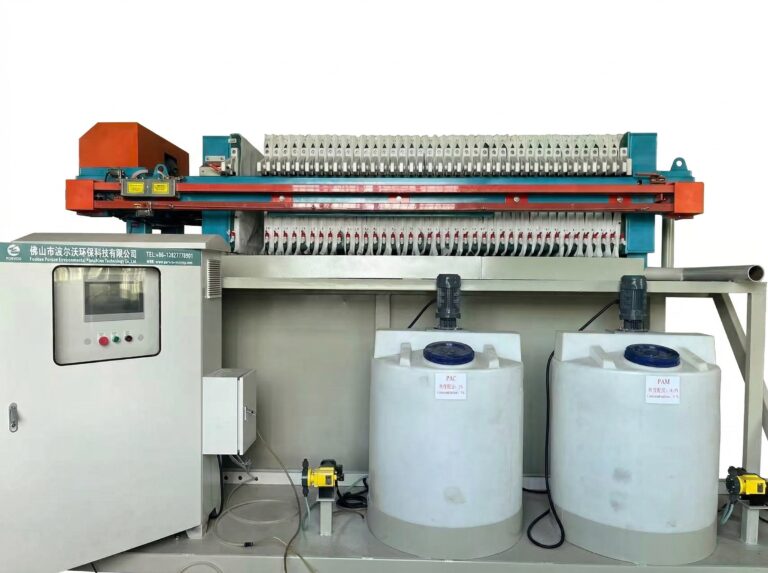
Compiling this evidence is also where the customer’s own project information enters a supplier’s configuration or quotation review: a supplier reviewing a filtro prensa de cámara empotrada configuration can only weigh in on plate, cloth, or cycle-related aspects of that configuration when the operating and inspection record for this specific press and feed accompanies the request. Submitting photographs and operating notes without the position mapping, or requesting a cycle-time recommendation without the dryness-release distinction already made, leaves the supplier working from less information than the case actually contains.
This evidence package also defines the boundary of what the review can deliver. It supports a case review grounded in what was observed on this press and this feed; it does not establish a universal cause, a one-size release setting, or a guaranteed outcome once a change is implemented. Further issues not covered in this record, such as a cloth material question, a different slurry type, or a related dewatering application, would need their own observation and comparison process before a supplier review could meaningfully address them.
Preguntas frecuentes
Q: Should I extend the cycle or raise pressure when a dry-looking cake still sticks?
A: Do not make either change automatically. Record cake dryness and release separately, map where the cake remains, and use that baseline to test one operating change at a time without losing evidence of whether release actually improved.
Q: How do I choose between inspecting the press and reviewing the feed process first?
A: Use the sticking pattern to choose the first inspection branch. A repeatable position gives you a defined cloth, seam, attachment, and plate location to inspect, while the feed condition, conditioning, pump sequence, and cycle end point should be compared against the same recorded location map rather than treated as a universal cause.
Q: What makes an operating comparison useful rather than inconclusive?
A: Start from one recorded test basis and change only one item, such as feed condition, conditioning, pump sequence, cycle end point, or opening procedure. Keep the plate-position map and separate dryness and release observations for every comparison so a shifted problem is not mistaken for a solved one.
Q: When should filter-cloth replacement enter the decision?
A: Replacement should not be the first automatic response to sticking. First document the affected cloth surface, cleanliness, seams, attachment, and the matching plate condition; that evidence allows the replacement decision to be tied to the actual recurring positions instead of to cake appearance alone.
Q: What can a supplier reasonably conclude from the troubleshooting evidence?
A: The supplier can review this specific case when given photographs, a plate-position map, cloth details, slurry observations, and recent operating changes. That package supports a case-specific next check or configuration discussion, but it does not establish a universal cause, release setting, or guaranteed result.