A commissioning sign-off that passes on a quiet shop floor can fail the first week of real production. The gap between an unloaded airflow check and actual capture performance during a dust-generating task is exactly where acceptance disputes and repeat complaints originate, which raises the practical question: what does it take to verify dust capture in a way that holds up once production resumes at normal rate?
Production Cases That Represent the Real Dust-Generating Duty
| Production-case factor | Condition to identify | Valor de la decisión |
|---|---|---|
| Material and dust-generating task | Material being processed and the task being performed | Establishes the source condition the case represents |
| Workpiece and tool | Workpiece position and tool in use | Fixes the dust-generating arrangement relative to capture |
| Production rate | Actual rate during the case, including the peak dust-generating task where applicable | Distinguishes representative production duty from an unloaded check |
| Active pickup points | Open pickup points during the case | Identifies the capture arrangement in service |
| Surrounding air conditions | Door positions, make-up air, and nearby cross-drafts | Defines the air-movement conditions present during observation |
| Controlled change | Material or operating condition changed one at a time | Keeps a failed result traceable instead of hiding it inside combined changes |
A capture system is tested against a condition, not against the equipment alone. If the test condition does not match the dust-generating duty the system will actually face, the result describes the test, not the system. This is why a verification exercise has to start by defining the production case before any reading is taken.
The material and the task performed on it set the baseline dust-generation behavior: the same hood and duct arrangement can look adequate against one material and task and inadequate against another, because the particle size, generation rate, and throw distance differ with the operation being performed. Workpiece position and the tool in use matter for the same reason — a tool held or positioned differently relative to the capture point changes the distance and angle the captured air has to overcome, independent of anything the fan or filter is doing.
Production rate is where many verification attempts quietly lose validity. A system checked while running below normal rate, or without the peak dust-generating task included, is being checked against a lighter duty than the one it must handle in service. Where the task includes a higher-intensity phase, that phase has to be part of the test case, not treated as an edge condition to be skipped.
Open pickup points, door positions, make-up air, and nearby cross-drafts describe the air environment the capture point is competing against. A hood that performs acceptably with adjacent pickup points closed may lose performance once those points open and divide the available airflow, and a cross-draft or make-up air pattern invisible during a still, after-hours test can dominate the airflow pattern during occupied, running conditions. These are not secondary details; they are part of the condition being tested.
Because several of these factors can change at once in a working shop, a sound verification approach changes material or operating conditions one at a time between cases. If material and production rate are both changed together and the result fails, there is no way to attribute the failure to either factor. A single controlled change keeps the result traceable to its cause, which is what makes a failed case useful rather than simply confusing.
Capture Observations at Operator, Workpiece, and Cross-Draft Positions
Once a production case is defined, where the observer stands determines what the observation can actually tell the reader. A capture system can look adequate from one vantage point and show visible escape from another, because airflow patterns near a hood or downdraft opening are not uniform — they are shaped by the geometry of the opening, the position of the dust source relative to it, and whatever cross-draft or door-induced air movement is present at that moment.
Observing at the operator’s position addresses the question of what passes near the person doing the task, since this is where the dust-generating activity and the breathing zone are closest together. Observing at the workpiece addresses a different question: whether the capture point is actually drawing dust from the point of generation, as opposed to merely creating airflow somewhere nearby that the dust does not follow. These can diverge — a hood can draw strongly at its own face while still failing to capture dust that is thrown or drifts away from the workpiece before reaching that face.
Observing at positions exposed to cross-draft addresses a third question: whether air movement from doors, adjacent equipment, or general shop ventilation is overpowering the capture airflow at the margins. A system that performs well in a sheltered test but was never checked against the cross-draft condition present during normal operation has an unverified capture margin, not a verified one.
Across all three positions, the check is the same in kind: whether dust escapes visibly under the exact as-tested condition. What differs is which weak zone each position can reveal. A visible-escape observation made only at the operator position can miss a workpiece-side capture gap that does not yet reach the operator, and an observation made only at the workpiece can miss a cross-draft overwhelming capture at the hood’s edge. Recording which position was observed, alongside the production case in force at that moment, is what turns a visible-escape note into something that can be traced back to a specific zone and condition rather than treated as a single pass/fail judgment for the whole system.
Airflow Readings Tied to Hood, Duct, and Fan Configuration
An airflow reading is only as meaningful as the configuration it was taken under. The same capture point can produce different readings depending on fan state, damper position, duct configuration, and filter condition, because each of these determines how much of the fan’s total capacity actually reaches that specific point. A reading taken without recording these variables cannot be compared to a later reading, even if both were taken at the same physical location.
Fan state matters because a fan running at a different speed or duty point changes total system airflow, which then distributes across however many pickup points are open at the time. Damper positions matter for the same distribution reason: closing or opening a damper elsewhere in the system changes how much airflow is available at the point being measured, even with no change at that point itself. Duct configuration — which runs are connected, how many bends or branches are active — changes the resistance the fan is working against, and filter condition changes resistance on the discharge side of the system; a loading filter increases static pressure and can reduce airflow at every capture point simultaneously, independent of anything happening at the hood.
This is why a defensible airflow record names the capture point being measured and attaches the full as-tested configuration to that single number. A reading of airflow at a named hood, without the fan, damper, duct, and filter state recorded alongside it, cannot later be reproduced or meaningfully disputed, because there is no way to know whether a different reading on a later date reflects a real change in the system or simply a different configuration at the time of measurement. Where a project is working through airflow problems at a downdraft or capture station, this kind of tied recording is the difference between a troubleshooting record that locates the cause and one that only documents that a number changed.
Visible Escape Versus Exposure or Emissions Measurements
| Verification check | What it can support | What it does not establish |
|---|---|---|
| Airflow reading under a recorded configuration | Airflow at a named capture point with the fan state, damper positions, duct configuration, and filter condition identified | Dust capture under representative production conditions by itself |
| Visible escape observation | Location of weak capture zones under the exact as-tested condition | Worker exposure or stack-emission conclusions |
| Worker exposure or stack-emission measurement | The corresponding conclusion when the applicable measurement method is used and competently interpreted | A universal dust-capture acceptance limit; hazard guidance alone is not proof of a specific exposure level or system performance, and source metadata alone is not an acceptance value |
A verification program has to match the evidence it collects to the question it is actually answering, because these checks do not substitute for one another. An airflow reading under a recorded configuration establishes airflow at that point under that configuration — nothing more. It does not, by itself, establish that dust capture is adequate under representative production conditions, because airflow at the hood face does not guarantee that the dust generated at the workpiece actually reaches that hood.
A visible-escape observation answers a narrower and different question: where capture is weak under the exact as-tested condition. It is a locating tool, not a conclusion about exposure or emissions. Treating a clean visible-escape result as proof that worker exposure or stack emissions meet any particular level overstates what the observation can support, because visible dust and measured particulate concentration are not the same quantity, and the absence of visible escape does not rule out a fine fraction that is not visible to the eye.
Reaching a conclusion about worker exposure or stack emissions requires the applicable measurement method, applied and interpreted by someone competent to do so. OSHA’s standard on local exhaust ventilation addresses ventilation for specified dry grinding, polishing, or buffing conditions, but it is a task- and exposure-specific rule; it does not supply a universal velocidad de captura that applies to every workstation regardless of task. Likewise, OSHA’s guidance on crystalline silica establishes hazard context for tasks that cut, grind, or disturb silica-containing material, but hazard context is not proof of a specific exposure level or of any particular system’s performance against it. On the emissions side, ISO 10780 addresses velocity and volume flowrate measurement of gas streams at a stationary source; its relevance here is as an identified method for that measurement, not as a dust-capture acceptance limit in itself.
The practical boundary is that an airflow or visible-escape result can tell a project where to look and what to check next, but a conclusion about exposure compliance or emissions compliance needs its own measurement, taken and read by someone qualified to apply the relevant method.
Repeatable Test Records for Acceptance and Retesting
A verification result that cannot be reproduced cannot be used for acceptance, and it cannot be used to confirm a fix later either. What makes a record reproducible is that it identifies the exact as-tested condition, not just the outcome observed under it.
That means a usable record ties together the production case in force at the time, the position from which any visible-escape observation was made, the airflow reading together with its fan, damper, duct, and filter configuration, and a photo or equivalent documentation of the physical arrangement. Any one of these pieces on its own is incomplete: a photo without the production variables does not show whether the system was tested at normal rate or at a lighter duty; an airflow number without the configuration cannot be compared to a later reading; a visible-escape note without the observation position cannot be matched to a specific capture zone.
This matters most at two points in a project’s life. At acceptance, the record is the evidence that the system performed against a defined, representative condition rather than an unspecified or lighter one. At retest — whether prompted by a complaint, a process change, or a scheduled check — the only way to know whether a result has genuinely changed is to reproduce the same as-tested condition the original record describes. Where the original record is incomplete, a later team has no way to tell whether a different reading reflects a real change in the system’s performance or simply a different production case, fan state, or observation position than before.
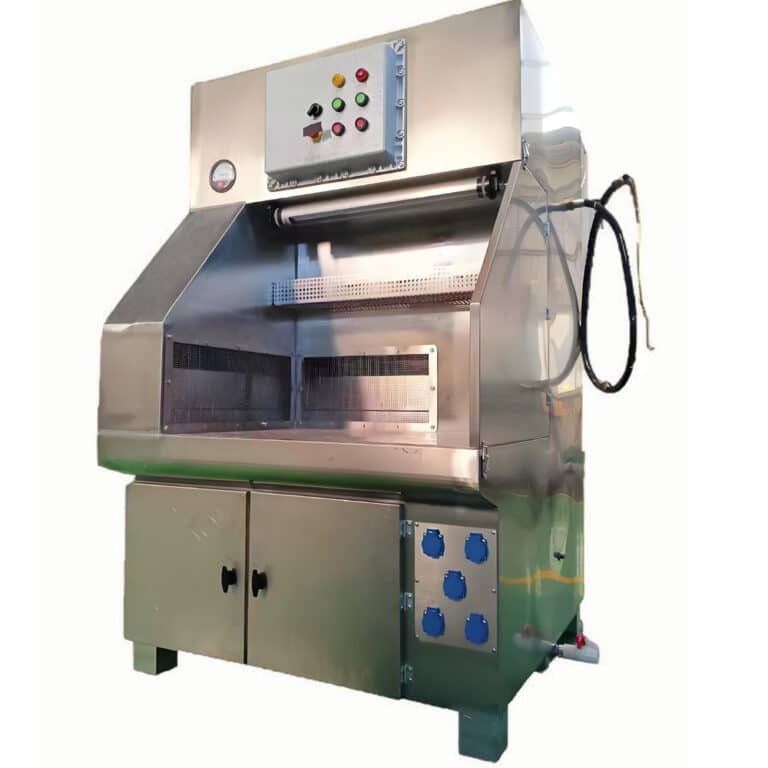
This recordkeeping discipline is also what a supplier needs on the receiving end of a configuration or quotation review: project information submitted with specific as-tested conditions attached — material, task, rate, open pickup points, and the surrounding air conditions — allows that information to be matched against equipment configuration in a way that a single unloaded airflow number cannot. Where the project calls for a mesa de amolar downdraft o un portable collector serving a defined task, the production case and configuration record are what connects the equipment’s intended duty to the condition it will actually face on the floor.
Preguntas frecuentes
Q: Which production conditions should be included in dust capture verification?
A: Test the normal production duty and, where applicable, the peak dust-generating task. Define the material, task, workpiece position, tool, production rate, open pickup points, door positions, make-up air, and nearby cross-drafts for each case.
Q: What should be checked when visible dust escapes during a test?
A: Note where escape occurs relative to the operator, workpiece, and cross-drafts, then vary one material or operating condition at a time. This makes it easier to trace the result to a specific change instead of combining several changes in one test.
Q: Can an airflow reading by itself confirm effective dust capture?
A: No. Record the reading at a named capture point with the fan state, damper positions, duct configuration, and filter condition, then evaluate capture under the defined production case rather than treating unloaded airflow as proof.
Q: When are worker exposure or stack-emission measurements needed?
A: Use the applicable measurement method when the acceptance question concerns worker exposure or stack emissions. Visible escape observations can locate weak capture zones, but they do not establish those exposure or emission conclusions.
Q: What should an acceptance record contain for later retesting?
A: Keep photos, readings, production variables, and observations linked to the exact as-tested condition. The record should make the material, task, capture arrangement, airflow configuration, and surrounding air conditions identifiable when the system is tested again.