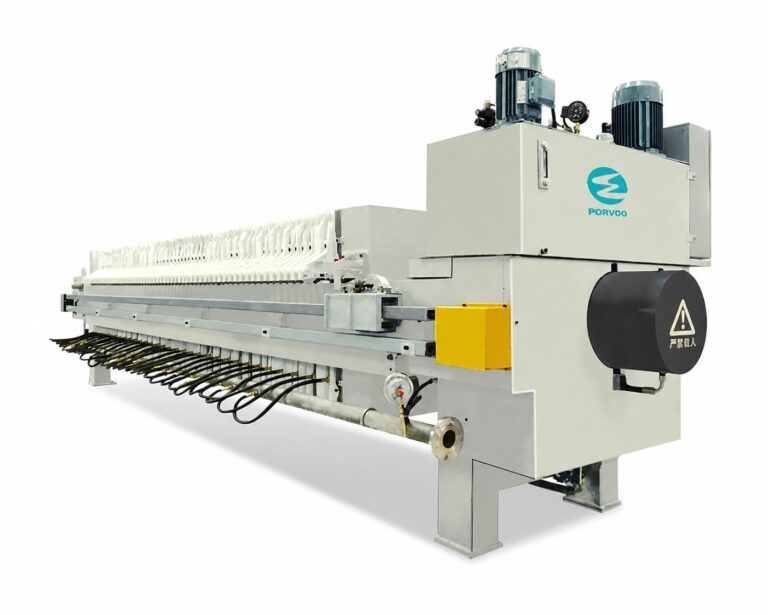
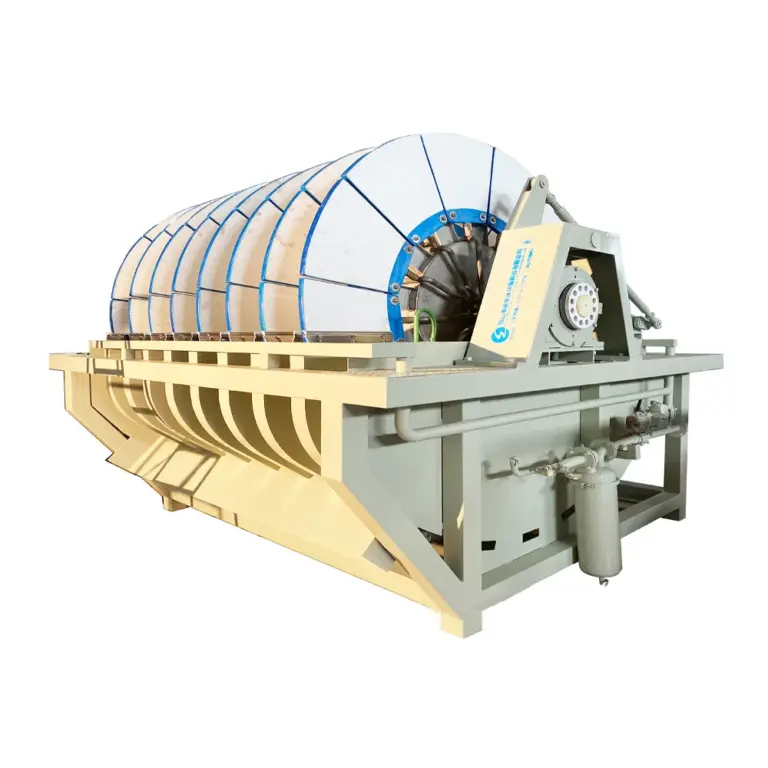
A dewatering duty that already clears on a plate-and-frame cycle does not automatically need a membrane stage added to it. The decision to add squeeze capability changes the press mechanically, adds utilities and control logic, and shifts maintenance workload — so the question is not whether membrane plates produce a drier cake in general, but whether that improvement is worth enough on this specific duty to carry the added scope.
What the secondary squeeze stage changes in the duty
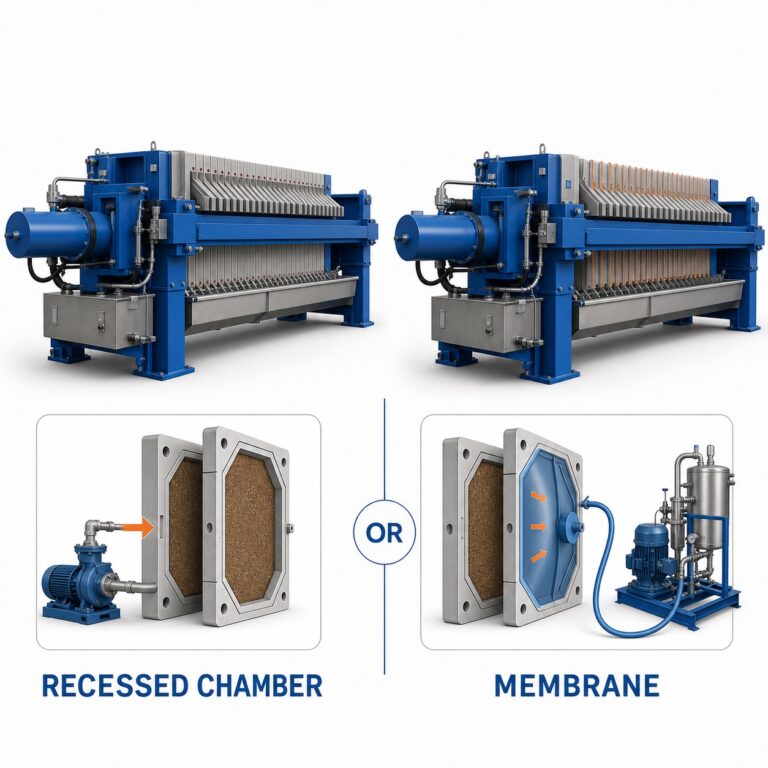
A plate-and-frame cycle builds cake by feeding slurry under pressure until the chambers fill and flow resistance stops further dewatering. The cake’s final moisture content is set by how far that filtration-driven consolidation can go before the cycle is considered complete. A membrane press adds a second mechanism: after the chamber fills, a flexible membrane on the plate face is inflated with air, water, or another medium, and it physically compresses the cake from both sides. This is a different physical action from filtration — it is mechanical squeezing rather than pressure-driven flow through the cake — and it can continue reducing cake volume and moisture after the filtration stage alone would have stopped.
What this changes for the buyer is the point at which the cycle’s governing limit shifts. On a base cycle, the limit is the feed’s filterability — how readily liquid moves through the forming cake under the applied pressure. Once a squeeze stage is added, the limit becomes the compressibility of the cake itself: how much further volume reduction the solids structure allows under mechanical pressure once filtration has slowed. Where a feed material compresses readily under load, the added stage can meaningfully change the cake’s final condition. Where a feed is already near its compressibility limit by the time the squeeze stage engages, the second mechanism has less room to act, and the same hardware produces a smaller marginal change.
This distinction matters because it reframes what the buyer is actually asking the supplier to configure. Adding a membrane stage is not simply “pressing harder” on the same process — it is adding a second, mechanically distinct consolidation step with its own medium, its own sequencing within the cycle, and its own interface to the press frame and plate pack. Any claim about how much drier or faster the cycle becomes with squeeze capability depends on how that feed behaves under mechanical compression, not only on how it behaves under filtration pressure, and that behavior has to be established for the feed in question rather than assumed from the category of equipment.
Project outcomes that may justify membrane scope
Three outcome areas carry the value case for membrane scope, and the same conditional test applies to each: does the measured difference between the base cycle and the squeeze-added cycle represent enough project value to justify the added utilities, controls, and upkeep that come with it. Cake handling is one area — a lower final moisture content can change how the cake behaves downstream, including how it is removed from the press and handled afterward. Downstream disposal is a second area, where cake moisture or volume affects how the material is transported, stored, or processed once it leaves the press. Cycle capacity is a third, where a shorter effective cycle or higher throughput per cycle changes how much duty the press can carry over a given period.
None of these outcomes is guaranteed by the presence of membrane plates; each depends on whether the feed’s compressibility allows the squeeze stage to produce a measurable difference, and whether that difference matters enough in the specific project context. A plant where cake disposal cost or handling difficulty is a significant part of the operating picture has a different value case than one where the base cycle’s cake condition already meets downstream requirements. Similarly, a duty where cycle time limits total throughput has a different case than one where the press has unused capacity regardless of per-cycle duration.
This is where the comparison has to be run on the actual feed rather than argued from general principle. A membrane stage either changes one or more of these three outcomes in a way the project can measure, or it adds scope without a corresponding benefit. The buyer’s task is to identify which of the three outcome areas, if any, carries enough weight in this project to make the added scope worth evaluating further — not to assume that because membrane presses exist as a product category, they represent an upgrade in this instance.
Utilities, controls and maintenance added by the squeeze system
A membrane stage does not attach to a plate-and-frame press without consequence elsewhere in the system. The squeeze medium — whatever is used to inflate the membrane — requires its own supply, and that supply has to be generated, stored, or piped to the press along with the existing feed and wash-water services. This is an added utility commitment distinct from what a base filtration cycle requires, and it has to be sized and coordinated as part of the press installation rather than treated as incidental.
The control sequence also changes. A base cycle runs through fill, filtration, and cake discharge as a single staged process; adding a squeeze stage inserts an additional step with its own timing, its own pressure or flow setpoints for the squeeze medium, and its own transition logic between filtration and squeeze. Where the press includes protective logic — safeguards that respond to abnormal pressure, incomplete sequencing, or other fault conditions — that logic has to account for the squeeze stage specifically, not only for the filtration stage, because the squeeze mechanism introduces its own failure modes distinct from filtration-stage faults.
Maintenance scope expands correspondingly. The membrane itself is a wear component subject to its own service life, separate from the plates, cloths, and seals already present on a base press. Confirming how the membrane is inspected, how it is replaced, and how its condition is verified between cycles becomes part of the maintenance plan in a way that has no equivalent on a base plate-and-frame configuration.
None of this means the added workload is unwarranted — it means the workload is additional, and has to be weighed against the outcome difference identified for the specific project. A project where cake handling or disposal value is substantial may still justify the added utilities and maintenance; a project where the outcome difference is marginal carries the same added workload without a corresponding return. The buyer’s task is to get the added scope stated clearly enough to weigh it, which is the basis for how a supplier’s quotation should define squeeze-system scope: the medium required, the sequence it follows, the protective logic covering it, and which elements of that scope are included as standard versus offered as options.
Side-by-side test data for a defensible comparison
| Elemento de comparación | Base filtration cycle | Filtration plus squeeze stage | Uso de la decisión |
|---|---|---|---|
| Base de la ración | Run the agreed representative feed | Use the same representative feed | Keep the feed basis consistent across both tests |
| Base de medición | Apply the agreed measurement definitions | Apply the same measurement definitions | Make the reported outcomes comparable |
| Cake handling outcome | Record the agreed test result for the base cycle | Record the agreed test result with the squeeze stage | Determine whether the difference has enough project value to support membrane scope |
| Downstream disposal outcome | Record the agreed base-cycle result | Record the agreed squeeze-stage result | Determine whether the disposal difference adds enough project value |
| Cycle-capacity outcome | Record the agreed base-cycle result | Record the agreed squeeze-stage result | Determine whether the difference supports the project cycle goal |
| Utilities, controls and upkeep | Use the base-cycle scope as the reference | Identify the additions required by the squeeze system | Weigh the added lifecycle workload against the demonstrated outcome value |
Comparing a base cycle against a squeeze-added cycle only produces a usable answer if both runs share the same feed and the same measurement definitions. Testing the base cycle on one feed sample and the squeeze-added cycle on a different sample — or measuring cake moisture by one method in one run and a different method in the other — produces a difference that cannot be attributed to the squeeze stage itself, because feed variability or measurement inconsistency can produce the same apparent change. The Ficha informativa de la EPA sobre la prensa de filtro de placas empotradas addresses batch pressure-filtration mechanics and representative testing as a basis for design decisions, in the context of municipal biosolids guidance; the general principle that comparison requires a consistent feed and consistent measurement basis applies regardless of application, though any specific numeric results from that guidance do not transfer to a membrane-press evaluation on a different feed.
Running both configurations on the same representative feed, under the same measurement definitions, produces a result set the buyer can actually use: a recorded outcome for cake handling, for downstream disposal condition, and for cycle capacity under each configuration, plus a record of what utilities, controls, and upkeep the squeeze stage required to produce its result. That pairing — outcome difference against added workload — is what supports a configuration decision, rather than a general assumption that membrane plates improve any given duty.
Where the test results show a meaningful difference in one or more of the three outcome areas, and that difference matters enough in the project context to offset the added utilities, controls, and maintenance, the squeeze stage has a supported basis for inclusion. Where the difference is small, or where the base cycle’s outcome already satisfies the project’s requirements, the added scope lacks a demonstrated justification regardless of what the equipment is theoretically capable of producing on a more compressible feed. The buyer’s position is strongest when this comparison exists in writing, tied to the specific feed, before the configuration is finalized — project information of this kind is what a supplier such as Porvoo would use when reviewing a configuration or preparing a quotation for a given press duty.
A contract boundary for selecting the press configuration
| Contract item | Supplier statement to include | Boundary established |
|---|---|---|
| Exprimir a presión media | Name the squeeze medium for the offered system | Makes the squeeze-medium basis explicit |
| Operating sequence | State the operating sequence, including the squeeze stage | Defines how the added stage fits the offered cycle |
| Protective logic | State the protective logic included with the squeeze system | Makes the included protection scope explicit without implying a performance guarantee |
| Standard and optional items | Identify which squeeze-system items are standard and which are optional | Separates included scope from optional scope |
| Configuration selection basis | Tie the selected configuration to the agreed test results and lifecycle workload | Prevents a generic claim that the squeeze stage is always the better choice |
Once the test comparison exists, the remaining task is to fix the boundary of what the supplier is offering so that the selected configuration is traceable to agreed evidence rather than to a general claim about squeeze performance. This means the supplier’s offer should name the squeeze medium specific to that system, state the operating sequence including where the squeeze stage falls within the cycle, and state what protective logic is included for the squeeze mechanism specifically. It should also separate what is supplied as standard scope from what is offered as an option, since membrane systems commonly include components — medium supply, control elements, membrane itself — that a supplier may structure differently across standard and optional scope.
Where a project’s test results show that the squeeze stage changes cake handling, disposal condition, or cycle capacity enough to justify the added utilities and maintenance identified earlier, selecting the membrane configuration follows directly from that evidence. Where the test results do not show a meaningful difference, or where the duty’s feed does not compress enough under the squeeze mechanism to produce one, the base plate-and-frame configuration remains the supported choice, and the added utilities and maintenance of a membrane system would be carried without a demonstrated return.
This is the boundary that keeps the selection decision tied to the project rather than to the equipment category: a membrane press is not inherently the better configuration, and a plate-and-frame press is not inherently sufficient — each is matched to the duty by the test outcomes and the lifecycle workload the squeeze system adds, not by a general preference for additional dewatering capability. Equipment interfaces such as the press’s connection to upstream feed conditioning or downstream cake handling also depend on which configuration is selected, so confirming this boundary before specifying the press affects how the surrounding equipment and process interfaces are defined as well. A configuration decision reached this way gives the buyer a documented basis for the choice, rather than a default assumption that the squeeze stage is always the better outcome.
Preguntas frecuentes
Q: When is the base plate-and-frame configuration the stronger choice?
A: Keep the base configuration in consideration when a controlled comparison does not show enough project value in cake handling, downstream disposal, or cycle capacity to justify the squeeze system’s added utilities, controls, and upkeep. Make that judgment with the same representative feed and measurement definitions for both options.
Q: How should a buyer define whether the squeeze stage is “worth it” before testing?
A: Rank the project outcomes that matter most and agree how each will be measured before the comparison starts. This gives the buyer a stated basis for deciding whether a demonstrated difference in cake handling, disposal, or cycle capacity outweighs the added lifecycle workload.
Q: Can results from one feed be used to select a press for a different feed?
A: Do not carry the conclusion over automatically. Confirm that the tested feed represents the intended duty; if the project feed is materially different or variable, identify the conditions that the comparison must cover before using the results for configuration selection.
Q: What should an RFQ include so base and membrane offers can be compared fairly?
A: Give each supplier the same representative feed basis, outcome priorities, and measurement definitions, then request the squeeze medium, operating sequence, protective logic, and standard-versus-optional scope for the membrane option. Require the recommended configuration to be tied to the agreed test results and its utility, control, and upkeep requirements.