Before a bench test is scheduled or a pilot skid is booked, the question a project team actually needs answered is simpler: does the material in front of us behave the way the material described in the proposal was assumed to behave? Tailings dewatering testwork exists to answer that question with evidence rather than assumption, but the value of that evidence depends entirely on how the sample was taken, what the bench and pilot stages were asked to show, and how cleanly those findings are carried into an equipment selection and an acceptance plan.
Sample Provenance and Feed Variability to Capture
A tailings sample is not a neutral object. It represents one point in a feed stream that may vary by ore zone, throughput rate, reagent dosing upstream, or the plant’s operating state at the moment the sample was drawn. If the sample was taken during a steady-state run, it represents a different feed envelope than one taken during startup, a blend change, or an upset. Treating either as representative of “the tailings” without recording the plant state at sampling detaches the result from the condition that produced it.
This matters because every downstream judgment in a testwork program — conditioning response, media selection, cycle time, cake release — is only valid for the feed envelope the sample actually represents. Where a single grab sample is used to qualify an entire dewatering route, the project risks sizing equipment against a feed condition that does not recur, or does not recur at the frequency the design assumes. Where a composite or multi-point sampling approach is used instead, the resulting test data reflects a wider band of plant conditions, which supports a more defensible equipment selection but also requires that each contributing sample be traceable to its own plant state.
Practitioners address this by recording, alongside each sample, where in the circuit it was drawn, what the plant was doing at that time, and whether that condition is expected to represent routine operation, a transition, or an outlier. Without this record, a bench or pilot result cannot be distinguished from a result that happened to be favorable or unfavorable because of a transient condition rather than the ore’s intrinsic dewatering behavior. ISO 5667-13, which addresses sampling of sludges, gives a source identity and broad scope for sludge sampling, cake evaluation, and dewatering-monitoring practice; a project team planning a sampling campaign would read the standard directly before adopting specific sampling locations or frequencies, since the standard’s detailed requirements are not reproduced here.
The practical consequence for later stages is direct: any bench or pilot result inherits the provenance of its sample. A supplier reviewing testwork data needs to know not just what the cake moisture or cycle time was, but what feed condition produced it, so that the equipment configuration is matched to the range of conditions the plant will actually present.
Bench Test Questions for Conditioning, Media, Filtrate, and Cake
| Bench test question | Evidence to record | Decision it supports |
|---|---|---|
| Conditioning response | Response under the tested conditioning | Whether the tested conditioning should advance to a larger trial |
| Media response | Response of the tested media | Which tested media response should inform the larger trial |
| Filtrate behavior | Filtrate behavior under the recorded test conditions | Whether the observed filtrate behavior is suitable for pilot evaluation |
| Cake release | Cake release under the recorded test conditions | Whether the observed release behavior is suitable for pilot evaluation |
Bench-scale testing exists to screen variables cheaply before a larger trial commits more sample, more time, and more cost to fewer configurations. The bench stage is not meant to produce a final sizing number; it is meant to narrow the range of conditioning approaches, media types, and operating parameters worth carrying into pilot work.
Conditioning response is the first variable bench work isolates. Tailings slurries vary in how they respond to flocculant or coagulant dosing, mixing energy, and residence time before dewatering. Where a slurry flocculates readily and produces a stable, fast-settling floc, the downstream dewatering step has more tolerance for variation in feed rate or pressure. Where flocculation is marginal or inconsistent, the bench stage needs to identify which conditioning approach produces a response worth testing further, rather than assuming any single dose or chemistry will transfer from a different ore or a different site.
Media response is tested separately because cloth or membrane selection interacts with particle size distribution, mineralogy, and conditioning in ways that are not always predictable from material specifications alone. A media that blinds quickly under one conditioning regime may perform differently under another. Bench testing isolates this interaction before the project commits to a specific media for a larger trial.
Filtrate behavior — clarity, solids carryover, and how filtrate quality changes over the course of a cycle — tells the project whether the water side of the process is likely to need additional polishing or can be returned directly, and whether the observed behavior is stable enough to warrant moving to pilot evaluation. Cake release, meanwhile, determines whether the solid side of the process will discharge cleanly from the chosen media and equipment geometry, or whether sticking, cracking, or incomplete release will constrain cycle time and automation at larger scale.
Each of these four questions produces different evidence and supports a different decision. A favorable conditioning result does not substitute for a favorable media result, and a clean filtrate does not guarantee acceptable cake release. The bench stage is complete only when each question has been tested on its own terms, under recorded conditions, so that the pilot stage inherits a narrowed and justified set of variables rather than an untested assumption.
Pilot Configuration That Matches the Intended Equipment Route
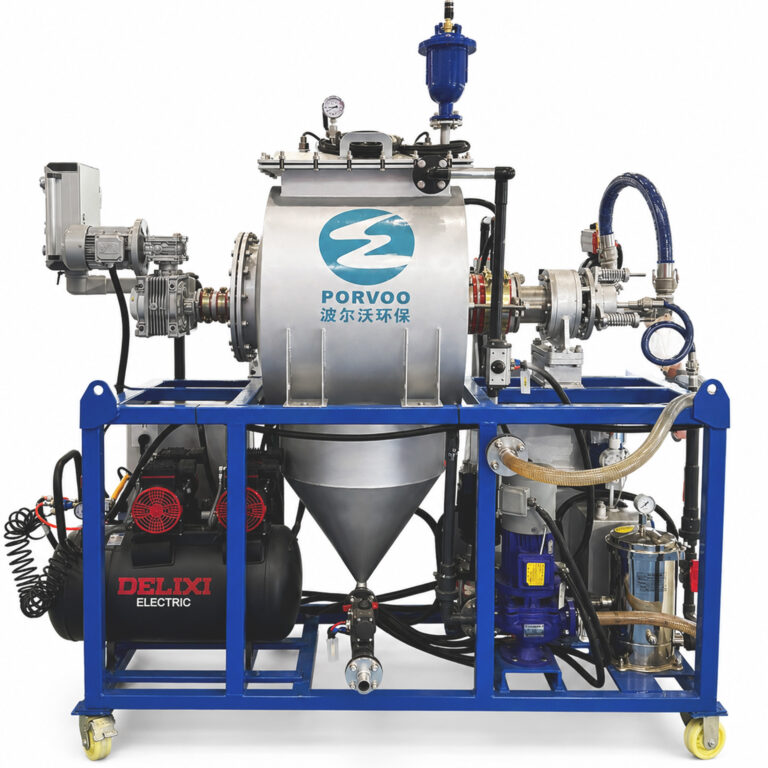
Pilot testing earns its value only to the degree that it reproduces the equipment route the project actually intends to use. A pilot run conducted on equipment that differs in filtration mechanism, cycle structure, or media format from the intended plant equipment produces data that describes a different process, even if the feed material is identical. Micronics’ onsite pilot and slurry testing services, for example, carry a source identity and broad scope covering slurry testing, cloth optimization, sizing, and scale-up — illustrating that pilot programs in this industry are typically built around a specific equipment configuration rather than a generic dewatering test.
Where the pilot equipment matches the intended route — same filtration mechanism, comparable media format, comparable cycle logic — the pilot result speaks directly to how the full-scale equipment will behave, subject to the scale differences between pilot and plant hardware. Where the pilot uses a different mechanism or a simplified rig for convenience or cost, the result describes that rig’s behavior, and the project must treat any transfer to the intended equipment as an assumption requiring confirmation rather than a demonstrated outcome.
This is also where differences between pilot conditions and expected plant operation need to be documented explicitly, not left implicit. Pilot runs are commonly shorter in duration, operate on a smaller sample volume, and may not reproduce the exact feed variability the plant will see over time. A pilot conducted on a single blended sample cannot speak to how the equipment will respond to the feed variability the sampling-provenance stage identified, unless the pilot program was deliberately designed to run multiple feed conditions through the same configuration.
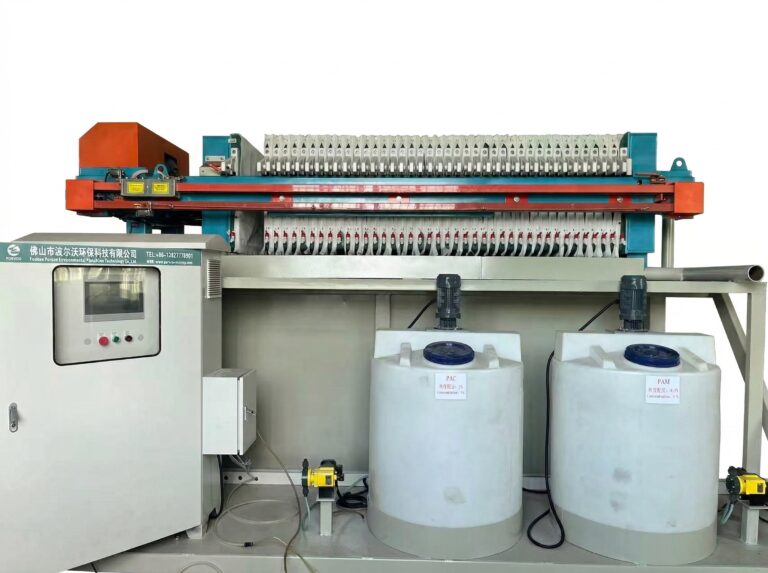
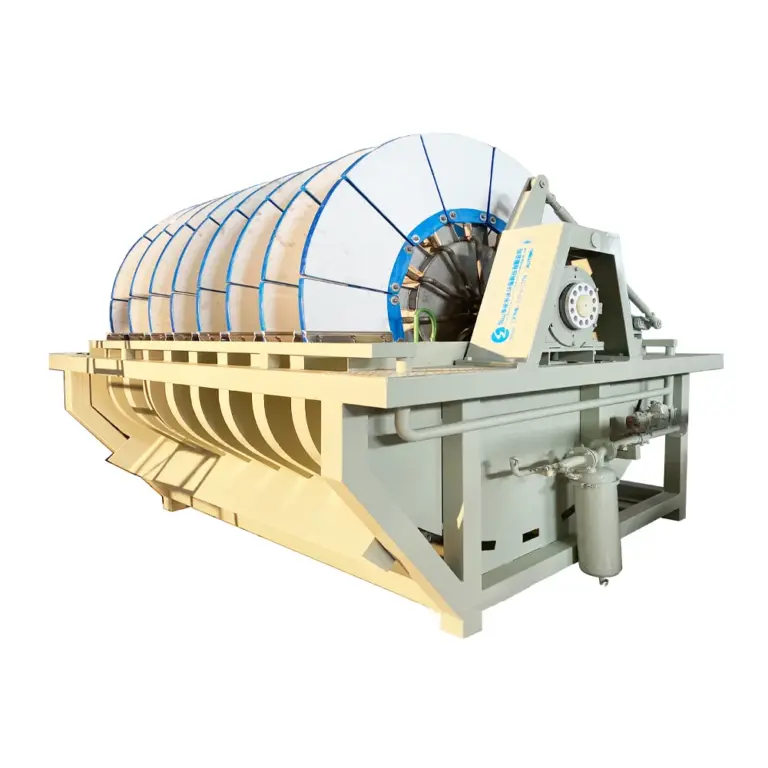
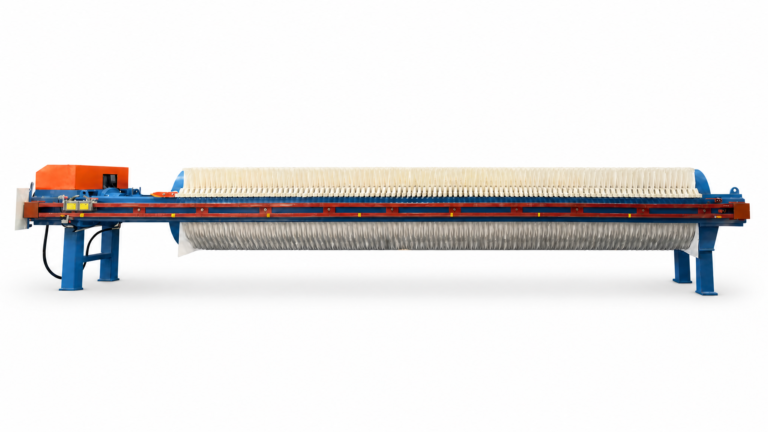
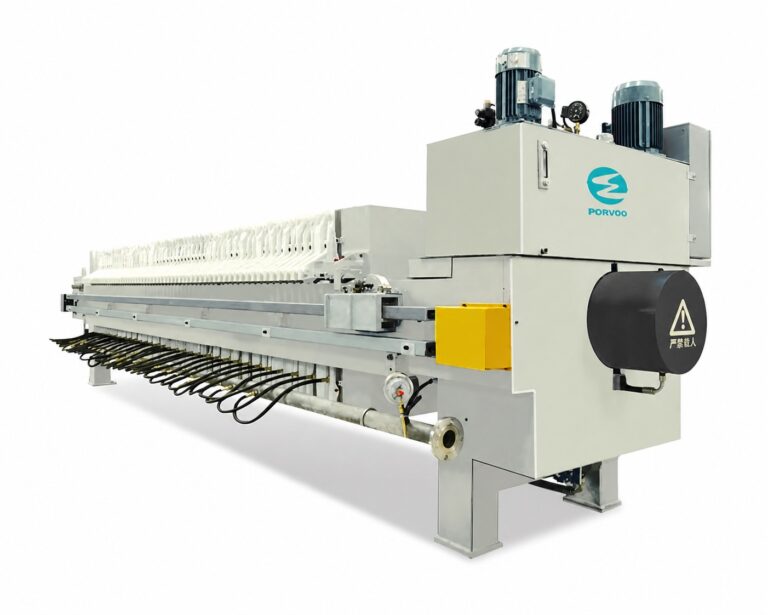
The practical discipline here is to record, alongside every pilot result, what about the pilot setup matched the intended plant route and what did not — media format, cycle time, pressure or vacuum levels, feed consistency, automation sequencing. Where a pilot used the intended configuration end-to-end, the project has direct evidence for scale-up. Where it approximated the configuration, the project has indicative evidence that still needs confirmation against the specific differences recorded. Neither case should be presented to a supplier as more conclusive than the documented match actually supports. When information supplied by the project enters a supplier’s configuration or quotation review, it is this documented match — not just the headline pilot numbers — that determines how directly the pilot data can inform a proposed route such as a round plate filter press or a vacuum ceramic disk filter for the application in question.
Scale-Up Assumptions and Their Operating Limits
Every scale-up calculation carries assumptions about how a bench or pilot result changes with equipment size, cycle duration, feed rate, and continuous operation over time. These assumptions are necessary — no project can test at full industrial scale before committing to equipment — but they are assumptions, not demonstrated outcomes, and treating them as guaranteed plant performance changes the risk profile of the procurement decision.
A scale-up assumption typically addresses how a rate or ratio observed at small scale is expected to hold as filtration area, chamber volume, or cycle count increases. Where the underlying mechanism scales linearly with area or volume — for instance, where cake formation behavior is governed primarily by local pressure and media characteristics rather than by equipment-specific geometry — the assumption carries less uncertainty. Where the mechanism depends on factors that do not scale simply, such as flow distribution across a larger equipment footprint or cumulative effects over longer continuous runs, the same assumption carries more uncertainty, and the gap between pilot evidence and plant performance widens.
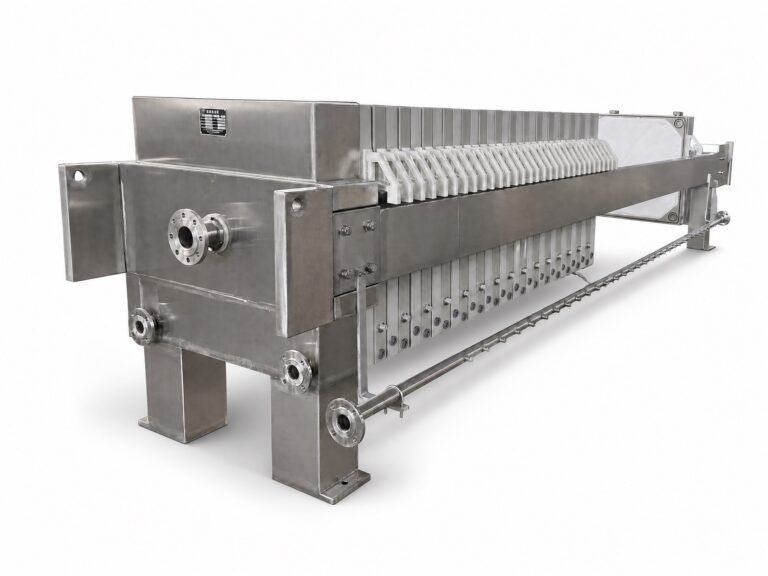
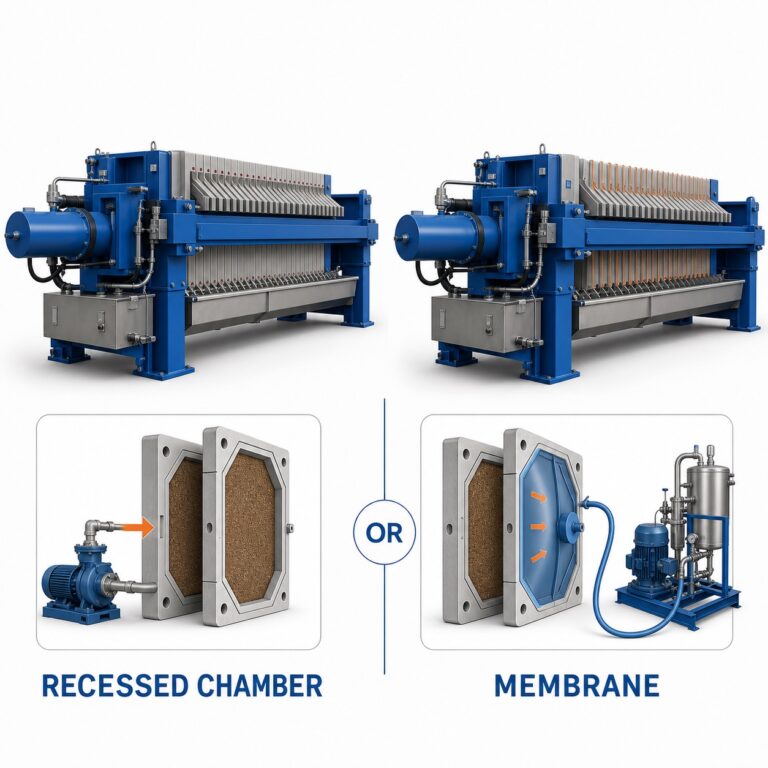
The EPA’s Biosolids Technology Fact Sheet on recessed-plate filter presses speaks to representative bench or vendor pilot testing and pressure-filter interfaces, but it does so within municipal biosolids guidance; its figures and scale-up relationships are not transferable to tailings dewatering without independent confirmation, since the feed material, chemistry, and operating context differ.
This is why scale-up assumptions belong in a bid package as limits to confirm rather than as guaranteed outputs. A stated cycle time, cake moisture, or throughput figure derived from pilot data represents what the pilot configuration achieved under its recorded conditions, extrapolated by a stated method to the proposed equipment size. The project team’s task is to identify which assumptions in that extrapolation are well supported by the pilot’s match to the intended route, and which remain open — and to carry the open ones forward as items requiring confirmation during commissioning or early operation, not as contractual performance guarantees assumed at the proposal stage.
Data Package Suppliers Need for Equipment Selection
| Data package section | Evidence to include | Selection boundary |
|---|---|---|
| Sample provenance | Where the sample was taken and the plant state at sampling | Shows the feed envelope represented by the test sample |
| Bench screening | Recorded conditioning, media, filtrate, and cake-release responses | Supports screening before commitment to a larger trial |
| Pilot configuration | Intended equipment route, pilot conditions, and documented differences from expected operation | Shows how closely the pilot represents the proposed operating route |
| Scale-up assumptions | Each assumption and its operating limit to confirm | Provides selection limits rather than guaranteed plant performance |
A supplier evaluating a tailings dewatering request for quotation can only size and configure equipment as precisely as the submitted evidence allows. Where the data package includes sample provenance, bench screening results, pilot configuration details, and scale-up assumptions as distinct, traceable blocks, the supplier can assess which parts of the proposed sizing rest on direct pilot evidence and which rest on extrapolation.
A data package that supplies bench results without pilot confirmation, for instance, tells a supplier that conditioning and media selection have been screened but that cycle time and cake-release behavior at the intended operating scale remain unverified. A data package that supplies pilot results without clear documentation of how the pilot configuration differed from the proposed equipment route forces the supplier to either assume a closer match than was demonstrated or flag the gap and request clarification before finalizing a quotation.
Each block in the package also has a boundary on what it can establish. Sample provenance establishes the feed envelope represented by the test program — it does not establish dewatering performance. Bench screening establishes which conditioning, media, and release behaviors merit further testing — it does not establish full-scale cycle time. Pilot configuration establishes how closely the test reproduced the intended equipment route — it does not, by itself, resolve scale-up uncertainty. Scale-up assumptions establish the limits the project still needs to confirm — they do not replace commissioning verification.
Submitting this package in a structured, traceable form is also how the information a customer supplies actually enters a supplier’s configuration and quotation review: the more clearly each block’s boundary is stated, the more precisely a proposed configuration — whether built around a round plate filter press for difficult-to-dewater slurries, a vacuum ceramic disk filter, or another filter press configuration — can be matched to the feed and process evidence rather than to assumed performance. Where the package leaves a block incomplete, the resulting quotation will carry wider margins or more qualifications, because the supplier is sizing against an assumption rather than a demonstrated condition. Project teams preparing this package benefit from treating it as a completeness check: for each block, has the limit of what the evidence shows been stated explicitly, alongside the evidence itself.
Acceptance Checks That Carry Testwork Into Procurement
| Acceptance check | Testwork evidence to carry forward | Procurement boundary |
|---|---|---|
| Cake moisture | Recorded cake-moisture result and the test conditions behind it | Set the project-specific acceptance value without treating the test result as guaranteed plant performance |
| Filtrate quality | Recorded filtrate-quality result and the test conditions behind it | Set the project-specific acceptance value within the represented feed and test conditions |
| Cycle time | Recorded cycle-time result, equipment route, and test conditions | Set the project-specific acceptance value while accounting for documented differences and scale-up assumptions |
Testwork results only become useful at the procurement stage once they are translated into acceptance checks the project can apply to the delivered equipment — and that translation has to preserve the conditions under which each result was produced. A cake moisture figure from bench or pilot testing was measured under a specific feed, conditioning, and cycle-time combination; written into an acceptance specification without that context, it becomes a number the supplier cannot reasonably be held to, because the plant’s actual operating conditions may differ from the test conditions in ways the bid package did not anticipate.
The same applies to filtrate quality and cycle time. A filtrate-quality result demonstrated acceptable clarity or solids carryover under the feed and conditioning the test program used; it does not by itself establish that the same filtrate quality will hold if the plant later processes a different blend or a feed condition outside the tested envelope. A cycle-time result reflects the equipment route and operating conditions of the specific pilot configuration used; where that configuration differed from the proposed plant equipment, the acceptance value needs to account for the documented differences and the scale-up assumptions carried forward from testwork, rather than treating the pilot’s cycle time as a direct commitment.
Building acceptance checks this way means each check is traceable back to a specific test result and the conditions behind it, which is also what allows the check to remain meaningful if site conditions shift during commissioning. A project team drafting acceptance criteria benefits from asking, for each proposed value: which test produced this number, under what feed and operating conditions, and what scale-up assumption connects that number to the full-scale equipment being accepted. Where that chain is intact, the acceptance check is defensible and specific to the project. Where a link in the chain is missing — an untested feed condition, an unconfirmed scale-up assumption, an undocumented difference between pilot and plant configuration — the acceptance value should be set as a target to verify during early operation rather than a fixed pass/fail threshold imposed without that evidence behind it.
Frequently Asked Questions
Q: How do I decide whether one tailings sample is representative enough for testwork?
A: Treat a sample as representative only of the feed envelope supported by its recorded location and plant state. Compare that context with the operating variability the project expects; if a relevant state is absent, add sampling for that state or state the resulting limit on the testwork.
Q: What should trigger the move from bench testing to a pilot trial?
A: Move forward when the tested conditioning and media options have been screened and their filtrate behavior and cake release have been recorded under known conditions. Use the remaining uncertainties to define the pilot conditions instead of asking the larger trial to repeat an unfocused bench program.
Q: How should pilot results be compared when the test conditions are different?
A: Compare them only after separating differences in feed context, equipment route, and recorded test conditions. Document each difference from expected operation and carry any unresolved effect forward as a scale-up assumption to confirm.
Q: What should the dewatering RFQ ask suppliers to confirm from the testwork?
A: Ask for confirmation of the proposed equipment route, each scale-up assumption, and the operating limit attached to it. Include sample provenance, bench observations, pilot conditions, and known differences from expected operation so the response can address the represented feed rather than an undefined slurry.
Q: Can the best bench or pilot result be used as expected plant performance?
A: No. Keep cake moisture, filtrate quality, and cycle time tied to the feed, equipment route, and conditions under which they were recorded, then set project-specific acceptance values that account for documented differences and scale-up assumptions.