Before a round-plate press can be sized or quoted, the buyer has to decide what “the slurry” actually means on this project. Ceramic slip, raw clay, and kaolin feed do not behave the same way across sites, and a specification built around the material name alone leaves the press configuration, cloth selection, and cycle expectations unanchored. The question that matters is not which filter press model fits the application in general, but which feed condition, interface, and acceptance basis the project will actually test and hold the supplier to.
Feed states to capture for ceramic, clay, and kaolin slurries
A material name describes a family of slurries, not a feed condition. Ceramic slip, clay, and kaolin can each arrive at a plant with different solids distributions depending on where in the production sequence the stream is drawn, how it was blended, and whether it has passed through upstream processing that changes particle size or moisture. Two streams carrying the same material name can therefore present different dewatering behavior to a press, and a specification that records only “ceramic slip” or “kaolin” gives the supplier no way to confirm that the proposed plate arrangement, cloth, or cycle basis matches what will actually be fed.
The practical consequence is that the specification should describe the feed state the press will see, not just the material category. Where the slurry is drawn directly from a single, consistent process step, the feed state may be straightforward to characterize. Where the slurry is blended from multiple sources, or where its solids content shifts with upstream batching or seasonal raw-material changes, the specification needs to capture that range rather than a single snapshot. If the project cannot yet state which feed condition will dominate operation, that gap itself is information the supplier needs, because it changes whether the proposal can commit to a single configuration or must allow for a range of operating points.
This matters because press sizing, cloth selection, and cycle estimation are all built from the feed state that was tested. A proposal based on an unrepresentative sample will carry that mismatch forward into every downstream figure, even if the arithmetic is otherwise sound. Capturing the feed state accurately is the first decision the buyer controls, and it determines whether every later comparison — cloth trials, press configuration, acceptance testing — is comparing like with like.
Conditioning history and variability that affect a comparable test basis
| Comparison control | Basis to document for every trial | Decision protected |
|---|---|---|
| Solids distribution | Identify the solids distribution represented by each trial sample. | Keeps the comparison tied to the feed condition actually tested. |
| Conditioning history | Record the conditioning history for each trial sample. | Prevents a conditioning difference from being mistaken for a press or cloth difference. |
| Slurry basis | Compare cloth candidates on the same representative slurry. | Makes differences in clarity, release, blinding, and cleaning response interpretable. |
Feed state alone does not fully describe a slurry’s dewatering behavior. Conditioning history — whatever treatment, dosing, aging, or mechanical handling the slurry underwent before it reaches the press — can shift how the same nominal material responds to filtration, independent of its solids distribution. Two samples with similar solids content can behave differently in a press trial if one was conditioned differently than the other, and if that difference is not recorded, the resulting trial data can be misread as a press or cloth effect when it is actually a feed-preparation effect.
This is why a comparable test basis requires documenting conditioning history alongside solids distribution for every trial sample used in supplier evaluation. Where a project runs multiple trials to compare cloth candidates or press arrangements, consistency in conditioning across those trials is what makes the comparison meaningful. If conditioning varies between trials without being recorded, differences in filtrate clarity, cake behavior, or cycle time cannot be reliably attributed to the variable the project actually wants to test.
Variability across the production cycle compounds this. If the slurry’s conditioning or composition changes over a shift, a batch, or a season, a single trial — however carefully documented — represents only one point in that range. The buyer needs to decide whether the project requires evidence across the expected variability or whether a single representative condition is sufficient for the decision at hand. This decision affects how many trials are needed and what claims can reasonably be drawn from them. The EPA’s Recessed-Plate Filter Press fact sheet, while developed for municipal biosolids rather than ceramic or clay slurries, outlines this same logic for press-cycle and feed specification: testing and planning dimensions are only meaningful when tied to a documented, representative feed basis. That framing applies here for the specification-and-testing approach, not for any performance figure, since the fact sheet’s values are specific to biosolids dewatering and do not transfer to ceramic, clay, or kaolin slurries.
Cloth trials for filtrate clarity, release, blinding, and cleaning
| Trial outcome | What to compare on the same slurry | Selection question |
|---|---|---|
| Filtrate clarity | Clarity produced by each cloth candidate | Does the result suit the defined filtrate return or discharge destination? |
| Cake release | Release behavior for each cloth candidate | Does the observed release align with the planned cake-handling route? |
| Blinding tendency | Observed blinding for each cloth candidate during the trial basis | How does the candidate respond across the representative feed states tested? |
| Cleaning response | Observed response to cleaning for each cloth candidate | Does the response fit the intended operating arrangement? |
Cloth selection is often treated as a secondary detail once the press frame and plate arrangement are chosen, but the cloth is the component that most directly determines several operating outcomes at once. A single cloth candidate’s weave, pore structure, and surface finish affect filtrate clarity, how cleanly the cake releases from the cloth surface, how quickly the cloth blinds as cake builds across cycles, and how the cloth responds when cleaned between cycles. Because these four outcomes are linked through the same physical surface, evaluating cloth candidates one outcome at a time — for example choosing based on clarity alone — risks selecting a cloth that performs well on that one measure while creating a problem in cake release or cleaning response.
The practical implication is that cloth candidates need to be judged together, on the same representative slurry, across all four outcomes in the same trial. If one candidate produces clearer filtrate but releases cake poorly, the choice depends on which outcome matters more for this project’s cake-handling plan and filtrate destination — a trade-off the buyer can only weigh if both outcomes were measured side by side rather than in separate, uncoordinated tests.
Blinding tendency deserves particular attention because it interacts with conditioning history and feed variability. A cloth that resists blinding on one feed state may blind more readily on a different conditioning history or solids distribution, so blinding behavior observed under one representative condition does not necessarily hold across the full range the project expects to feed. Where the project’s feed is expected to vary, cloth trials should span that variability rather than rely on a single favorable test run.
Cleaning response — how the cloth recovers after cleaning, and how repeatable that recovery is — connects directly to operating planning, since a cloth that recovers poorly after cleaning will show declining performance across a sequence of cycles even if its first-cycle results looked acceptable. Evaluating cleaning response as part of the same trial, rather than inferring it from clarity or release data alone, is what makes the cloth decision defensible.
Press configuration and feed interfaces to state in the specification
| Specification item | What the project should state | Decision enabled |
|---|---|---|
| Feed-pump interface | How slurry is delivered to the press and where the feed-pump interface sits within the project boundary | Allows the feed system and press arrangement to be checked as one interface. |
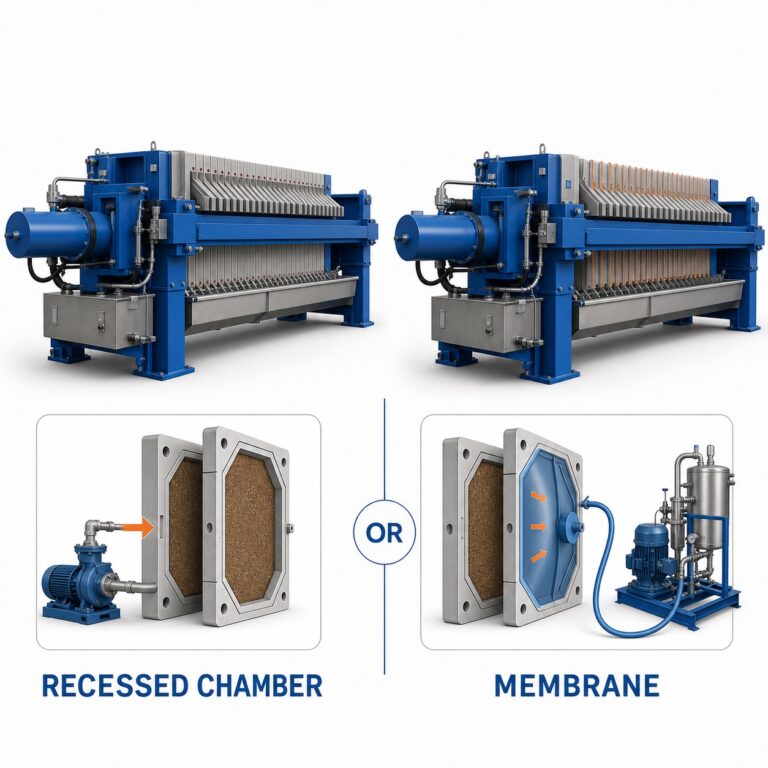
| Plate and chamber arrangement | The configured plate and chamber arrangement proposed for the representative feed states | Shows which physical arrangement the proposal is based on. |
| Press-cycle basis | The estimated cycle basis and the feed state or test basis behind it | Keeps a cycle estimate tied to its stated basis. |
| Cloth arrangement | The cloth candidate or trial basis carried into the proposal | Connects the proposed configuration to observed clarity, release, blinding, and cleaning response. |
Once feed state and cloth behavior are established, the specification needs to state how the press connects to the rest of the system, not only what the press itself is. The feed-pump interface — how slurry is delivered to the press and where that interface sits relative to the press boundary — determines whether the feed system and the press are being evaluated and quoted as one coordinated arrangement or as separately scoped items that happen to connect. Where the feed-pump interface is left unstated, a supplier’s proposal may assume a feed condition (pressure, flow consistency, pre-treatment) that the project’s actual pump and piping cannot deliver, and that mismatch will not surface until commissioning.
The plate and chamber arrangement proposed for a project should be traceable to the representative feed states the project actually tested and documented. A configuration chosen for one feed condition may not be the right configuration if the dominant feed state later proves to be different — which is why the earlier decisions about feed state and conditioning history feed directly into this one. The specification should make clear which feed state the proposed arrangement is based on, so that if the operating feed later shifts, the project can see why the original configuration might no longer match.
A press-cycle basis — the estimated cycle time or throughput figure in a proposal — is only as reliable as the feed state or test basis it was estimated from. An estimate is not evidence of project-specific performance; it is a planning figure tied to a stated basis, and that basis needs to be visible in the specification so it can be checked later against representative testing rather than accepted as a fixed commitment.
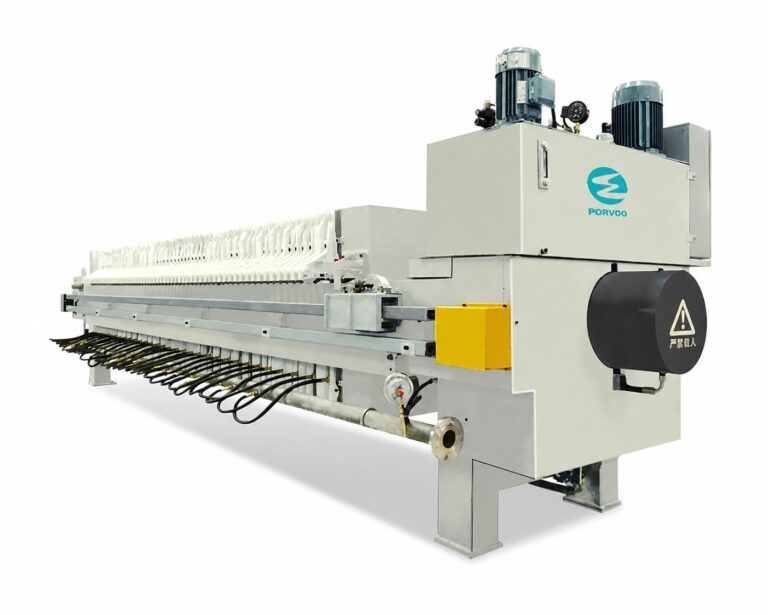
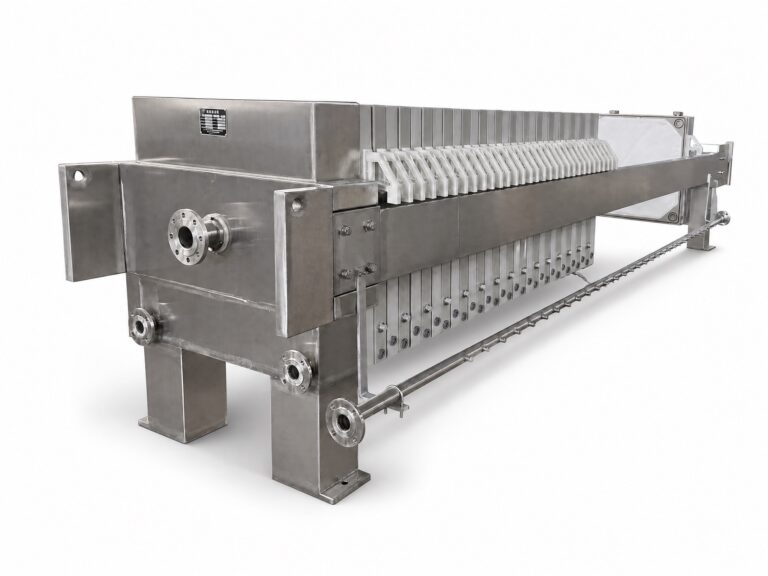
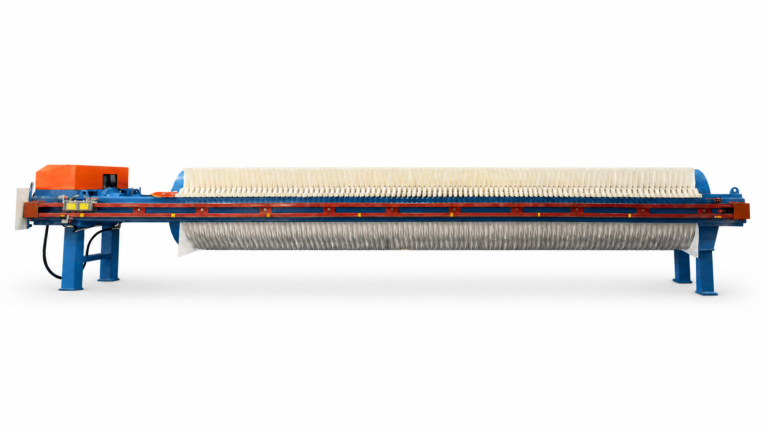
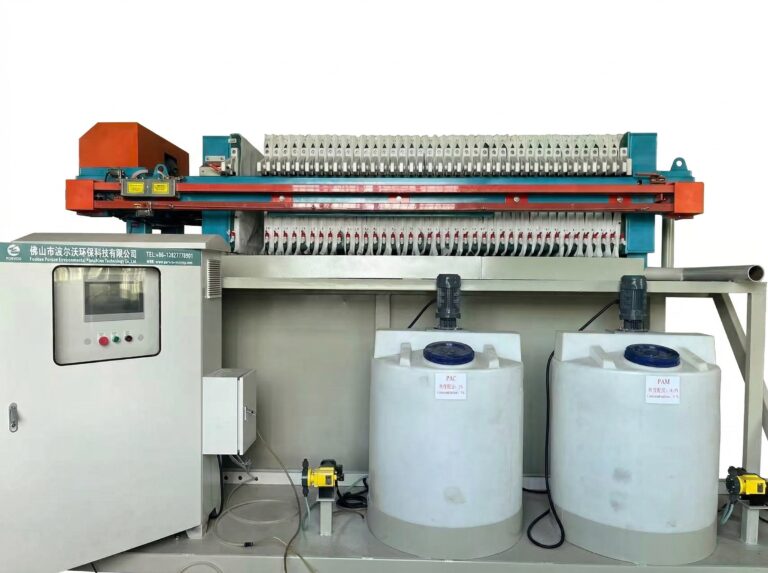
The cloth arrangement carried into the proposal should trace back to the trial basis described earlier, rather than being selected independently at the configuration stage. This is also where supplied project information — feed states, conditioning history, trial results, interface details — enters a supplier’s configuration and quotation review: the more completely these are documented, the more the resulting proposal can be checked against the project’s actual conditions rather than against assumed ones. Round plate filter presses built for difficult-to-dewater slurries are configured around exactly these feed and interface variables, which is why the specification needs to state them explicitly rather than leave them implicit in the material name.
Cake handling and filtrate routing around the production loop
| Process stream | Route the buyer must define | Press-boundary decision |
|---|---|---|
| Filtrate | Where the filtrate returns or discharges | Where the filtrate outlet connects to the production loop |
| Cake | How the cake will be released, moved, or reused | Where press discharge ends and the planned cake-handling route begins |
A press specification is incomplete if it describes only what happens inside the plate stack. The press has two outlets, and each one connects to a different part of the production loop with a different decision attached. Filtrate leaving the press either returns to a process step, is discharged, or is routed to further treatment, and that destination affects what filtrate clarity is required from the cloth and configuration chosen earlier. A filtrate destined for direct reuse in a process step may tolerate different clarity than one being discharged, and the buyer needs to settle this destination before clarity requirements can be judged as sufficient or insufficient.
Cake leaving the press follows a separate logic. How the cake will be released, moved, and either disposed of or reused is a planning decision independent from the filtrate route, and it determines where the press’s responsibility ends and the plant’s material-handling system begins. A press configured for a cake that releases cleanly as a stackable solid implies a different downstream handling arrangement than one producing cake that still requires further processing before it can be moved or reused. If this handoff point is not defined, the press can be specified and even perform as configured while still leaving the plant without a workable path for the cake it produces.
Both routing decisions sit upstream of the press specification in the sense that they should inform cloth selection, plate configuration, and cycle planning, not be decided afterward as an afterthought to what the press produces. A project that defines filtrate and cake routing early can specify the press against a complete boundary; a project that leaves these open is effectively asking the supplier to configure a press for an undefined destination at each outlet, which limits how firmly the proposal can be held to as a final arrangement.
Acceptance evidence for confirming the selected project arrangement
| Acceptance item | Evidence to review | Decision boundary |
|---|---|---|
| Configured press arrangement | Proposal description tied to the project feed and interface inputs | Confirms what is being offered; it does not by itself confirm project-specific performance. |
| Estimated cycle basis | Proposal estimate with its stated feed state or test basis | Supports comparison and planning, but remains an estimate until checked against representative testing. |
| Cake moisture expectation | Representative testing on the project slurry and stated feed condition | Provides the basis for accepting a project-specific moisture expectation. |
| Throughput expectation | Representative testing on the project slurry and stated cycle basis | Provides the basis for accepting a project-specific throughput expectation. |
| Consistency expectation | Representative testing covering the feed states included in the specification | Provides the basis for accepting the expected consistency across those stated feed conditions. |
A proposal document can establish what is being offered — a configured press arrangement, a cloth selection tied to trial results, and an estimated cycle basis — without yet establishing that this arrangement will deliver specific moisture, throughput, or consistency outcomes on this project’s actual slurry. These are different kinds of evidence, and conflating them is where acceptance disputes tend to originate. A configured arrangement, confirmed against the feed and interface inputs the project supplied, tells the buyer what the supplier intends to deliver. It does not, by itself, confirm that the arrangement will produce a given cake moisture or throughput figure once operating on the real feed.
Cake moisture expectations, throughput expectations, and consistency expectations across the feed states included in the specification each require representative testing on the project’s own slurry before they can be accepted as commitments rather than estimates. This is the same distinction raised earlier about cycle-basis estimates: an estimate built from a stated test basis is useful for comparison and planning, but it remains an estimate until it has been checked against testing that represents the actual feed conditions the press will operate under.
The practical question for the buyer is not whether to trust the proposal, but which expectations in it are already supported by representative testing and which still require it. A proposal that states its cycle basis and feed assumptions clearly gives the buyer something concrete to test against; a proposal that states only a final figure without its basis gives the buyer nothing to verify. Where the project’s feed states span a documented range of conditioning histories or solids distributions, consistency expectations should be tested across that range rather than against a single favorable condition, since a press and cloth arrangement validated on one feed state does not automatically establish performance across the others. Separating what the configured arrangement confirms from what still requires representative testing is what allows the buyer to accept a project-specific moisture, throughput, or consistency figure with a documented basis behind it, rather than as an unverified projection carried over from a general filter press proposal.
Frequently Asked Questions
Q: Is naming the slurry as ceramic slip, clay, or kaolin enough for a press specification?
A: No. Define the representative feed states the press must handle, including the solids distribution and conditioning history for each state. Use those same descriptions when selecting trial samples so results can be traced to expected operating conditions rather than to the material name alone.
Q: How can buyers compare proposals when suppliers tested different slurry samples?
A: First check whether the samples had comparable solids distributions and conditioning histories. If those bases differ, do not treat differences in cycle estimates or cloth behavior as equipment differences; align the test basis or request a comparable trial before ranking the proposals.
Q: Should the cloth that produces the clearest filtrate automatically be selected?
A: No. Compare clarity together with cake release, blinding tendency, and cleaning response on the same representative slurry. Choose the trade-off that fits the defined filtrate destination, cake-handling route, and intended operating arrangement.
Q: Which process interfaces should be settled before the round-plate press arrangement is finalized?
A: Define how slurry reaches the press, where filtrate will return or discharge, and where cake release ends and downstream movement or reuse begins. Recording these connection points keeps the proposed press, feed system, and outlet handling within one clear project boundary.
Q: What evidence is sufficient for accepting a moisture, throughput, or consistency expectation?
A: A proposal estimate is suitable for comparison and planning only when its feed state and cycle basis are stated. Accept a project-specific expectation only after representative testing, and tie the accepted result to the slurry condition and test basis actually covered rather than extending it to untested feed states.