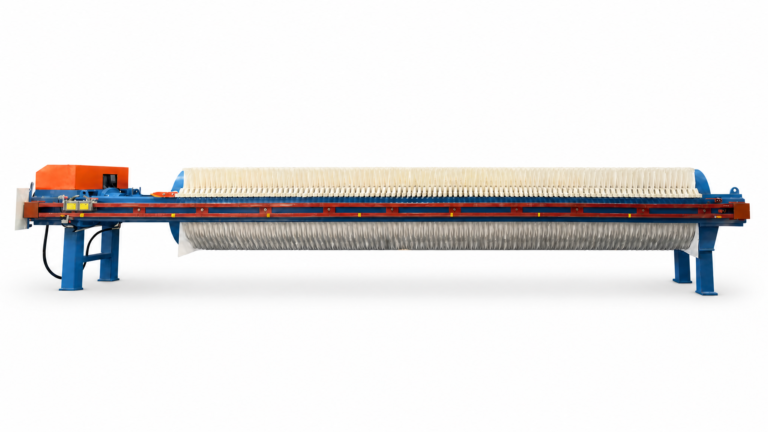
A filter press sizing or chamber-fill test is only as good as the slurry that enters it. If the sample handed to the test program does not represent what the press will actually receive during operation, the resulting cycle time, cake moisture, and throughput figures describe a stream that may never exist on site. The decision a buyer or process engineer faces before any test request goes out is not “do we have a sample” but “does this sample represent the condition the press is being sized against.”
The Process Condition the Sample Must Represent
| Sampling choice | What it represents | Boundary to record |
|---|---|---|
| Point on the stream entering the proposed press | The feed the press is expected to receive | Identify the sampling point and the process condition at collection |
| Composite across expected operation | The expected operating conditions included in the composite | State that it is a composite and define the operation covered |
| Deliberately bounded worst-case condition | The specified worst-case condition only | State the selected condition; do not treat it as proof of all operating conditions |
| Unusually clear or settled portion selected without a defined boundary | A nonrepresentative portion rather than the press feed | Do not use it as the representative test sample |
Before anyone fills a container, the project team has to decide what the sample is supposed to answer. A filter press test can respond to a representative feed condition, a composite built across the range of expected operation, or a deliberately bounded worst-case scenario, and these are three different test questions with three different interpretations of the result.
A sample taken from the point where slurry actually enters the proposed press reflects the feed condition the equipment will have to handle. If that point is upstream of a thickener, a reaction tank, or a blending step, the solids content, particle distribution, and chemistry at that point may differ meaningfully from a sample pulled somewhere else in the circuit, even if both locations carry the same nominal material. Where the process includes staged concentration or intermittent dosing, the sampling point has to match the point the press will see in operation, not an earlier or later stage that happens to be more convenient to access.
A composite sample, built by combining portions collected across the expected range of operation, answers a different question: what does the press need to handle across normal variability, rather than at one moment. This is useful where the process is known to shift — feed solids content changing with upstream batch cycles, or slurry chemistry drifting with raw material changes — and the buyer wants the press tested against that range rather than a single snapshot. The composite’s value depends entirely on whether the portions collected actually span the operation the plant expects; a composite built from a narrow operating window will understate variability even though it looks like a composite.
A deliberately bounded worst-case sample is narrower again: it represents one selected condition, chosen because it is expected to be harder to dewater, higher in solids, or otherwise more demanding than typical operation. This has legitimate use where the buyer needs to know the press will perform under a defined upper bound, but it should never be substituted for a representative or composite sample when the question is how the press performs across normal operation. A worst-case result describes that worst case; it does not describe the average, and treating it as if it does will distort sizing in either direction depending on which way the bound was set.
What should not happen, regardless of which of these three approaches is chosen, is selecting a portion of the stream because it happens to be clearer, more settled, or easier to handle than the rest. A grab taken from a settled or diluted portion of a tank, chosen because it is simpler to collect or produces a tidier sample, does not represent the press feed and does not answer any of the three legitimate test questions above. The choice of representation approach should be recorded at the time of sampling, not reconstructed afterward from whatever container happens to arrive at the lab.
Sampling Locations and Timing Across Expected Operation
Once the representation approach is chosen, the physical sampling plan has to put that choice into practice. The sampling location is not simply “a point on the line” — it is the point that corresponds to what will actually feed the press, and it has to be identified specifically enough that the sample can be defended later if the test result is questioned.
Where the proposed press sits downstream of equipment that changes solids concentration or particle size — a thickener, a clarifier, a reaction or conditioning tank — the sampling point should sit as close as practical to the press feed line itself, after those upstream changes have occurred. A sample taken upstream of a thickener describes a different material than what the press will receive after thickening, even if both come from the same process train. If access to the actual press feed line is not available because the press does not yet exist on site, the sampling point has to be chosen at the closest equivalent point in the current process, and that substitution should be documented as part of the sample record so anyone reviewing the test later understands what stood in for the press feed.
Timing follows the same logic as location. If the representation decision calls for a composite across expected operation, sampling needs to occur across the conditions that make up that operation — different shifts, different batch stages, different points in a cycle that is known to vary — rather than all at one time that happens to be convenient. A single grab taken during one pass of a cyclical process, even if taken at the correct location, only represents that moment of the cycle. Where the process is known to run in batches or stages with different solids loading at different points, a single timing choice risks capturing only one stage of that cycle and missing the conditions the press will also have to handle at other stages.
Where the worst-case approach has been chosen instead, timing should target the specific condition defined as worst case — a particular stage of a batch, a particular upstream event, a particular point in a cycle — rather than an arbitrary time that happens to coincide with sampling availability. The timing plan and the representation decision have to stay aligned; choosing composite representation but sampling at only one point in time, or choosing worst-case representation but sampling during routine operation, produces a sample that does not answer the question the project actually needed answered.
Mixing and Segregation Controls Before Container Filling
Slurries segregate. Solids settle, coarse and fine fractions separate, and a stream that looked uniform at the sampling point can stratify before it ever reaches the container. The handling between the sampling point and the sealed container is where a representative sample can quietly become an unrepresentative one, and this step receives less attention than the choice of sampling location even though it can undo that choice entirely.
If the sample sits for any length of time between collection and transfer into its container, settling begins, and how much settling occurs depends on the particle size distribution and density of the solids in that specific slurry — material that settles quickly in one process may remain in suspension much longer in another. A sample collected correctly at the right location and the right time, then left standing while other samples are collected or paperwork is completed, may no longer carry the same solids distribution it had at the moment of collection. Where settling has occurred before transfer, the sample needs remixing before it goes into the container, and that remixing step should be sufficient to resuspend the settled fraction rather than simply disturbing the surface.
Container fill introduces its own segregation risk. Pouring a settled or partially mixed slurry into a container can leave coarser material concentrated at the bottom of the pour and finer material carried into suspension at the top, so that the top and bottom of the same container no longer match. Filling in a way that keeps the material moving, or mixing again immediately before sealing, reduces this risk, and whichever method is used should be recorded so that anyone reviewing the sample later understands what state it was in when sealed.
Every one of these steps — mixing state at collection, settling time before transfer, and the method and completeness of container fill — changes what physical material actually sits inside the sealed container when it leaves the site. None of it is visible in the finished sample report unless it is written down. A filter press test run against a sample that settled for an uncontrolled period before filling will produce results describing that settled, segregated material, not the slurry the press is actually expected to receive, and there is no way to detect this after the fact without a record of what happened during collection and filling.
Handling Records for Storage, Transport, and Receipt
| Stage | Conditions to record | Interpretation boundary |
|---|---|---|
| Collection and container filling | Mixing state, settling time, and container fill | These conditions define the physical state placed in the container |
| Storage and transport | Storage, transport, and any preservative or temperature handling | These conditions can change what reaches the test unit |
| Receipt and test preparation | Visible segregation or unexpected change, plus any rehomogenization step | The test record should reflect the sample condition received and any handling before testing |
The sample’s condition can keep changing after it leaves the site, and the record has to track that condition through every stage until the test unit receives it. Three stages matter here, and each can alter what finally reaches the test.
During storage and transport, temperature changes, extended time in transit, or the physical motion of the container can all affect a slurry sample. Where the slurry includes chemically reactive components, biological content, or material sensitive to temperature, holding time and temperature during transport can change its chemistry or physical behavior before it ever reaches the lab. ISO 5667-13, which addresses sludge sampling, provides general relevance to sludge characterization and dewatering monitoring, though the specific preservation and holding conditions appropriate to a given slurry remain a project-specific determination rather than a fixed rule that applies uniformly across materials. Where a preservative or specific temperature control is appropriate for the slurry in question, that handling needs to be applied consistently and recorded, because inconsistent application across multiple samples intended for comparison will introduce differences that have nothing to do with the process itself.
Vibration and motion during transport can also cause further settling or compaction, particularly over longer transport distances or rougher transit conditions, so a sample that was properly mixed and filled at the site can still arrive in a segregated state purely as a result of the journey. This is a separate mechanism from the settling that occurs before container filling, but it has the same consequence: the physical material inside the container no longer matches what was placed there.
At receipt, the sample should be checked against what was recorded at collection. ISO 5667-10, which addresses wastewater sampling program design and sampling technique, offers sampling guidance of this general kind, though site-specific conditions, preservation requirements, frequency, and any applicable permit obligations remain determinations the project team and its laboratory need to make rather than conclusions the standard itself provides. The receiving record should note the storage and transport conditions actually experienced, not just the conditions intended, since unplanned delays or temperature excursions during transit are exactly the kind of deviation the record needs to capture if the test result is later questioned.
Sample Release Check Before Filter Press Testing
Before the sample is released into testing, it needs one more check: does the material inside the container still look like what was described at collection, or has something changed during storage and transport that was not anticipated. This check is separate from the handling record itself — the record documents what was supposed to happen, while the release check confirms what the container actually contains at the moment testing begins.
The check has two parts. First, visible inspection for segregation — a layer of clear liquid above settled solids, a visible change in color or texture, or any separation that was not present when the container was sealed. Second, comparison against the expected condition recorded at collection: if the sample was expected to represent a particular solids content or appearance and what arrived looks different, that discrepancy needs to be resolved before testing proceeds, not discovered after the test results come back inconsistent with expectations.
Where segregation or change is found, the sample needs rehomogenization before testing, and that step — how the sample was remixed, for how long, and by what method — belongs in the test record alongside the original handling history. A test result generated from a sample that was quietly rehomogenized without documentation leaves the next reviewer unable to tell whether the tested material still represents the original sampling decision or whether the remixing introduced its own changes.
This is the point where the earlier decisions in the sampling plan either hold up or do not. A sample that was collected at the correct location, mixed and filled correctly, and handled correctly in transport should pass this check with no surprises. Where surprises appear anyway — unexpected segregation, a visible change not explained by anything in the handling record — that is information the project team needs before committing to a press configuration based on the test result, because it signals that some part of the chain between collection and receipt did not perform as intended. The project information behind that chain — the sampling point, the representation approach, the handling record — is also what a supplier needs when reviewing test results against a proposed filter press configuration, since sizing and chamber selection depend on the feed condition the test was actually built to represent, not on the condition the buyer assumed it represented.
Frequently Asked Questions
Q: Should I submit a composite sample or a deliberately selected worst-case slurry sample?
A: Match the sample to the decision the test must support. Use a composite when the goal is to represent defined expected operation, or a deliberately bounded sample when the goal is to examine one specified worst-case condition; record that choice so the result is not applied beyond the condition tested.
Q: How should I plan sampling when the press-feed slurry changes during operation?
A: Define the operating period the test needs to represent, then choose the sampling location and timing around that period. Record which conditions were included so a short-lived clear or settled portion is not mistaken for the normal stream entering the proposed press.
Q: What should I do if the slurry is visibly segregated when it reaches the test unit?
A: Record the received condition before testing and document any rehomogenization step. If the segregation or another unexpected change cannot be reconciled with the collection and handling record, treat it as a limit on how confidently the test represents the original press feed.
Q: Which sample details are most useful when interpreting filter press test results?
A: Provide the sampling point, process condition, sampling strategy, mixing state, settling time, container fill, storage and transport conditions, and any preservative or temperature handling. Also record visible changes at receipt and any preparation before testing, because these details establish what material the test actually evaluated.