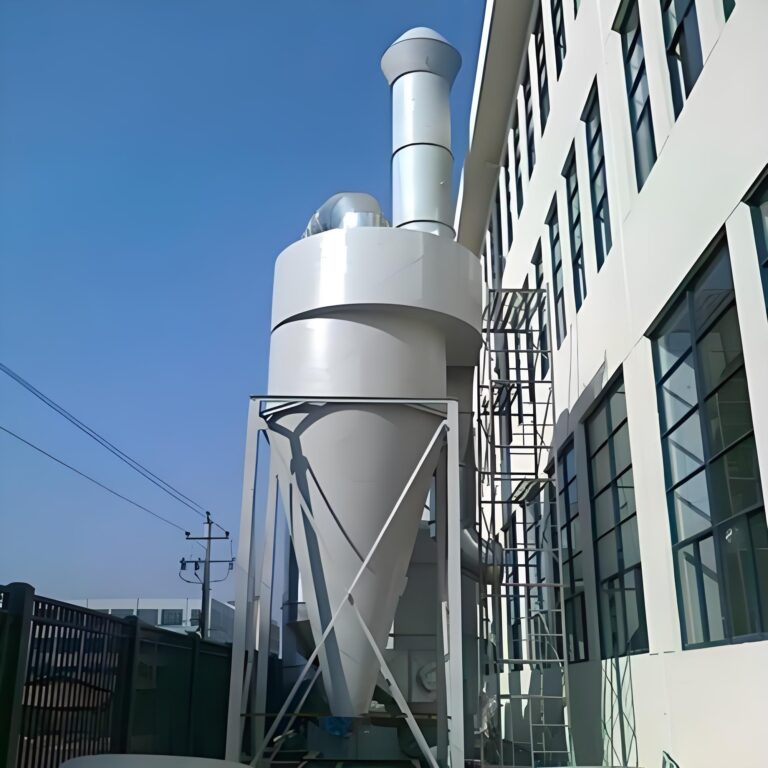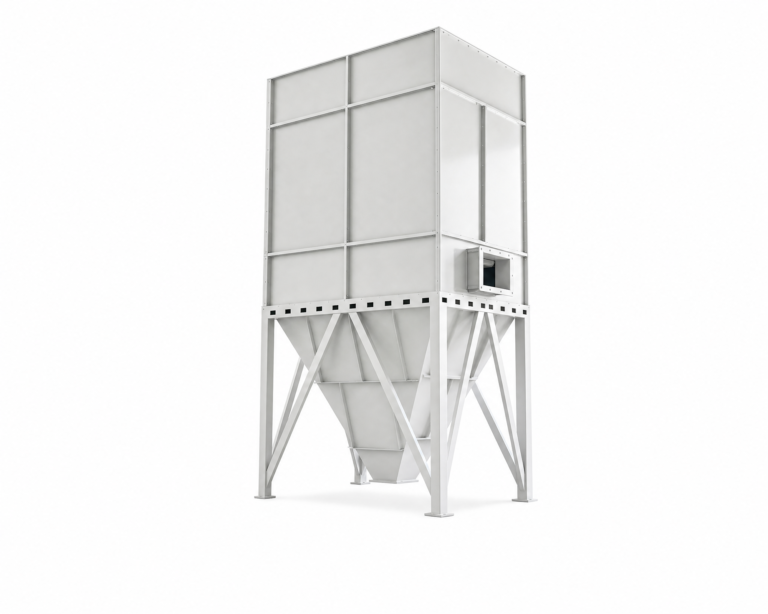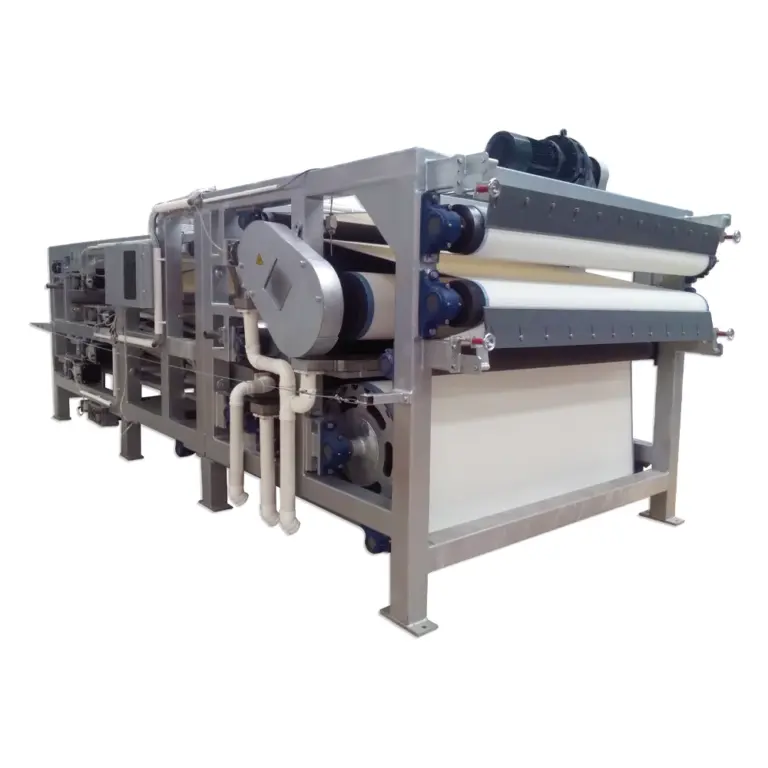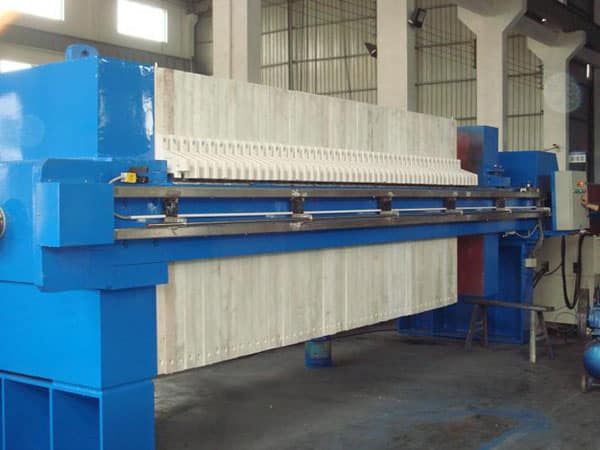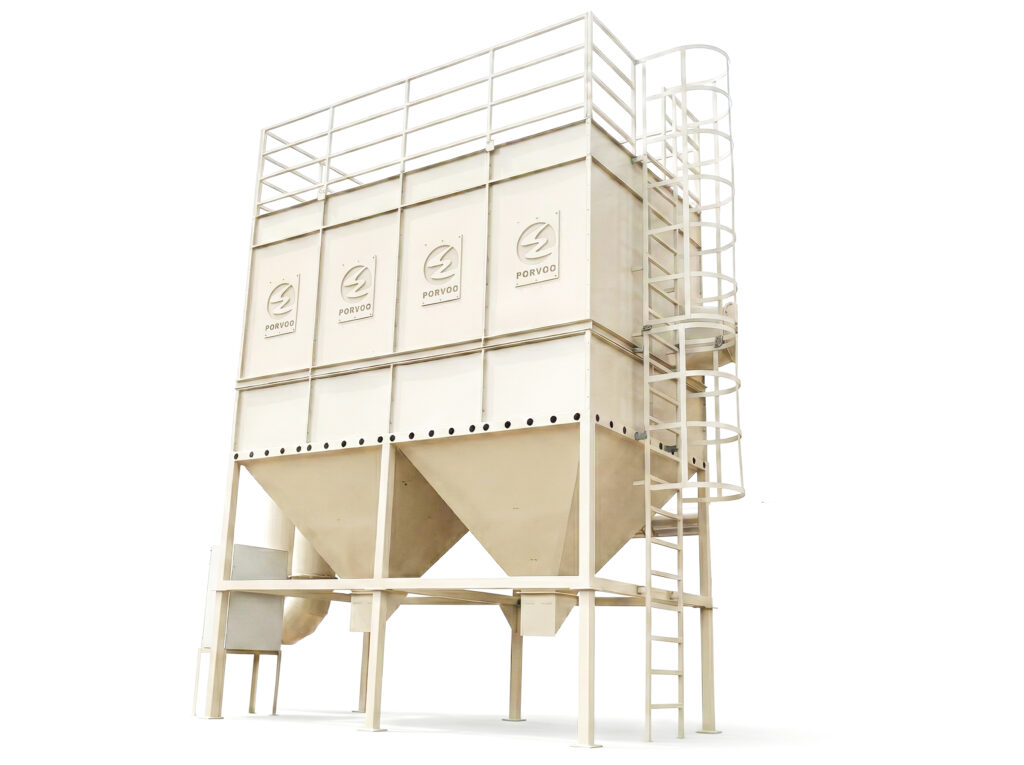
Factory-Built Chambers. Container-Shipped. Bolted Together On Site — No Welding Required.
Most pulse jet dust collectors arrive at site as one oversized welded shell, or as loose steel that has to be cut and welded together on the spot. Either way, you’re paying for a crane, a certified welding crew, hot-work permits, and days — sometimes weeks — of field construction before the unit ever touches dust.
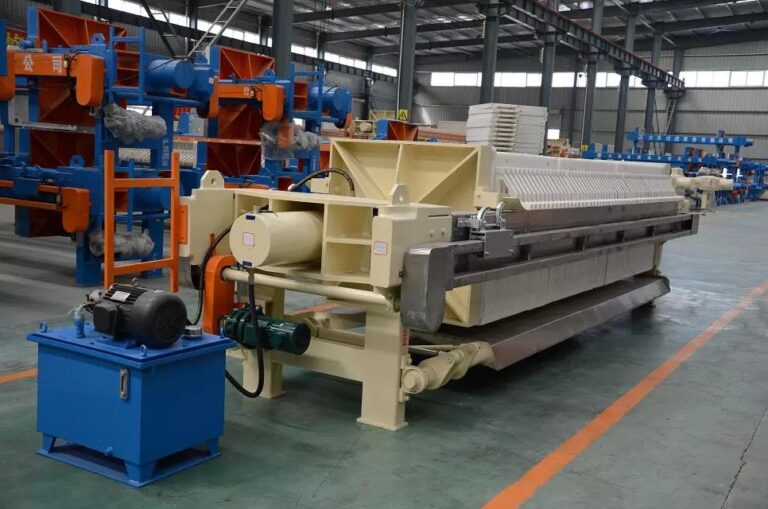
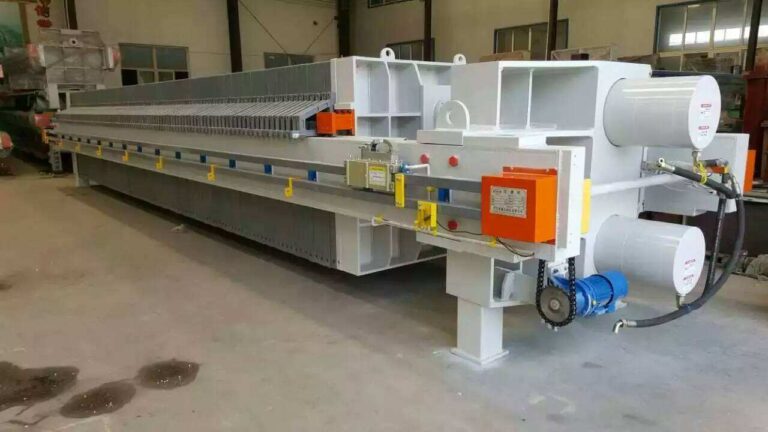
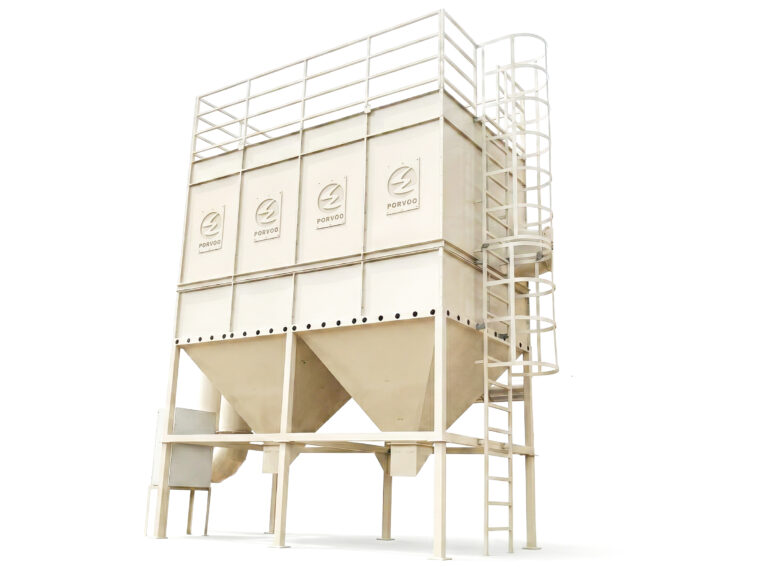
PORVOO’s Modular Pulse Jet Dust Collector is built differently from the ground up. The collector’s housing is already divided into independent filtration chambers — this is standard design, not a special version. What we changed is how those chambers are delivered and joined: each chamber is fabricated, painted, and pressure-tested as a complete module at the factory, sized to load directly into a standard shipping container. On site, modules are set on the frame and bolted together, chamber by chamber, with gasket-sealed flange joints. No cutting, no arc welding, no welding inspection. A mechanical fitting crew with hand tools and a torque wrench can complete assembly that would otherwise require a full welding crew.
Because each chamber is already a discrete structural unit in the standard design, going modular didn’t mean re-engineering the collector — it meant re-engineering how the same chambers reach site and get joined together.
Modular vs. Conventional Field-Welded Construction
| Характеристика | Conventional Field-Welded | PORVOO Modular Bolt-Together |
|---|---|---|
| Shipping format | Oversized shell or loose plate, special transport | Standard container-sized modules |
| On-site joining method | Field welding | Bolted flange + gasket seal |
| Labor required | Certified welders, riggers | General mechanical fitters |
| Hot-work permits | Usually required | Не требуется |
| Typical erection time | Days to weeks | Hours to a few days |
| Fabrication quality control | Dependent on field welding conditions | Factory-controlled, tested before shipment |
| Adding capacity later | Difficult — often requires cutting in new sections | Bolt on additional chamber modules |
| Relocating the unit | Not practical | Unbolt, transport, reassemble |
Full Model Range — Chambers Are Modules
The table below is PORVOO’s standard POR series selection range. Every model is already built from independently housed filtration chambers (“室”); in the modular version, each chamber ships and installs as one bolt-together module — so choosing a model is the same as choosing how many modules your project needs.
| Модель | Modules (Chambers) | Airflow (m³/h) | Площадь фильтра (м²) | Filter Bags | Bag Size (mm) | Импульсные клапаны | Resistance (Pa) | Matched Fan |
|---|---|---|---|---|---|---|---|---|
| POR32-3 | 3 | 5,220 – 8,700 | 72 | 96 | Φ130×1850 | 3 × 1.5″ | 1400–1700 | 4-72-4.5A / 7.5kW |
| POR64-3A | 3 | 10,800 – 18,000 | 150 | 192 | Φ130×1850 | 3 × 2.5″ | 1400–1700 | 4-72-5.3A / 18.5kW |
| POR64-3B | 3 | 10,800 – 18,000 | 150 | 192 | Φ130×1850 | 3 × 2.5″ | 1400–1700 | 4-72-5.6A / 22kW |
| POR64-3C | 3 | 10,800 – 18,000 | 150 | 192 | Φ130×2450 | 3 × 2.5″ | 1400–1700 | 4-72-5.6A / 30kW |
| POR64-4A | 4 | 13,900 – 23,100 | 193 | 192 | Φ130×1850 | 4 × 2.5″ | 1400–1700 | 4-72-6A / 30kW |
| POR64-4B | 4 | 18,400 – 30,700 | 256 | 256 | Φ130×2450 | 4 × 2.5″ | 1500–1800 | 4-73-9D / 37kW |
| POR64-5 | 5 | 23,000 – 38,400 | 320 | 256 | Φ130×2450 | 5 × 2.5″ | 1500–1800 | 4-73-10D / 45kW |
| POR64-6 | 6 | 27,600 – 46,000 | 384 | 320 | Φ130×2450 | 6 × 2.5″ | 1500–1800 | 4-73-10D / 55kW |
| POR64-8 | 8 | 36,800 – 61,400 | 512 | 384 | Φ130×2450 | 8 × 2.5″ | 1500–1800 | 4-73-11D / 75kW |
| POR64-10 | 10 | 46,000 – 76,800 | 640 | 512 | Φ130×2450 | 10 × 2.5″ | 1500–1800 | 4-73-11D / 90kW |
| POR64-12 | 12 | 55,000 – 92,000 | 768 | 640 | Φ130×2450 | 12 × 2.5″ | 1500–1800 | 4-73-12C / 132kW |
Filtration velocity: 1.2–2.0 m/min · Outlet dust concentration: ≤30 mg/Nm³ · Inlet concentration: up to 500–1000 g/Nm³ depending on model · Collector negative pressure rating: 3000–5000 Pa depending on model
Need something between two standard sizes, or above POR64-12? Chambers can be added in the same increments — talk to our engineers about a custom module count.
What’s Inside Each Module
Every chamber module ships as a complete, self-contained unit — not a kit of loose parts to fit together on site. Each module includes:
- Pre-painted structural housing section, sized for standard container loading
- Filter bags and cages pre-installed (quantity and size per model above)
- Pulse valve(s) and compressed-air header, pre-piped and pressure-tested
- Hopper section with dust discharge connection
- Access door for filter bag inspection and replacement
- Bolted flange connections on all mating faces, with gaskets fitted
- Pre-drilled bolt holes aligned to factory-verified templates, so field crews aren’t drilling or fitting on site
The support frame, main ductwork transitions, control cabinet, and fan are shipped as separate standard modules and connect into the chamber assembly using the same bolt-and-gasket method.
How Assembly Works On Site
- Level and anchor the support frame to the foundation bolts.
- Set the first chamber module onto the frame and bolt it down.
- Add chamber modules one at a time, bolting each to the previous one through the gasketed flange joints — the same sequence whether you’re building a 3-chamber or 12-chamber unit.
- Connect the compressed-air header between modules using quick-connect couplings.
- Mount the hopper, ductwork transitions, and fan, all via bolted flanges.
- Wire in the control cabinet using pre-terminated connections, then run commissioning checks.
No step in this sequence requires cutting, grinding, or welding. The crew size and tools needed are closer to installing prefabricated equipment racks than erecting a steel structure.
Why This Matters for Your Project
Lower field labor cost and lower skill threshold. Certified welders and hot-work permitting are some of the largest hidden costs in a field-erected dust collector, especially at remote sites or for export projects where mobilizing a qualified welding crew is difficult. A bolt-together module needs a competent mechanical fitting crew — a lower bar to clear, and one that’s easier to staff almost anywhere.
Predictable, standard freight. Because every module is sized to load into a standard shipping container, there’s no need for oversized-load permits or specialized heavy transport for a single large welded shell. This matters most for overseas shipments and sites with restricted road access.
Factory quality, not field quality. Every module is fabricated, painted, and pressure-tested under controlled factory conditions before it ships — airtightness and structural quality don’t depend on weather, site conditions, or the skill of whoever’s holding the welding torch that day.
Built to grow with the plant. Because “more modules” is already how PORVOO scales this product line (see the model table above — each step up is simply more chambers), adding capacity later means bolting on additional modules rather than re-engineering or replacing the unit.
Can move if the plant does. A bolted structure can be unbolted. For project-based operations, temporary sites, or facilities that may relocate equipment, that’s simply not an option a welded shell gives you.
Where It Fits Best
| Project Type | Why Modular Helps |
|---|---|
| Export / overseas installations | No need to mobilize certified welders on a foreign site; ships in standard containers |
| Remote or rural industrial sites | Reduces dependence on scarce, expensive local welding labor |
| Sites planning future expansion | Add chamber modules later instead of re-engineering the unit |
| Relocatable or project-based operations | Unit can be disassembled, shipped, and reassembled elsewhere |
| Sites with limited crane capacity or access | Individual modules are far lighter and easier to place than one large welded shell |
Common Questions
Do bolted joints seal as well as welded ones? Each flange joint uses a gasket rated for the operating pressure and temperature of the application, factory-fitted and matched to a pre-verified bolt pattern. This is the same joining method used across chamber connections in large field-erected collectors — the difference here is that every joint is made under factory tolerances rather than in the field.
Can I still get the unit fully pre-assembled if I don’t need modular shipping? Yes — the modular version and the standard field-erected version share the same core chamber design. Choosing modular only changes how the chambers are delivered and joined.
How many people does it take to assemble a unit? It depends on model size, but because each module arrives complete and pre-drilled, a small mechanical crew handles what would otherwise require a dedicated welding team. Ask our engineers for a crew-and-timeline estimate for your specific model.
What’s the largest size available? The standard range runs from POR32-3 up to POR64-12 (see table above). Larger installations are handled by adding more chamber modules in the same increments.
PORVOO’s Modular Pulse Jet Dust Collector delivers the same filtration performance as our standard POR series — up to 99%+ dust removal efficiency, continuous online cleaning, and the full POR32-3 to POR64-12 capacity range — while replacing field welding with a bolted, container-shippable modular structure. The result: lower field labor costs, more predictable freight, factory-controlled build quality, and a system that can expand or relocate as your project does.