A cyclone quotation is only as good as the operating basis behind it. When a plant buyer issues a cyclone dust collector RFQ without a locked process and dust description, each bidder fills the gaps with their own assumptions, and the resulting quotes stop being comparable even when the prices look close. The RFQ checklist that follows is built around what must be fixed before bidding, what must be divided in scope, and what must be verified before the equipment is accepted.
Process and Dust Data Suppliers Need to Size the Cyclone
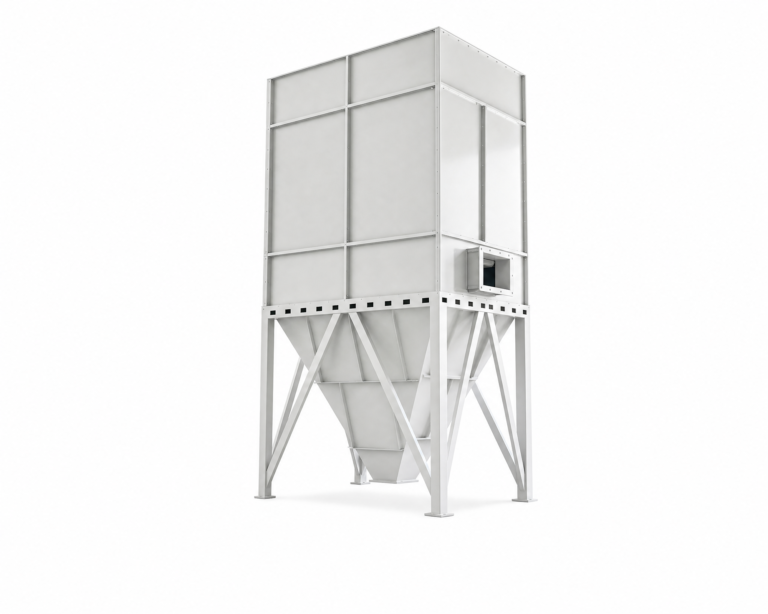
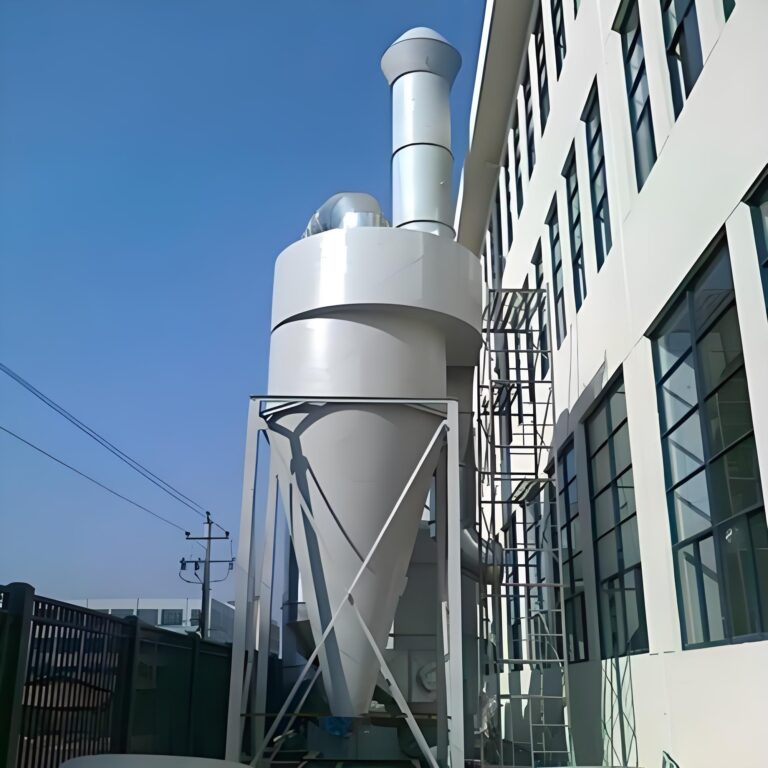
A cyclone separates particles from an air or gas stream by directing the flow into a rotating pattern so that centrifugal force throws heavier particles toward the outer wall, where they lose velocity and drop into a discharge point while the cleaned stream exits through the center. This separation mechanism only performs against the specific material, size distribution, and flow condition it is designed around. Where the RFQ does not fix these inputs, the supplier has no choice but to select a configuration against generic assumptions, and the buyer loses the ability to compare one bid against another on equal terms.
The source process matters because it determines the character of the dust arriving at the inlet, not just its rate. A process that generates fine, low-density particles behaves differently inside a cyclone than one generating coarser or denser material, even at the same total loading, because separation depends on the balance between centrifugal force and drag on each particle. Particle-size distribution is therefore not a single number for the RFQ to state; it is a range that determines what fraction of the dust the cyclone geometry can be expected to separate versus what fraction remains too fine to respond strongly to the rotational force.
Temperature and moisture change the physical behavior of both the gas stream and the dust itself. Where the stream carries elevated temperature, gas density and viscosity shift, which changes the separation behavior at a given velocity. Where moisture is present in the dust or the carrier gas, particles can agglomerate or adhere to internal surfaces, which changes how the collected material behaves at the discharge point regardless of what the separation curve predicts for dry material. A buyer who states only “hot” or “damp” without a defined condition leaves the bidder to assume a value that may not match the actual process.
Airflow cases deserve the same discipline. A process rarely runs at one constant flow; startup, normal operating range, and any elevated or reduced-flow condition each present a different velocity at the cyclone inlet, and velocity is the variable that governs both separation efficiency and pressure drop. An RFQ that states only a single design airflow gives the bidder no basis to confirm the configuration holds up across the actual operating range the plant will run.
| Input group | Information to state | Bid comparison use |
|---|---|---|
| Process source and cases | Source process and every airflow case | Check that every bidder uses the same operating cases |
| Caractéristiques des poussières | Material, particle-size distribution, and dust loading | Check that every bidder uses the same dust duty |
| Process conditions | Temperature and moisture | Check that every bidder uses the same stated conditions |
Locking this process and dust basis before circulating the RFQ is discussed in more detail in guidance on how to correctly size an industrial cyclone dust collector, and it is the step that determines whether every later comparison in the bidding process means anything.
Airflow Cases, Pressure Drop, and Separation Duty to State
Once the process and dust basis is fixed, the RFQ needs to convert that basis into the specific figures bidders must return, and pressure drop is the one that most directly reflects how a bidder has configured the cyclone. Pressure drop across a cyclone results from the energy lost to the rotational flow pattern and from friction against internal surfaces; a tighter, more aggressive separation geometry generally produces higher pressure drop, while a larger, gentler geometry produces less. Because this trade-off exists, two bidders can propose different internal geometries for the same stated dust duty and arrive at different pressure-drop figures, and neither number means anything unless it is stated against the same airflow case and the same dust loading the RFQ specified.
This is why the RFQ should require every bidder to state their pressure-drop figure against the RFQ’s stated cyclone duty rather than against a duty the bidder has redefined internally. If one bidder quotes pressure drop at a lower airflow than another, or against a lighter dust loading, the comparison collapses even though both numbers appear on the same line of a quotation table. The buyer’s task is not to select the lowest pressure-drop number in isolation but to confirm that every number on the comparison sheet was generated against the identical stated case.
Separation duty works the same way. A bidder’s separation basis is a design output, meaning it describes what a specific configuration is expected to remove from a specific dust characteristic under a specific flow condition; it is not a fixed property of “a cyclone” independent of the material it is separating. Where the particle-size distribution shifts toward finer material, or where dust loading changes, the same physical cyclone will produce a different separation outcome. This is the mechanism behind why laboratory or vendor reference curves for a given cyclone model cannot be read as a guarantee for an unspecified dust; the curve is only valid for the material, loading, and flow condition under which it was established.
Where a bidder’s separation basis is not tied explicitly to the RFQ’s material, particle-size distribution, and dust loading, the buyer should treat that figure as unverified for the actual duty rather than as a comparable data point. This applies equally across every airflow case the RFQ lists, since a configuration that meets a stated separation basis at one flow condition is not automatically assumed to meet it at another.
| Comparison point | Common RFQ basis | Bid response to require |
|---|---|---|
| Airflow cases | Every operating airflow case stated with the process data | Cyclone configuration basis for each stated case |
| Perte de charge | The same stated cyclone duty | Pressure drop stated against that duty |
| Separation duty | Material, particle-size distribution, and dust loading | Separation basis stated against those inputs |
Equipment Scope, Utilities, and Site Interfaces to Divide
A cyclone dust collector RFQ commonly treats “the cyclone” as shorthand for a complete system, but the base collector is only one component in a chain that includes the ductwork bringing dust-laden air to the inlet, the fan that drives the flow, the discharge device that removes separated material from the bottom, the controls that operate and monitor the system, and the structural, access, installation, and commissioning work that puts all of it in place. Where the RFQ does not force each bidder to state explicitly which of these elements are included, excluded, or handled at a defined interface boundary, the buyer risks comparing a complete system quote from one bidder against a bare-collector quote from another under the same line-item price.
The consequence of an undefined interface shows up most clearly at the boundaries between equipment. Ductwork design depends on the airflow cases and pressure drop the cyclone imposes on the system, so if the ductwork is supplied by a different party than the collector, both parties need the same duty figures to design against; a mismatch at this interface can leave the fan sized against one assumption and the collector against another. The same applies to the discharge device, since the rate and character of material leaving the cyclone’s dust outlet depends on the separation performance and dust loading established earlier in the RFQ, and a discharge device sized without that information may not match what the cyclone actually delivers.
Utilities are a related but separate category. Where a discharge device or controls require compressed air, power, or other utilities, the RFQ needs to state whether the bidder is supplying that utility, connecting to a utility the plant provides, or leaving that boundary undefined. This distinction matters at the point of coordination between the equipment package and the plant’s existing services, and it is one of the areas addressed in guidance on the dust collector interface matrix covering who provides ductwork, power, compressed air, and discharge connections.
Structural support, access, installation, and commissioning belong in the same scope division, since these are frequently split between an equipment supplier and a site contractor or the plant’s own resources. Where the RFQ leaves any of these unassigned, the buyer discovers the gap during execution rather than during bid comparison, which is precisely the outcome a scope-division exercise in the RFQ is meant to prevent.
The project information a buyer supplies through this process and scope division is what a supplier such as PORVOO uses to align a configuration and quotation with the actual duty and site boundaries rather than with generic assumptions.
| Scope group | Items to identify | Bid response needed |
|---|---|---|
| Base collector | Base cyclone collector | Included collector scope and exclusions |
| Air path | Ductwork and fan | Inclusion or exclusion and the interface boundary |
| Dust discharge | Discharge device | Inclusion or exclusion and the interface boundary |
| Controls and utilities | Controls and required utilities | Included scope, required utilities, and exclusions |
| Site work | Structural support, access, installation, and commissioning | Responsibility allocation and exclusions |
Wear Provisions, Access, Spares, and Documentation to Price
Beyond the base equipment and interface boundaries, an RFQ needs to draw out how each bidder prices the provisions that keep the cyclone operating over time, because these provisions are shaped directly by the dust duty established earlier and cannot be evaluated as generic add-ons. Wear inside a cyclone concentrates at the surfaces where the rotating dust stream contacts the housing, and the rate at which those surfaces wear depends on the same particle characteristics, loading, and velocity that were fixed in the process and dust data. Where a bidder’s wear provisions are stated without reference to the RFQ’s stated duty, the buyer cannot tell whether the provision reflects the actual application or a generic default that may prove insufficient, or unnecessarily conservative, for the dust the plant actually handles.
Maintenance access and clearances follow a related logic but at the site rather than the equipment level. A cyclone configuration that assumes generous clearance for inspection or wear-surface access carries different site footprint and structural implications than one designed for a tighter arrangement, and the RFQ should require bidders to state what access and clearance their configuration needs so the buyer can check it against the site’s actual layout before award rather than after delivery.
Spares scope is where bidders most easily create the appearance of price parity while quietly differing in what is actually included. A bid that includes a defined set of spares reflects a different total commitment than one that lists the base equipment only and treats spares as a separate, unstated cost. The RFQ should require each bidder to state explicitly what spares scope is included and what is excluded, so that the comparison reflects the full provision rather than the base unit price alone.
Drawings belong in the same pricing discipline. Where a bidder includes design and fabrication drawings as part of the delivered package and another treats them as a separate deliverable or excludes them, the buyer is not comparing equivalent scopes even if both bids describe “the same cyclone.” Stating drawing deliverables explicitly against the same duty allows the buyer to see whether the documentation needed for site integration, maintenance planning, and future modification is actually included in the price under review.
| Pricing check | Bid response to make explicit | Comparison use |
|---|---|---|
| Wear provisions | Wear provisions included for the stated duty | Compare included provisions and exclusions |
| Maintenance access | Required maintenance access and clearances | Compare site access and clearance needs |
| Spares | Spares included in the bid and any exclusions | Compare the stated spare scope |
| Drawings | Drawings included in the supplier scope and any exclusions | Compare the stated drawing deliverables |
Factory and Site Checks to Define Before Award
An RFQ that specifies duty, scope, and pricing still leaves open the question of how the parties will confirm that the delivered equipment meets what was quoted, and this question needs an answer before award rather than after delivery. Factory checks and site checks address different things, and treating one as a substitute for the other creates a gap the buyer may not discover until the equipment is already installed.
A factory fabrication check confirms that the cyclone has been built to its design, and a factory control check confirms that its controls operate as intended. Both are useful and both belong in an agreed acceptance method, but neither one measures how the equipment behaves once it is connected to the plant’s actual ductwork, fan, and process stream. Airflow through a cyclone depends on the full system it is installed into, including duct geometry, fan characteristics, and any resistance introduced by connected equipment; none of that exists at the point a factory check is performed. This is why a fabrication or control check, however thorough, does not by itself establish site airflow or particulate performance.
Confirming airflow requires a site measurement taken under an agreed method at agreed points in the duct. The ISO 10780 standard addresses the measurement of velocity and volume flowrate of gas streams in stationary source emissions, and referencing this kind of measurement basis in the RFQ gives both parties a shared understanding of what an airflow check actually measures and where in the duct it applies. Confirming particulate performance is a separate measurement again, addressed by manual gravimetric determination of particulate mass concentration such as that described in Organisation internationale de normalisation, which applies to ducted stationary-source emissions specifically; it is not a worker-exposure method, and it does not translate automatically into a guarantee of collector efficiency independent of the agreed measurement points and conditions.
Beyond the measurement standards themselves, the RFQ should require agreement on the acceptance-test scope, activities, and responsibilities, a subject addressed by Commission électrotechnique internationale 62381 in the context of factory and site acceptance testing and site integration testing. Applying that agreement discipline to a cyclone package means the buyer and bidder settle in advance which party performs each check, what result constitutes acceptance, and where the measurement points sit in the ducted stream, so that no party discovers a disagreement about acceptance criteria after the equipment is already on site. Reviewing what a completed acceptance check can and cannot establish is covered further in guidance on dust collector acceptance checks covering airflow, pressure drop, and visible dust escape.
| Vérifier | Define before award | Evidence boundary |
|---|---|---|
| Factory fabrication check | Agreed fabrication checks and acceptance method | Addresses fabrication checks; does not by itself establish site airflow or particulate performance |
| Factory control check | Agreed control checks, test scope, and responsibilities | Addresses controls; does not by itself establish site airflow or particulate performance |
| Site airflow check | Agreed airflow measurement method and duct measurement points | Establishes airflow at the agreed points under the agreed method; does not establish particulate performance |
| Site particulate check | Agreed particulate measurement method and measurement points in the ducted emission stream | Establishes the agreed particulate result at those points; it is not a worker-exposure result or an automatic collector-efficiency guarantee |
Bid Exceptions That Must Be Resolved Before Supplier Selection
Every section of an RFQ built this way is designed to produce a comparable bid, and the exceptions bidders take against that basis are exactly where comparability breaks down if left unresolved. An exception is not necessarily a problem with a bid; it is a signal that the bidder’s configuration, pricing, or acceptance approach diverges from the common basis the RFQ established, and the buyer’s task before supplier selection is to identify each divergence and understand what it means for the comparison.
Exceptions taken against the process and dust basis are the most consequential because they propagate through every later figure. Where a bidder states pressure drop or separation performance against a modified version of the stated dust loading, particle-size distribution, or airflow case, every other figure that bidder has quoted needs to be re-checked against what was actually assumed rather than accepted as directly comparable to a bid that held the original basis. This is not a matter of preferring one assumption over another; it is a matter of recognizing that the comparison itself is only valid when the basis is shared.
Exceptions against scope division carry a different kind of consequence. Where a bidder excludes ductwork, discharge device, controls, or site work that the RFQ intended to be included, or defines an interface boundary differently than the RFQ specified, the total responsibility the buyer is accepting differs from what the price alone suggests. Where alternatives exist between a bidder taking on broader scope at a higher price and a bidder taking on narrower scope at a lower price, the choice depends on what the buyer’s own project team or contractor is prepared to absorb at the excluded interfaces, and the RFQ responses should make that trade-off visible rather than leaving it implicit in a lower headline number.
Exceptions against wear provisions, spares, drawings, and access requirements affect the comparison in a similar way but at a smaller scale individually, while exceptions against the acceptance method affect how any of the prior figures can ever be confirmed. Where a bidder proposes a different measurement method or different measurement points than the RFQ specified, the buyer needs to determine whether that alternative still allows a meaningful check against the stated duty or whether it substitutes a weaker confirmation for the one the RFQ intended.
Resolving these exceptions before selection, rather than during contract negotiation after an award decision has effectively been made, is what keeps the comparison the RFQ was built to produce intact through to the final decision.
Questions fréquemment posées
Q : Can bids be compared if suppliers used different duty assumptions?
A : Not reliably. First reconcile the airflow cases, dust inputs, process conditions, pressure drop basis, and separation basis, then record each remaining deviation so scope and price are compared against the same duty.
Q : What should the RFQ do with process data that are still provisional?
A : Label each provisional input and require the bidder to state the assumption used and which selection or scope item depends on it. Close those open points before award instead of treating unlike assumptions as comparable.
Q : Is the lowest quoted pressure drop automatically the best choice?
A : No. Compare pressure drop only when it is tied to the same airflow and separation duty, then review the included equipment, utilities, wear provisions, and maintenance access alongside it.
Q : How should an excluded package interface be handled before award?
A : Assign each excluded item to a named responsible party and define its handoff point. Confirm the matching drawings, utility information, site access, installation, and commissioning responsibilities in the final scope.
Q : Can factory checks replace site acceptance measurements?
A : No. Factory fabrication and control checks answer different questions from site airflow and particulate measurements. Define the site methods and measurement points before award, and do not treat a particulate result as a worker-exposure result or an automatic collector-efficiency guarantee.
Q : When is a bid exception fully resolved?
A : It is resolved when the agreed duty basis, inclusion or exclusion, responsibility, and acceptance treatment are reflected in the final offer. An oral clarification alone leaves the comparison basis unclear.