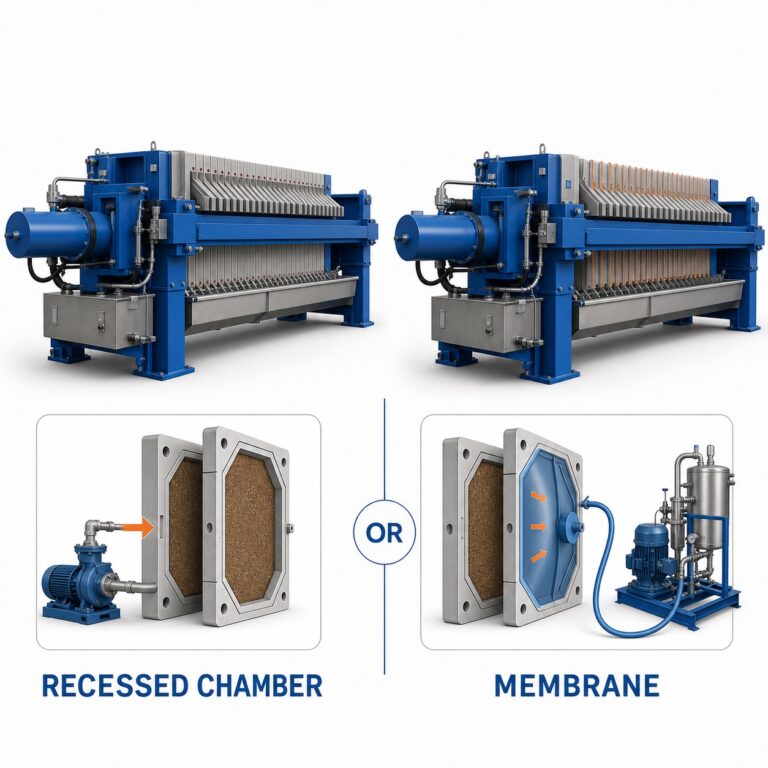
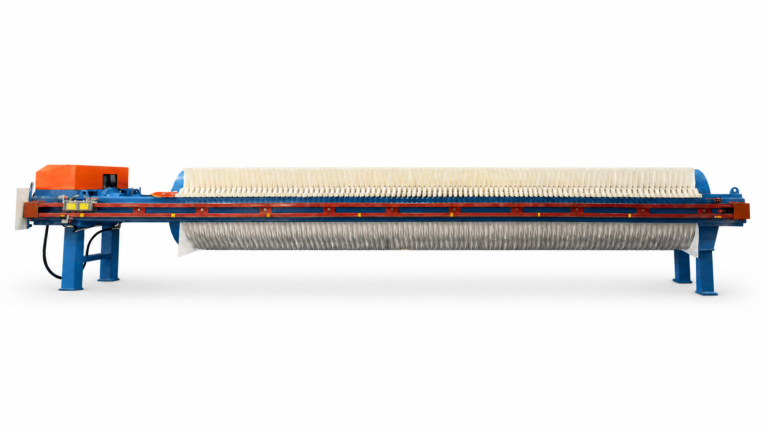
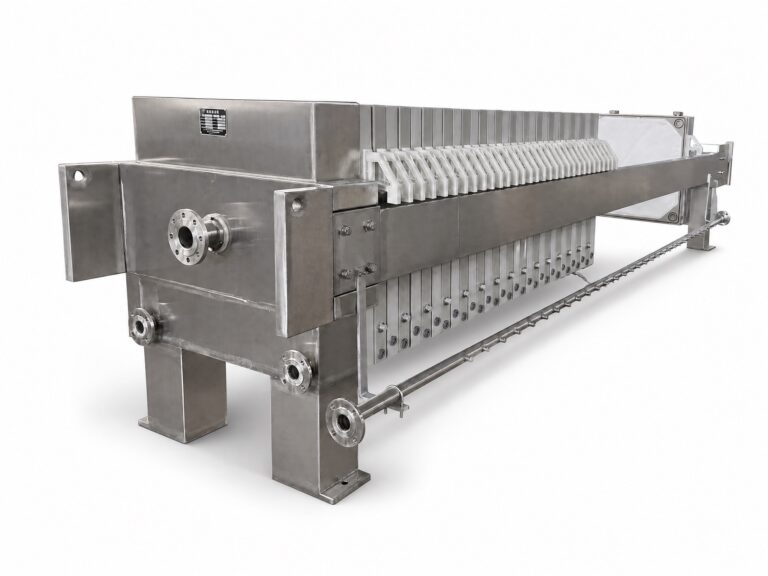
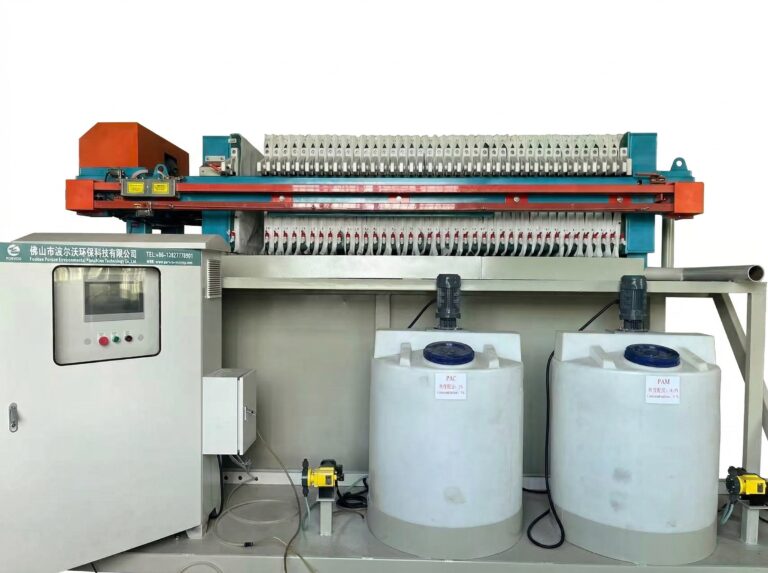
A filtre-presse à membrane costs more than a standard recessed-plate unit, and the difference is justified only when the squeeze phase changes the outcome the project cares about. Before specifying membrane plates across a batch, the real question is whether secondary squeezing earns its place in that specific duty cycle, or whether the slurry and the operating pattern never give it a reason to matter.
Secondary Squeezing as a Separate Phase in the Batch Cycle
A filter press cycle is built from distinct mechanical phases: feed and cake formation, any washing step the duty requires, cake discharge, and cloth or plate reset. Secondary squeezing is an added phase that sits after cake formation has already reached a stable state. The membrane inside each plate inflates against the formed cake, applying mechanical pressure that is independent of the feed pump’s pressure. This distinction matters because it separates two different ways of pushing more liquid out of a cake. Feed-pressure filtration relies on the pump to drive liquid through the cake and the cloth, and that mechanism loses effectiveness as the cake thickens and its resistance rises. Membrane squeezing instead compresses the cake mechanically once feed-driven filtration has already slowed, applying force without depending on additional flow through an already-resistant cake structure.
Where a project treats squeezing as something that happens automatically whenever membrane plates are installed, that framing already misses the sequencing logic. The chambers need to reach a stable cake state first; squeezing a cake that has not yet formed properly does not produce the same mechanical effect, because there is not yet a continuous solid structure to compress. A buyer evaluating membrane plates is really evaluating whether this second, distinct phase does enough extra work in their process to justify the added hardware, added control logic, and added cycle time it introduces.
This also means secondary squeezing cannot be assessed by looking at a plate pack specification alone. The phase only has meaning in the context of a complete cycle: how the cake formed, how long formation took, and what state the cake was in before the membrane engaged. A project that cannot describe those upstream conditions cannot yet evaluate whether the downstream squeeze phase will add value. Treating the squeeze as a bolt-on feature rather than a sequenced, testable phase is the most common source of mismatched expectations when the equipment reaches site.
Feed and Cake Conditions That Make a Trial Worthwhile
| Trial-readiness condition | Ready-to-test basis | Why it changes the decision |
|---|---|---|
| Slurry basis | The trial uses representative slurry from the intended duty. | Results from another slurry cannot establish whether squeezing fits this project. |
| Cake state | The chambers can first form a stable cake before the squeeze phase is added. | This keeps secondary squeezing identifiable as an extra phase rather than part of an undefined cycle. |
| Comparison basis | The same feed can be run under an agreed baseline sequence and an agreed squeeze sequence. | A controlled comparison is needed to attribute any change to the added phase. |
| Conditions d'acceptation | Project criteria cover cake condition, cycle duration, filtrate behavior, utility demand, and daily throughput. | A dryer-looking cake alone does not establish project value. |
Whether a squeeze trial is worth running depends on characteristics of the feed and the cake it produces, not on a general preference for drier output. A slurry that compresses readily under mechanical pressure behaves differently from one whose particle structure resists further consolidation once a cake has set. Where the solids are compressible, the membrane phase has physical room to do additional work; where the cake structure is already close to its practical limit after formation, squeezing may add cycle time without a corresponding change in cake condition.
The feed used for any trial has to represent the intended duty. A slurry from a different source, a different concentration, or a different particle distribution can behave in ways that have no bearing on how the target material will respond, so a result drawn from an unrelated feed cannot settle whether squeezing fits this project. This connects directly to how the chambers are run before the trial even begins: the squeeze phase needs to be introduced only after the baseline cycle has produced a stable cake, so that what gets measured is the incremental effect of the added phase and not an artifact of an incomplete or still-forming cake.
A trial also needs an acceptance basis that goes beyond appearance. A cake that looks drier after squeezing does not, by itself, establish that the phase belongs in the final cycle. The same trial needs to capture cycle duration, filtrate behavior, and utility demand together with cake condition, because a change in one of these without visibility into the others leaves the central trade-off unresolved: added dryness that costs daily throughput is a different outcome than added dryness obtained within the same number of completed cycles. Defining these conditions before testing begins, rather than inferring them from a single data point afterward, is what turns a one-off observation into evidence a project specification can rely on.
Plate Pack, Utility, and Control Inputs to Define
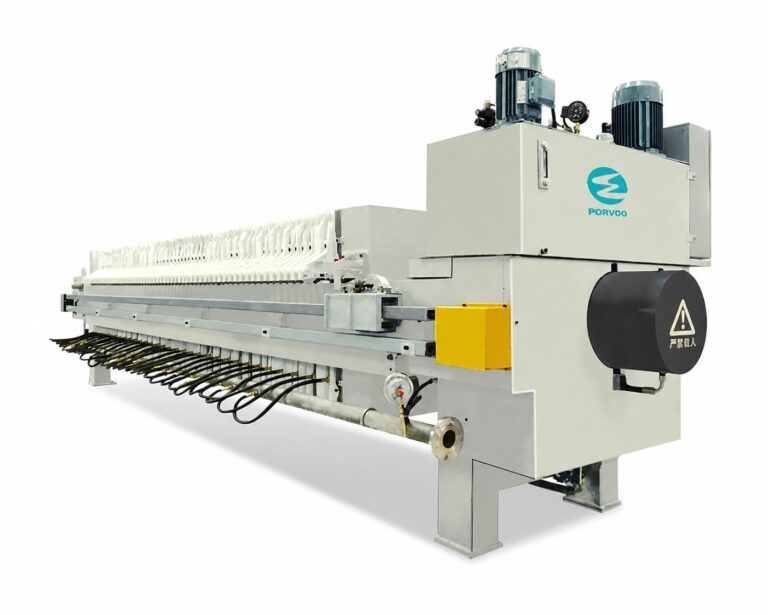
Once a trial is justified, the physical and control basis for testing it needs to be defined together, because these three inputs are connected rather than independent choices. The plate pack determines how much membrane area is available and how the chambers are arranged, which in turn affects how evenly pressure is distributed across the cake during the squeeze phase. A plate pack configured for one chamber volume and arrangement will not transfer its behavior to a different configuration, so the plates used in testing need to match what the project would actually specify, not a convenient substitute.
Utility supply is the second connected input. Membrane squeezing requires a pressurized medium delivered to the membrane side of the plate, separate from the feed pump supplying the slurry. The capacity and control of that utility source shape how much pressure can be applied, how quickly the membrane can be engaged, and how repeatable that engagement is across cycles. A utility system sized or controlled differently from what the project intends will not produce results that transfer cleanly to the final installation, because the pressure applied during squeezing is part of what determines whether the cake responds at all.
Control logic ties the two together. The point at which the system transitions from cake formation into the squeeze phase, how long the membrane remains engaged, and how that transition interacts with discharge and reset all depend on control settings rather than on the plates or the utility supply alone. Defining this sequencing as part of the project specification, not as an afterthought once hardware is selected, is what allows the squeeze phase to be evaluated on equal terms with the baseline cycle. Where any one of these three inputs is left undefined, the results from a trial become difficult to attribute: a weak outcome might reflect an underpowered utility source rather than an unsuitable slurry, and a strong outcome might depend on a control sequence that will not hold up once incorporated into a complete production cycle.
Testwork Comparisons That Keep the Baseline Fair
| Dimension de comparaison | Baseline run | Secondary-squeeze run | Utilisation de la décision |
|---|---|---|---|
| Base alimentaire | Use the representative slurry selected for the project trial. | Use the same representative slurry. | Prevents feed differences from being mistaken for squeeze value. |
| Cycle sequence | Run the agreed baseline sequence. | Run the agreed sequence with squeezing added after a stable cake has formed. | Isolates the added phase for comparison. |
| État du gâteau | Assess the cake produced by the baseline sequence. | Assess the cake after the squeeze phase. | Shows whether the added phase creates meaningful cake value under the project criteria. |
| Cycle duration and daily throughput | Establish the baseline cycle duration and resulting daily throughput. | Include the added phase in the cycle duration and throughput assessment. | Tests whether cake value is offset by fewer completed cycles. |
| Comportement du filtrat | Establish behavior under the baseline sequence. | Compare behavior under the squeeze sequence. | Keeps filtrate behavior in the decision alongside cake and cycle effects. |
| Utility demand | Establish demand for the baseline sequence. | Include demand from the agreed squeeze sequence. | Shows whether the added demand is justified by the measured value. |
A squeeze trial only answers the project’s question if the comparison it rests on isolates the added phase from everything else that could change the result. This means running the same representative slurry under two sequences: one without squeezing and one with it, introduced only after the chambers have reached a stable cake under the baseline conditions. Where the feed differs between the two runs, or where the baseline sequence itself is altered to make the squeeze result look more favorable, the comparison no longer isolates the mechanism being tested; it becomes two different experiments compared as though they were one.
Cake condition is the most visible output, but it cannot be judged in isolation. A squeeze phase that produces a measurably different cake needs to be assessed against what that phase cost in cycle duration. Because a batch process depends on completing cycles within the available operating time, a sequence that improves cake condition but extends each cycle changes the number of batches a system completes in a day. This is the mechanism connecting cake quality to daily throughput, and it is why the trial needs to capture cycle duration and throughput as part of the same comparison, not as separate follow-up questions.
Filtrate behavior and utility demand complete the comparison. The liquid that passes through the cake during and after the squeeze phase can carry different characteristics than the liquid produced under the baseline sequence, and a project with downstream filtrate handling or reuse requirements needs that difference captured, not assumed. Utility demand, meanwhile, is the resource cost of running the added phase; it needs to be measured against the baseline so the project can weigh what the squeeze consumed against what it delivered. The Fiche d'information de l'EPA sur le filtre-presse à plaques encastrées frames pressure-filtration evaluation around exactly these interface and cost dimensions, using representative testing as the design basis rather than inferring performance from a specification sheet, and that same logic applies directly to comparing a baseline cycle against a squeeze-added cycle: the comparison has to be structured to isolate the variable under test, not left to a single uncontrolled run.
Throughput, Cake Condition, Filtrate, and Maintenance Tradeoffs
The tension at the center of this decision is that a squeeze phase can improve one outcome while working against another, and the project has to weigh them together rather than optimizing any one in isolation. A drier, more consolidated cake can reduce downstream handling demands, but only if the cycle time added to achieve it does not reduce the number of cycles the press completes within the operating period the project depends on. Where a facility’s constraint is daily throughput rather than cake dryness, a squeeze phase that extends each cycle works against the operational goal even if the cake itself looks better.
Filtrate behavior sits alongside this trade-off rather than following automatically from cake condition. A cake that holds together better under mechanical pressure does not guarantee a filtrate result that matches the project’s downstream requirements; the two need to be verified independently, because the mechanisms producing cake consolidation and the mechanisms determining what passes through the cloth are not identical.
The added phase also introduces ongoing demands beyond the cycle itself. A membrane plate pack carries more components subject to wear and more seals and connections subject to failure than a standard plate pack, and the pressurized membrane utility requires its own control and maintenance attention. Where a project evaluates only the immediate cake and cycle outcome without accounting for this added maintenance burden, the comparison is incomplete, because the value of a drier cake has to be weighed against what it costs to keep the additional hardware functioning over the life of the equipment. A buyer reviewing this trade-off with a supplier needs to ask not only what the squeeze phase achieves on a stable test cake, but what it requires in ongoing attention to plates, cloths, and controls once it is running in production. The configuration data gathered through that conversation, covering plate pack details, utility capacity, and control sequencing, is what a supplier such as Porvoo would need to carry a membrane filter press proposal through configuration and quotation review.
Decision Gate for the Project Specification
| Pointe de décision | Basis for specifying secondary squeezing | Basis for holding it out of the specification |
|---|---|---|
| Representative evidence | The same representative slurry has been compared under the agreed baseline and squeeze sequences. | The case depends on results from another slurry or an unmatched comparison. |
| Incremental cake or cycle value | The trial shows added value under the project’s acceptance criteria. | The evidence is limited to a dryer-looking cake without demonstrated project value. |
| Daily throughput | The complete squeeze sequence keeps daily throughput within the project criteria. | The added phase reduces daily throughput beyond the accepted boundary. |
| Comportement du filtrat | The squeeze-sequence result meets the project criterion when judged with cake condition and cycle duration. | The filtrate result misses the criterion or remains unresolved. |
| Utility and maintenance burden | Added utility demand and work on plates, cloths, and controls are justified by the measured value. | The added burden is not justified by the measured value or has not been evaluated. |
The decision to specify secondary squeezing, or to hold it out of the specification, rests on whether the project has gathered evidence that is both representative and complete. Representative evidence means the comparison used the slurry the project will actually run, under a baseline and squeeze sequence that isolated the added phase rather than conflating it with other changes. Without that basis, a result drawn from a different slurry or an uncontrolled comparison cannot settle the question, regardless of how favorable it looks.
Completeness means the trial captured the full set of outcomes the project depends on: cake condition measured against the project’s own acceptance criteria rather than visual impression, daily throughput assessed with the added phase included in the cycle time, filtrate behavior evaluated independently rather than assumed from cake condition, and utility and maintenance demands weighed against what the trial actually demonstrated. Where all of these align in favor of the added phase, specifying membrane plates is supported by evidence the project can defend. Where any one of them falls outside what the project’s acceptance criteria allow, that single gap is enough to hold the specification at a standard recessed-plate configuration rather than carrying an unresolved trade-off into equipment selection.
This is also the point at which a supplier interaction has the most to contribute, because the specification decision depends on interface details, a project team working through this gate with a supplier such as Porvoo is positioned to confirm plate pack compatibility, utility sizing, and control sequencing against the trial conditions already established, so the equipment configuration matches the duty the testwork actually represents rather than a generic membrane filter press offering.
Questions fréquemment posées
Q : Should secondary squeezing be treated as a standard requirement for every membrane filter press duty?
A : No. Treat it as a project option until representative slurry testing shows that the added phase creates enough cake or cycle value to justify its plate-pack, utility, control, and maintenance implications.
Q : What should the project team agree before a secondary-squeeze trial starts?
A : Agree on the representative slurry, the baseline and squeeze sequences, and the acceptance criteria before testing. The criteria should state how cake condition, full cycle duration, daily throughput, filtrate behavior, utility demand, and maintenance work will be weighed in the final decision.
Q : How can a team tell whether the added squeeze time is acceptable?
A : Judge the complete cycle rather than the squeeze phase alone. Convert the measured cycle duration into the resulting daily throughput, then decide whether the measured cake or filtrate benefit is worth any reduction in completed cycles under the project’s acceptance criteria.
Q : What information belongs in an RFQ while secondary squeezing is still under evaluation?
A : State the intended duty, representative test basis, comparison sequence, and project acceptance criteria, and ask that the plate pack, utilities, and controls needed for the squeeze case be identified. This lets the team compare the baseline and squeeze routes without presenting an unproven benefit as a fixed requirement.
Q : When should secondary squeezing be held out of the project specification?
A : Hold it out when a stable cake cannot first be formed, the comparison does not use representative slurry and aligned sequences, or the measured benefit does not justify the effects on throughput, utilities, and maintenance. Keep the decision open if filtrate behavior or another project criterion remains unresolved.