Les entreprises de transformation de la céramique et de la pierre soumettent régulièrement des appels d’offres sans fournir l’élément indispensable qui donne tout son sens aux autres chiffres du devis : la concentration mesurée en matières solides dans la boue d’alimentation. Lorsque ce chiffre est estimé à partir du débit de production plutôt que mesuré par échantillonnage au point de collecte de la boue, l’erreur se répercute immédiatement sur la durée du cycle, le volume de la chambre et la surface de filtration — et la presse livrée sur site est souvent dimensionnée pour une boue qui n’existe pas. Cette lacune lors de la mise en service est alors considérée comme un problème lié au fournisseur, alors qu’il s’agissait dès le départ d’un problème de données. Pour y remédier, il faut savoir exactement quels paramètres de procédé doivent être fixés avant qu’un devis de filtre-presse puisse être évalué sur le plan technique plutôt que accepté sur la base de la confiance.
Recueillir les hypothèses relatives au volume quotidien de boues et aux heures de fonctionnement
Le volume quotidien de boues et l'organisation des équipes constituent des données indispensables au calcul des dimensions, et non de simples informations contextuelles destinées à une lettre de motivation. Sans ces données, un fournisseur ne peut pas déterminer combien de cycles de filtration peuvent être intégrés dans la plage de fonctionnement, ni quel volume chaque cycle doit traiter — et sans ces chiffres, la surface de filtration et le nombre de chambres ne sont que des estimations accompagnées de quelques décimales.
La logique de calcul est simple : il suffit de diviser le volume quotidien de boue par le nombre de cycles par jour pour obtenir le volume par cycle, puis de dimensionner la presse de manière à traiter ce volume dans le temps de remplissage disponible. À titre d’illustration, une installation produisant 1 800 gallons par jour sur un poste de travail de 8 heures pourrait prévoir trois cycles de 600 gallons chacun. Le nombre de cycles n’est pas un paramètre de conception fixe : il découle du temps de filtration par cycle, qui dépend lui-même des teneurs en solides de la charge et des objectifs d’humidité du gâteau abordés dans les étapes suivantes. Considérer le nombre de cycles par jour comme une hypothèse plutôt que comme un résultat dérivé est une erreur de planification courante qui fausse l’ensemble du processus de dimensionnement.
L'hypothèse relative aux heures de fonctionnement doit également préciser clairement la structure des équipes : si la presse fonctionne en continu d'une équipe à l'autre, si une équipe comprend un créneau dédié à la maintenance et si un fonctionnement le week-end est prévu. Une presse dimensionnée pour une journée de fonctionnement de 16 heures s’avérera sous-dimensionnée si le débit de production de boue est maintenu 24 heures sur 24, mais que la plage de fonctionnement a été mal indiquée. Vérifier le volume quotidien dans des unités cohérentes — les mètres cubes par jour sont préférables pour les équipements dont les spécifications sont exprimées en unités métriques — et l’associer à un planning de quarts de travail clair constitue le minimum requis pour entamer une discussion techniquement crédible sur le dimensionnement.
Mesurer la teneur en matières solides des aliments pour animaux plutôt que de la estimer à partir du volume de production
La concentration en matières solides de l'alimentation est la variable qui, plus que toute autre, est le plus souvent estimée plutôt que mesurée, et les conséquences de cette approximation sont directement proportionnelles à l'ampleur de l'erreur d'estimation. Une boue présentant une teneur en matières solides sèches de 5% en poids nécessite un temps de cycle de remplissage environ deux fois plus long qu'une boue à 10% — une différence suffisamment importante pour réduire de moitié le nombre de cycles disponibles par équipe et faire passer la surface de filtration requise bien au-delà de ce que spécifierait un devis établi sur la base d'hypothèses par défaut.
Le seuil de 3% de matières sèches mérite une attention particulière. En dessous de cette concentration, les méthodes de dimensionnement standard et les hypothèses par défaut généralement appliquées par les fournisseurs ne constituent plus des points de départ fiables. Les boues aussi diluées — qu’elles soient dues à l’entraînement d’eau de lavage, à la recirculation ou à des variations saisonnières de la charge — nécessitent un traitement distinct dans le modèle de dimensionnement, et une presse choisie sans tenir compte de ce régime affichera des performances insuffisantes dès que la charge se diluera pour atteindre ou descendre en dessous de ce niveau. La réponse appropriée lorsque la teneur en matières solides de la charge est variable consiste à prélever des échantillons dans des conditions de fonctionnement représentatives, et non à calculer la moyenne de la plage et à dimensionner la presse en fonction du point médian.
La méthode d'échantillonnage a également son importance. Pour la caractérisation des boues à ce stade, la norme ISO 5667-13:2011 fournit des recommandations sur l'échantillonnage représentatif des boues, ce qui s'avère pertinent lorsque la composition de la charge d'alimentation est hétérogène ou difficile à évaluer en un seul point du flux de traitement.
| Matières solides de l'aliment (%, poids sec) | Conséquences sur la durée du cycle | Points à clarifier avec le fournisseur |
|---|---|---|
| Trois pièces d'un pence | Les dimensions standard ne conviennent pas ; cela nécessite un traitement particulier et des cycles plus longs | Méthode de sélection appropriée d'une presse pour les boues très diluées |
| 5% | La durée du cycle de remplissage est environ le double de celle des solides 10% | La marge prévue pour la durée du cycle doit refléter la concentration réelle de l'alimentation |
| 10% | Durée de cycle de remplissage plus courte ; souvent utilisée comme référence pour le dimensionnement | Vérifiez que ce chiffre correspond à la teneur en matières solides mesurée dans le processus |
Le fait de ne pas effectuer cette mesure n'entraîne pas seulement une taille de presse incorrecte, mais aussi une mauvaise répartition du temps de cycle qui n'apparaît qu'en conditions de charge de production. Une presse qui passe le contrôle de dimensionnement du papier à 101 TP3T de couverture ne sera pas à la hauteur dès la première semaine où elle fonctionnera de manière constante avec une alimentation à 51 TP3T, et la correction à ce stade implique généralement d'ajouter une deuxième presse ou d'accepter un goulot d'étranglement dans la production.
Convertir l'objectif d'humidité du gâteau en besoins pour la chambre ou la zone de filtration
Une valeur cible d'humidité du gâteau exprimée en pourcentage ne constitue pas une spécification relative à la surface de filtration. Sa conversion en volume de la chambre nécessite un bilan massique que peu d'appels d'offres mentionnent et que très peu d'acheteurs vérifient.
Le calcul se déroule en quatre étapes : déterminer la masse quotidienne de matières sèches entrant dans la presse, diviser ce chiffre par la fraction cible de matières sèches du gâteau pour obtenir la masse totale quotidienne du gâteau humide, diviser ce résultat par la densité du gâteau pour obtenir le volume quotidien du gâteau, puis diviser ce volume par le nombre de cycles quotidiens pour obtenir le volume de la chambre que chaque cycle doit pouvoir contenir. À titre d’exemple — et non de référence standard pour les matériaux —, une installation traitant 330 kg par jour de matières sèches et visant une teneur en matières sèches du gâteau de 30%, avec une densité supposée du gâteau de 1,4 kg/dm³, obtient un volume de gâteau par cycle qui détermine directement le choix de la chambre. Les acheteurs doivent remplacer ces chiffres par les valeurs mesurées sur leur propre boue ; l’utilisation de données illustratives comme valeurs par défaut reproduit exactement le problème d’hypothèses du fournisseur que cette étape est censée corriger.
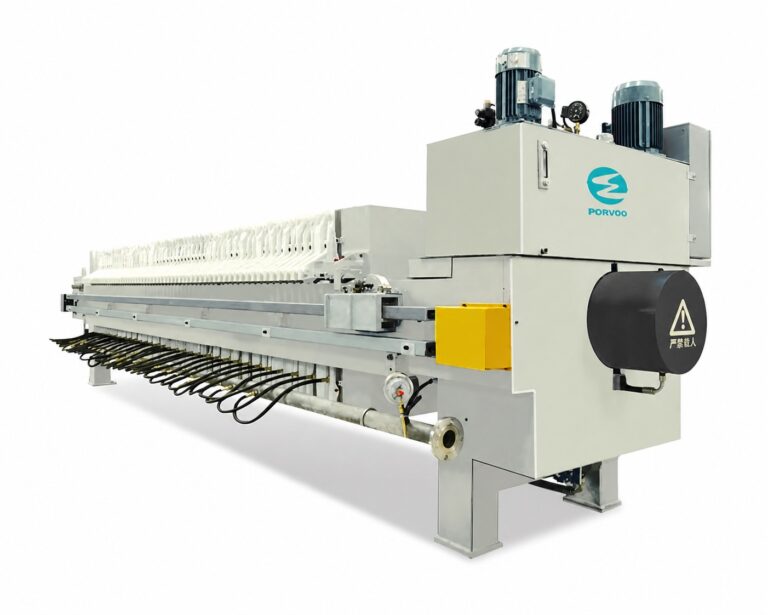
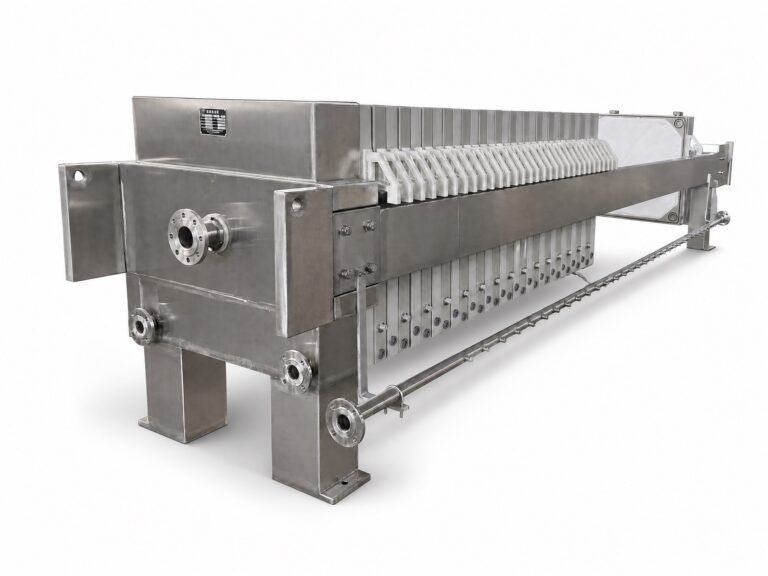
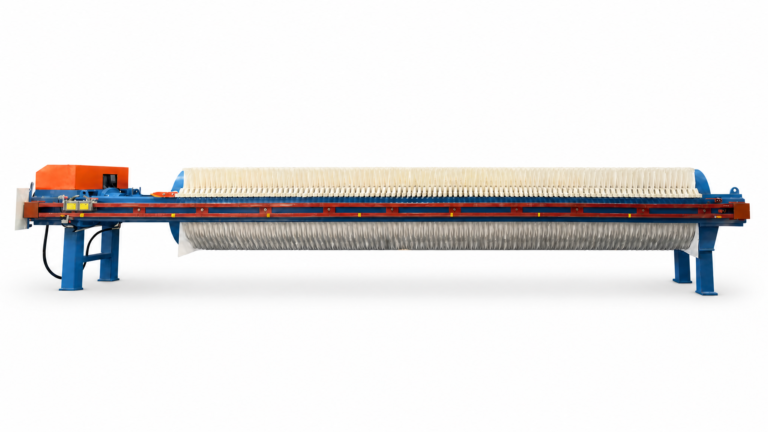
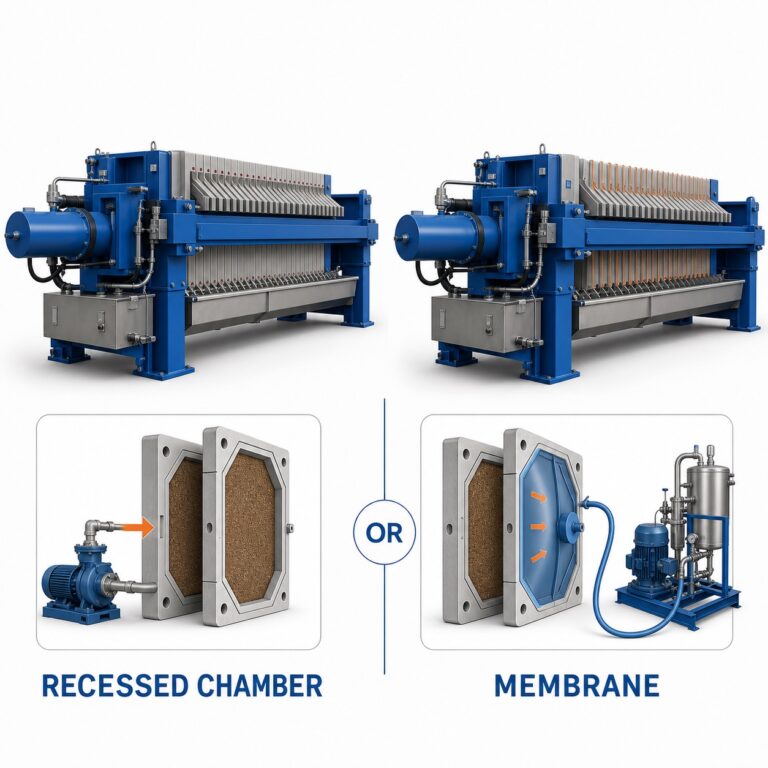
Le compromis à trouver ici concerne la sécheresse du gâteau et la surface de filtration. Un gâteau plus sec réduit le volume à manipuler et à éliminer, mais nécessite un temps de filtration plus long et une pression de pressage potentiellement plus élevée — ce qui oriente le choix de l’équipement vers un filtre-presse à membranes plutôt que vers une configuration à plaques encastrées. Si l’objectif d’humidité est fixé à un niveau plus strict que ne le permet la résistance à la filtration de la boue dans le temps de cycle disponible, la contrainte ne réside pas dans la taille du filtre-presse mais dans les attentes du procédé, et cette distinction doit être clarifiée avant de définir le volume de la chambre. Pour les applications où la sécheresse du gâteau détermine le choix, Filtre-presse à membrane Ces configurations offrent une fonctionnalité de phase de compression qui permet de modifier le taux d'humidité pouvant être atteint au cours d'un cycle donné.
Prendre en compte la durée du cycle (nettoyage et déchargement) dans le calcul de la capacité
Le temps de filtration n'est pas le temps de cycle. C'est précisément cette différence entre ces deux chiffres qui est à l'origine de la plupart des erreurs dans les calculs de capacité.
Pour les presses dont le volume de la chambre est égal ou inférieur à 125 pieds cubes, l’ouverture de la plaque, le purge d’air et l’évacuation du gâteau ajoutent environ 45 minutes à chaque cycle à titre de marge de sécurité — avant même qu’un seul litre du cycle suivant ne soit traité. Il s’agit d’un chiffre couramment utilisé par les professionnels, et non d’une spécification du fabricant, mais il reflète la réalité mécanique de ce qui se passe entre la fin de la filtration et le début du remplissage suivant. Un modèle de dimensionnement qui omet cette constante indiquera un débit suffisant sur le papier, alors que la presse accusera un retard dès la première équipe.
Lorsque le processus nécessite également un purge du noyau ou un lavage du gâteau, la constante de non-filtration dépasse ce seuil de référence de 45 minutes. La purge du noyau, destinée à dégager le canal d’alimentation, et le lavage du gâteau, visant à respecter une spécification de qualité du filtrat ou de teneur en solides résiduels, prennent chacune du temps qui se situe entièrement en dehors de la phase de filtration. Cette augmentation n’est pas fixe — elle dépend de la géométrie de la presse, du volume de lavage et de la durée du soufflage —, ce qui signifie qu’elle doit être estimée pour la configuration spécifique faisant l’objet du devis, et non considérée comme négligeable.
La conséquence en matière d'approvisionnement est directe : un devis qui indique la surface de filtration et le volume de la chambre sans préciser la durée de cycle supposée — et sans décomposer cette durée de cycle entre la phase de filtration et la constante hors filtration — ne peut pas être vérifié quant à l'exactitude de la capacité. Demandez aux fournisseurs de présenter la ventilation complète de la durée de cycle, y compris la marge prévue pour la manutention mécanique, avant d'accepter le dimensionnement comme valide. Pour une méthodologie de dimensionnement qui détaille les composantes de la durée de cycle, consultez le Guide de dimensionnement et de spécifications des filtres-presses à plaques encastrées décrit en détail chaque étape du calcul.
Précisez si le dimensionnement porte sur le débit de pointe moyen ou sur le débit futur
Tout modèle de dimensionnement nécessite un débit de conception, et le choix entre un débit moyen, un débit de pointe ou un débit futur prévu n’est pas un simple ajustement mineur : il détermine quelle presse doit être installée sur site pour toute la durée de vie de l’installation.
Le dimensionnement en fonction du débit journalier moyen implique que la presse fonctionne à pleine capacité dans des conditions normales et ne dispose d’aucune marge de manœuvre en cas de pics de débit d’alimentation — lors de périodes de forte production, de variations saisonnières ou de modifications des équipements en amont entraînant une augmentation de la consommation d’eau. Une presse fonctionnant à un taux d’utilisation de 100% sur un débit moyen ne dispose d’aucune marge de manœuvre pour faire face à un pic de production de 20% et ne peut pas prendre en charge une deuxième ligne de traitement sans être remplacée. Le dimensionnement en fonction du débit de pointe entraîne des coûts d’investissement supplémentaires, mais modifie le profil de risque : la presse fonctionne avec une marge de manœuvre dans des conditions normales, ce qui réduit également l’usure mécanique et prolonge la durée de vie des plaques.
Le débit futur relève d’une décision distincte qui nécessite des données issues de la planification de la production, et non de l’ingénierie des procédés. Si le site dispose d’un plan d’extension de capacité documenté couvrant la durée de vie de la presse, le dimensionnement doit refléter le volume futur prévu, et non la moyenne actuelle. Si l’extension est hypothétique, l’approche la plus justifiable consiste à dimensionner l’installation en fonction du débit de pointe mesuré et à s’assurer que la presse peut être étendue — en ajoutant des plaques ou en installant une unité en parallèle — sans avoir à la remplacer entièrement. Laisser cette question en suspens dans l’appel d’offres transfère cette hypothèse au fournisseur, qui n’a aucune base pour la formuler et qui a tout intérêt à opter pour un dimensionnement prudent, limité au seul volume indiqué.
Demandez aux fournisseurs d'exposer les hypothèses qui sous-tendent le choix du modèle
Les fournisseurs qui travaillent à partir d'appels d'offres incomplets comblent les lacunes avec des valeurs par défaut. Ces valeurs par défaut ne sont pas choisies au hasard — elles tendent à se situer autour de 30% de matières sèches dans le gâteau, d’une densité de gâteau de 75 lb/ft³ et de 3 cycles par journée de fonctionnement de 8 heures — mais elles ne sont pas validées par rapport à la boue réelle de l’acheteur, et le modèle de dimensionnement élaboré à partir de celles-ci n’est précis que dans la mesure où ces valeurs par défaut correspondent au processus réel.
Demander la divulgation de ces hypothèses constitue une vérification qui devrait figurer explicitement dans l'appel d'offres plutôt que d'être soulevée après réception des devis. Un fournisseur qui expose ouvertement ses hypothèses permet à l'acheteur de comparer les valeurs par défaut aux données de processus mesurées et d'identifier les écarts entre le modèle et la réalité. Un fournisseur qui ne précise pas ses hypothèses a produit un résultat de dimensionnement qui ne peut pas faire l'objet d'un audit.
| Hypothèse | Cas typique de défaillance d'un fournisseur | Pourquoi la validation est-elle importante ? |
|---|---|---|
| Matières sèches du gâteau | 30% | La valeur cible réelle d'humidité a modifié le volume requis de la chambre |
| Densité du gâteau | 75 lb/ft³ | Les variations de densité modifient la surface de filtration nécessaire par cycle |
| Cycles par journée de travail de 8 heures | 3 | La durée réelle du cycle peut varier ; la valeur supposée détermine la capacité de la presse |
Les conséquences en aval de l'acceptation de paramètres par défaut non validés apparaissent lors de la mise en service, lorsque la presse atteint le débit pour lequel elle a été conçue — et non le débit dont le site a réellement besoin. À ce stade, la solution consiste soit à exploiter la presse au-delà de son nombre de cycles prévu, soit à accepter un déficit de capacité et à acquérir des équipements supplémentaires. Ces deux options s'avèrent plus coûteuses qu'un audit des hypothèses réalisé avant l'appel d'offres.
Refuser les devis qui ne s'appuient pas sur les données de processus
Un devis qui ne repose pas sur des données de processus clairement définies ne constitue pas une estimation prudente : il s'agit d'un exercice de dimensionnement réalisé sans les données nécessaires pour procéder à un dimensionnement responsable, et l'accepter revient à transférer entièrement à l'acheteur le risque lié à un choix inapproprié.
La filtrabilité est la variable qui rend ce risque concret. Le sable se déshydrate en 10 à 30 minutes environ dans les conditions de pressage ; l’hydroxyde d’aluminium peut nécessiter 2 à 6 heures pour la même différence de pression. Une presse configurée pour un matériau serait nettement sous-dimensionnée pour l’autre, alors que les deux apparaissent dans les flux de déchets issus de la transformation industrielle de la céramique et de la pierre. Un devis qui ne précise pas quelle filtrabilité a été prise en compte dans le calcul du temps de cycle ne fournit aucune base permettant d’évaluer si ce temps de cycle est crédible pour la boue en question.
Les quatre données requises — type de boue, pourcentage de matières sèches, volume quotidien de boue et durée de traitement autorisée par jour — constituent les données minimales indispensables à tout modèle de dimensionnement pouvant faire l'objet d'une vérification. Leur absence constitue un motif techniquement valable justifiant le rejet du devis, et non pas simplement une préférence pour davantage de détails.
| Données obligatoires | Pourquoi c'est essentiel | Risque en cas de disparition |
|---|---|---|
| Type de boue (par exemple, sable, hydroxyde d'aluminium) | La durée de filtration varie entre 10 et 30 minutes et entre 2 et 6 heures | Le dimensionnement devient une question d'estimation ; risque de sous-performance |
| Pourcentage de matières sèches | Cela a une incidence directe sur la durée du cycle de remplissage et le volume du gâteau | Dimensions de la presse et répartition des cycles incorrectes |
| Volume quotidien de boues | Définit le nombre de cycles par jour et le volume par cycle | Il n'est pas possible de déterminer la capacité |
| Durée de traitement autorisée par jour | Définit la plage de fonctionnement pour les cycles de filtration | La presse risque de ne pas s'adapter au calendrier de l'usine ou au débit de pointe |
Cette distinction est importante en matière d’approvisionnement : un devis qui inclut ces données et précise ses hypothèses peut être comparé à des devis concurrents sur une base équivalente. Un devis qui les omet ne peut être évalué sur le plan technique, mais uniquement sur le plan tarifaire — ce qui signifie que tout avantage apparent en termes de coût reste invérifiable tant que la presse n’est pas mise en service. Pour les acheteurs qui souhaitent comprendre comment les données requises se traduisent par un calcul de dimensionnement spécifique avant d’envoyer l’appel d’offres, Comment calculer la capacité requise du filtre-presse en fonction du volume quotidien de boue et de la concentration de solides ? explique en détail la conversion du volume en capacité. Les options d'équipement pour les applications de boues de céramique et de pierre, où les teneurs en solides de la charge et les objectifs d'humidité du gâteau varient considérablement, comprennent à la fois Filtre-presse à plaques et cadres encastrés et les configurations des membranes en fonction de la position de la cible d'humidité par rapport aux performances pouvant être obtenues par drainage par gravité et par filtration standard.
La chose la plus utile qu’un acheteur puisse faire avant de lancer un appel d’offres est de distinguer les données qu’il a mesurées de celles qu’il a estimées — et de considérer les chiffres estimés comme des questions en suspens plutôt que comme des données d’entrée. La concentration en solides de la charge, le taux d’humidité cible du gâteau et le volume journalier maximal sont les trois paramètres le plus souvent supposés plutôt que confirmés, et chacun d’entre eux a un effet direct et traçable sur la surface de filtration, le volume de la chambre et la durée du cycle que le fournisseur calculera. Un devis qui n’indique pas comment ces paramètres ont été utilisés ne constitue pas un résultat de dimensionnement ; il s’agit d’un prix associé à un modèle invérifiable.
Avant de comparer les devis, assurez-vous que chaque fournisseur a précisé les teneurs en matières sèches de la matière première, le volume journalier, les heures de fonctionnement, la répartition de la durée des cycles (y compris la manutention mécanique) et l’hypothèse relative à la teneur en humidité du gâteau qui a motivé le choix de la chambre. Si l’un de ces paramètres diffère d’un devis à l’autre, la comparaison porte alors sur des scénarios de dimensionnement différents, et non sur des prix différents pour une même solution. C’est en résolvant cette divergence avant l’attribution du contrat que l’on parvient à gérer ou à transférer le risque lié au dimensionnement.
Questions fréquemment posées
Q : Que devons-nous faire si la concentration en matières solides de notre alimentation varie considérablement d'un poste à l'autre au lieu de rester stable ?
R : Effectuez des prélèvements sur l’ensemble des conditions de fonctionnement et dimensionnez l’installation en fonction du cas le plus défavorable (concentration la plus faible), et non de la moyenne intermédiaire. Une presse dimensionnée pour une valeur intermédiaire ne sera pas à la hauteur lors de chaque équipe où la teneur en solides de la charge tend vers l’extrême dilué — et dans le traitement de la céramique et de la pierre, cette dilution est souvent prévisible à partir des cycles de lavage ou des schémas de recirculation. La norme ISO 5667-13:2011 fournit des recommandations sur l’échantillonnage représentatif des boues lorsque la composition de la charge est irrégulière ou difficile à caractériser en un seul point.
Q : Une fois le dossier d'appel d'offres complet, quelle est la bonne méthode pour comparer deux devis qui indiquent des volumes de chambre différents pour une même capacité déclarée ?
R : Demandez aux deux fournisseurs la ventilation complète de la durée du cycle — durée de la phase de filtration plus marge pour la manutention mécanique — avant de comparer les volumes des chambres. Des volumes de chambre différents pour une même capacité reflètent presque toujours des hypothèses différentes concernant le nombre de cycles par équipe, les valeurs par défaut des solides d'alimentation ou les hypothèses relatives aux solides secs du gâteau. Tant que ces données n'auront pas été communiquées et recoupées avec vos données de processus mesurées, les deux devis porteront sur des scénarios de dimensionnement différents, et non sur la même solution à des coûts différents.
Q : La constante de 45 minutes sans filtration s'applique-t-elle quelle que soit la taille de la presse, ou varie-t-elle pour les configurations plus grandes ?
R : Le temps de planification de 45 minutes s'applique spécifiquement aux presses dont le volume de la chambre est inférieur ou égal à 125 pieds cubes. Pour les configurations plus grandes, la course de la plaque, la zone de déchargement et le volume de purge augmentent tous, de sorte que le temps de manutention mécanique dépassera cette valeur de référence. La bonne approche pour les presses plus grandes consiste à demander au fournisseur la constante de non-filtration indiquée pour la configuration spécifique faisant l'objet du devis, et non à reprendre par défaut la valeur prévue pour les petites presses.
Q : Une configuration à plaques encastrées est-elle toujours suffisante pour les boues de céramique et de pierre, ou faut-il adapter le type d'équipement en fonction du taux d'humidité souhaité ?
R : Le choix du type d'équipement doit dépendre de l'objectif de teneur en humidité, et non l'anticiper. Les presses à plaques encastrées assurent la déshydratation uniquement par la pression de filtration ; lorsque la teneur en humidité cible du gâteau est inférieure à ce que cette pression peut permettre d’atteindre dans le temps de cycle disponible, une configuration à membrane avec une phase de compression modifie les résultats obtenus sans allonger le cycle. Le critère de décision est de savoir si la teneur en humidité cible se situe dans la plage atteinte par la pression de filtration standard compte tenu de la résistance à la filtration de votre boue spécifique — ce qui ne peut être déterminé sans une mesure de la teneur en solides de la charge et une évaluation de la filtrabilité.
Q : Si le site prévoit une augmentation de sa capacité mais que celle-ci n'a pas encore été approuvée, est-il judicieux de dimensionner dès maintenant la presse en fonction des débits futurs ?
R : Déterminez la capacité en fonction du courant de crête mesuré et vérifiez explicitement auprès du fournisseur si la presse choisie peut être étendue — en ajoutant des plaques ou en exploitant une unité en parallèle — sans qu’il soit nécessaire de la remplacer entièrement. Le dimensionnement en fonction de volumes futurs hypothétiques entraîne des coûts d’investissement avérés pour répondre à un besoin non confirmé. La position la plus justifiable consiste à documenter le scénario d’extension dans l’appel d’offres afin que les fournisseurs conçoivent des solutions évolutives, tout en basant le dimensionnement principal sur le volume que vous pouvez mesurer et pour lequel vous pouvez vous engager dès aujourd’hui.