Mining Tailings Dewatering
Select a tailings dewatering route around the solids load, the water destination and the cake handover. These three requirements determine which filters to test and what the installation must connect to.
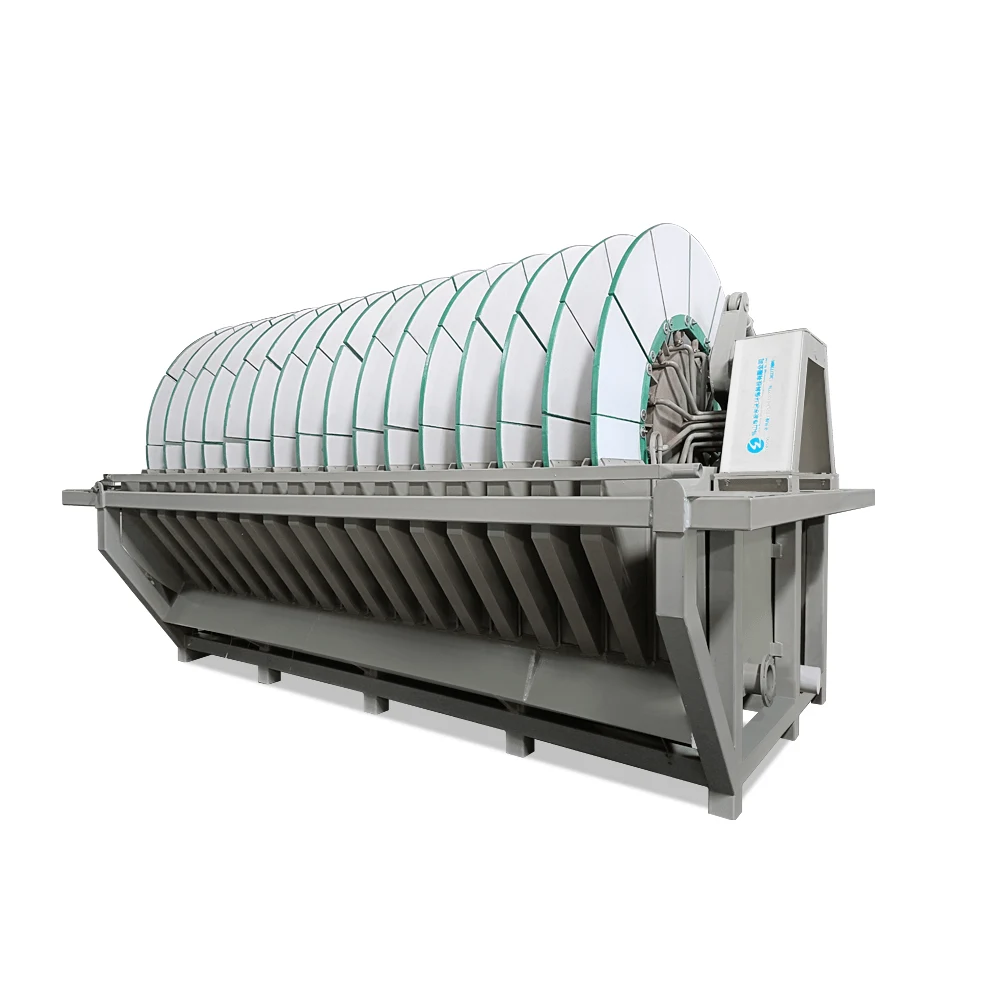
Compare Ceramic Vacuum, Cloth Vacuum and Membrane Pressure Filtration
| Route | When to shortlist it | What to check before committing |
|---|---|---|
| Ceramic disk vacuum | Continuous duty where the slurry forms a coherent cake on porous ceramic sectors, releases repeatedly and produces usable filtrate. | Track output before and after cleaning. If flow falls quickly and cleaning cannot sustain the required dry-solids rate, compare cloth media on the same feed. If vacuum cannot meet the cake handover, include pressure filtration. |
| Cloth disc vacuum | Continuous duty where trial cloths may offer a better combination of release, filtrate quality and sustained rate. | Check cloth blinding and wear, early filtrate quality and the proposed release mechanism. If acceptable release still leaves a cake too wet for the receiver, test pressure filtration against the same requirement. |
| Filtre-presse à membrane | Batch pressure filtration where an additional squeeze may help meet cake moisture or handling requirements that vacuum trials miss. | Measure any gain from squeezing against the added cycle time. Include filling, dewatering, squeezing, opening, discharge and scheduled cloth washing. Check buffer and conveyor capacity for batch discharge. |
See the vacuum ceramic disk filter product page for equipment construction and configuration options.
Define the Filter Feed and the Two Plant Handover Points
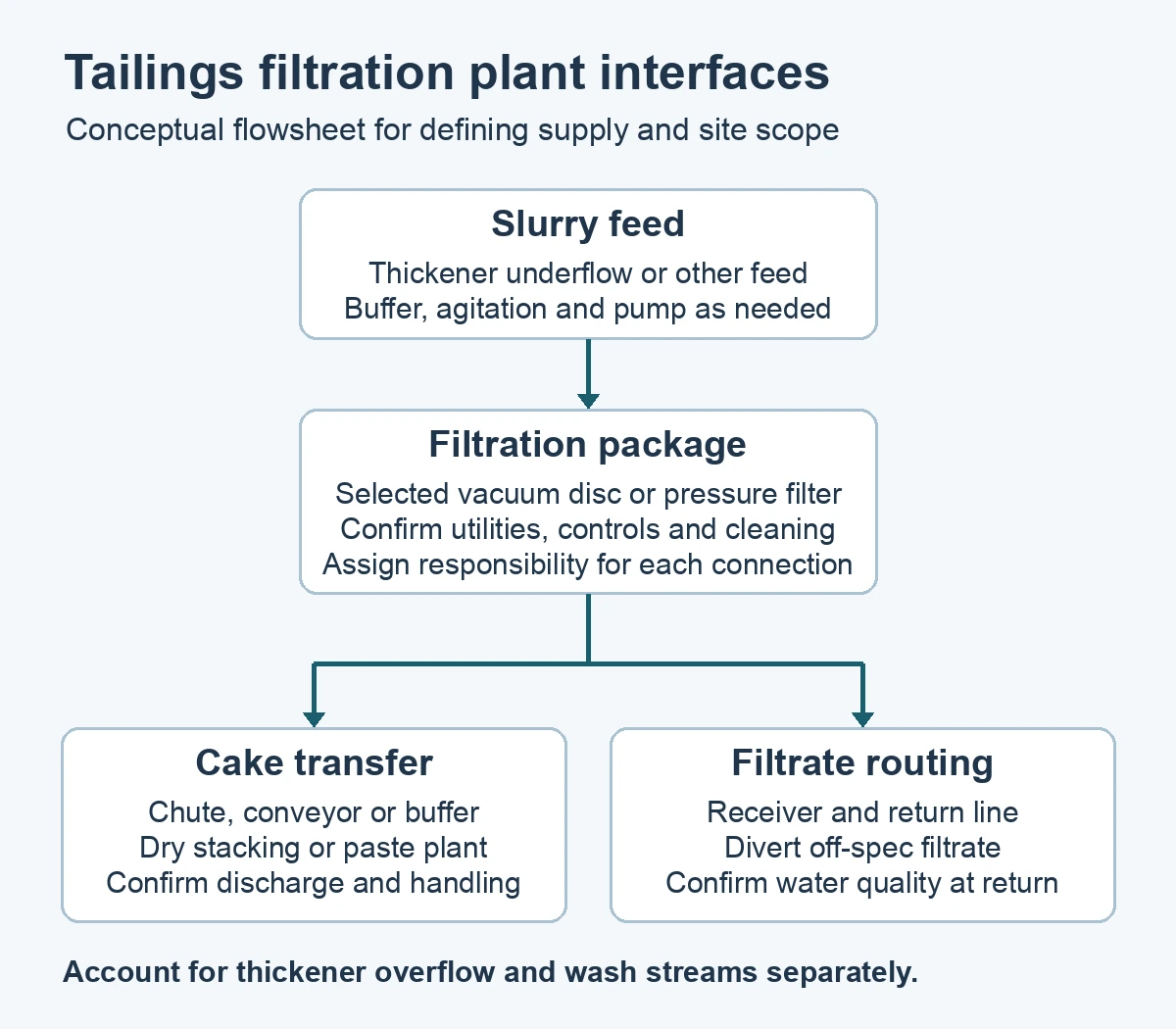
- Define the feed at the filter. Record normal and peak dry solids in tonnes per hour and the corresponding slurry solids by weight. Identify the feed point, any thickener or buffer, and credible shifts in fines, clay content, water chemistry and reagent carryover. At the same dry-solids load, dilute feed brings more water to handle and can change cake formation. A sample taken before thickening may behave differently from the underflow the filter will receive.
- Define acceptable cake at the receiving point. For dry stacking, work with the handling and geotechnical teams to agree the moisture range and how the cake will be conveyed, placed and compacted. For paste backfill, get the paste plant’s feed and mixing requirements. The useful target can differ between the two routes. Check discharge and transfer along with moisture. See dry stacking and paste backfill handover requirements.
- Define acceptable filtrate at the receiving process. Identify which circuit or tank can take it, the acceptable suspended solids and any relevant chemistry limits. Allow a route for startup or off-spec water. In the plant water balance, track thickener overflow, filter filtrate and wash streams separately, then subtract any water diverted or consumed within the circuit to estimate net usable return. See process water recovery.
When to Change the Shortlist
- The cake is wet even while the vacuum filter is operating steadily. Check whether additional drying time can meet the handover while keeping enough throughput. If it cannot, test a membrane press with the same feed and moisture basis. Compare the handling gain with the full press cycle and the buffer it needs.
- The nominal feed works but the fines-rich feed stalls. Check whether the problem tracks feed dilution, particle size, reagent changes or the medium. Evaluate buffering or feed conditioning where the plant can maintain it. Compare media on the difficult feed before sizing from a favorable sample. See sampling considerations by ore type.
- The cake meets spec but the water cannot go back to the plant. Sample startup and steady filtrate separately. If suspended solids are the issue, check media or routing options. If dissolved chemistry is the issue, confirm whether the receiving circuit can tolerate it or needs separate treatment. Changing the filter medium alone may leave dissolved species in the water.

Specify the Filter Package Around Your Plant
PORVOO can configure the scope around an existing circuit or a new filtration line. Define the following interfaces in the inquiry so suppliers quote against the same boundary.
- Adding a filter to an existing circuit: Share the available feed head, normal and peak slurry flow, discharge elevation and usable floor space. Confirm whether the existing feed tank and pump can supply the new filter and whether the receiving conveyor can handle the discharge pattern.
- Setting up a new filtration line: Ask for an itemized scope covering the filter and any required feed buffer, agitator, slurry pump, filtrate receiver, controls and cake transfer equipment. If a press is shortlisted, check the upstream buffer and downstream handling against the batch cycle.
- Reusing filtrate: Define where acceptable filtrate should return and where startup or off-spec water should go. Ask whether the quote includes the receiver, return pumps and diversion controls or leaves those interfaces to the site.
Agree the feed conditions and operating window before setting acceptance criteria. Record dry solids handled over the window, cake moisture and discharge at the handover, and filtrate quality at the return point. State which cleaning and interruption allowances are included.
Compare Tests on a Common Operating Basis
Use split samples from the same representative feed lots. Record normal and difficult feed conditions separately and document any conditioning used for each route. For vacuum filters, report dry-solids rate per active filtration area, measured at a realistic formation and drying time. For presses, divide dry solids per batch by the full cycle time and document how periodic washing and other downtime affect operating output. Compare the resulting net dry tonnes handled over the same operating window, alongside wet-basis cake moisture, discharge and usable filtrate.
For example, a press that discharges 5 dry tonnes every 30 minutes averages 10 dry tonnes per hour while cycling. With 60 minutes of additional planned washing in an eight-hour window, it would deliver 70 dry tonnes, or 8.75 dry tonnes per scheduled hour, assuming identical complete cycles in the remaining seven hours. This is a calculation example. Use measured cycle times and downtime in a project comparison. Ask each supplier to state which allowances are already included so that downtime is counted once.
Before ordering, agree how the filter plant will handle a feed surge, a cleaning stop and off-spec filtrate. Compare equipment on the same supply boundary, including feed buffering, filtrate handling, cleaning utilities and the cake transfer point. See the testwork checklist et engineering scope guide.
For independent technical background on integrating testwork, filtration and cake handling, see the Filtered Stacked Tailings: A Guide for Study Managers, published by the Tailings Management Consortium initiated by BHP and Rio Tinto.
Explore Equipment, Applications and Services
- Vacuum Ceramic Disk Filters for Mining Tailings for ceramic media and plant connections.
- Cloth Disc Vacuum Filter for cloth selection, cake release and utilities.
- Ceramic Filter Plates and Vacuum Disk Filter Spare Parts for identifying parts and checking compatibility.
- Tailings Dewatering by Ore Type for copper, gold, iron ore and coal tailings.
- Process Water Recovery from Mine Tailings for routing and checking recovered filtrate.
- Tailings Filtration for Dry Stacking and Paste Backfill for two distinct cake handovers.
- Tailings Filtration Testwork and Pilot Testing for samples and the test record.
- Tailings Filtration Engineering and Services for supply scope, retrofits and commissioning.
Le mine tailings dewatering guide describes the selection and testwork sequence in more detail.
Discuss Your Project
Send the feed point, normal and peak dry tonnes per hour, slurry solids by weight and any particle-size data. Add your cake destination and handling criteria, the filtrate return point and its limits, and the planned operating hours. A flowsheet or test report helps identify which routes to shortlist and which conditions to include in the comparison.