A mineral concentrate shipped by sea carries a dewatering target that cannot be set by the plant alone. Before any filtro prensa or disk filter is sized to hit a cake moisture number, the project team needs to know whether that number is a cargo transport requirement, a process design assumption, or something else entirely. Getting this sequence backwards — fixing an equipment target before the cargo basis is confirmed — creates rework risk that has nothing to do with filtration mechanics and everything to do with which rule actually applies to the shipment.
Establish Whether the Concentrate Falls Under an Applicable IMSBC Cargo Schedule
| Applicability check | What to establish | Límite de decisión |
|---|---|---|
| Cargo schedule | Whether the concentrate is covered by an applicable IMSBC cargo schedule | Do not derive a dewatering target until the applicable schedule is confirmed. |
| Cargo group | Whether the schedule identifies Group A or Group A and B | Use the TML and shipment-moisture evidence route only where the cargo classification makes it relevant. |
| Applicable IMSBC amendment | Which amendment applies to the shipment | Use the amendment currently applicable to the cargo and shipment; Amendment 07-23 is a reference, not an automatic universal basis. |
| Competent-authority requirements | Which requirements apply to the shipment | Include them in the shipment boundary before translating it into a plant target. |
The first judgment is not a dewatering question at all. It is a classification question: does the concentrate being produced fall under an applicable cargo schedule, and if so, which group does that schedule assign it to? This matters because the entire logic of a transportable moisture limit, and the shipment moisture evidence that accompanies it, only applies where the cargo schedule and group make that regime relevant. A concentrate that is not covered by an applicable schedule, or that falls outside the groups where moisture-limit evidence governs carriage, does not inherit a transport-driven moisture ceiling by default.
This is where many dewatering target discussions start in the wrong place. A plant manager or process engineer may ask what cake moisture a filter press or vacuum disk filter needs to achieve, when the prior question — whether an IMSBC-type limit even applies to this cargo, at this port, under this flag or competent authority — has not been settled. The schedule, the group, the applicable amendment, and the competent-authority requirements together define the shipment boundary. Until that boundary is confirmed, any dewatering number quoted as a target is an assumption, not a requirement.
The condition that changes this judgment is cargo identity and intended trade route. A concentrate processed at the same plant but sold into different markets, or declared under different cargo descriptions, can face different applicability outcomes. Where the schedule and group are confirmed and the cargo sits in the group range where moisture-limit evidence governs, the transportable moisture limit becomes a real constraint that dewatering performance must respect. Where the cargo falls outside that scope, the operating target for the dewatering stage is instead a process or commercial decision, not a derived transport limit, and should not be dressed up as one. The current IMO Resolution MSC.539(107), the 2023 Amendments to the IMSBC Code (Amendment 07-23 consolidated version), is a reference point for cargo-group scope and the moisture-limit and shipment-information regime — but it applies only to the applicable schedule, port, and competent authority for the actual shipment, not as a universal basis assumed for every concentrate.
Distinguish Shipment Moisture Evidence From Plant Cake Measurements
| Evidence or measurement | What it answers | Límite |
|---|---|---|
| Shipment moisture information and TML evidence | Whether applicable cargo moisture evidence is tied to the recognized sampling, testing, and certification route | It does not define a universal plant cake target or prove equipment performance. |
| Process cake measurement | What was measured in the dewatering process cake | It is not automatically a representative cargo sample and does not replace shipment evidence. |
Once a cargo is confirmed to fall within an applicable schedule and group, a second distinction becomes necessary before any number moves from the ship to the plant: shipment moisture evidence and plant cake measurement are not the same evidence, and one cannot substitute for the other.
Shipment moisture information and transportable moisture limit evidence exist to answer a specific question — is this cargo, as sampled and certified through the recognized route, safe to load and carry at its declared moisture content. That evidence is tied to a defined sampling, testing, and certification procedure that the cargo regime recognizes. It is built to represent the cargo as presented for shipment, not the output of any particular stage inside the dewatering process.
A cake moisture reading taken at a filter press discharge or a vacuum disk filter cake removal point measures something different: the moisture content of the material at that specific point in the dewatering sequence, under the sampling method used in the plant. That reading is useful for process control, performance tracking, and operating adjustment. It is not, on its own, a representative cargo sample, and treating it as equivalent to certified shipment moisture evidence skips the sampling and certification steps the cargo regime requires.
The condition that separates these two evidence types is representativeness. A process cake sample reflects the moment, location, and method of plant sampling; a cargo sample reflects the procedure the applicable cargo schedule recognizes for establishing shipment moisture. Where feed is uniform and dewatering performance is stable, the gap between the two may be small in practice — but the inputs do not establish how small, and closing that gap is a sampling and testing exercise, not an assumption. Where feed is variable, the gap can widen, and relying on plant cake readings alone to infer cargo compliance introduces risk that only a recognized cargo sampling and certification route is positioned to resolve. The buyer’s task at this stage is to keep the two evidence streams labeled separately rather than letting a convenient plant number stand in for a cargo certificate.
Translate Cargo-Specific TML Information Into a Conditional Operating Target
Even after the cargo schedule, group, and shipment moisture evidence are confirmed, the transportable moisture limit itself is not a plant setpoint. It is a shipment-side boundary, and converting it into an operating target for a dewatering line is a translation exercise, not a direct read-across.
The reasoning works like this: the TML defines the moisture level above which the cargo’s behavior during carriage becomes the governing concern. The plant’s dewatering operation produces material before that cargo is sampled, tested, and certified for shipment. Between the dewatering discharge point and the certified shipment condition sits handling, storage, blending, and time — any of which can change moisture distribution within the stockpile or cargo lot. A target set at the plant has to account for that distance, not simply mirror the TML value as though the two points in the material’s life were interchangeable.
This is also where the earlier distinction between shipment evidence and plant cake measurement becomes practically consequential rather than just conceptual. If the project team treats the TML as a cake moisture specification and designs the dewatering stage to hit that number exactly, the margin between dewatering discharge and certified cargo condition has been assumed away rather than tested. Where storage and handling conditions are well understood and consistent, that margin may be narrow; where they are not yet characterized, assuming it away carries risk the inputs do not allow this article to quantify.
The translation, then, is conditional rather than fixed. It depends on how the project defines the relationship between the TML, the shipment sampling and certification point, and the dewatering discharge point — and that relationship has to be established through the project’s own testwork and handling assessment, not asserted as a general rule. A dewatering target derived this way is a plant-specific operating figure that reflects the project’s margin decision, not a republished cargo transport limit.
Align Feed Variability and Testwork With the Dewatering Target
| Target-setting factor | What to test or compare | How it affects use of the target |
|---|---|---|
| Variabilidad en la alimentación | How changing feed conditions affect dewatering results | Derive the operating target with feed variability included rather than assuming one fixed condition. |
| Sampling uncertainty | Uncertainty in the samples used to compare cake and cargo moisture | Interpret measured differences with sampling uncertainty included. |
| Process cake versus representative cargo sample | Whether the measured sample represents process cake or shipment cargo | Keep these evidence types separate when assessing the operating target. |
| Plant testwork | The relationship between dewatering performance and the shipment boundary for the project feed | Use testwork to derive the plant operating target; shipment TML information alone does not set it. |
A dewatering target set from a single feed condition or a single comparison between cake and cargo samples is fragile the moment the feed changes — and concentrate feed does change, as ore source, blending ratio, or upstream process adjustments shift. The operating target has to be derived with that variability built in, not treated as a one-time calculation performed under one set of conditions and then fixed.
This is a testwork question as much as a process-design question. Plant testwork that spans the range of feed conditions the project expects gives the dewatering target a basis that holds up under normal operating variation. Testwork performed under a single, possibly best-case, feed condition gives a target that may not hold once feed shifts. The condition that changes the judgment here is exactly that: where feed is consistent and well characterized, a narrower band of testwork may be sufficient to support a stable target; where feed composition or moisture varies across sources, blends, or campaigns, the testwork needs to capture that range before the target can be treated as reliable across the project’s operating life.
Sampling uncertainty compounds this. Any comparison between a process cake sample and a reference cargo sample carries uncertainty from the sampling method itself, independent of real differences in moisture content. A measured gap between the two has to be interpreted with that uncertainty in mind rather than read as a precise, repeatable offset. This is also where the distinction between process cake and representative cargo sample, introduced earlier, becomes an active part of target-setting rather than a background definition: the testwork program needs to generate samples that can honestly be called representative of each category, or the comparison between them is not meaningful.
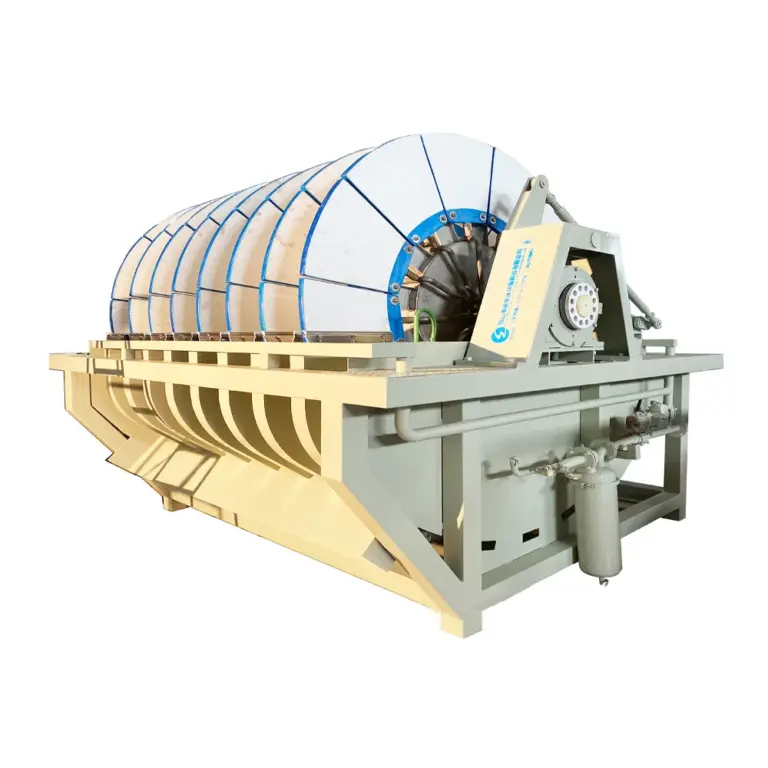
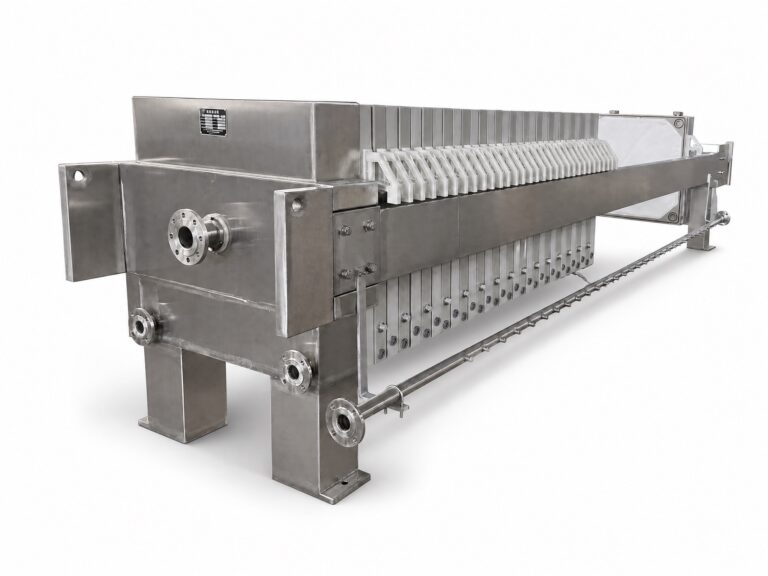
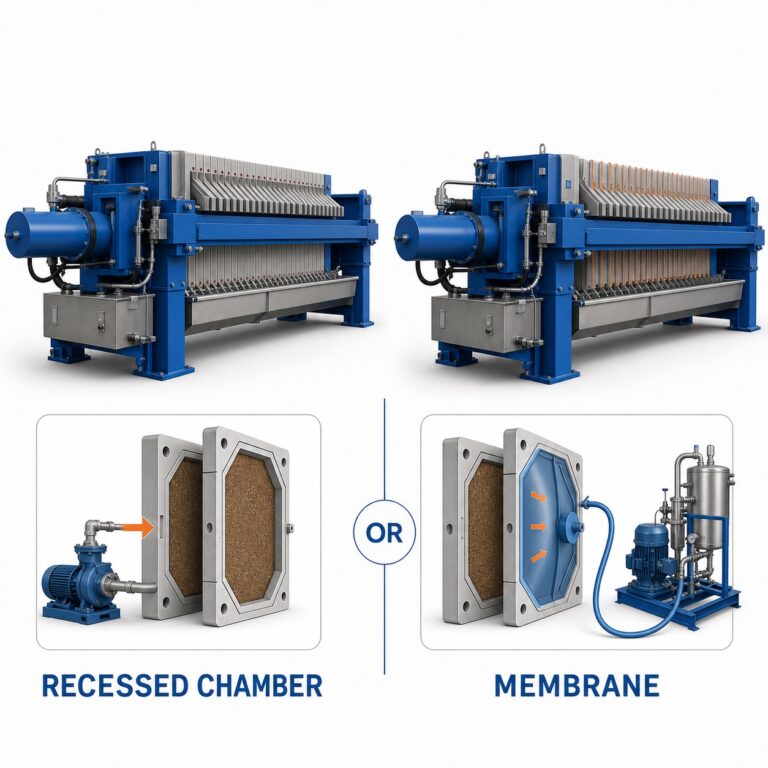
For equipment selection and configuration, this means the dewatering target feeding into a filtro de disco cerámico al vacío or filter press specification should be the output of testwork across the expected feed range, not a single figure handed to the equipment supplier as fixed. When a project submits its feed characterization and testwork results for configuration or quotation review, that range — not a single target point — is the information that lets the equipment configuration be matched to how the material actually behaves across operating conditions, rather than to one representative moment.
Define Sampling, Testing, Certification, and Responsibility Boundaries
| Límite | What belongs within it | What it must not be used to establish |
|---|---|---|
| Cargo sampling, testing, and certification | Shipment moisture and TML evidence for an applicable Group A or Group A and B cargo, tied to the recognized route | Equipment performance acceptance or a PORVOO supply claim |
| Marine cargo acceptance | The cargo schedule, applicable amendment, port, competent-authority requirements, and shipment evidence | Equipment performance acceptance |
| Equipment performance acceptance | Project-specific equipment test and acceptance evidence | Marine cargo acceptance or cargo certification |
| PORVOO supply claim | Evidence specific to the PORVOO equipment and supply under review | Cargo classification, TML, or shipment moisture evidence alone |
Four distinct boundaries sit around this subject, and keeping them separate prevents evidence from one from being asked to do the work of another.
Cargo sampling, testing, and certification is the route recognized for establishing shipment moisture and TML evidence for an applicable Group A, or Group A and B, cargo. This route produces the evidence that marine cargo acceptance relies on. It does not produce evidence of equipment performance, and a certificate obtained through this route says nothing about whether a particular dewatering machine met its process guarantee.
Marine cargo acceptance draws on the cargo schedule, the applicable amendment, the port and competent-authority requirements, and the shipment moisture evidence together. It answers whether the cargo, as presented, may be carried. It does not answer whether the equipment that produced that cargo performed to its design or contractual specification — that is a separate acceptance question entirely, resolved through project-specific equipment test and acceptance evidence.
Equipment performance acceptance sits on the plant side: it is built from the test conditions, feed material, and acceptance criteria agreed for that specific equipment and project. It cannot be inferred from a cargo certificate, and a cargo certificate cannot be inferred from it. A dewatering line can produce cake that supports a successful cargo certification while separately being subject to its own equipment acceptance test under entirely different criteria and evidence.
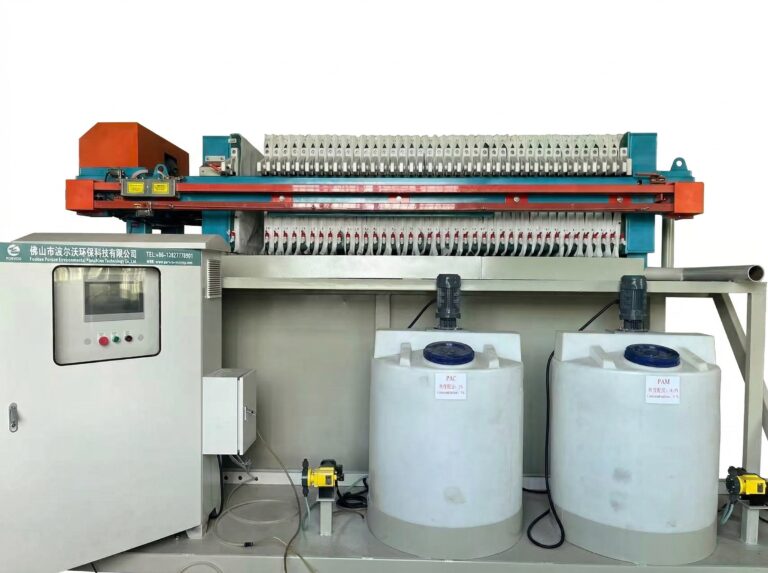
The fourth boundary is any claim tied specifically to equipment supplied by PORVOO. Evidence of PORVOO equipment performance has to be specific to the equipment and configuration under review — the documented test conditions, feed, and configuration for that supply — and cannot be established merely by reference to cargo classification, TML values, or shipment moisture evidence, none of which describe equipment behavior. When a project is evaluating a vacuum ceramic disk filter or a filter press for a concentrate dewatering duty, the cargo-side documentation establishes what the shipment needs to achieve; it is a separate exercise, resting on separate evidence, to confirm what the specific equipment configuration can be expected to deliver against the plant’s own operating target.
Record the Applicable Amendment and Competent-Authority Requirements
The schedule, group, and shipment-evidence judgments made earlier are not static once confirmed for a project — they are specific to a point in time and a jurisdiction, and both can change. The applicable IMSBC amendment governing a shipment is the version in force for that cargo at that time, and amendments are periodically updated; a project that confirmed its basis under one amendment needs to reconfirm it if the shipment timeline crosses into a period where a newer amendment applies. Treating an earlier confirmation as permanent skips a check that the regime itself requires to be revisited.
Competent-authority requirements add a second axis of specificity. These requirements are tied to the particular flag, port, and jurisdiction involved in the shipment, and they can differ between ports or authorities even for the same cargo schedule and group. A project with multiple shipment destinations, or with a shipment plan that spans different competent authorities over time, cannot assume that the applicability and evidence requirements confirmed for one port or one shipment carry over unchanged to another.
The practical consequence is that the applicability work done at the start of this process — confirming schedule, group, amendment, and competent-authority requirements — is not a one-time gate passed before dewatering target-setting begins. It is a record that needs to be current at the time each shipment is prepared, with the amendment and authority requirements re-verified against whatever is in force for that specific cargo, port, and shipment window. Where a project ships on a recurring basis to a single port under stable requirements, this re-verification may be straightforward; where destinations, authorities, or amendment cycles change between shipments, the verification step itself becomes part of the project’s ongoing compliance work, separate from and prior to any dewatering or equipment-configuration decision.
Preguntas frecuentes
Q: Can the shipment TML be used directly as the filter cake moisture setpoint?
A: No. First establish the applicable cargo schedule, cargo group, IMSBC amendment, competent-authority requirements, and shipment evidence route; then use plant testwork, feed variability, and sampling uncertainty to derive a project-specific operating target.
Q: Does a process cake result below the shipment moisture boundary demonstrate that the cargo is acceptable?
A: Not by itself. A process cake sample is not automatically representative of the shipped cargo, so record what each sample represents and keep the recognized cargo sampling, testing, and certification evidence separate from the process measurement.
Q: What information should be included when requesting dewatering testwork for a concentrate project?
A: Provide the confirmed cargo schedule and group, the applicable amendment and competent-authority requirements, the expected range of feed conditions, and a plan that distinguishes process cake samples from representative cargo samples. Ask the testwork to show how dewatering results relate to the shipment boundary under those stated conditions.
Q: When should an established plant operating target be reviewed again?
A: Review it when the applicable cargo schedule or amendment changes, competent-authority requirements differ, feed conditions move beyond the tested range, or the sampling basis no longer represents the cargo. Each change can alter how the target should be interpreted even if the equipment has not changed.
Q: How should an equipment RFQ keep cargo acceptance separate from filter performance acceptance?
A: Define separate evidence and acceptance sections. Place shipment sampling, testing, certification, and marine cargo acceptance in the cargo section; place project-specific equipment tests and acceptance evidence in the performance section; and require any PORVOO supply claim to be supported by evidence specific to the offered equipment and scope.