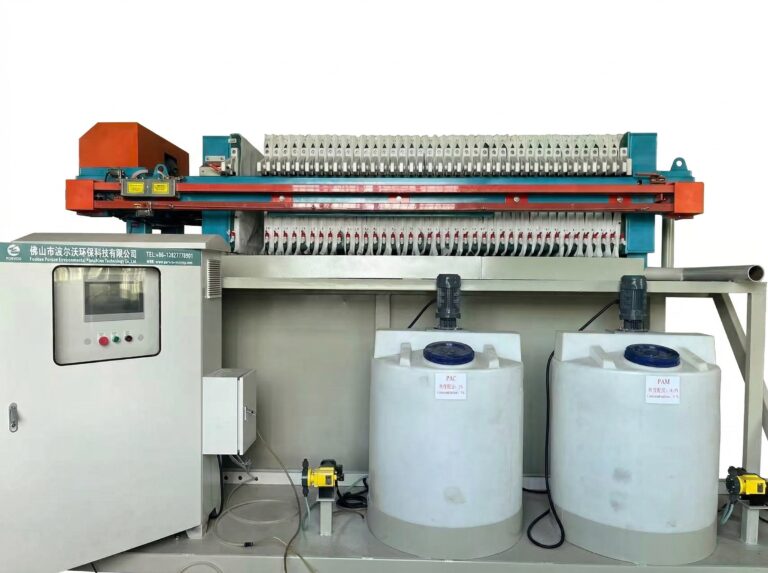
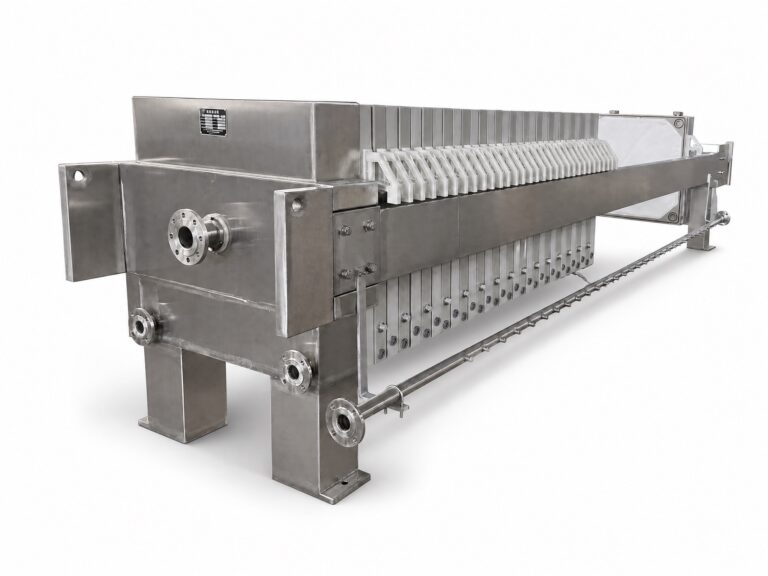
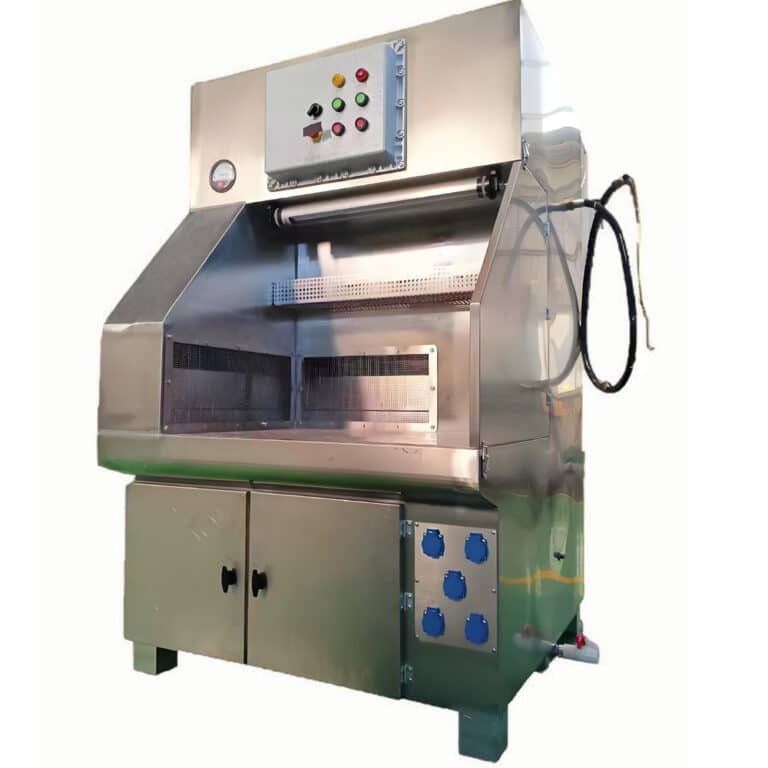
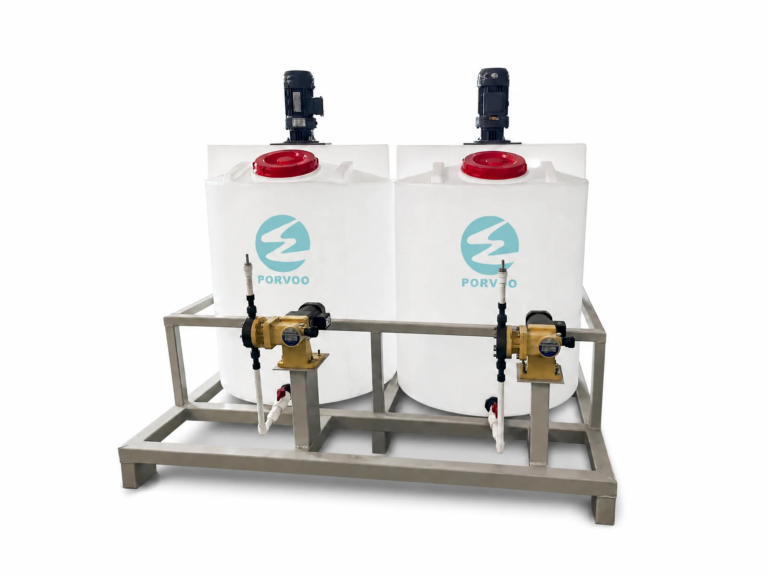
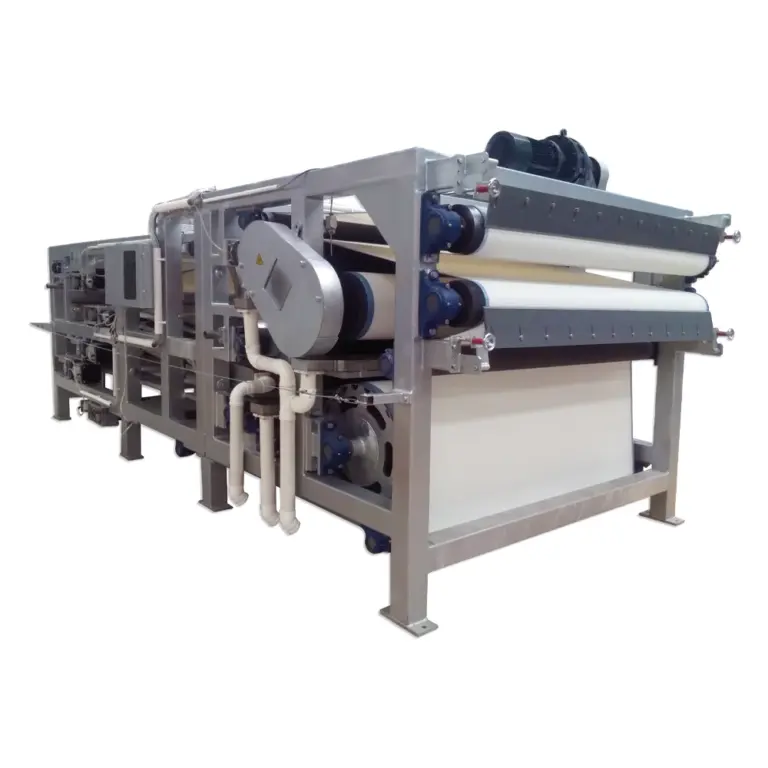
A round-plate filter press trial can produce a clean moisture number and still leave the scale-up question unanswered, because the number means something different depending on what feed state, configuration, and cycle activity produced it. Before a plant manager or process engineer carries pilot results into a sizing conversation, the test program itself needs to be checked for what it actually represents and what it leaves open.
Representative feed states the test program must include
| Feed state to include | Basis to document | Scale-up question addressed |
|---|---|---|
| Representative production feed state | Solids condition, sample preparation, and any conditioning used | Does the run represent a feed state the full-scale press must handle? |
| Meaningful change in solids condition | The changed solids condition and the corresponding run results | Does filtration behavior remain suitable across the expected feed variation? |
| Each conditioning case used before filtration | Conditioning applied and the resulting feed state | Can results from different preparation bases be interpreted separately? |
A test result only answers the production question if the material fed to the press during the trial resembles what the full-scale press will actually receive, run after run. Slurries rarely arrive at a plant in one fixed condition. Solids content shifts with upstream process changes, storage time, and blending; particle structure changes with upstream mechanical or chemical treatment; and conditioning agents, where used, change the slurry’s filtration character before it ever reaches the plate pack. A single feed sample tested once describes that sample, not the range of feed states the press must handle over time.
Where a project’s upstream process is stable and well characterized, a narrower feed-state coverage may reasonably represent production conditions. Where upstream conditions vary meaningfully, by solids concentration, particle condition, or conditioning practice, the test matrix needs to include that variation deliberately rather than treat one favorable sample as representative. The judgment a buyer must make is not whether a result is good, but whether the feed state behind that result is the one the press will actually see in operation, and whether other feed states the press must also handle were tested at all.
Conditioning deserves separate attention because it changes the slurry rather than the press. If a conditioning step is used before filtration in production but omitted during testing, or applied differently, the filtration behavior recorded in the trial reflects a feed state the production press may never encounter. Each conditioning case used, including no conditioning, is effectively a different test material and needs its own documented run and result rather than being folded into a single reported outcome. A buyer reviewing a test report should be able to trace every reported run back to a specific, named feed state and conditioning basis, and should treat any run where that basis is unclear as incomplete evidence rather than a usable data point.
Test configuration details needed to interpret each run
| Configuration item | Detail to identify for each run | Why the detail matters |
|---|---|---|
| Plate and chamber arrangement | The arrangement tested | Identifies the physical test basis behind the result |
| Cloth | The cloth used and its observed condition | Connects the recorded behavior to the tested cloth condition |
| Pump and pressure sequence | The pump and pressure sequence applied | Defines the operating sequence behind the fill and filtration observations |
| Sample preparation | Preparation steps and any conditioning used | Links the run to its documented feed state |
| Measurement method | The method used for each reported measurement | Allows another supplier to interpret the result on the same stated basis |
Moisture and filtrate results are properties of a system, not of the slurry alone. The same slurry run through a different plate and chamber arrangement, a different cloth, or a different pump and pressure sequence can produce a different cycle time and a different cake condition. This means a reported result is only interpretable once the configuration that produced it is also known, in the same way a feed state must be known before a result can be trusted.
The plate and chamber arrangement sets the filtration area and the physical volume available per cycle, which shapes how fill and filtration proceed and how the cake eventually forms and releases. The cloth governs how filtrate passes and how cleanly the cake separates from the surface at the end of a cycle; cloth condition can change across repeated use within a test program, and a worn or blinded cloth late in a trial will not behave like a fresh one used earlier. The pump and pressure sequence determines how fill and filtration are actually carried out, including how pressure is built and held, which shapes both filtrate clarity over time and how long the productive part of the cycle runs. Sample preparation and the measurement method used for each reported value complete the basis: a moisture reading taken by one method is not directly comparable to one taken by another, and a sample prepared differently from the production feed will not filter the same way regardless of press configuration.
A trial report that omits any of these details leaves the buyer unable to tell whether a favorable result reflects the slurry’s inherent filterability or a configuration choice specific to that test run. Where a buyer is comparing results from more than one supplier or more than one test date, this configuration record is what allows the comparison to be made on a like basis at all, rather than comparing numbers whose origin cannot be reconstructed.
Moisture, filtrate, cake release, and cycle observations to record together
| Run element | Observations to record together | Decision value |
|---|---|---|
| Feed basis | Feed condition, sample preparation, and conditioning used | Keeps the outcome tied to the slurry state actually tested |
| Fill and filtration | Fill and filtration steps, pump and pressure sequence, filtrate observations, and cloth condition | Shows the productive filtration behavior under the stated setup |
| Cake outcome and unloading | Moisture measurement, cake release, and unloading activity | Connects the dewatering result with practical cake handling |
| Cleaning and reset | Cleaning and reset activity | Captures availability constraints outside active filtration |
| Whole cycle | Total cycle activity for the run | Prevents a single moisture or filtrate result from standing in for the complete cycle |
A single moisture percentage or a single filtrate description cannot establish whether a press configuration fits production, because moisture and filtrate are outcomes of a cycle that also includes fill behavior, cloth performance, cake release, and the activity that surrounds active filtration. Reporting only the headline number discards the information needed to judge whether that number is repeatable, whether it came at the cost of a long cycle, or whether the cake that produced it actually released cleanly from the cloth.
Fill and filtration behavior, including how filtrate quality evolves and how the cloth performs under the applied pump and pressure sequence, shows whether the productive part of the cycle is behaving as expected for the tested feed state. A moisture result paired with poor filtrate clarity or a struggling cloth tells a different story than the same moisture result achieved with clean filtrate and stable cloth performance, even though the moisture figure alone would look identical in both cases. Cake release and unloading activity matter because a press that achieves low moisture but releases the cake poorly, requiring extended manual intervention, is not demonstrating the same practical performance as one where the cake drops cleanly. Cleaning and reset activity, and the total cycle time these add to, determine how much of the cycle is actually productive filtration versus activity that constrains how often the press can run.
Where a buyer evaluates a press primarily on cake moisture, a configuration that achieves excellent moisture through an extended cycle, or through cake behavior that complicates unloading, can still underperform a configuration with modestly higher moisture but faster, cleaner cycling. Which trade-off is acceptable depends on what the project actually needs from the press, throughput, cake handling simplicity, or minimum moisture, and that judgment is only possible when all of these observations are recorded against the same run rather than reported separately or selectively. This is also the level of detail referenced in supplier acceptance testing discussions around cake moisture, filtrate quality, and cycle time, where the same principle, that no single measurement substitutes for the full cycle record, applies.
Repeat runs and slurry variation before drawing scale-up conclusions
A single successful run, however completely it is documented, demonstrates that a configuration can produce a given result once, under one instance of a feed state that may itself vary from batch to batch. It does not demonstrate that the same configuration will produce a comparable result reliably, because slurry behavior is rarely perfectly constant even within what is nominally the same feed state. Variation in particle condition, solids concentration, or conditioning consistency between batches can change filtration behavior in ways a single run cannot reveal.
Repeat runs under the same stated feed state and configuration test for this kind of variation directly. Where repeat runs produce closely similar moisture, filtrate, and cycle results, that consistency supports treating the configuration’s behavior as reasonably predictable for that feed state. Where repeat runs diverge, the divergence itself is informative: it may point to uncontrolled variation in the feed material between runs, to a configuration that is sensitive to small feed changes, or to a measurement or procedural inconsistency in how the trial was conducted. Any of these explanations changes what the buyer should do next, and distinguishing between them usually requires looking at the feed-state documentation and configuration record alongside the results rather than at the outcome numbers alone.
Slurry variation across the feed states a production press must handle is a separate question from repeatability within one feed state, though both affect the same scale-up conclusion. A configuration validated carefully for one feed state but never tested against a meaningfully different one, higher solids content, a different conditioning case, or altered particle condition, has not been validated for the full range of conditions the production press will encounter. Where a project’s upstream process is expected to deliver a narrow, stable feed state over the press’s operating life, this gap matters less. Where upstream conditions are expected to vary, an unaddressed gap in feed-state coverage leaves open exactly the conditions under which the press is least proven, which is a different and more consequential uncertainty than ordinary run-to-run repeatability.
Scale-up limits between pilot evidence and a production press
| Evidence area | What the pilot evidence can inform | What remains to be confirmed |
|---|---|---|
| Productive filtration behavior | Fill, filtration, filtrate, moisture, and cake-release behavior under the tested setup | Behavior outside the tested feed state, configuration, sequence, and measurement basis |
| Practical availability | Unloading, cleaning, reset, and total cycle activity observed during the runs | Availability under the production press’s actual operating conditions |
| Variation and repeatability | Results across the feed states and repeat runs included in the program | Untested slurry states and repeatability at production scale |
| Equipment basis | Results for the documented plate and chamber arrangement, cloth, pump, and pressure sequence | The final production configuration and its project-specific scale-up basis |
Pilot or bench-scale results carry real information, but they carry it about a specific tested system: a specific feed state, a specific plate and chamber arrangement, a specific cloth and pump and pressure sequence, and a specific sample preparation and measurement basis. Scale-up is the act of deciding how far that information extends beyond the system that was actually tested, and that extension has limits that depend on what the test program covered.
Productive filtration behavior, the fill and filtration performance, filtrate quality, moisture achieved, and cake-release behavior observed under the tested setup, is the part of the evidence most directly transferable, provided the production feed state and configuration resemble what was tested. Practical availability, the unloading, cleaning, reset, and total cycle activity observed during the trial, is equally part of the evidence but answers a different question: how much of the cycle time is consumed by activity outside active filtration, and whether that pattern is likely to persist at larger scale. Neither of these, on their own, establishes how the press will behave across feed states or configurations that were not part of the tested program, and neither establishes behavior at the production press’s actual scale and operating conditions, which is a separate confirmation step beyond the pilot evidence itself.
The EPA Biosolids Technology Fact Sheet on recessed-plate filter presses, within its scope of US municipal biosolids guidance, frames pressure filtration cycles, cloth condition, filtrate, cake discharge, and the representative bench or vendor pilot testing behind sizing decisions in comparable structural terms, supporting the general point that representative testing and attention to the full cycle underlie sound scale-up judgment, independent of the specific moisture or cycle-time values appropriate to any particular industrial slurry. Where a buyer is working with an industrial slurry rather than municipal biosolids, the specific numbers from that guidance do not transfer, but the discipline of matching test basis to production conditions does.
Where the production configuration under consideration matches the tested plate and chamber arrangement, cloth, and pump and pressure sequence closely, and the feed states tested cover the range expected in production, the pilot evidence supports a more confident estimate. Where the production configuration departs from what was tested, larger plate and chamber arrangement, a different cloth, or an adjusted pressure sequence, the pilot evidence still informs the estimate but no longer substitutes for confirmation at the configuration and scale actually proposed for the project.
Decision record for accepting estimates, retesting, or changing configuration
| Decision | Evidence condition | Boundary to record |
|---|---|---|
| Carry estimates forward | Representative feed states were tested; configuration and measurement methods are identified; moisture, filtrate, cake release, and cycle activity were assessed together; repeat runs support the interpretation | Treat the estimates as conditional on the tested feed states and setup, with final production performance still subject to scale-up confirmation |
| Retest | A meaningful feed variation or conditioning case is missing, repeatability is unclear, or key run observations lack a documented basis | State the missing evidence and the exact feed state or run basis to be tested |
| Change configuration and retest | The tested plate and chamber arrangement, cloth, or pump and pressure sequence does not provide the required balance of filtration behavior and practical availability for the project | Identify the changed configuration and keep its results separate from the earlier test basis |
Once feed-state coverage, run configuration, combined cycle observations, and repeatability have been reviewed, the buyer’s task is to decide what to do with the resulting evidence: treat it as sufficient to carry forward as an estimate, identify specific gaps that call for retesting, or conclude that the tested configuration itself needs to change before further testing is useful.
Carrying estimates forward is reasonable where the feed states tested represent the production feed basis, including its meaningful variation and conditioning cases; where the plate and chamber arrangement, cloth, pump and pressure sequence, sample preparation, and measurement method are all identified; where moisture, filtrate, cake release, and cycle activity were recorded together rather than reduced to a single figure; and where repeat runs support the consistency of the result. Even then, the estimate remains conditional on the tested feed states and setup, with the production press’s actual performance still subject to confirmation at its own scale.
Retesting is the appropriate response where a specific, nameable gap exists rather than a general sense that more data would help: a feed variation or conditioning case the production process will encounter but the test program did not include, repeatability that was not checked, or run observations, cloth condition, cake release, cleaning and reset activity, reported without a clear basis. In each case, the gap points to the exact feed state or run condition that still needs a test result, which is more useful to the buyer and to the supplier reviewing the request than a general call for additional testing.
Changing configuration and retesting is warranted where the evidence itself shows the tested plate and chamber arrangement, cloth, or pump and pressure sequence does not deliver the balance of filtration behavior and practical availability the project needs, for instance where moisture is acceptable only at the cost of cake release problems or extended cleaning and reset activity that the combined cycle record has already revealed. In that case, results from the changed configuration should be kept distinct from the earlier test basis rather than blended with it, since they describe a different tested system. This is the same project information, feed states, conditioning, configuration details, and combined cycle results, that feeds into how a supplier’s configuration or quotation review for a round plate filter press is actually conducted, and it is also the basis on which delivery, commissioning, and maintenance planning for the selected press configuration proceed once a production decision is made.
Frequently Asked Questions
Q: How should we choose slurry samples when feed conditions change during production?
A: Define the meaningful production feed states separately and include a sample for each state the press must handle. Record the solids condition, sample preparation, and any conditioning for every sample so a blended or convenient sample does not hide a difficult operating case.
Q: Can the lowest cake-moisture result be used as the basis for selecting a production press?
A: Not by itself. Use that result only with its documented feed state, test configuration, measurement method, filtrate observations, cake release, total cycle activity, and repeat-run behavior; otherwise it does not show whether the tested route is practical or repeatable for production.
Q: How can we make test results from different suppliers easier to compare?
A: Give each supplier the same defined feed cases and ask them to report the plate and chamber arrangement, cloth, pump and pressure sequence, sample preparation, measurement methods, and complete cycle observations. Keep any differences in conditioning or configuration visible, because results from different test bases should not be treated as direct equivalents.
Q: When should a slurry test be repeated instead of carrying its estimates into scale-up?
A: Retest when a feed state or conditioning case the production press must handle was not covered, repeat runs do not support a stable interpretation, or a key result lacks its configuration or measurement basis. Target the missing or changed case and keep the new evidence separate if the plate arrangement, cloth, or operating sequence changes.
Q: What should we prepare before asking for a full-scale round-plate press proposal?
A: Prepare the expected feed states and variations, sample preparation and conditioning details, the complete test configuration, measurement methods, combined run records, and practical constraints around unloading, cleaning, and reset. Ask the proposal to identify which estimates come from the tested basis and which items still require project-specific production confirmation.