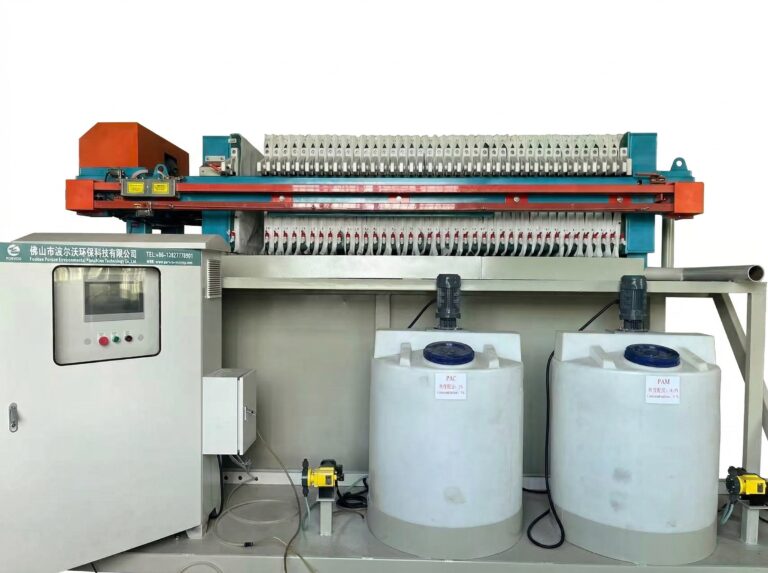
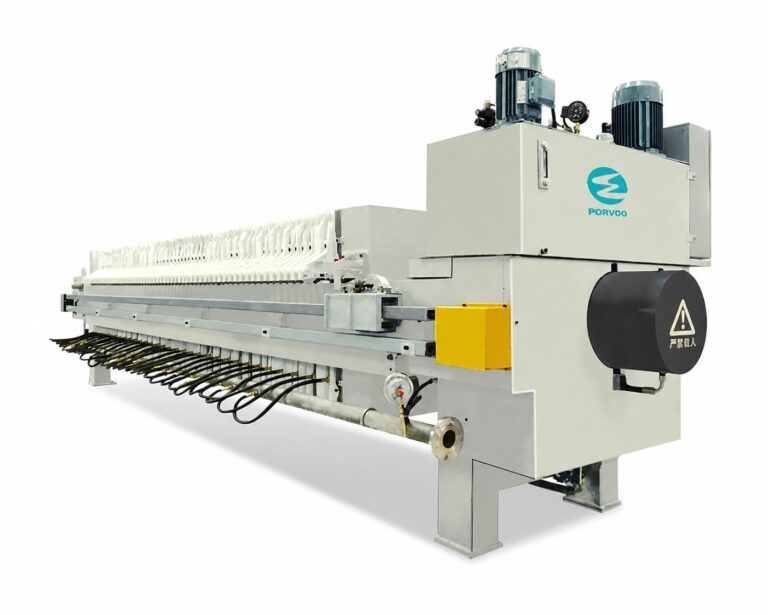
A plate-and-frame filter press that keeps losing availability puts the plant in front of a recurring decision: spend again on the machine that is already installed, or commit capital to a replacement. The answer depends less on which component has just failed than on what the full condition record shows, and on whether the faults driving downtime are bounded or compounding.
Establish the press condition and recurring loss of availability
| Assessment area | Condition evidence to record | How it informs the decision |
|---|---|---|
| Cycle history and downtime | Recent cycle history and the pattern of lost availability | Shows whether downtime is repeated or confined to a bounded fault |
| Leakage | Observed leakage condition and whether it recurs | Helps separate a local repair need from a broader condition problem |
| Hydraulics and plates | Current hydraulic and plate condition | Identifies component work that must be included in the refurbishment scope |
| Frame and structural base | Evidence that the frame and structural base remain serviceable | Establishes whether the machine retains a credible foundation for refurbishment |
| Controls and guarding | Current control condition, guarding condition and identified safety work | Exposes retrofit, obsolescence and safety scope that can alter the capital choice |
| Documentation and spares | Available documentation, compatible spare parts and support | Tests whether the press can be maintained and supported after refurbishment |
Before any repair-or-replace judgment can be made, the plant needs a condition record that goes beyond the immediate failure in front of the maintenance team. A single leaking plate or a hydraulic fault that has just occurred tells the reader very little on its own; what matters is whether that event sits inside a pattern. Cycle history carries that pattern. Where lost availability is scattered across different causes and keeps recurring, the press is communicating something about its underlying condition that a one-off repair will not resolve. Where lost availability traces to an isolated, identifiable cause, the same cycle history supports a narrower, repair-led response.
Leakage works the same way. Leakage observed once, tied to a specific plate or seal, is a different finding than leakage that keeps appearing at different points in the press after apparent repairs. The first supports a bounded scope of work; the second suggests the sealing faces, frame alignment, or hydraulic clamping force no longer hold the tolerances the press was built to maintain, which is a condition question rather than a parts question.
Hydraulics and plates need their own assessment, separate from leakage symptoms, because a hydraulic system that no longer develops or holds rated closing force changes the case load on every plate in the stack, and plate condition in turn affects how evenly that closing force is distributed. Each can mask or expose problems in the other, so both need to be read together rather than treated as independent faults.
The frame and structural base matter because they cannot be exchanged through routine maintenance in the way a plate or hydraulic component can. If the structural base shows it remains serviceable, that finding anchors any refurbishment case that follows. If it does not, no amount of work on replaceable components changes that underlying constraint.
Controls, guarding, documentation, and spare-parts availability complete the baseline. A press with intact structure and hydraulics but with controls that cannot be supported, or guarding that no longer meets required safety work, carries a different scope of unresolved work than a press with no such gaps. Recording all of this together, rather than reacting to the most recent failure, is what allows the next sections to classify the press honestly instead of guessing from a single symptom.
Repairable components versus structural or system constraints
| Condition finding | Refurbishment interpretation | Capital-planning consequence |
|---|---|---|
| One replaceable component has failed, while the structural base remains serviceable | A bounded component fault can support a repair-led scope | Do not treat the component failure alone as a replacement trigger |
| Recurring faults are bounded and compatible parts and support are available | The repair scope and continuing support case are more credible | Compare the defined refurbishment scope with the replacement path |
| The structural base is not shown to be serviceable | A core condition supporting refurbishment has not been established | Resolve the structural condition before assigning capital to refurbishment |
| Faults remain recurring without a bounded scope | Refurbishment may not address the continuing loss of availability | Include the unresolved recurrence in the replacement case |
| Compatible parts or support are unavailable | Continued maintenance depends on an unresolved support constraint | Treat the support gap as an obsolescence factor in the capital decision |
Not every finding from the condition baseline carries the same weight in the capital decision, and separating them is the core judgment this section supports. A component failure and a structural or systemic constraint point toward different conclusions even when they produce similar symptoms on the shop floor.
Where a single replaceable component has failed and the structural base has independently been shown to remain serviceable, that failure supports a bounded repair case. The press has demonstrated, through its condition record, that the rest of the machine continues to perform its function; the fault is confined to a part that can be exchanged without reopening questions about the frame, the hydraulic system as a whole, or the control platform. This is the condition under which refurbishment carries the clearest justification, because the scope of work is defined and the remaining asset has already shown it can support that scope.
The picture changes when recurring faults cannot be bounded to one component, or when compatible parts and manufacturer or third-party support for those parts are no longer available. A press that keeps generating faults across different subsystems, without those faults converging on one correctable cause, is signaling a condition problem that an isolated repair will not close out. Similarly, a structural base whose serviceability has not been established, or support and documentation that no longer exist, both represent constraints that a parts-level repair cannot resolve regardless of how straightforward that repair might otherwise be.
This distinction has a direct consequence for how the plant frames its capital request. A bounded component fault, confirmed against a serviceable structural base and available support, belongs in the refurbishment case. An unresolved structural question, a recurring fault pattern without a defined cause, or an unavailable parts and support chain belongs in the replacement case, because continuing to repair under those conditions commits further capital without closing the underlying constraint. The same observed symptom, in other words, supports opposite conclusions depending on what the structural, support, and recurrence evidence shows underneath it.
Retrofit options for controls, hydraulics and plate handling
Where the structural and support findings support continued use of the press, the next question is whether a retrofit can extend its service life without carrying forward unresolved mechanical problems. Controls, hydraulics, and plate handling are the areas most commonly addressed in this type of upgrade, and they share a common condition for success: the retrofit depends on the existing machine’s ability to accept new interfaces, not on the new equipment’s own capability.
A control upgrade, for instance, assumes that the press frame, hydraulic system, and sensing points can present the signals and physical interfaces the new control platform requires. Where that assumption holds, the retrofit can proceed as planned work against a known scope. Where the underlying hydraulic or mechanical condition is uncertain, installing new controls on top of that uncertainty does not resolve it; it adds a new system that reports on a press whose fundamental condition remains unconfirmed, and any faults traceable to the frame, seals, or hydraulic circuit will continue to appear regardless of how the press is controlled.
The same logic applies to hydraulic retrofits and to plate-handling additions. A hydraulic system upgrade can only be evaluated against the condition of the frame and the clamping path it drives; if the structural base has not been confirmed serviceable, a hydraulic retrofit is being layered onto an unresolved question. Plate-handling automation depends on the plates and frame presenting consistent, repeatable positions, which in turn depends on frame alignment and plate condition established during the baseline assessment.
This is the distinction that separates a retrofit from a repair disguised as an upgrade: a retrofit adds capability to a machine whose mechanical condition is already established as sound, while installing new controls or handling equipment onto an unresolved mechanical problem defers that problem rather than closing it. Readers evaluating a retrofit path should confirm, before committing to the new interface, that the structural, hydraulic, and plate condition findings from the baseline support taking on that addition. For presses where the duty or condition suggests a move beyond incremental retrofit, the fully automatic filter press represents a different configuration path, built around automated plate handling and control integration as a complete system rather than as an addition to the existing frame.
Replacement triggers tied to capacity, risk and obsolescence
| Trigger | Project-specific condition to establish | Effect on the replacement case |
|---|---|---|
| Capacity | The existing press constrains the required future duty | Adds a limitation that component repair alone does not resolve |
| Obsolescence | Controls, interfaces, parts or support create a continuing support constraint | Adds continuity and retrofit constraints to the lifecycle comparison |
| Safety work | Guarding or other identified safety work must be included in the project scope | Adds required work, capital and outage to the existing-machine path |
| Repeated downtime | Cycle history shows recurring loss of availability | Adds an ongoing operating burden rather than a one-time repair event |
| Compound case | Several of these conditions apply together | Makes replacement more defensible than any single replaceable-component failure would |
A single replaceable component failing, on its own, does not establish a replacement case; the preceding sections cover that condition and route it toward bounded repair. Replacement becomes defensible when separate conditions compound rather than when one component wears out.
Capacity is one such condition. Where the press constrains the duty the plant now needs to run, whether because of required throughput, cake quality, or cycle frequency, that constraint exists independently of the press’s mechanical condition. A press that passes every structural and hydraulic check can still fail to meet a capacity requirement that has changed since it was installed, and no component repair resolves a capacity mismatch.
Obsolescence works on a different axis. Controls, interfaces, or parts sourcing can reach a point where continued support is no longer available, even while the press itself continues to run. This connects directly to the retrofit question: an obsolete control platform may be unable to accept the new interfaces a retrofit requires, which converts what looked like a retrofit decision into a replacement decision once the obsolescence is confirmed.
Safety work introduces a third, independent condition. Where the baseline has identified guarding or other safety work that must be completed regardless of the capital path chosen, that work adds cost and outage to the existing-machine option in a way that changes its comparison against replacement, even if the press is otherwise mechanically sound.
Repeated downtime, documented through the cycle history gathered during the condition baseline, is the fourth condition, and it is distinct from a bounded component fault because it reflects an operating burden rather than a single event. A press that keeps losing availability across different causes imposes a continuing cost on operations regardless of whether any individual fault is itself serious.
None of these four conditions, taken alone, converts a repairable press into a replacement case. A capacity shortfall with no obsolescence or safety constraint may be addressed through a different scope than full replacement. The replacement case strengthens as these conditions compound: a press that constrains required capacity, depends on obsolete controls or unsupported parts, carries identified safety work, and shows a recurring downtime pattern presents a materially different decision than a press with one unresolved issue against an otherwise sound condition record.
Lifecycle comparison to support the capital decision
| Comparison dimension | Refurbishment path | Replacement path | Assumption to document |
|---|---|---|---|
| Capital | Cost of the bounded repair, safety work and selected retrofit scope | Capital required for the replacement scope | Included scope and excluded work |
| Outage | Planned loss of availability for repair and retrofit work | Planned loss of availability for the replacement project | Outage period used in each estimate |
| Operating workload | Expected operator and maintenance workload after refurbishment | Expected operator and maintenance workload for the replacement configuration | Duty and staffing basis used for comparison |
| Spares and support | Availability of compatible parts, documentation and support for the existing press | Parts, documentation and support expected for the replacement configuration | Availability and compatibility assumptions |
| Future duty | Ability of the refurbished press to serve the required future duty | Ability of the replacement configuration to serve the required future duty | Project-specific capacity and duty requirement |
| Decision boundary | No universal payback point is established | No universal payback point is established | Compare both paths with the same project-specific assumptions |
Once the condition baseline, the repair-versus-constraint classification, the retrofit feasibility, and the replacement triggers have each been worked through, the remaining task is comparing the two capital paths on consistent terms. The EPA’s Recessed-Plate Filter Press biosolids technology fact sheet frames this kind of comparison around the press’s mechanical complexity, its installed components, the operator work it requires, and the maintenance and capital and operating cost elements that follow from them; those are the dimensions worth carrying into a plant-specific comparison, not any numeric service-life or cost figure from that guidance, which was developed for municipal biosolids applications and does not transfer directly to another project.
Capital is the most visible dimension, but it only compares fairly when each path’s scope is defined the same way. A refurbishment estimate should include the bounded repair work, any required safety work, and any retrofit scope the plant has decided to pursue; a replacement estimate should state what is included and excluded with the same discipline, since omitting commissioning, interface work, or controls integration from either side distorts the comparison.
Outage matters independently of capital because lost production time carries its own consequence regardless of which path costs less on paper. The outage required to complete a refurbishment and retrofit scope should be estimated against the outage required to install and commission a replacement, using the same operating calendar assumptions for both.
Operating workload shifts between the two paths in ways that are easy to overlook. A refurbished press with retained manual elements may carry a different operator and maintenance workload than a replacement built around a more current configuration; this is also the comparison addressed when deciding whether to move from manual to fully automatic operation, since that workload difference is often what separates the two configurations rather than any difference in filtration performance itself.
Spares and support availability should be assessed for both paths, not only for the existing press, since a replacement configuration carries its own future parts and documentation profile worth confirming before capital commits to it. Managing that spares position, for whichever press ends up in service, is a planning task in its own right, covered in the filter press spare-parts inventory management guidance referenced elsewhere.
Future duty closes the comparison: whichever path is chosen needs to serve the capacity and process requirement the plant has defined, not only the duty the current press was originally sized for. No universal payback point separates refurbishment from replacement across projects; the comparison holds only when capital, outage, operating workload, spares, and future duty are evaluated together against the plant’s own assumptions. Supplying that condition and duty information is what allows a configuration and quotation review, including through Porvoo’s plate and frame filter press range, to be matched to the project rather than assumed from a general case.
Frequently Asked Questions
Q: What information should be included when requesting refurbishment and replacement proposals?
A: Give every proposer the same project brief: the required operating duty and credible future duty, the documented condition baseline, recurring fault and downtime history, identified safety work, interface constraints, outage limits, and available drawings, documentation, and spare-parts information. Require each proposal to state its assumptions, included scope, and exclusions so the two capital paths can be compared on a common basis.
Q: What should the team do if the press condition records are incomplete?
A: Treat the missing evidence as an unresolved decision risk rather than support for either route. Inspect the frame and structural base, hydraulics, plates, controls, and guarding; record recent cycle, leakage, and downtime patterns; and confirm documentation, compatible parts, and support before committing capital.
Q: How should a retrofit quote be separated from the underlying repair scope?
A: Separate the proposal into mechanical work needed to establish a serviceable base, interface changes needed to accept the retrofit, and optional controls, hydraulics, or plate-handling upgrades. This makes unresolved mechanical problems visible and shows whether the existing machine can credibly accept the proposed interfaces.
Q: How can the team compare proposals that use different assumptions?
A: Normalize them against the same required duty, safety scope, outage basis, expected operating and maintenance workload, and parts and support assumptions. Compare each proposal’s deviations, exclusions, and unresolved conditions before comparing headline capital amounts.
Q: When should the capital decision remain open rather than moving directly to selection?
A: Keep the choice conditional while a high-consequence fact remains unestablished, such as structural serviceability, retrofit interface compatibility, ability to serve future duty, required safety work, or continuing parts and support. Price clearly labeled conditional scopes if needed, then close those specific evidence gaps before selecting refurbishment or replacement.