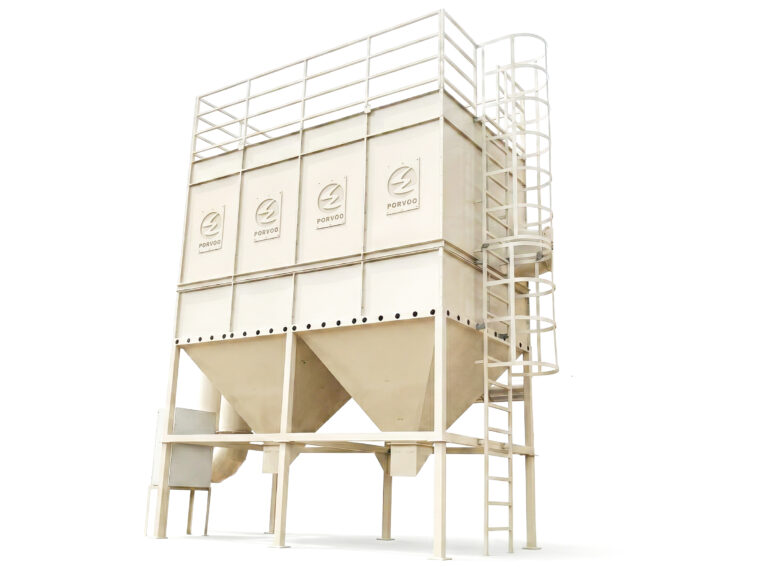
Modular dust collector packages arrive on a schedule that the lifting plan, not the shipping date, actually controls. Before a crane is booked or a module leaves the yard, the site team needs to know what information a competent lifting planner requires, where that information comes from, and what happens when a data point is missing or in conflict. Treating a checklist of site facts as if it were the lift plan itself is the point where this preparation most often goes wrong.
A Site-Information Checklist Is Not the Lifting Plan
A list of module weights, site dimensions, and access notes is an input set. It is not a lift design, a method statement, or an authorization to proceed. The distinction matters because the people compiling site information — plant engineers, procurement staff, the receiving contractor — are rarely the same people qualified to plan or supervise a lift, and the two roles should not be blurred by a document that looks complete.
The UK Health and Safety Executive frames this directly: lifting operations should be properly planned and organized by people with the competence to do so, using appropriate resources, and addressing foreseeable risks, the actions required to control them, and clear responsibilities. That framing separates the assembly of facts from the exercise of judgment. A checklist can tell a planner what exists on site. It cannot tell them whether a route is safe, whether a surface will bear a load, or whether a sequence is sound — those are determinations that depend on competence and context the checklist cannot supply. Where local legal requirements govern lifting work, they may set out their own competence, documentation, or authorization requirements, and those requirements sit above and outside anything a site-information document can satisfy.
This has a practical consequence for how the reader should treat everything that follows in this article. Every table and every data point described here exists to make a handoff to a competent planner faster and more reliable — not to replace that planner’s design, review, or sign-off. If a site team completes a thorough information package and treats it as authorization to proceed, they have skipped the step that actually makes the lift safe. If the same team treats the package as merely a starting point for a competent party’s own assessment, the information becomes useful rather than misleading. The condition that changes here is intent: information gathered to inform a competent decision behaves differently from the same information gathered to avoid needing one.
Use Only Approved Module and Load Data
The single most consequential discipline in preparing for a modular lift is refusing to estimate safety-critical numbers. Weight, dimensions, lifting or attachment points, orientation, and intended destination position are data that must originate from the project-approved package identity and the supplier-issued load data — not from a product page, a general impression of the module’s size, or an assumption carried over from a similar project.
The reason this matters is mechanical, not procedural. A lifting plan is built around the actual mass and geometry of what will be lifted, including where its center of gravity sits and how it is intended to be attached. If that data is wrong — even by a margin that seems minor against the fabricated visual scale of the equipment — the plan built on it inherits the error. A planner working from an unconfirmed figure cannot know they are working from an unconfirmed figure unless the site team flags it as such.
Where the approved data is complete and unambiguous, the site team’s task is straightforward: transmit it faithfully, with its revision status intact. Where it is missing, or where two documents disagree — a packing schedule showing one weight and a drawing showing another — the task changes. The correct response is not to select the more plausible number or average the two. It is to hold the item as unresolved and route it back to the authorized supplier or project contact for confirmation. This is also where a buyer’s dealings with an equipment supplier such as PORVOO become part of the information chain: project-specific configuration and quotation review depend on the buyer supplying accurate operating, site, and module information in the first place, and any load or dimensional data returned through that same channel should carry the same approval status as the rest of the package record. A destination position or erection reference supplied at this stage should also be checked against the current arrangement drawing, since a superseded layout can carry forward a destination that no longer matches the approved erection sequence.
| Information item | Accepted project source | If missing or conflicting |
|---|---|---|
| Package or module identity | Approved packing or module schedule | Return to the authorized supplier/project contact |
| Weight and dimensions | Approved supplier-issued load data | Do not estimate; hold for confirmation |
| Lifting or attachment information | Approved project document, where provided | Refer to the authorized supplier and competent planner |
| Orientation and destination | Approved arrangement or erection reference | Reconcile before arrival |
| Document revision | Current project register | Replace superseded or unapproved references |
Map the Pick, Movement, and Set-Down Context
Approved load data describes what is being moved. It says nothing about where it starts, how it travels, or where it ends up — and that gap is exactly what this section of the handoff exists to close. The site team’s task here is to describe the physical path of the lift as it will actually occur: the delivery position of the module, the pick point and the space and visibility around it, any constraints on travel or slew, the set-down location, and the access route connecting them.
The consequence of getting this wrong is not abstract. A pick point that looks unobstructed in a site walk-through may sit close enough to another operation, structure, or piece of equipment that the intended lift geometry cannot be used as assumed. A set-down location that matches the general layout drawing may not match the specific erection sequence for that module — for instance, where other modules are intended to be placed first and the set-down order actually matters to the plan. Recording the sequence context, not just the endpoints, is what lets a competent planner check whether the intended movement is consistent with the approved module and erection plan, rather than merely physically possible in isolation.
HSE’s planning guidance identifies location, access, visibility, positioning, and proximity to other hazards as factors relevant to lift planning. That list is useful precisely because it tells the site team what categories of fact to gather — it does not tell them, and should not be read as telling them, which route or method to use. A route that is fine for one module orientation may not be fine for another; a working area that is clear during one shift may not be clear during the delivery window. Where the site team can only describe the space as it exists generally, rather than as it will exist at the specific time of the lift, that gap should be stated rather than assumed away.
| Stage | Site information to provide | Project reference to align |
|---|---|---|
| Delivery position | Vehicle location, access, and working-space constraints | Approved arrival plan |
| Pick point | Available space, visibility, nearby operations, and obstructions | Approved package identity |
| Movement | Route or slew constraints and proximity conditions | Competent lifting plan |
| Set-down | Location, access, space, and interface with erection sequence | Approved layout and module sequence |
Record Site, Proximity, and Environmental Constraints
This section separates observable facts from the engineering conclusions built on them, and the separation is the entire point. The site team’s job is to measure and report: available space, what is known about the surface and its support structure, the presence of overhead or buried services, nearby structures or excavations, operating restrictions, and the environmental conditions expected at the time the lift is planned to occur.
None of those facts, by themselves, answer the questions that matter for safety. Whether a surface can bear a given load, whether a structure needs an exclusion zone and how large it should be, and whether expected wind or visibility conditions fall inside or outside acceptable limits are determinations reserved for competent review — the site team’s role is to make sure that review has accurate inputs, not to perform it. A surface record that states what is known, including gaps in what is known, is more useful to a planner than a confident assertion about surface capacity made without the basis to support it.
The conditional relationship worth holding onto here is this: where a site has complete, current records of its surface and subsurface conditions, the competent planner’s review can proceed directly to determining allowable loading and positioning. Where those records are absent, outdated, or contradicted by site observation, the review has to start earlier — establishing what is actually there before it can determine what that surface or structure can support. The site team cannot close that gap by estimating; they can only make clear which situation applies. The same logic applies to environmental conditions: reporting expected conditions at the planned time is different from setting the limits at which the lift should not proceed, and the two should not be merged into a single figure that looks like a limit but is only a forecast.
| Constraint group | Facts to provide | Decision reserved for competent review |
|---|---|---|
| Space and access | Measured available area and route limitations | Equipment position and operating method |
| Surface and support | Known site information and existing records | Strength, stability, and allowable loading |
| Proximity | Structures, overhead lines, excavations, buried services, and active work | Controls, clearances, and work-zone arrangement |
| Environment | Expected wind, weather, visibility, and site operating conditions | Limits, timing, and additional controls |
| Destination interface | Set-down location and erection-sequence constraints | Final placement method and authorization |
Confirm Competence, Responsibilities, Revisions, and Release Gates
The last piece of preparation is organizational rather than technical, and it is where incomplete handoffs most often surface late — after modules have already arrived. Four things need to be confirmed before release: who supplies the approved load data, who owns the site data, who is responsible for planning and authorizing the lifting work, and which version of each document is current.
ISO 10006 supports tailoring project quality arrangements to the specific characteristics and parties of a project, rather than applying a fixed template regardless of context. Applied here, that means the responsibility split for a given lift should reflect who is actually involved in that project — the module supplier, the site owner, the lifting contractor, an EPC party — rather than being assumed by default. Where a project has multiple modules arriving from different sources, or multiple parties responsible for different site areas, this confirmation step has more distinct interfaces to close than a project with a single supplier and a single site owner; the coordination task scales with the number of parties, not with the complexity of any one module.
Document revision control belongs in this same step because a lift plan built on a superseded layout, an outdated load figure, or an obsolete erection sequence carries the same risk as a plan built on no data at all — the risk is simply hidden behind the appearance of completeness. Confirming which revision is current, and how a change to any input gets reviewed and re-issued, is what keeps the plan connected to present project reality rather than to whatever version happened to be circulating when preparation began.
The release gate is the point where all of this resolves into a decision: is every input confirmed, or does an unresolved or conflicting item still exist? An unresolved load figure, an unconfirmed surface record, or an unauthorized planner are each, individually, sufficient reason to hold release rather than proceed. This is also the stage at which a supplier’s product-side interface becomes relevant to the buyer’s next step — where a modular collector’s delivery and integration depend on site readiness confirmed through this same process, the responsible party should hold the module or the lifting work until the specific unresolved item is closed, not until the overall schedule pressure makes proceeding seem necessary.
| Control point | Confirmation needed | Status options |
|---|---|---|
| Approved load information | Issuer, revision, and completeness | Confirmed, unresolved, or conflicting |
| Site data | Owner, measurement date, and constraints | Confirmed, unresolved, or conflicting |
| Competent planning | Authorized planner and applicable requirements | Confirmed or unresolved |
| Responsibility split | Planning, equipment, site, supervision, and authorization roles | Agreed or unresolved |
| Change control | Current plan basis and review route | Current, changed, or awaiting review |
| Release gate | Authorized decision before module arrival or lifting work | Released or held by the responsible party |
Frequently Asked Questions
Q: The supplier’s package weights are not yet confirmed. Can we use estimates to start equipment selection?
A: Use approved supplier-issued load data for the competent planner’s assessment. Request the package identity, weight, dimensions, and available lifting or attachment information with their document revisions; resolve missing or conflicting values rather than estimating from a product page or appearance.
Q: What site information will make the lifting planner’s review more useful?
A: Provide the delivery position, pick point, movement constraints, set-down location, and their relationship to the approved module sequence. Add measured working space, access limits, surface and support records, nearby operations and services, and expected environmental conditions so the planner can assess the actual site context.
Q: What needs to be revisited if the unloading location or module sequence changes before arrival?
A: Send the changed location or sequence and affected approved references through the agreed review route. Confirm the current load-data and site-data revisions, the authorized planner and responsibility split, and which unresolved conditions prevent release; the competent project parties determine the revised lifting arrangement.