An acceptance test on a filter press or vacuum filter system only means what the sampling behind it means. If the cake sample came from the wrong point in the cycle, or the filtrate was grabbed without regard to what the equipment was doing at that moment, the resulting numbers may satisfy a lab report without answering the actual question the project needs answered: did the equipment, configured and operated as specified, perform as required at the agreed boundary? Getting sampling right is a design task in its own right, not an afterthought to running the equipment.
Match Cake and Filtrate Samples to the Acceptance Measures
Before deciding where or when to sample, the project team has to be clear on what the acceptance test is actually measuring. Cake moisture, cake solids content, filtrate clarity, filtrate suspended-solids concentration, and overall solid-liquid separation performance are different measures, and each one implies a different sample stream, a different sampling point, and sometimes a different frequency of collection. A cake sample collected to support a moisture-content acceptance measure is not interchangeable with a cake sample intended to represent average solids recovery across a run, even though both are physically “cake.”
This matters because the acceptance measure defines what a representative sample looks like. If the measure is a single-point specification, such as a moisture limit that must not be exceeded, the sampling plan needs to capture the conditions most likely to produce the governing result, not simply an average. If the measure is a run-average performance figure, the sampling plan needs to spread collection across the full run so that normal variation in feed, cycle timing, or filter condition is represented rather than excluded. Confusing these two sampling logics is one of the more common ways an acceptance test produces a result that technically exists but does not answer the contractual question.
The same logic applies on the filtrate side. A filtrate sample meant to verify clarity for downstream reuse is tied to a different point in the process, and potentially a different moment in the filtration cycle, than a filtrate sample meant to confirm that the filter media or ceramic element is performing within its intended separation range. Where the filtrate is intended for process-water recovery, the acceptance measure may be defined against a reuse-quality criterion rather than a simple clarity check, which changes what the sample needs to represent and how it should be timed relative to the equipment’s operating state.
Before any sample is taken, the project team should be able to state, in plain language, which acceptance measure each sample is meant to support and why the proposed sampling point and timing will produce a sample that fairly represents that measure. If that statement cannot be made, the sampling plan is not yet ready, regardless of how carefully the physical collection is executed.
Choose Sampling Locations Across the Equipment Boundary
Sampling location is inseparable from the equipment boundary the acceptance test is meant to evaluate. A cake sample taken before final discharge represents something different from a sample taken after cake has been exposed to downstream handling, conveying, or storage, because moisture and structure can change once the cake leaves the immediate control of the filtration equipment. Likewise, a filtrate sample collected at the point the liquid leaves the filter is not the same evidence as a sample collected further downstream in a collection tank, where it may have mixed with other streams or been affected by residence time.
The practical rule is that the sampling point should sit as close as possible to the boundary the acceptance criterion is written against. Where the acceptance criterion concerns the equipment’s own separation performance, the sample belongs at the equipment’s outlet, before any other process step can alter the stream. Where the criterion concerns the condition of material delivered to the next process step, such as cake destined for a specific handling or disposal route, the sampling point needs to reflect that downstream condition, which may require a different location than the one used to judge the filtration equipment itself.
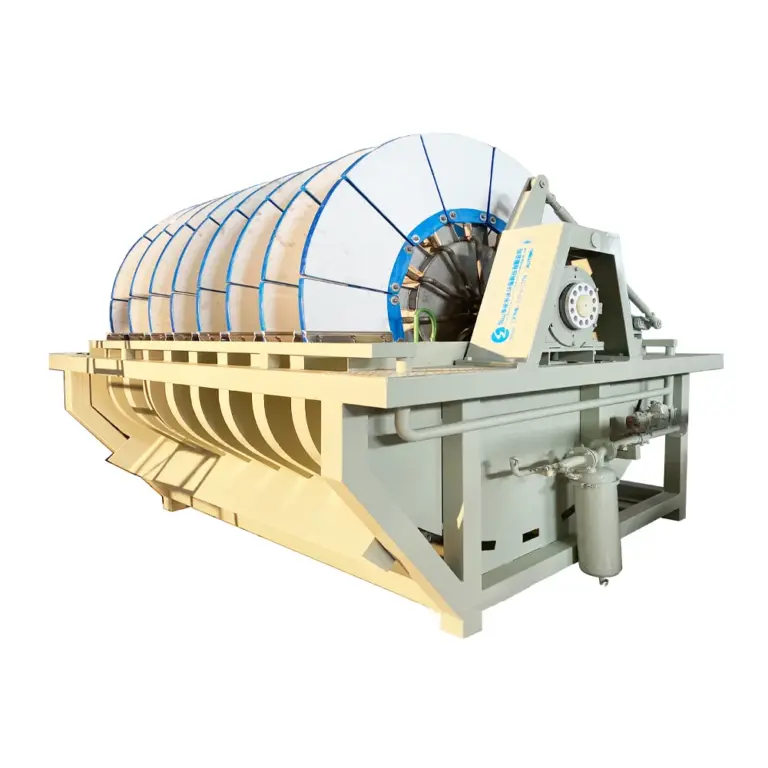
This distinction becomes more significant where multiple pieces of equipment sit in sequence, such as a filtration stage followed by a dosing step or a water-recovery loop. A filtrate sample taken immediately after a vacuum ceramic disk filter answers a different question than one taken after that filtrate has passed through subsequent treatment, and project parties should agree in advance which boundary the acceptance test is actually evaluating. If the intent is to accept the filtration equipment on its own performance, sampling after additional treatment steps will not isolate that performance, and any shortfall or surplus in the result cannot be attributed cleanly to the filter.
Where site layout makes the ideal sampling point physically difficult to access, the project team needs to agree on a documented, defensible alternative location rather than defaulting to whatever point is most convenient. An undocumented substitution of sampling location is one of the more direct ways an acceptance result becomes disputable later, because the location itself becomes a variable nobody agreed on.
Plan Timing, Increments, Composites, and Duplicate Samples
| Planning element | Decision to fix before the test | What the decision establishes |
|---|---|---|
| Run period | The operating period covered by sampling | The period over which normal variation is represented |
| Collection timing | When cake and filtrate samples are collected during the run | Which operating state and timestamp each sample corresponds to |
| Number of increments | How many increments are collected for each sample stream | The planned sampling coverage within the run period |
| Combining or retaining samples | Whether increments are combined or kept as individual samples | Whether the laboratory result relates to a composite or a retained individual sample |
| Duplicate samples | Which cake or filtrate samples are duplicated | The agreed duplicate set available for analysis and result handling |
Even with the right sampling points chosen, a single grab sample at a single moment rarely represents equipment performance across a run. Feed characteristics can change over time, filter media or elements can behave differently as a cycle progresses, and operating conditions such as flow or pressure can vary within the period the acceptance test is meant to cover. The sampling plan needs to state the run period being evaluated, when during that period samples are collected, how many increments are taken, and whether those increments are combined into a composite or kept as individual samples.
The choice between a composite and a set of retained individual samples is not a procedural detail; it changes what the laboratory result means. A composite smooths variation across the run and produces a single figure representing an average condition, which suits an acceptance measure defined as a run average. Individual retained samples preserve the variation itself, which suits an acceptance measure defined as a limit that must not be exceeded at any point, since averaging could mask a brief excursion that the criterion is specifically meant to catch. Deciding this before sampling begins, rather than after the fact, avoids a situation where the available samples cannot actually support the acceptance measure they were meant to prove.
Duplicate samples serve a related but distinct purpose: they test whether the sampling and analysis process itself is reliable, independent of whether the equipment is performing well. Agreeing in advance which cake or filtrate samples will be duplicated, and under what conditions a duplicate result is treated as representative, protects both sides from a dispute over whether an unusual result reflects the equipment or the sampling.
Preserve, Label, Transport, and Record Every Sample
| Checkpoint | Project-specific decision or record | What to verify before acceptance analysis |
|---|---|---|
| Sample identification | Cake or filtrate identity and sampling point | The sample is linked to the intended equipment boundary and acceptance measure |
| Operating record | Sampling timestamp and operating conditions | The laboratory result can be connected to the correct feed and filter state |
| Container | Agreed container for the sample | The container used matches the project and laboratory agreement |
| Preservation | Agreed preservation method | The recorded preservation matches the agreed method |
| Transport | Agreed transport arrangement | The recorded transport matches the agreed arrangement |
| Analysis | Agreed analysis method | The reported result identifies the agreed method |
| Chain of custody | Agreed custody record among the project parties and laboratory | The sample remains traceable through handoffs |
A correctly located, correctly timed sample loses its value if nobody can later connect the laboratory result back to the operating conditions that produced it, or if the sample degraded before analysis. Each cake or filtrate sample needs a clear identity tying it to its sampling point and the acceptance measure it supports, along with a timestamp and a record of the operating conditions at the moment of collection. Without this record, a laboratory figure is just a number; with it, the project team can confirm that the result reflects the feed and filter state the acceptance test intended to evaluate, rather than some transient or unrepresentative condition.
Preservation and transport decisions follow from the nature of the sample and the analysis to be performed. Guidance such as ISO 5667-3, which addresses preservation and handling of water-quality samples, and ISO 5667-10, which addresses wastewater sampling-program design and technique, is relevant context for establishing how these decisions should be approached, though the specific container, preservation method, and transport arrangement for a given project remain matters to confirm with the laboratory rather than settled in advance by a general standard. ISO 5667-13, concerned with sampling of sludges, is similarly relevant background for filter-cake evaluation and dewatering monitoring, though its specific requirements need to be read and confirmed against the project’s own sampling plan rather than assumed.
Chain-of-custody recording matters most where samples pass between multiple parties, such as site operating staff, a project engineer, and an external laboratory. Each handoff is a point where a sample could be mislabeled, delayed, or exposed to conditions that compromise its integrity, so the custody record should state who held the sample at each stage and when. This becomes directly relevant when acceptance testing accompanies a system such as a ceramic membrane wastewater recycling setup, where reuse-quality filtrate and sludge-output cake samples may need to satisfy separate acceptance measures within the same test campaign, and a record that conflates the two streams undermines both.
Resolve Invalid Results and Retest Conditions Before Sign-Off
Not every acceptance test produces a usable result on the first attempt, and the project needs an agreed process for handling that outcome before testing begins, not after a disputed result arrives. A sample can be invalidated by a breach in the agreed container, preservation, or transport arrangement; by a documented deviation from the agreed sampling location or timing; or by an analysis result that falls outside the laboratory’s own quality-control checks. Any of these conditions can make a result unusable regardless of how the equipment actually performed, and the project parties need a shared understanding of what counts as invalidating versus what counts as normal variation within an otherwise valid result.
Where a sample or result is judged invalid, the project team needs an agreed basis for retesting: whether the original run conditions can still be considered representative, whether a new run under the same operating setpoints is required, and who bears the responsibility for arranging the retest. This matters more where configuration or operating conditions could have shifted between the original test and any retest, since a retest conducted under materially different conditions does not resolve the original question, it simply produces a different test. Agreeing this in advance, alongside the sampling plan itself, keeps a single invalid sample or disputed result from becoming a separate negotiation conducted without reference to the criteria the acceptance test was originally built around.
Frequently Asked Questions
Q: Can one laboratory result represent the entire acceptance run?
A: Only if the sampling plan defines the run period, collection timing, number of increments, and whether those increments are combined or retained separately. The result should be interpreted against that agreed coverage and the recorded operating conditions.
Q: Do cake and filtrate samples need to be collected at the same time?
A: Coordinate their timing when the acceptance decision requires the two results to represent the same filter state. Record each sampling point, timestamp, and operating condition so the project team can confirm whether the results are directly comparable.
Q: Should sampling increments be combined or analyzed separately?
A: Choose this before the test according to the decision the result must support. A combined sample relates to the agreed composite, while retained individual samples preserve their separate identities; the plan should state which approach applies to each sample stream.
Q: What information should accompany each sample to the laboratory?
A: Provide the cake or filtrate identity, sampling point, timestamp, operating conditions, agreed analysis method, and custody record. Also confirm the agreed container, preservation, and transport arrangements so the reported result remains linked to the intended sample and filter state.
Q: What should happen if a sample cannot be accepted as valid?
A: Apply the invalid-sample and retest rules agreed before sign-off. Those rules should identify how departures from the agreed location, identification, timing, handling, or custody plan are assessed and what must be repeated before the result is used for acceptance.