Cloudy filtrate and leakage around a plate-and-frame filter press are different symptoms with different root causes, yet operators sometimes chase both with the same adjustment. Which branch does the evidence actually point to, and what should be checked before any setting is changed? Answering that well depends on where each symptom appears, at which point in the cycle, and what has changed recently in the feed or the plate pack.
Locate whether the fault is in the filtrate path or plate pack
| Observed pattern | Record first | Inspection branch to open |
|---|---|---|
| Suspended solids in the filtrate | Where the solids appear in the filtrate route and the cycle step when they appear | Filtrate-path interfaces, beginning with the filter cloth and its seating |
| External leakage | The exact leak location around the plate pack and the cycle step when it appears | Cloth edges, plate faces, sealing areas, alignment and closing-system condition |
| Both symptoms | The location and timing of each symptom as separate observations | Keep the two routes separate until the recorded evidence shows whether they share a supported cause |
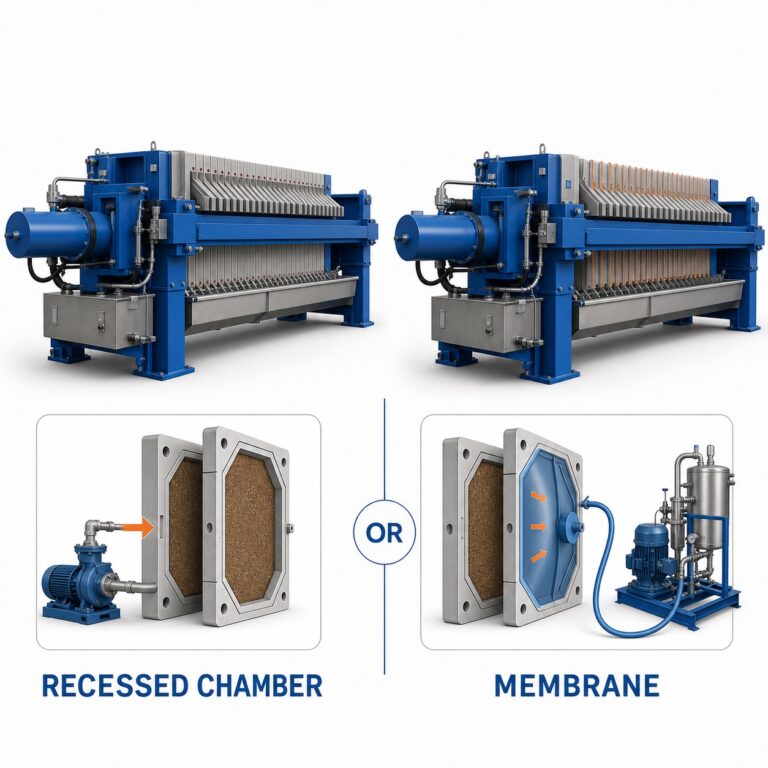
A plate-and-frame press has two distinct physical routes where a fault can originate: the filtrate path, which carries liquid that has already passed through the cloth and plate drainage surfaces to the outlet, and the plate pack itself, where chambers are sealed against each other and against the frame under compression. Cloudy filtrate means something in the filtrate path is allowing suspended solids to bypass the cloth or travel through a compromised interface before reaching the outlet. External leakage means fluid is escaping the plate pack boundary rather than reaching the intended filtrate route at all. These are mechanically different failure modes, and treating them as a single problem risks correcting a condition that was never responsible for the symptom actually observed.
The first discipline is separating the two symptoms before forming any hypothesis about cause. If cloudy filtrate and external leakage appear together, that does not mean they share a cause; it means two observations exist that must each be traced on their own evidence. Recording where each symptom appears matters because the filtrate path and the plate pack have different inspection points. Cloudy filtrate is read at the filtrate outlet or in the discharge line, while external leakage is read at the visible boundary of the plate pack, at seams between plates, around the frame, or at the closing-system interface. Collapsing these two observation points into one note such as “the press is leaking” discards the information needed to choose a branch.
The second discipline is recording the cycle step at which each symptom appears. A press cycle moves through distinct phases, and a condition that shows up only during one phase points toward a different mechanism than one present throughout the cycle. Where a fault appears only as pressure builds, that points toward the plate pack’s sealing and closing interfaces, which are stressed differently at different pressures. Where a fault is present from the start of filtration and does not change with pressure, that points more toward the filtrate path and the cloth’s filtering condition. This is general reasoning that applies to any press and any feed; the specific cycle step and location recorded for the actual event are what the subsequent inspection branches use as their starting evidence.
This separation step is also what keeps the investigation from running two inspection tracks in parallel that interfere with each other. Opening the plate pack to examine sealing surfaces while filtrate clarity is still unexplained can disturb evidence relevant to the filtrate-path question, and adjusting cloth seating before external leakage is understood can mask or shift a leak path. Confirming which path explains the symptom, using the location and cycle-step record, determines which of the following inspection branches is opened first.
Cloth damage, folds and seating checks
| Cloth branch | Evidence to capture | Decision use |
|---|---|---|
| Damage | The affected cloth and the location of the observed damage | Keeps the investigation on cloth condition rather than unrelated process settings |
| Folds | The fold location and whether it coincides with the recorded symptom location | Shows whether cloth position warrants correction before other settings are changed |
| Edge bypass | The plate edge where bypass is observed and the associated filtrate or leak symptom | Directs attention to the cloth edge and its interface with the plate pack |
| Poor seating | The seating condition at the affected plate interface | Supports a seating correction only when the observed location matches the symptom evidence |
Once the filtrate path is the suspected branch, the filter cloth itself is the component that most directly governs whether suspended solids pass into the filtrate. Cloth-related causes fall into several distinct conditions, and each has a different mechanical signature that should be matched against the recorded symptom location before any corrective action is taken.
Damage to the cloth, meaning a tear, puncture, or worn area, creates a direct opening for solids to bypass the intended filtration surface. Where damage is present, the location of the damage on the cloth should align with where cloudy filtrate is observed downstream; a press has multiple plates and chambers, and filtrate from one chamber can be distinguishable from another depending on how the filtrate path is configured. Confirming that the damaged cloth corresponds to the chamber or plate associated with the cloudy filtrate keeps the diagnosis evidence-based rather than assumed.
A fold in the cloth is a different condition from damage: the cloth material is intact, but its position relative to the plate face or drainage surface has shifted, creating a gap or an altered flow path. A fold does not always produce the same symptom as a tear, and whether it causes cloudy filtrate depends on where the fold sits relative to the drainage surface and the cake-forming area. This is why the fold’s location needs to be compared against the recorded symptom location rather than treated as a cause on its own.
Edge bypass is a third branch, distinct from damage or folding within the cloth body. It occurs at the boundary where the cloth meets the plate or frame, and it matters because this edge is also where sealing performance and filtrate integrity depend on the cloth being correctly positioned against the plate’s drainage and sealing features. Edge bypass can produce cloudy filtrate without any damage to the cloth body at all, which is why inspecting only the cloth surface and not its edges can miss the actual cause.
Poor seating, meaning the cloth is not seated correctly against the plate at the relevant interface, is related to but distinct from edge bypass; seating can be compromised across a broader area of the plate face, not only at the edge. Seating condition should be checked against the plate interface that corresponds to the symptom location recorded earlier. Where the symptom and the observed cloth branch align, that branch supports a corrective action; where they do not align, the investigation should continue rather than correcting a cloth condition that does not match the evidence. This structured approach mirrors the kind of filtrate-clarity troubleshooting used when diagnosing cloudy reuse water problems in other filtration contexts, where tracing the symptom to its originating interface precedes any corrective step.
Plate alignment, sealing surfaces and closing-system evidence
| Evidence area | What to document | What the check establishes |
|---|---|---|
| Plate faces | The affected plate and the observed face condition | Identifies a plate-specific inspection branch; it does not establish an adjustment limit |
| Sealing areas | The condition and exact location at or near the recorded leak | Tests whether the external leak aligns with a sealing-area concern |
| Plate alignment | The observed alignment condition at the affected part of the pack | Identifies whether alignment needs manual-based evaluation |
| Closing system | Its observed condition when the symptom occurs | Identifies whether the closing-system branch remains open |
| Applicable press manual | The stated limits and adjustment instructions for the actual press | Governs whether and how alignment or closing adjustments may be made |
Where external leakage is the suspected branch, or where the filtrate-path branch has been checked without finding a cloth condition that explains the symptom, attention shifts to the plate pack’s structural and sealing interfaces: plate faces, sealing areas, alignment, and the closing system that holds the pack under compression.
Plate face condition matters because the face is where cake forms and where the plate contacts the cloth and, at the perimeter, the adjacent plate. A condition observed on a plate face identifies which specific plate is implicated, but on its own it does not establish what degree of wear or damage is acceptable; that determination belongs to the applicable press manual, not to visual inspection alone. This distinction matters practically: documenting the affected plate and the observed condition is the inspection step within scope, while deciding whether that condition requires plate replacement or rework is a manual-governed decision tied to the specific press design.
Sealing areas are the interfaces between adjacent plates, and between plates and the frame, that are intended to prevent fluid from escaping the plate pack. Where external leakage is recorded at a specific location, checking the sealing area at or near that same location tests whether the sealing interface is the actual source. A sealing-area condition that is recorded far from the leak location does not establish a cause-and-effect relationship; proximity between the observed condition and the recorded leak location is what gives the evidence its diagnostic value.
Plate alignment affects how evenly compression and sealing forces are distributed across the pack. Misalignment can originate in a specific plate or in how the stack has shifted over time, and where it is observed, the affected part of the pack should be recorded precisely rather than described generally. Alignment evaluation against defined limits is a manual-governed judgment, since presses differ in their tolerance for alignment variation depending on plate design and closing-system type.
The closing system, meaning the mechanism that applies and maintains compression across the plate pack, is a further branch because insufficient or uneven closing force can produce leakage even where plates and cloths are otherwise in acceptable condition. Its condition should be checked specifically at the time the symptom occurs, since closing-system behavior can differ between a press at rest and a press under operating pressure.
Across all of these areas, the applicable press manual governs what adjustment, if any, is permitted, and what limits define an acceptable versus unacceptable condition. Site evidence establishes where to look and what was observed; the manual establishes what that observation means for the specific press. This is also where early indicators of developing leaks, such as those described in leak detection guidance for filter presses, can be cross-referenced against the recorded symptom history to see whether a condition had been building before it became an external leak.
Feed changes and cycle history that can narrow the cause
| Recent-change group | Comparison to make | Branch it can prioritize |
|---|---|---|
| Slurry, conditioning or feed profile | Compare the timing of the change with the first affected cycle and the last normal cycle | Feed-condition investigation before unrelated plate-pack settings are changed |
| Cloth work | Compare the work performed with the affected cloth, symptom location and first affected cycle | Cloth damage, folds, edge bypass or seating checks |
| Plate maintenance | Compare the maintained plate or area with the symptom location and cycle timing | Plate faces, sealing areas, alignment or closing-system evidence |
| No matching recent change | Preserve the symptom location and cycle history without assigning a cause | Continue evidence-led inspection rather than treating timing alone as proof |
Inspection branches describe where a fault can physically occur; recent changes describe why a fault may have started when it did. Comparing the timing of known changes against the timing of the first affected cycle narrows which inspection branch deserves priority, without replacing the inspection itself.
Changes to slurry characteristics, conditioning, or feed profile affect how cake forms against the cloth and how the cake-cloth interface behaves under pressure. Where such a change in feed condition precedes the first cycle in which cloudy filtrate or leakage appeared, that timing supports opening a feed-condition line of inquiry before adjusting plate-pack settings that were not recently changed. The underlying mechanism is general: a feed change alters the particle size distribution, solids concentration, or conditioning chemistry reaching the press, and any of these can change how effectively the cloth retains solids or how evenly cake builds across the pack, independent of whether the cloth or plates themselves have changed at all.
Cloth work performed before the symptom appeared is a second comparison point. Where cloth was replaced, repositioned, or serviced, and the affected cloth and symptom location correspond to that work, this supports prioritizing the cloth-inspection branch described earlier. Where the work performed does not correspond to the plate or chamber associated with the symptom, that mismatch is itself useful evidence, since it indicates the cause may lie elsewhere even though a change did occur around the same time.
Plate maintenance follows the same logic. Work performed on a specific plate or area, compared against the symptom’s recorded location and cycle timing, either supports or weakens the case for prioritizing plate-face, sealing, alignment, or closing-system evidence. A maintained plate that matches the symptom location strengthens that branch; a maintained plate in an unrelated part of the pack does not rule out plate-pack causes generally, but it does not support prioritizing that specific maintenance event as the cause.
Where no recent change corresponds to the symptom’s onset, the correct response is to preserve the symptom location and cycle history as recorded evidence rather than assigning a cause based on timing alone. Timing proximity between a change and a symptom is a reason to investigate a branch with priority, not proof that the branch is responsible. This distinction matters because a change coinciding with an unrelated fault’s first appearance can misdirect the entire inspection if timing alone is treated as sufficient evidence, delaying attention to the branch the physical evidence actually supports. Information submitted by the project team about feed characteristics, cloth history, and plate maintenance records is also the kind of detail that supports a configuration or quotation review when sizing or specifying replacement components for the press.
Controlled verification after each corrective action
| Verification stage | Required record | Decision boundary |
|---|---|---|
| Before correction | Filtrate behavior, external leak behavior, symptom locations and cycle step | Establishes the comparison point under the selected controlled conditions |
| Corrective action | The single supported cause addressed and the one correction made | Keeps the result attributable to one change |
| Controlled check | Filtrate behavior and external leak behavior under the same controlled conditions | Shows whether the targeted symptoms changed after the correction |
| Return decision | The verification result against the applicable operating limits and instructions | Resume routine operation only after the correction is verified for the actual press and feed |
Identifying a supported cause does not establish that correcting it resolved the symptom; that requires verification under conditions that isolate the effect of the single change made. This final step closes the diagnostic sequence by confirming, rather than assuming, that the corrective action addressed the observed fault.
Before any correction is made, the filtrate behavior and external leak behavior should be documented as they stand, along with the symptom locations and the cycle step at which each appears. This pre-correction record is the comparison baseline; without it, any change observed afterward cannot be attributed with confidence to the correction itself, since feed conditions, cycle timing, or other variables may also have shifted.
The corrective action taken should address exactly one supported cause identified through the preceding inspection branches. Where multiple potential causes were found, correcting more than one at the same time removes the ability to determine which correction, if any, was responsible for a change in symptom behavior. This single-variable discipline is what allows the verification step to produce a meaningful answer rather than an ambiguous one.
After the correction, filtrate behavior and external leak behavior should be checked under the same controlled conditions used for the baseline record, meaning comparable feed, pressure, and cycle step. A change observed under different conditions than the baseline does not confirm or rule out the correction’s effect, because the conditions themselves could account for the difference.
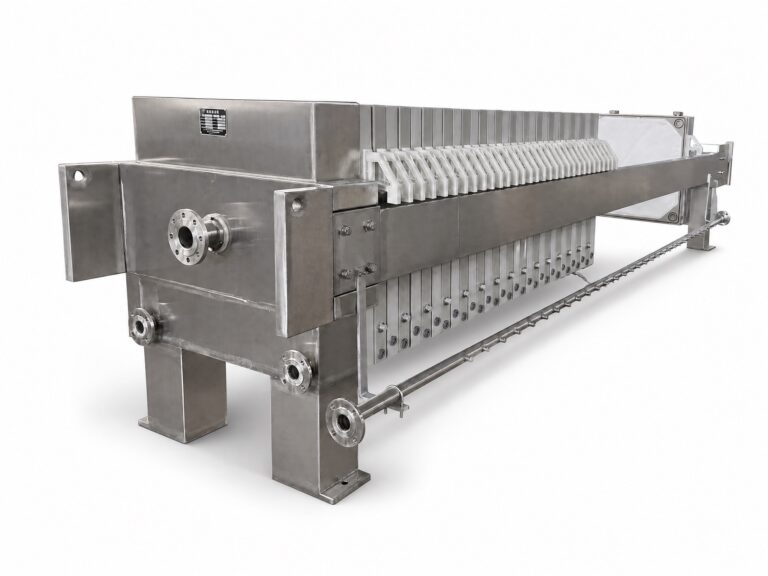
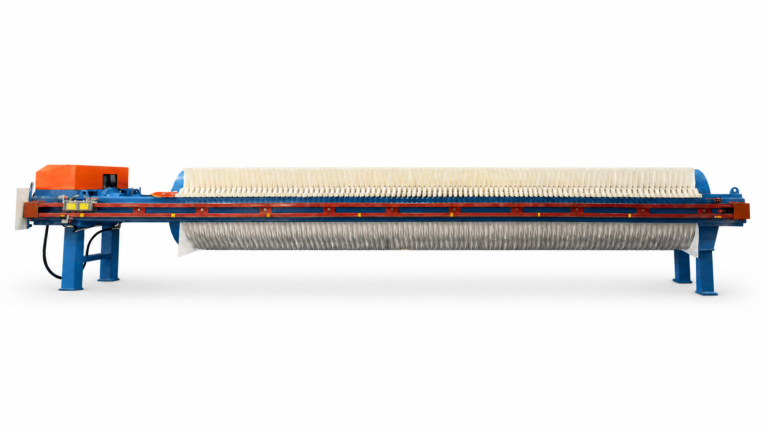
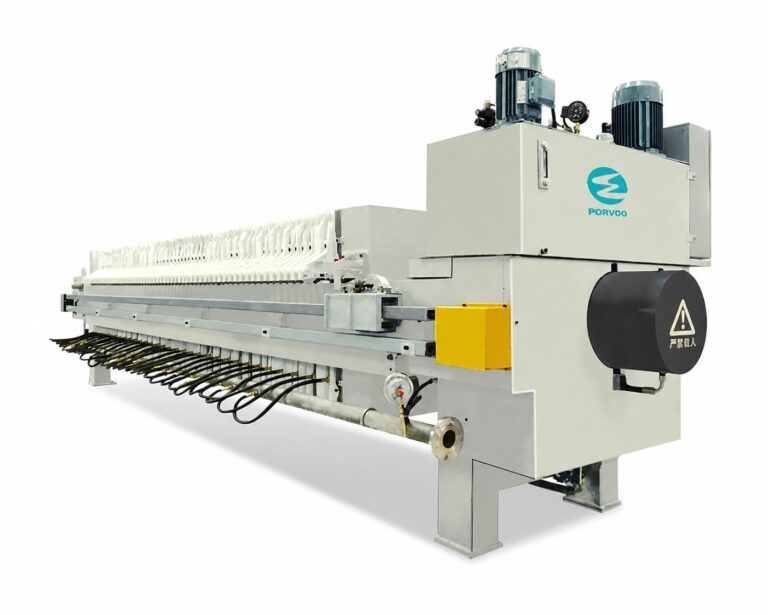
The result of this controlled check is then read against the applicable operating limits and instructions for the actual press, which is where the earlier manual-governed boundary around alignment and closing-system limits applies directly to the return-to-service decision. Where the verification shows the targeted symptom has resolved under controlled conditions and the press is within its stated operating limits, returning to routine operation is supported by that evidence. Where the symptom persists, recurs, or the controlled check was not performed under comparable conditions, the appropriate response is to continue the inspection with the branches not yet confirmed, rather than treating a single uncertain check as sufficient grounds for resuming routine operation. This is also the point at which the plate-and-frame filter press itself, including its plate configuration and cloth interface, becomes relevant to the buyer’s next decision, whether that decision concerns replacement components, plate-pack rebuilding, or evaluating whether the existing press configuration still matches current feed and operating conditions.
Frequently Asked Questions
Q: If cloudy filtrate and an external leak begin in the same cycle, should they be treated as one fault?
A: No. Record each symptom by its exact location and cycle step, then open the filtrate-path and plate-pack branches separately. Consider a shared cause only if the evidence connects both symptoms to the same cloth, plate interface, feed change, or maintenance event.
Q: What should be recorded before settings are changed or the plate pack is reworked?
A: Preserve the last normal cycle, the first affected cycle, each symptom location, and the filtrate and leak behavior. Also record recent slurry, conditioning, feed-profile, cloth-work, and plate-maintenance changes so the original sequence remains available for comparison.
Q: When should a visible cloth issue take priority over alignment or closing-system adjustments?
A: Prioritize the cloth branch when observed damage, a fold, edge bypass, or poor seating matches the affected plate interface and symptom location. Make only the supported cloth correction, verify the result, and use the actual press manual before making any alignment or closing-system adjustment.
Q: What should the team conclude if the filtrate clears after a correction but external leakage remains?
A: Conclude only that the filtrate-path symptom improved; keep the external-leak branch open. Record the remaining leak under the same controlled conditions, then continue with the matching cloth-edge, plate-face, sealing-area, alignment, or closing-system checks.
Q: What information makes a troubleshooting handoff actionable?
A: Provide the two symptoms separately, their exact locations and cycle timing, the affected cloth or plate area, relevant recent changes, the single correction attempted, and the controlled-check result. Include the applicable manual limits or instructions whenever alignment, closing, or return-to-operation decisions are involved.