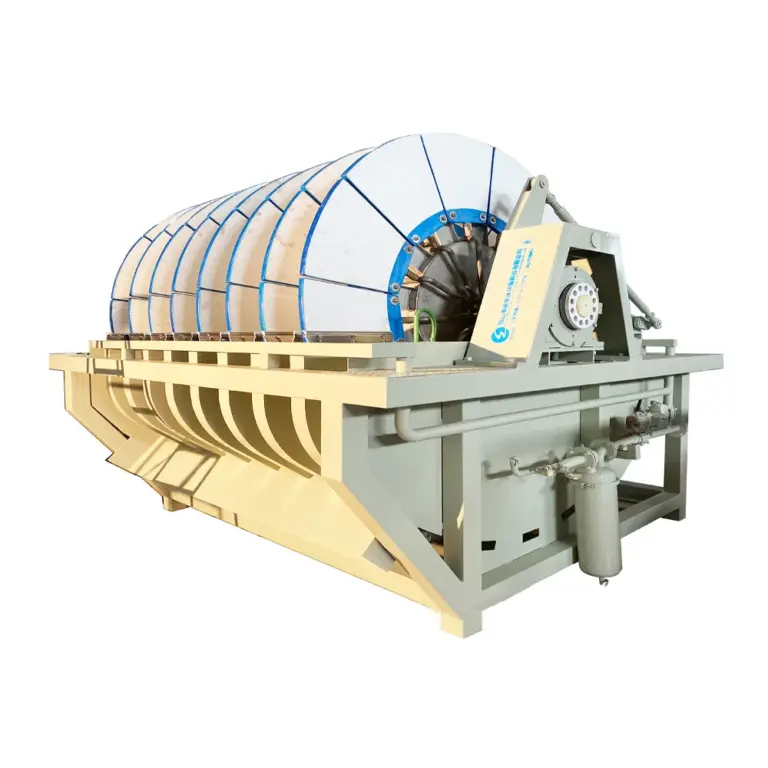
When a ceramic disc filter loses permeability, the real question is not whether to clean it but what to clean for. Restoring flux without knowing whether the cause is particle blocking, mineral crystallization, or a vacuum-side fault risks treating the wrong problem, consuming media life or downtime without recovering performance. Getting this diagnosis sequence right determines whether the next intervention fixes the filter or only resets the symptom temporarily.
Separate Loss of Permeability From Vacuum and Mechanical Faults
A drop in filtrate flow or an increase in cake moisture is frequently read as a fouling event, but permeability loss is a symptom with more than one possible origin. Before any deposit-focused diagnosis begins, the vacuum system, seals, piping, and associated mechanical components need to be confirmed as functioning within their expected range. Where the vacuum level at the filter is lower than the system is designed to deliver, or where air is leaking into the vacuum circuit, the ceramic medium itself may be unobstructed while the filter still underperforms. Treating that condition as fouling and proceeding directly to a cleaning or regeneration response would not address the actual cause and would leave the mechanical fault in place.
This separation matters because the two fault categories call for different diagnostic paths and different people. A vacuum or mechanical fault is typically investigated through the equipment’s operating parameters, seal condition, and distribution-valve function, while a fouling investigation is built around the deposit itself and the process history that produced it. If both are allowed to blur together, the investigation can cycle between cleaning attempts and mechanical checks without resolving either.
Where the project has independent instrumentation on vacuum level, filtrate flow, and cake thickness, those trends offer the first basis for separating the two fault families: a permeability loss that tracks with a drop in achieved vacuum points toward the mechanical side, while a permeability loss that occurs under stable, confirmed vacuum conditions points toward the ceramic medium. If the plant lacks this instrumentation or history, that gap itself becomes the first piece of information to establish before any fouling diagnosis can be trusted. A buyer preparing to discuss this filter with a supplier should be ready to state whether the vacuum system has already been checked and confirmed normal, because that single confirmation determines whether the rest of the diagnostic effort belongs to the medium or to the surrounding equipment.
Inspect Deposits Before Selecting a Cleaning Response
Once the mechanical and vacuum side is confirmed normal, the next decision is not which cleaning method to apply but what is actually deposited on or within the ceramic medium. Different blockage mechanisms leave different physical and chemical signatures, and selecting a cleaning response before that signature is established risks applying a chemistry or mechanical action suited to one deposit type against a different one. A response matched to the wrong mechanism can fail to restore permeability, and in some cases can interact unfavorably with a deposit or medium it was not intended for.
Direct inspection of the medium surface and pore structure, combined with characterization of what has accumulated there, gives the project team the evidence needed to route the problem correctly. This step is distinct from monitoring filtrate trends or vacuum readings; it requires examining the deposit itself, whether through visual inspection, sampling, or analytical characterization, before any cleaning chemistry or procedure is chosen. Skipping this step and moving directly to a standard or previously used cleaning response assumes the current fouling event matches a prior one, which the project has not yet confirmed.
The practical consequence is that deposit inspection becomes a gating step rather than an optional diagnostic extra. Where the inspection shows a loose, particulate deposit sitting on or near the medium surface, the diagnostic path differs from where it shows a hardened, crystalline layer that has formed within the pore structure. Each of these indicates a different origin and a different compatible response, which is the distinction the next stage of diagnosis addresses in more detail.
Compare Particle Blinding With Mineral-Scale Indicators
| Diagnostic branch | Deposit evidence to establish | Supporting context | Decision boundary |
|---|---|---|---|
| Particle blinding | Slurry particles are blocking the ceramic medium | Slurry-particle fouling is identified as one blockage mechanism in magnetite-concentrate filtration | Supports the particle-fouling branch; it does not establish a cleaning recipe |
| Mineral scale | Crystalline mineral deposits are blocking the ceramic medium | Calcium oxalate crystallization is identified as a distinct mechanism in the cited magnetite process | Supports the mineral-scale branch; it does not establish a universal cause or treatment |
Particle blinding and mineral scale represent two distinct blockage mechanisms, and confirming which one applies depends on evidence drawn directly from the deposit rather than from the symptom of reduced permeability alone. The study of ceramic filter media fouling during magnetite concentrate dewatering documents slurry-particle fouling and calcium oxalate crystallization as separate mechanisms occurring in the same filtration context, which demonstrates that a single filter application can be subject to more than one blockage pathway depending on the feed and process-water conditions present at the time.
Particle blinding occurs where fine solids from the slurry physically lodge in or across the medium’s pore structure, reducing the open area available for filtrate passage. This mechanism is tied to the characteristics of the feed material itself, including particle size distribution and concentration, and it tends to respond to interventions aimed at dislodging or flushing trapped particles. Mineral scale, by contrast, forms where dissolved species in the process water crystallize onto or within the medium, a mechanism driven by water chemistry rather than by the solid particle content of the feed. A crystalline deposit does not respond to the same type of mechanical or flushing action that addresses particle blocking, and attempting that response against a scale-type deposit risks leaving the crystalline layer substantially intact.
Because these two mechanisms arise from different root causes, feed-side particle characteristics in one case and process-water chemistry in the other, the diagnostic evidence needed to distinguish them also differs. A deposit that is loose and removable under light mechanical action points toward particle blinding; a deposit that is hard, adherent, and resistant to simple removal points toward mineral scale. Where a project’s process water carries elevated concentrations of scale-forming species, the likelihood of encountering a crystallization mechanism changes even if the feed solids have not changed, which is why water chemistry history becomes part of this comparison rather than a separate consideration. The magnetite study covers one process and one pair of mechanisms; it does not establish which mechanism predominates generally or provide a cleaning recipe, so confirming the deposit identity in the specific project remains necessary before selecting a response.
Trace Process-Water Chemistry and Feed Changes Against the Fouling Timeline
| Record to align | Timeline comparison | Decision use |
|---|---|---|
| Feed changes | Compare the timing of feed changes with the onset or worsening of permeability loss | Keeps a temporally aligned feed change in the active diagnosis; timing alone does not prove cause |
| Process-water chemistry | Compare chemistry changes with the same fouling period | Shows whether water chemistry changed before or during the problem; it does not identify the deposit by itself |
| Operating trends | Review trend changes around the loss of permeability | Identifies operating changes that coincide with the symptom for further diagnosis |
| Cleaning history | Compare cleaning events and subsequent permeability response with the fouling timeline | Shows whether permeability recovered after cleaning without establishing a universal cleaning interval |
Confirming a deposit’s chemical or physical identity answers what is blocking the medium, but it does not by itself explain why the fouling began when it did. Establishing that timing requires comparing the fouling timeline against the records the plant already keeps: feed composition changes, process-water chemistry changes, operating trend shifts, and cleaning events.
A feed change that coincides with the onset or worsening of permeability loss keeps that change active as a candidate cause, but coincidence in timing does not by itself prove causation. Other variables may have shifted at the same time, and a project that stops at timing correlation without checking alternative explanations risks acting on an unconfirmed assumption. Process-water chemistry comparisons serve a related but different purpose: they show whether the chemistry driving a potential scale mechanism changed before or during the fouling period, which supports or weakens the mineral-scale branch of the earlier deposit diagnosis without identifying the deposit on its own.
Operating trend review extends this comparison beyond feed and chemistry to include any other process condition that shifted around the same period, since fouling can follow changes in flow, temperature, or other operating parameters even where the feed material itself has not changed. Cleaning history comparisons answer a more specific question: whether permeability actually recovered after a past cleaning event, and for how long that recovery held before degrading again. A cleaning response that restored performance only briefly suggests the underlying cause was not addressed, while a cleaning response that held for an extended period under similar operating conditions suggests the cleaning matched the mechanism, at least under those conditions.
None of these comparisons substitutes for the others. A project that aligns feed changes against the timeline but ignores process-water chemistry, or that reviews cleaning history without checking whether the feed changed at the same time, risks reaching a conclusion supported by only part of the available evidence. Where multiple records point to the same period and the same type of change, the diagnostic confidence in that cause increases; where the records conflict or only one record shows a correlating change, that gap defines exactly what still needs to be investigated before a cause is accepted.
Check Cleaning History, Media Compatibility, and Regeneration Limits
| Check before regeneration | Evidence to confirm | Decision consequence |
|---|---|---|
| Deposit identity | Deposit characterization distinguishes particle blocking from mineral crystallization | Select regeneration chemistry only for the confirmed deposit branch |
| Cleaning history | Prior cleaning events and the associated permeability response | Use the observed response as project evidence rather than assuming one universal interval |
| Media compatibility | Compatibility between the proposed regeneration chemistry and the ceramic medium | Do not proceed on an unconfirmed compatibility assumption |
| Regeneration limits | Project-specific recipe, concentration, and interval are confirmed for the actual application | The cited magnetite-process evidence does not supply a universal cleaning prescription |
Once a deposit mechanism is reasonably well supported by the inspection and timeline evidence, the decision shifts to whether and how to proceed with a regeneration or cleaning chemistry. This decision depends on three separate confirmations, and skipping any one of them turns the choice into an assumption rather than a verified step.
The first confirmation is that the deposit identity itself is solid enough to act on. A regeneration chemistry selected for a mineral-scale deposit will not necessarily perform the same function against a particle-blinding deposit, so the deposit characterization from the earlier inspection step needs to be treated as a prerequisite rather than a formality. The second confirmation is the plant’s own cleaning history: prior cleaning events and their associated permeability response constitute project-specific evidence about what has or has not worked on this filter under its actual operating conditions. This evidence carries more direct relevance to the current decision than a general assumption about cleaning intervals, because the same filter application can behave differently depending on feed and water chemistry specific to that site.
The third confirmation is compatibility between the proposed regeneration chemistry and the ceramic medium itself. Ceramic media vary in their resistance to different chemical agents, and proceeding with a chemistry whose compatibility with the installed medium has not been confirmed introduces a risk to the medium that is independent of whether the chemistry would otherwise address the deposit correctly. The magnetite concentrate study documents scaling and regeneration behavior within a single process context; it does not supply a cleaning recipe, concentration, or interval that applies outside that specific application, and extending its findings to a different feed, water chemistry, or ceramic medium without separate confirmation would overstate what that evidence supports.
Where all three confirmations align, deposit identity, a supporting cleaning history, and confirmed media compatibility, the project has a reasonable basis for evaluating a specific regeneration response. Where any one of them is missing, that gap is the next item to resolve, and a supplier conversation at this stage is most useful when it focuses on what the ceramic disc filter‘s media specification can confirm about chemical compatibility, since that detail sits outside what the plant’s own operating records can establish on their own.
Verify Recovery Against a Stable Pre-Fouling Baseline
Applying a regeneration or cleaning response is not the end point of the diagnosis; the response needs to be checked against a baseline that reflects the filter’s performance before the fouling event began, not against an assumed or target value. A stable pre-fouling baseline is built from the same type of operating data used earlier in the diagnostic sequence, filtrate flow, vacuum level, cake condition, recorded under conditions that were not already affected by the fouling mechanism under investigation.
Comparing post-cleaning performance against this baseline, rather than against a general expectation of what the filter should achieve, keeps the verification specific to the equipment and conditions actually in use. If the comparison instead relies on a general performance assumption rather than the filter’s own prior stable operation, an incomplete recovery can be mistaken for success, or a genuine recovery can be mistaken for a continuing problem, because the reference point itself is unreliable.
Where recovery against the baseline is confirmed, the project has evidence that the selected response matched the diagnosed mechanism under the conditions present at the time. Where recovery is partial or does not hold beyond a short period, that outcome indicates either that an additional mechanism remains unaddressed or that the mechanical and vacuum-side conditions checked earlier need to be reconfirmed, since a partial recovery can reflect a secondary fault rather than a failure of the cleaning chemistry itself. In either case, the baseline comparison is what converts a cleaning action into a verified outcome rather than an assumed one, and it is the step that determines whether the diagnostic sequence is complete or needs to return to an earlier stage.
Frequently Asked Questions
Q: When should I stop treating permeability loss as a cleaning problem?
A: Pause cleaning-based diagnosis until vacuum and mechanical faults have been separated from medium blockage. Compare changes in those systems with the start of permeability loss; if the equipment-side condition remains unresolved, deposit evidence alone is not enough to choose a regeneration response.
Q: What should be captured before the filter is cleaned?
A: Preserve the evidence needed for a before-and-after comparison: characterize the deposit, record relevant feed and process-water changes, save operating trends, note the cleaning event, and identify a stable pre-fouling permeability baseline. Capturing these items first reduces the risk of removing evidence needed to distinguish cause from coincidence.
Q: Does a poor response to cleaning prove that the ceramic medium is scaled?
A: No. Limited permeability recovery shows that the selected response did not restore performance under the actual conditions, but it does not identify the blockage mechanism. Recheck deposit identity, unresolved vacuum or mechanical faults, and media compatibility before changing the regeneration chemistry.
Q: How can I compare regeneration options when there is no universal cleaning recipe?
A: Compare each option against three project facts: the confirmed deposit branch, compatibility with the actual ceramic medium, and a defined recovery check against a stable baseline. Treat recipe, concentration, and interval as application-specific values to confirm rather than transferring them from a single magnetite process.
Q: Can findings from a magnetite-concentrate case be applied directly to another mineral feed?
A: No. They support considering particle blinding and mineral crystallization as distinct diagnostic branches, but they do not establish the cause ranking or regeneration settings for another application. Use evidence from the actual deposit, feed changes, process-water chemistry, operating history, and ceramic medium to make that decision.