A membrane filter press can squeeze cake with either compressed air or pressurized water, and the choice is not a matter of preference. It depends on what the press and its membrane plates were built to accept, how that medium gets distributed through the system, and how the surrounding valve sequence is designed to handle it. Getting this wrong at the specification stage means retrofitting piping and controls later, so the question deserves a project-specific answer before equipment is ordered.
What the squeeze medium changes in a membrane-press project
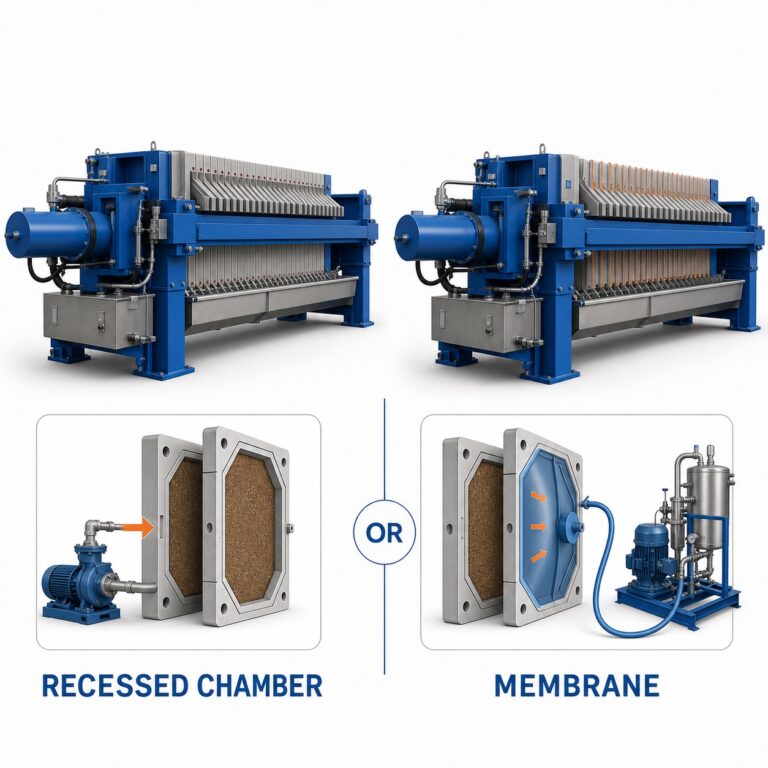
The squeeze medium is not an accessory choice layered onto a finished press design; it is a variable that shapes the press from the plate specification outward. Membrane plates are built to transmit pressure from one side of a flexible membrane to the cake on the other side, and the medium behind that membrane determines how the plate, its ports, and its seals are designed. A plate built around water distribution is not automatically interchangeable with a plate built around air distribution, even if both are described generically as “membrane plates.”
This matters because the squeeze medium touches more than the membrane chamber itself. It connects to the distribution manifold, the valving that governs when squeezing starts and stops, the piping that carries the medium to each plate, and the control logic that sequences squeezing against filtration, washing, or cake discharge. Changing the medium after a press has been engineered around the other one is not a simple substitution; it can mean re-specifying plates, distribution lines, and controls together.
The condition that changes this judgment is where the project sits in its specification timeline. If the press and plates have already been selected and documented, the medium question becomes one of confirming what that documentation supports, not one of open comparison. If the press is still being specified, the medium decision and the plate decision need to be made together, because one constrains the other. A buyer who treats the squeeze medium as a late-stage utility decision, separate from plate and press selection, risks specifying a system where the mechanical design and the utility supply do not match.
This also means the squeeze medium is not a standalone performance claim. Whether squeezing is driven by air or water does not by itself establish cake dryness, cycle time, or any other outcome; those depend on the complete arrangement of plates, distribution, sequencing, and the material being filtered. Evaluating the medium in isolation, without the plate and distribution context it operates inside, gives an incomplete picture of what the press will actually do.
Compare operating-pressure and product requirements for air and water
| Comparison point | Evidence to compare for air and water | Specification use |
|---|---|---|
| Operating pressure | Permitted pressure conditions in the offered press and plate documentation | Establish which medium is documented for the intended pressure conditions |
| Product requirements | The supplier’s stated fit of each medium for the intended product requirements | Compare application fit without assuming that one medium is universally better |
| Pressure transmission and deflation behavior | Water pressure transmission and air deflation behavior for the offered arrangement | Identify behavior that must be resolved in the selected sequence and controls |
Air and water are both documented as acceptable squeeze media, and neither is established as universally preferable; the comparison has to run through operating pressure, product requirements, and how each medium behaves mechanically once it is in the system. Metso’s FP Filter Press documentation frames this as a set of selection dimensions rather than a single answer: operating pressure, product requirements, medium distribution, and the valves and piping tied to the filtration sequence all enter the decision together, and the FP system’s own documentation governs what is compatible within that specific design.
Operating pressure matters because the press and plates are rated for defined pressure conditions, and the permitted range can differ depending on which medium is supplying that pressure. A plate and distribution system engineered around one medium’s pressure characteristics is not necessarily rated the same way for the other, so the offered documentation needs to state which medium the rated pressure applies to, not just what the rated pressure is.
Product requirements are a second axis, independent of pressure. The nature of the material being filtered, and what the project requires from the finished cake, informs which medium the supplier’s documentation treats as the fit for that application. This is a supplier-stated fit specific to the offered press, not a general rule that one medium suits one product category and the other medium suits the rest.
A third dimension is how each medium behaves once pressure is applied and then released. Diemme Filtration’s technical guide on membrane filter press working principles describes water pressure transmission and air deflation behavior as mechanically distinct: a liquid medium transmits pressure differently than a compressible gas, and a gas medium deflates differently than a liquid one when pressure is released. These are not claims that one behavior is better than the other — they are mechanical differences that the selected sequence and controls have to accommodate. Where the plate and distribution design already account for one of these behaviors, introducing the other medium without redesign risks a mismatch between how the system expects pressure to build and release and how the chosen medium actually behaves.
The condition that should guide a buyer’s reading of these comparisons is the offered press’s own documentation, not a generic preference. A configuration that is well-suited to one product and pressure profile may be documented very differently for another, and the only way to resolve the comparison for a specific project is against the specific press and plate paperwork being offered.
Check plate compatibility, distribution connections, and sequence-dependent valves
| System check | Evidence to match | Decision value |
|---|---|---|
| Membrane plates | The accepted squeeze medium named for the offered plate configuration | Establishes whether the medium is documented as compatible with the offered plates |
| Medium distribution | The distribution arrangement specified for the selected medium | Shows how the squeeze medium is routed through the offered system |
| Membrane-plate connections | Connection details for the selected medium and offered plates | Confirms that the distribution arrangement matches the plate interfaces |
| Sequence-dependent valves and piping | The valve and piping arrangement tied to the documented filtration sequence | Shows whether the selected medium is supported through the required sequence transitions |
Once a medium is identified as the candidate for a project, it needs to be traced physically through the system before it is accepted. Diemme Filtration’s working-principle guide lays out the filtration process in phases, and within that sequence, where the squeeze medium enters and exits is tied to specific valve and piping arrangements rather than being a single universal interface.
The first check is the membrane plate itself. Plates are documented as compatible with a named squeeze medium, and this compatibility is a property of the specific plate design offered, not an assumption that any plate accepts any medium. A plate rated for one medium may have port sizing, seal material, or membrane construction that is not validated for the other.
The second check is medium distribution: how the chosen medium is routed from its source, through the press frame, to each plate position. Distribution design differs depending on the medium, because the piping, manifolds, and flow characteristics required to deliver pressurized water through a system are not identical to those required for compressed air.
The third check is the connection between that distribution arrangement and the plate interfaces themselves. Even where the general distribution concept is sound, the specific connections — ports, fittings, seals — need to match the plate design the project has selected. A mismatch at this interface, even a small one, can undermine an otherwise correctly chosen medium.
The fourth check concerns valves and piping that depend on the filtration sequence. Squeezing does not happen in isolation; it is one phase among filling, filtration, possible washing, squeezing, and cake discharge, and the valve logic governing when the squeeze medium is admitted and released has to be built around that full sequence. If the sequence changes — for example, if washing or an additional phase is introduced — the valve and piping arrangement supporting the squeeze medium may need to change with it.
Where a project’s documentation supports all four checks for the same medium, the medium can be accepted as matched to the offered configuration. Where any one of these checks points to a different medium than the others, that conflict is exactly the kind of detail the offered press and plate documentation needs to resolve before the equipment is finalized — not something to assume will work itself out once installed. For buyers refining this at the configuration stage, the detail supplied about press setup and optimization is the kind of project input that feeds directly into how a supplier’s quotation review addresses these interface questions.
Separate membrane squeezing from optional air blow or channel clearing
| Function | Supported medium distinction | Specification boundary |
|---|---|---|
| Membrane squeezing | Air and water are both documented squeeze options | Acceptance depends on the offered press and plate documentation; this does not establish a universal preference |
| Optional air blow | Air blow can be a separate optional phase | Its inclusion does not by itself determine the membrane squeeze medium |
| Drying or channel clearing | One published machine example uses air for these functions while water performs membrane squeezing | The example distinguishes functions only; it does not transfer that arrangement to the offered press |
A common source of confusion is treating “air” and “water” as if they only ever describe the membrane squeeze medium, when a press can use one medium for squeezing and a different one for an entirely separate function. Membrane squeezing — applying pressure behind the membrane to compress the cake — is mechanically distinct from functions like air blow or channel clearing, which address the filter cake or the flow channels rather than the membrane itself.
The Putsch PKF 100 NG-2 operating instructions document a specific machine where water is used for membrane squeezing while air is used separately for drying or channel clearing functions, with pressure release required before the press is opened. This is useful as an illustration of how two different media can coexist in a single press performing two different jobs — it is not evidence that this split arrangement, or any particular combination, transfers to another offered press. The PKF 100 NG-2 example establishes that the functions are separable; it does not establish what medium any other press uses for either function.
This separation matters for specification because an optional air blow phase can be included or excluded independently of which medium is doing the membrane squeezing. A press might squeeze with water and still include an air blow step for the cake, or it might squeeze with air and have no separate air-use phase at all. Assuming that the presence of air blow in a system tells you the squeeze medium — or that the absence of air blow means water must be the squeeze medium — is not a supported inference.
The condition that resolves this is how the offered press’s documentation names each function separately. Where documentation distinguishes “squeeze medium” from “air blow” or “channel clearing” as separate line items, each should be confirmed on its own terms: what medium performs the squeeze, and separately, whether any air-use function exists and what it does. Where documentation does not make this distinction clearly, that ambiguity itself is something to raise with the supplier before assuming either function’s medium.
For a project team evaluating press options, this distinction also affects utility planning. Squeezing and an optional air function may draw on different utility supplies, require different piping runs, and be controlled by different valve logic — planning utilities around an undifferentiated “air or water” question, without separating which function each medium serves, risks under-specifying one of the two systems.
Confirm the offered utility and control arrangement before specification
The comparisons and interface checks already covered point toward a single confirmation task: before a membrane filter press is specified, the offered utility supply and control arrangement need to be verified against the medium the project intends to use. This is not a new technical question so much as a closing step that ties operating pressure, product requirements, plate compatibility, distribution, and function separation together into one specification decision.
Operating pressure and product requirements, read against the offered press and plate documentation, narrow the medium choice to what that specific system is documented to accept. Plate compatibility, distribution connections, and sequence-dependent valves confirm that the physical path for the chosen medium is intact through the whole press, not just at the membrane chamber. Separating membrane squeezing from any optional air-use function confirms that utility planning accounts for every medium the press actually uses, not only the one most visible in a product description.
What remains is the utility and control confirmation itself: does the site have the supply — compressed air capacity, or pressurized water supply — that the offered press’s squeeze medium requires, and does the control system sequence that medium correctly against filtration, washing, and cake discharge. This is where the Metso FP documentation’s point about sequence-dependent valves and piping, and the Diemme guide’s description of pressure release and membrane deflation before opening, come together as a single operational question: can the site’s utilities and controls actually execute the sequence the offered press is designed around.
Where a project’s utility supply and control logic already match the offered press’s documented requirements, the medium decision is effectively confirmed. Where a gap exists — insufficient air capacity for an air-squeeze system, or absent high-pressure water supply for a water-squeeze system — that gap is a configuration issue to resolve with the supplier before the press is finalized, not an operating problem to discover after installation. This is also where the equipment interface connects to what comes next for the buyer: confirming utility and control compatibility for the offered membrane filter press is the step that determines whether the press moves forward into detailed engineering or back into reconsideration of the squeeze-medium choice itself.
Frequently Asked Questions
Q: Can the available plant utility determine whether air or water should be used for membrane squeezing?
A: Utility availability alone should not determine the choice. First confirm which medium the offered press and plate documentation accepts for the intended pressure conditions and product requirements, then verify that the site’s utility arrangement can support the required distribution path and operating sequence.
Q: What information should be included in an RFQ for the squeeze-medium decision?
A: State the intended product requirements and pressure conditions, and request confirmation of the accepted medium for the offered membrane plates. Also ask the supplier to identify the medium distribution arrangement, plate connections, sequence-dependent valves and piping, and any separate air-blow, drying, or channel-clearing functions.
Q: Does an air-blow or channel-clearing step mean that air must also be the membrane squeeze medium?
A: No. These can be separate functions, so each one should be identified independently in the utility list and control sequence. A configuration may use one medium for membrane squeezing and air for another phase, but that arrangement must be confirmed for the offered press.
Q: How should a published water-squeeze and air-drying machine example be used during specification?
A: Use it to clarify the difference between membrane squeezing and separate air functions, not as a design to copy. The practical next step is to mark each required function on the proposed sequence and confirm its medium, connections, valves, and control transition for the offered configuration.
Q: What is the risk of choosing the squeeze medium late in the project?
A: A late choice can leave the utility and control design misaligned with the offered plate configuration. Because the selected medium affects distribution, membrane-plate connections, and sequence-dependent valves and piping, resolve those interfaces before the utility layout and control arrangement are finalized.