A filter press test can generate cycles of data without ever answering the question that justified running it. Before a plant owner, process engineer, or procurement team schedules bench time, they need to know what decision the test is supposed to close, because a test built to screen filter cloth looks nothing like a test built to size a press or to set acceptance criteria. Getting that distinction wrong is how teams end up with results that are internally consistent but useless for the purchase decision in front of them.
The Purchasing Question the Test Plan Must Close
A filter press test plan has to start with a single decision statement, not a general desire to “see how it dewaters.” Cloth screening, configuration comparison, sizing input, and acceptance development are four different purchasing questions, and each one calls for a different test structure, different controlled variables, and a different standard of proof.
Where the decision is cloth screening, the test only needs to hold the press configuration and feed constant while the cloth varies, so that any difference in filtrate clarity or cake release can be attributed to the cloth itself. Where the decision is configuration comparison, the cloth and feed are held constant while plate type, chamber depth, or cycle sequence varies, because the question is which hardware arrangement performs better under the same material. Where the decision is a sizing input, the test is run to characterize how a specific slurry behaves under pressure and time, feeding that behavior into a capacity calculation rather than comparing hardware options at all. Where the decision is acceptance development, the test is designed to produce the reference values that a delivered press will later be checked against, which means every condition has to be documented with enough precision that the same test could be repeated by a different party and compared against the same numbers.
Conflating these purposes produces data that cannot support any of them cleanly. A test run loosely for sizing purposes, then later invoked to settle a cloth question, will not have isolated cloth as the controlled variable, so any apparent difference in results could belong to feed variation, fill sequence, or something else entirely. The decision statement has to be written down before slurry preparation begins, because it determines which variables get frozen and which are allowed to change between runs. If the project team has not yet agreed on whether they are screening cloth, comparing configurations, generating a sizing input, or building acceptance criteria, that disagreement needs to be resolved before any bench time is scheduled, since the answer changes what “a valid comparison” even means for the runs that follow.
Fixed Feed Preparation and Equipment Configuration
| Control area | Items fixed before comparison | Límite de decisión |
|---|---|---|
| Base de la ración | Slurry source, sample preparation, and conditioning state | Feed consistency must be documented before repeatability is judged. |
| Press setup | Press configuration and filter cloth | A comparison applies only to the configuration and cloth recorded for the run. |
| Cycle setup | Fill sequence | The sequence must be held constant before run results are compared. |
| Base de medición | Methods used for pressure, flow, filtrate, cake result, and time | Methods must be fixed before the recorded results are treated as comparable. |
Once the decision statement is set, the next judgment is whether enough has actually been fixed to make the planned runs comparable to each other. Feed variability is the most common way a filter press test loses its validity, because slurry drawn from different points in a process, at different times, or after different handling will not behave the same way under pressure even if everything about the press is identical. Where the slurry source, sample preparation, and conditioning state are not documented and controlled, any difference observed between runs could be a feed artifact rather than a result of the variable the test was designed to isolate.
Conditioning state deserves particular attention because it directly affects how a slurry dewaters. If dosing, mixing, or settling time differs between samples pulled for testing, the feed entering the press is not the same feed, even if it came from the same source stream. A test plan has to state how samples are collected, how long they wait before testing, and whether any conditioning step is applied consistently, so that a reader of the results can judge whether feed consistency was actually achieved or only assumed.
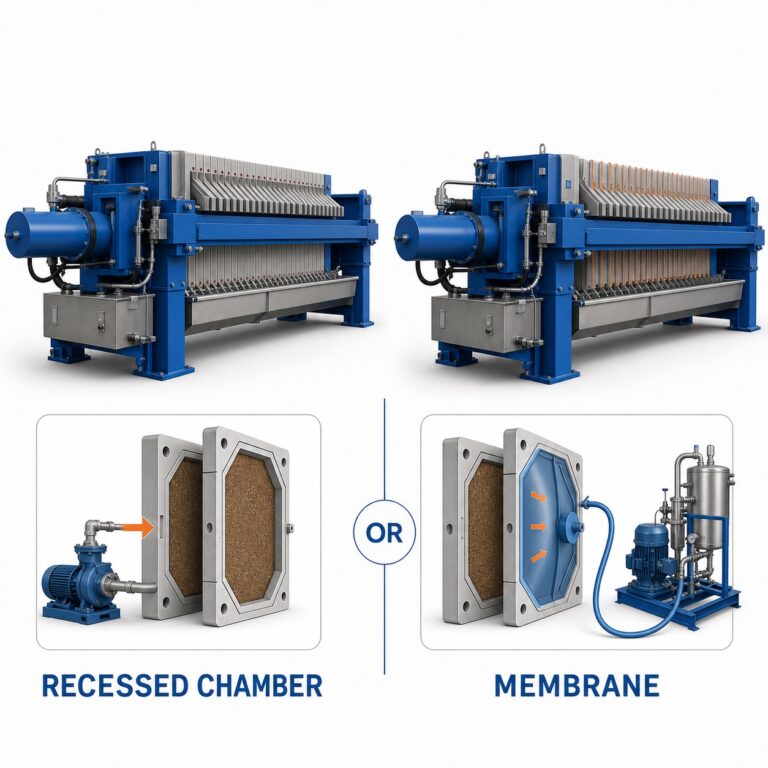
On the equipment side, the press configuration and the filter cloth in use have to be recorded as fixed conditions for any given comparison, because a result produced with one plate type, chamber depth, or cloth weave does not transfer to another configuration. Where the purchasing question is configuration comparison, this is the variable under test, and the feed must be held constant instead. Where the purchasing question is something else, the configuration should be fixed and documented so later readers of the test report understand exactly what the recorded cake and filtrate results describe.
The fill sequence is a third element that needs to be frozen before runs are compared. How a chamber is filled affects how material packs and how the cycle develops, so a comparison between runs that used different fill sequences is not a comparison of the variable the test intended to isolate. Finally, the measurement methods themselves, for pressure, flow, filtrate, cake result, and time, need to be fixed in advance. A reader checking whether a set of results is genuinely comparable should be able to confirm that the feed basis, press setup, cycle setup, and measurement basis were all held constant before the runs were run, not reconstructed afterward to explain an inconvenient result.
Controlled Fill, Filtration, Squeeze, and Discharge Sequence
A filter press cycle runs through distinct stages, fill, filtration, squeeze, and discharge, and each stage behaves differently depending on how the one before it was executed. Running the sequence consistently is what allows the measurements taken during the cycle to mean the same thing from one run to the next.
The fill stage sets the starting condition for everything that follows. How quickly chambers fill, and in what pattern, affects how cake begins to form against the cloth, which in turn affects how the filtration stage behaves once pressure builds. If fill conditions are allowed to drift between runs, differences observed later in the cycle cannot be attributed cleanly to the variable the test is meant to isolate, because the cycle did not start from the same place.
During filtration, flow declines as cake builds and resistance increases; this is the stage where the relationship between pressure and flow becomes most informative about how the slurry and cake behave under the test conditions. If the press configuration allows a squeeze stage, applying mechanical or diaphragm pressure after initial filtration changes the cake’s final condition, and whether squeeze is used, and for how long, has to be held constant across runs intended for comparison. A test that applies squeeze inconsistently, or omits it in some runs without noting that difference, produces cake results that answer different questions even though they came from the same press.
Discharge is the stage most easily treated as an afterthought, but how cake releases from the cloth and plates affects both the practical usability of the result and whether the cycle can be considered complete and comparable. Where discharge behavior differs sharply between runs, that difference itself is relevant information, but only if it was observed and recorded rather than left unremarked.
The sequence needs to be written into the test plan in enough detail that two people running the test independently would execute the same stages in the same order with the same stage-to-stage transitions. Where the sequence is left implicit, each operator may introduce small variations that accumulate into real differences in the recorded results, undermining the comparability the rest of the test plan was built to protect.
Measurement Methods for Cake, Filtrate, Pressure, Flow, and Time
| Measurement or observation | Record with the run | What the record can establish |
|---|---|---|
| Pressure and flow | Both measurements over the cycle | Supports review of pressure drop and throughput; it does not by itself establish cake or filtrate performance. |
| Filtrado | The measured filtrate result and its cycle context | Supports separation verification using the method fixed in the test plan. |
| Tarta | The measured cake result and its cycle context | Records the dewatering outcome for the tested feed and configuration; no acceptance value is supplied here. |
| Time and cycle events | Timing together with recorded cycle events | Connects measurements and results to the relevant parts of the cycle. |
| Abnormal observations | The observation and the affected run | Supports application of the exclusion rules set before testing. |
Deciding what to measure is only half the task; the other half is deciding what each measurement can and cannot establish on its own. Pressure and flow recorded together over the course of the cycle support a review of how resistance develops and how throughput changes as the cycle progresses, but neither measurement by itself establishes what the cake or filtrate result will be. A buyer reading test data should treat pressure and flow as context for interpreting the cycle, not as a substitute for directly measuring the outcome they care about.
Filtrate needs to be measured using the method fixed in the test plan, and its result needs to be read in the context of the cycle stage at which it was recorded, since filtrate quality can change over the course of a cycle rather than remaining constant. A single filtrate reading taken without noting when in the cycle it was collected is difficult to compare against another run’s filtrate reading taken at a different point.
Cake results describe the dewatering outcome for the specific feed and configuration tested, and recording one requires documenting the conditions under which it was produced, since a cake result from one configuration says nothing about how a different configuration would perform on the same feed. No acceptance threshold is established by the act of measuring cake condition; that threshold, where one is needed, has to come from a separate acceptance-setting decision informed by the GB/T 30176-2013 performance measurement methodology where applicable, or from the project’s own acceptance development process, not from the measurement itself.
Time and cycle events tie all of the above together by anchoring each measurement to the part of the cycle it describes. Without a timeline connecting fill, filtration, squeeze, and discharge to the pressure, flow, filtrate, and cake data collected along the way, a reviewer cannot reconstruct what happened during a given run or compare its timeline against another run’s.
Abnormal observations, anything from an irregular discharge to an unexpected pressure behavior, need to be recorded against the specific run they affected rather than noted in general terms. This record is what allows the exclusion rules set before testing to be applied consistently rather than being decided after the fact based on whether a result was favorable.
Repeatability and Exclusion Rules Set Before the Run
| Control question | Evidence to document | Uso de la decisión |
|---|---|---|
| Was the feed basis consistent? | Slurry source, sample preparation, conditioning state, and documented feed consistency | Determines whether run-to-run comparison has a stable feed basis. |
| Were the decision metrics stable? | The decision metrics selected for the test and their results across comparable runs | Provides the stated basis for judging repeatability. |
| Did an abnormal event affect a run? | Cycle events and abnormal observations linked to the run | Supports the exclusion decision under rules defined before testing. |
| Why was a run excluded? | The excluded run and the applicable predefined rule | Preserves traceability instead of silently removing an unfavorable or irregular result. |
| Why did testing stop? | The predefined stopping logic, stable decision metrics, and feed-consistency record | Shows why the evidence was considered sufficient without relying on an unexplained cycle count. |
Repeatability in a filter press test is not the same as running the same cycle count on every test program. A test plan establishes what repeatability means for its specific decision statement before the first run, and that definition rests on two things: whether the feed basis stayed consistent across runs, and whether the decision metrics selected for the test stabilized across comparable runs.
Feed consistency has to be documented, not assumed, because even runs drawn according to the same stated procedure can vary if the source stream itself changed between sampling events. A test plan that checks and records feed consistency gives later readers a basis for trusting that observed differences between runs reflect the variable under test rather than feed drift. Where feed consistency cannot be confirmed, the comparison built on top of it loses its footing regardless of how carefully everything else was controlled.
Deciding which metrics count as the decision metrics follows directly from the decision statement set at the start. A cloth screening test and a sizing test will often track different combinations of filtrate clarity, cake result, and cycle timing as their primary evidence, and the stability of those specific metrics across runs, not stability in every measurement collected, is what supports a repeatability conclusion.
Exclusion rules exist to prevent a result from being discarded simply because it was inconvenient. Setting the rules before testing begins means that when an abnormal observation is recorded against a run, there is already a standing basis for deciding whether that run should be excluded, and that basis does not depend on whether the result helped or hurt the outcome the project team hoped for. Each excluded run should carry a record of which predefined rule applied, preserving a trail that a later reviewer can check rather than a quiet removal that only the original tester could explain.
Stopping logic follows the same principle. Ending a test program because a predetermined cycle count was reached, without reference to whether the decision metrics had actually stabilized or whether feed consistency had been confirmed, leaves the stopping decision without a stated basis. A defensible stopping point is one supported by stable decision metrics and a documented feed-consistency record, which together show that further runs were unlikely to change the answer to the decision statement the test was built to close.
Test Report Package for Traceable Decisions
| Report element | Include | Traceability purpose |
|---|---|---|
| Decision statement | The purchasing decision the test was designed to support | Keeps cloth screening, configuration comparison, sizing input, or acceptance development tied to the evidence collected for that decision. |
| Fixed test basis | Slurry source, sample preparation, conditioning state, press configuration, cloth, fill sequence, and measurement methods | Defines the feed and configuration to which the reported results apply. |
| Run record | Pressure and flow over the cycle, filtrate, cake result, time, and cycle events | Connects each reported result to the run in which it was observed. |
| Excepciones | Abnormal observations, excluded runs, and the predefined exclusion rule applied | Makes omissions and exclusions visible to the decision reader. |
| Repeatability and stopping record | Stable decision metrics, documented feed consistency, and the stopping logic | Shows the basis for concluding that the test evidence was repeatable and sufficient for the stated decision. |
| Límite de las pruebas | Relevant source passages used and any stated scope limitation | Prevents a standard reference or municipal biosolids example from being treated as an unsupported PORVOO performance conclusion or transferred industrial-slurry result. |
The report produced at the end of a filter press test program has to let a reader trace the path from the original purchasing question to the final conclusion without gaps. That traceability is what allows someone who was not present for the testing, an engineer reviewing a quotation, a procurement team comparing proposals, or a plant manager signing off on acceptance, to judge whether the evidence actually supports the decision being made.
The report needs to restate the decision statement the test was designed to support, because a reader evaluating the evidence has to know whether they are looking at a cloth screening result, a configuration comparison, a sizing input, or acceptance development data; the same cake and filtrate numbers mean different things depending on which question they were collected to answer. Alongside that, the fixed test basis, slurry source, sample preparation, conditioning state, press configuration, cloth, fill sequence, and measurement methods, defines exactly what feed and hardware combination the reported results apply to, so the results are not mistakenly generalized to a different feed or configuration.
The run record itself needs to connect pressure and flow, filtrate, cake result, time, and cycle events back to the specific run in which each was observed, rather than presenting averaged or summarized figures that obscure run-to-run variation. Exceptions, abnormal observations, excluded runs, and the predefined rule applied to each exclusion, need to be visible in the report rather than absorbed silently into a final average, since a result set that excluded several runs without explanation carries a different weight than one that excluded nothing.
The repeatability and stopping record closes the logical chain by showing why the decision metrics were considered stable, why feed consistency was documented as sufficient, and why testing stopped where it did. Where the report draws on a methodology reference such as GB/T 30176-2013 for measurement method context, or on general route mechanics described in the EPA Recessed-Plate Filter Press fact sheet for how fill, filtration, squeeze, and discharge interact in a cycle, the report should state that scope explicitly rather than letting a municipal biosolids example or a general standard reference be read as a transferred industrial-slurry result or an unsupported performance conclusion about the specific press under evaluation. Information a plant supplies about its slurry source, conditioning state, and site constraints is what allows a reviewer, including PORVOO’s quotation process for its filter press equipment, to match a proposed configuration against the evidence this kind of test produces, rather than against general claims alone.
Preguntas frecuentes
Q: Can one filter press test series support several purchasing decisions?
A: Only when each decision is declared and the test captures the evidence needed for it. Set one primary purpose—such as cloth screening, configuration comparison, sizing input, or acceptance development—and do not automatically treat evidence collected for one purpose as sufficient for another.
Q: How should a planned change, such as a different filter cloth, be handled between runs?
A: Treat the changed item as the comparison variable and keep the feed basis, remaining press configuration, fill sequence, and measurement methods fixed. If more than one material factor changes, record the run under a different test basis instead of presenting it as a direct comparison.
Q: How many repeat runs are needed before testing can stop?
A: An unexplained cycle count is not a sufficient stopping rule. Define the decision metrics in advance, compare only runs with a consistent documented feed basis, and stop when those metrics meet the predefined stability logic; record abnormal or excluded runs separately with the rule applied.
Q: Can results from one slurry or press configuration be applied to another project?
A: The results apply to the recorded slurry source, preparation and conditioning state, press configuration, cloth, cycle setup, and measurement basis. Before reusing them, verify which of those conditions still match; otherwise, use the earlier result as planning input and establish a new test basis for the changed project.
Q: What information should a buyer prepare before scheduling the test?
A: Prepare the purchasing decision to be closed, the slurry source and sample-preparation plan, the conditioning state, the press and cloth configuration, the fill sequence, the measurement methods, and the decision metrics. Also agree in advance on abnormal-run exclusions, stopping logic, and the report format so the final evidence remains traceable.