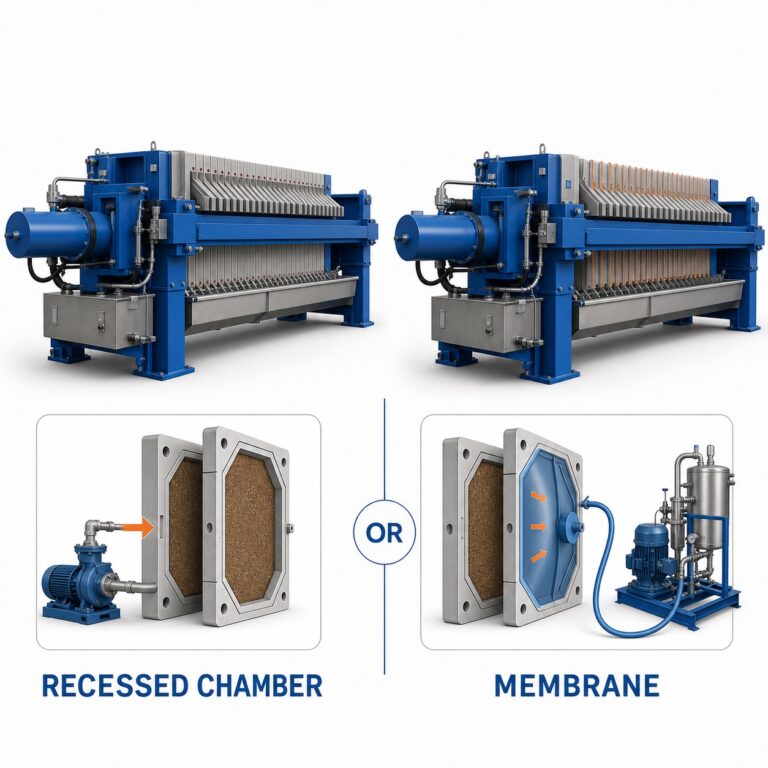
A plant team running side-by-side filter press trials often reaches the same question partway through the test: how many cycles justify a conclusion? Stopping too early risks ranking two configurations on noise rather than real difference; running cycles indefinitely delays the decision without clarifying it. The right answer depends on what the comparison needs to resolve, not on a fixed count carried over from a previous project.
Why a Fixed Cycle Count Can Mislead
A cycle count chosen before the comparison is defined treats all testing situations as equivalent, when they are not. A trial meant to confirm that one cloth type sheds cake more cleanly than another needs enough cycles to separate a real difference from cycle-to-cycle scatter. A trial meant to characterize average filtrate clarity across a feed that varies in solids content needs enough cycles to represent that variation, not simply enough to produce a number. These are different questions, and they do not converge on the same number of repeats.
Where the comparison concerns a well-controlled variable, such as a configuration change applied under otherwise constant conditions, fewer cycles may be sufficient because the variability in the data mainly reflects the mechanism under study, not an unrelated conditions change. Where the comparison concerns performance across an operating window, such as a feed stream that shifts over time, a count chosen for the first case will understate the number of runs the second case requires, because the thing changing between runs is masked by too short a window.
Treating a cycle count as portable from one project to another also conceals the step that should come first: naming the output the comparison depends on. If the decision rests on cake moisture, the number of cycles needed to see whether moisture has stabilized may differ from the number needed to see whether filtrate clarity has stabilized, because these outcomes can respond to different mechanisms within the press cycle. A count that satisfies one output does not automatically satisfy another, and a single fixed number applied to both risks declaring the comparison finished before either metric has actually stabilized. The number of cycles that is “enough” is answer-specific, not press-specific or project-specific in a way that transfers.
Feed Stability Needed Before Repeatability Has Meaning
Repeat cycles are only informative once the feed entering the press is stable enough that consecutive runs are describing the same material. If the feed composition, solids concentration, or chemical conditioning varies cycle to cycle, then variation observed across runs reflects a mix of the comparison being tested and an uncontrolled change in what is being filtered. At that point, additional cycles do not resolve the comparison; they add more data points to a confounded data set.
This condition sits ahead of any discussion of how many repeats are enough, because the repeat count only answers “is this result stable” once “is this feed stable” has already been answered. Where the feed is drawn from a batch tank or holding vessel that is well mixed and representative across the test window, feed stability may be established relatively early, allowing the comparison to focus on press-side behavior. Where the feed is drawn directly from an upstream process that itself varies, such as a stream whose solids loading or chemistry shifts with the originating operation, establishing feed stability takes more attention, and the test plan should confirm that incoming material is tracked alongside press outputs rather than assumed constant.
A buyer evaluating test results should ask how feed consistency was confirmed across the cycles being compared, not only what the press produced. Without that confirmation, a tight spread in output results could reflect a controlled feed, or it could reflect a feed that happened not to vary much during a short test window, which is a different and weaker basis for drawing conclusions about expected behavior under full operating conditions. The EPA’s Recessed-Plate Filter Press fact sheet addresses this adjacent point when it describes batch-operation interfaces and the attention a fill-and-unload cycle requires, and treats bench or vendor pilot testing as the route to representative data for design decisions; that scope is specific to municipal biosolids operation and does not establish a transferable cycle count for industrial slurries, but the underlying expectation that testing should be representative of actual feed behavior applies regardless of the stream.
Startup and Cloth-Conditioning Runs in the Data Set
| Cycle group | How to use it in the comparison | Record boundary |
|---|---|---|
| Startup or cloth-conditioning runs | Assess separately from later runs | Retain the records; do not discard them without an explicit reason |
| Later runs | Assess separately from startup or cloth-conditioning behavior | Interpret repeatability only after feed stability has been established |
Early cycles in any filter press test sequence can behave differently from later ones because the filter cloth has not yet reached its conditioned state and because startup transients in pressure or flow have not settled. A cloth that is new or freshly cleaned filters differently than one that has built up the fine residual layer it will carry through normal operation, and a press restarting from an empty state does not immediately replicate the flow and pressure pattern of a cycle that follows an identical predecessor.
If these early runs are mixed into the same data set as later, steady-state runs without being identified, they widen the apparent variability of the comparison and can shift an average toward a condition the press will not sustain in ongoing operation. The correction is not to discard these records. They carry information about how the press behaves during startup and conditioning, which matters for understanding commissioning behavior and for setting expectations about how many early cycles a given cloth and configuration need before output stabilizes. The correction is to classify them separately and retain them with that classification intact, so later reviewers can see what was excluded from the steady-state comparison and why.
Where the test’s purpose is to characterize sustained operating performance, startup and conditioning cycles are set aside from the steady-state subset used for ranking or acceptance comparison. Where the test’s purpose includes characterizing commissioning behavior itself, such as how many cycles a particular cloth needs to reach conditioned performance, those same early cycles become the primary subject rather than a nuisance to exclude. The distinction depends on what the comparison is meant to answer, which returns to the same requirement that governs the overall cycle count: define the comparison before deciding which data belong in it.
Variability Across Cake, Filtrate, Cycle, Pressure, and Flow
A filter press produces several outputs simultaneously, and they do not necessarily stabilize at the same rate or respond to the same underlying cause. Cake moisture reflects how completely the solids have been compressed and dewatered within the available cycle time. Filtrate quality reflects how effectively the cloth and any precoat or conditioning are retaining fine solids. Cycle time reflects how quickly the press fills, builds pressure, and completes the dewatering phase. Feed pressure and flow reflect the pump and feed-system behavior delivering material to the press. Because these outputs arise from different mechanisms within the same cycle, a comparison that looks stable on one metric can still be moving on another.
This matters directly for deciding when enough cycles have run. If only cake moisture is tracked and it appears consistent after a small number of cycles, that consistency says nothing about whether filtrate clarity or cycle time have also settled. Where the decision depends on more than one of these outputs jointly, such as a configuration comparison that must hold up on both dewatering performance and throughput, each relevant output needs its own check for stability rather than relying on whichever output happened to converge first.
The relationship between these outputs also changes with the condition being tested. If a condition under study mainly affects cake formation, such as a change intended to improve dewatering, filtrate quality may be largely unaffected and need no particular scrutiny in that comparison. If the condition under study affects feed delivery, such as a change at the pump or feed line, pressure and flow variability become the metrics most informative about whether the condition is behaving consistently from cycle to cycle, while cake and filtrate outcomes may only show the downstream effect once that upstream variability has itself stabilized. Reviewing these outputs together, rather than selecting one convenient metric, is what reveals whether an apparent trend is a real effect of the condition being tested or a transient still working its way through the cycle.
Stop Rule Based on the Intended Comparison
| Stop-rule check | Evidence to review | Límite de decisión |
|---|---|---|
| Intended comparison | The variation that the comparison must resolve | Do not use a universal cycle count in place of this definition |
| Estado del pienso | Feed consistency across the runs being compared | Repeatability has meaning only after feed stability is established |
| Declared decision metrics | Stability of the predeclared metrics for the intended comparison | Continue if the metrics are not yet stable enough for that comparison |
| Ranking sensitivity | Spread in cake, filtrate, cycle, pressure, and flow outcomes | Continue if another run could change the ranking |
| Excluded runs | A stated reason for every exclusion | Do not stop on a data set with unexplained exclusions |
A defensible stopping point in a filter press comparison is reached when the result no longer depends on which cycle happens to be the last one recorded. That condition cannot be checked without first having fixed what the comparison is meant to resolve, because “stable enough” only has meaning relative to a declared decision metric. A comparison aimed at ranking two cloth types on cake moisture is stable when the moisture difference between the two options holds up consistently across the later, steady-state runs; a comparison aimed at characterizing average cycle time across a variable feed is stable when enough cycles have captured the range of feed conditions the process actually produces.
Reaching that point depends on the earlier conditions already established: feed consistency confirmed across the cycles being compared, startup and cloth-conditioning cycles identified and set aside from the steady-state subset, and the relevant outputs among cake, filtrate, cycle, pressure, and flow tracked together rather than individually. Stopping before these conditions are satisfied risks a conclusion that reverses once additional cycles are run, which defeats the purpose of running a comparison test in the first place.
Where every run in the comparison is stable, consistent, and included, the decision is straightforward. Where some runs have been excluded, such as early cloth-conditioning cycles or a run affected by an identified feed disruption, the stopping decision also requires that each exclusion carry a stated reason, so the comparison can be reviewed by someone who was not present for the testing and can confirm that no result was removed simply because it did not support the expected outcome.
This is also the point at which project information supplied to a supplier such as PORVOO becomes relevant to equipment selection, because feed characteristics, intended comparison metrics, and acceptance expectations gathered during this kind of testing are the same inputs a configuration or quotation review depends on for sizing a filter press to the actual application. Where the test results feed into acceptance review rather than a pre-purchase comparison, the same reasoning applies at the project stage, as described in the related discussion of filter press acceptance testing covering cake moisture, filtrate quality, and cycle time. A comparison that stops only when its predeclared metrics are stable, with every exclusion justified, gives both the buyer and the supplier a basis for configuration decisions that an arbitrary cycle count cannot provide.
Preguntas frecuentes
Q: Should startup or cloth-conditioning cycles count as failed repeat tests?
A: Do not automatically treat them as failures or combine them with later cycles. Retain their records, classify them separately, and base any repeatability judgment on later runs only after feed stability has been established.
Q: What should be defined before repeat testing begins?
A: Define the comparison the test must resolve and declare the decision metrics in advance. Record feed consistency and the cake, filtrate, cycle, pressure, and flow outcomes needed to judge whether the comparison has become stable.
Q: What if some test metrics look stable while others still vary?
A: Continue testing if the remaining variation could affect the intended comparison or change the ranking. Use the predeclared decision metrics to distinguish consequential variation from movement that does not alter the decision.
Q: When can a test cycle be excluded from the comparison?
A: Exclude a cycle only when there is an explicit reason for doing so, and retain the record of both the cycle and the reason. A stopping decision based on unexplained exclusions is not defensible.
Q: How can a team decide that another filter press cycle is unlikely to change the conclusion?
A: Check that the compared runs have stable feed conditions, the declared decision metrics are stable enough for the intended comparison, and the observed spread would not allow another run to change the ranking. If any of those checks remains unresolved, the evidence does not yet support stopping.