A ceramic disk filter arrives on site as a tested machine, but the test that matters to the plant’s permit, its filtrate quality, and its uptime happens after installation. The commercial question buyers and EPC teams need to settle early is not whether acceptance testing will occur, but which claims factory testing can support and which claims only a site test, under real feed and real utilities, can support. Getting that boundary wrong in the contract creates disputes later about what a passed test actually proved.
Separate Factory Verification from Site Performance Proof
| Acceptance stage | Primary decision | Conditions and evidence | Limite |
|---|---|---|---|
| Factory acceptance test (FAT) | Does the manufactured unit match the agreed configuration, and do specified controls, alarms, and interlocks function before shipment? | Agreed configuration, documentation, and practical no-load or simulated function records | Factory evidence does not establish installed performance under plant duty. |
| Site acceptance test (SAT) | Do the installed interfaces work, and does the system perform under the agreed plant duty? | Agreed feed readiness, utilities, sampling, and operator support | Capacity, cake moisture, filtrate quality, and other equipment results require a separate agreed test plan and project-specific acceptance values. |
A factory acceptance test and a site acceptance test answer different questions, and confusing them is the most common source of disagreement at commercial close-out. The FAT exists to confirm that the unit built matches what was ordered and that its controls, alarms, and interlocks behave as specified under conditions the factory can practically create — typically no-load or simulated conditions, since the factory does not have the project’s actual feed stream, sludge characteristics, or full utility supply available to it. The SAT exists to confirm that the installed, interconnected system performs under the plant’s actual operating duty.
The distinction matters because evidence generated at one stage does not transfer to the other. A disk filter that cycles correctly on an empty tank, with simulated signals triggering its alarms and interlocks, has demonstrated that its control logic and mechanical sequencing work as designed. It has not demonstrated what cake moisture, filtrate clarity, or throughput will look like once it is dosed with the project’s actual sludge or process stream, because those outcomes depend on feed characteristics, upstream conditioning, and utility conditions that only exist at the installed site. Where a contract treats FAT sign-off as proof of plant-duty performance, the buyer has accepted a document that was never designed to carry that conclusion.
This boundary should be set before either test is scheduled, not discovered afterward. The buyer’s acceptance criteria should state explicitly which performance claims — capacity, cake moisture, filtrate quality, membrane flux, or recovery rate — are reserved for SAT and excluded from FAT scope. Commission électrotechnique internationale 62381, which addresses FAT, SAT, and site integration testing structure for automation systems, supports this general separation of factory-stage verification from site-stage performance demonstration, though it is written for automation systems generally rather than for dewatering equipment specifically; the project still needs its own agreed test plan defining what capacity, moisture, and filtrate values will be measured at SAT and against what reference. Where the project skips that step and relies on a generic FAT/SAT checklist, the buyer carries the risk of accepting equipment on evidence that answers the wrong question.
Map Each Test Activity to an Owner and Witness
Every check inside a FAT or SAT belongs to someone who performs it, someone who verifies it, and someone who has authority to accept or reject the result — and when a project does not assign these roles in writing, the ambiguity surfaces exactly when a test result is disputed. The supplier typically owns execution of most FAT activities, since the unit is on their premises and under their control; the buyer or their delegate witnesses those activities to confirm the result independent of the supplier’s own sign-off. At SAT, the balance shifts: the integrator or installer may own commissioning activities, the buyer’s operations team owns feed and utility readiness, and an independent laboratory may own sampling and analysis where filtrate or reuse-water quality is part of the acceptance basis.
The practical risk is not the absence of named parties but the absence of a single document that ties each activity to its owner, its witness, and the prerequisite that must exist before the activity can be run. If an interlock test requires a specific control state and the party responsible for establishing that state is not named, the test either does not happen on schedule or happens without the verification step the buyer expected. The same applies to sampling at SAT — if the laboratory is not identified in advance, along with the sampling method and chain of custody, a disputed filtrate-quality result has no independent record to resolve it.
Where EPC contractors are involved, an additional layer appears: the EPC may hold contractual responsibility for coordinating both supplier and buyer personnel, which changes who issues punch items and who has authority to delay a test. This does not change what the test demonstrates, but it changes who is accountable for readiness and who the buyer should escalate to if a prerequisite is not met. Before scheduling either test, the buyer should confirm who performs each check, who witnesses it independently, what must be true before it can run, and who is authorized to accept or reject the recorded result — resolving this in advance prevents the test matrix from becoming a dispute document after the fact.
Confirm FAT Prerequisites, Functions, and Deliverable Records
| FAT review area | Evidence to examine | What the evidence establishes |
|---|---|---|
| Agreed manufactured configuration | Configuration record matched against the agreed configuration | Whether the unit presented for FAT matches the agreed manufactured configuration |
| Controls and alarms | Recorded results from practical pre-shipment function checks | Function observed under the stated factory test conditions; no plant-duty performance conclusion |
| Verrouillages | Recorded results from practical pre-shipment function checks | Interlock behavior under the stated factory test conditions; no installed-interface conclusion |
| Documentation | Agreed document set and its review status | Which required records were available at FAT and their status |
| No-load or simulated functions | Record identifying the function, test condition, and outcome | Only the demonstrated no-load or simulated behavior; SAT remains the stage for installed-duty proof |
The value of a FAT depends entirely on what was agreed before the unit was built, because the test can only confirm conformance to a prior agreement — it cannot establish whether that agreement was adequate for the application. The first prerequisite is a configuration record the buyer can check the physical unit against: disk count, drive arrangement, instrumentation, and any options specified during quotation. Where this record is incomplete or was never formally agreed, the FAT has nothing authoritative to verify against, and disagreements about scope surface at the factory rather than earlier, when they are cheaper to resolve.
Controls, alarms, and interlocks are checked next, and here the distinction between what is demonstrated and what is implied needs attention. A factory test confirms that a given input produces the specified output — a simulated high-level signal trips the correct alarm, an interlock prevents the correct sequence. It does not confirm that the sensor will perform identically once installed in the project’s actual environment, subject to the project’s actual vibration, temperature, or electrical conditions. The record from this stage should state the function tested, the simulated condition used, and the outcome, without extending the conclusion to installed behavior.
Documentation review belongs inside the FAT because it is one of the few deliverables that can be fully verified before shipment — manuals, drawings, certificates, and spare-parts lists either exist in the agreed form or they do not. Where documentation is incomplete at FAT, the buyer has a choice to make: hold shipment until the record is complete, or accept shipment with a written punch item and a deadline, which shifts leverage away from the buyer once the equipment has left the factory.
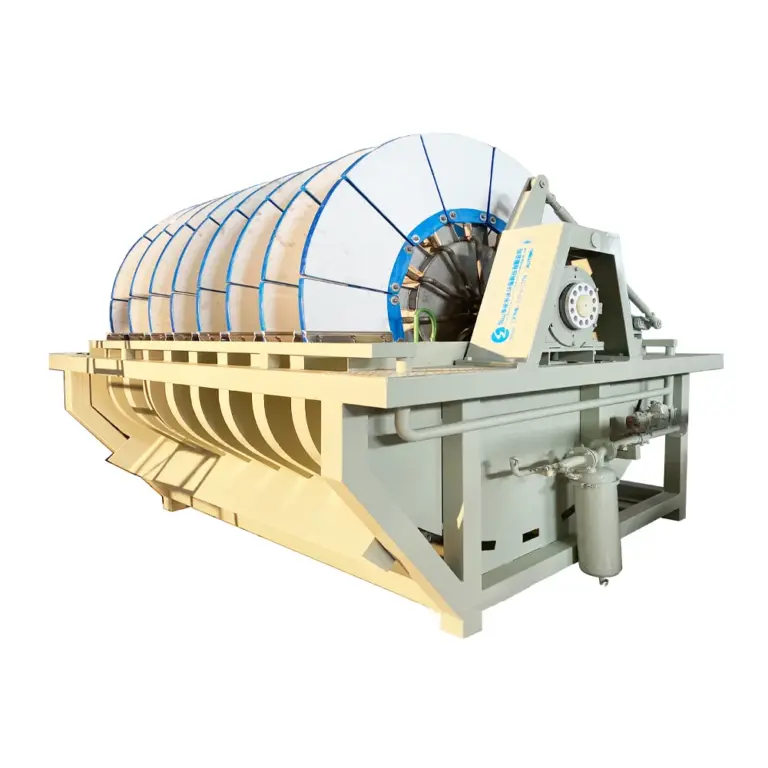
No-load or simulated function tests — rotation, drive engagement, basic sequencing — demonstrate mechanical function without demonstrating separation performance, since no equivalent of the project’s actual slurry is available at the factory. A filtre à disque céramique sous vide that cycles correctly without load has passed a meaningful but limited test; the buyer should record exactly which functions were run under what simulated condition, so that SAT scope is not later assumed to duplicate or replace what FAT already covered.
Prepare SAT Feed, Utilities, Sampling, and Interface Conditions
| SAT readiness item | Project-specific condition to agree | Why it matters to the SAT decision |
|---|---|---|
| Installed interfaces | Interfaces included in the test and their readiness evidence | Defines the installed boundary being tested |
| Feed readiness | Agreed plant duty and feed condition available for the test | Ties observed performance to the agreed duty |
| Services publics | Required utilities and their readiness status | Distinguishes equipment performance from unavailable site support |
| Échantillonnage | Sampling plan, records, and any laboratory involvement | Defines the evidence used to judge performance |
| Operator support | Required operator support and availability | Confirms that the agreed test can be executed under supported site conditions |
A site acceptance test is only as good as the conditions under which it runs, and conditions that are missing or substituted at test time will weaken or invalidate the performance conclusion the buyer wants from the test. The first condition to confirm is which installed interfaces are actually included in the test boundary — feed piping, filtrate piping, cake discharge, and any upstream or downstream connections to other equipment. Where an interface is excluded from SAT scope because it is not yet complete, the test result applies only to what was actually exercised, and the buyer should not treat it as validating the excluded interface by implication.
Feed readiness is the condition most likely to compromise a SAT result if it is not planned. The test needs to run against an agreed plant duty — meaning a feed stream whose characteristics are known and ideally representative of ongoing operation, not a convenience feed selected because it was available on the test date. Where the actual process feed differs meaningfully in solids content, particle size, or chemistry from what is fed during SAT, the capacity and cake-moisture results obtained will not represent the equipment’s behavior under normal operation, and the acceptance basis should say so explicitly rather than treating the test feed as equivalent.
Utilities — compressed air, vacuum, electrical supply, and any backwash or cleaning water — need to be confirmed available at the rates and qualities the equipment was designed around before the test starts. A capacity shortfall caused by an undersized utility supply is not a filter performance issue, but without prior agreement on utility readiness, a utility-driven shortfall can be attributed to the equipment by default.
Sampling deserves its own agreement: what is sampled, how often, by what method, and whether an independent laboratory is involved, particularly where filtrate or reuse-water quality carries contractual weight — a concern addressed more directly where ceramic membrane reuse quality is the acceptance basis. Operator support, meaning availability of the buyer’s own personnel to run the equipment under normal operating instructions rather than supplier personnel operating it as a demonstration, confirms that the result reflects how the plant will actually run the unit. Where a project supplies its feed, utility, and sampling conditions in advance, that information becomes the basis for configuration and quotation review, since the acceptance values a supplier can agree to depend on the duty the equipment will actually see.
Close Punch Items, Retests, and Acceptance Authority in Writing
| Closeout situation | Contract point to state in writing | Decision controlled |
|---|---|---|
| Punch item remains open | Item, responsible party, closeout evidence, and sign-off authority | Whether the item may remain open at acceptance and what closes it |
| Check fails | Corrective work, responsibility, and required record | What must happen before the failed check is reconsidered |
| Repeat test is required | Retest scope, prerequisites, witnesses, records, and responsible party | How the repeated result will be assessed and signed |
| Commercial acceptance is considered | Acceptance authority, required records, and treatment of unresolved items | Who may accept and how open matters affect commercial acceptance |
A test that produces open items without a written mechanism for closing them leaves acceptance undefined, regardless of how well the test itself was executed. The contract should state, before testing begins, what happens when a punch item remains open at the scheduled sign-off date — specifically, whether conditional acceptance is possible, what evidence closes the item afterward, and who has authority to confirm that closure. Where this is left undefined, a minor open item can either block commercial acceptance entirely or be waved through informally, and neither outcome serves a buyer who wants the record to reflect what was actually resolved.
A failed check carries a different consequence than an open item, because a failure implies corrective work is needed before the equipment or system can be re-evaluated, not merely before paperwork is completed. The contract should identify who is responsible for that corrective work, what record documents it, and what triggers reconsideration of the failed check. Where a failure occurs at SAT on a function that passed at FAT, the buyer and supplier need an agreed basis for distinguishing an installation issue from an equipment issue, since the two carry different responsibility.
Retesting needs its own scope rather than an assumption that the entire test repeats. The contract should define what portion of the test is rerun, what prerequisites must be satisfied before the retest is scheduled, who witnesses it, and what record is produced — otherwise a partial failure can escalate into a full repeat test that neither party intended or budgeted for.
Finally, the document needs to name who holds authority to grant commercial acceptance, what records that authority relies on, and how outstanding punch items or unresolved retests are treated at that moment — whether acceptance is withheld entirely, granted conditionally against a remediation schedule, or granted with a reservation of rights. Where a vacuum ceramic disk filter has passed its agreed FAT and SAT scope but carries open items unrelated to core performance, stating in advance how those items affect commercial acceptance prevents the closeout from being renegotiated informally after the equipment is already in service. The same written structure applies whether the test in question concerns a filtration unit’s mechanical and control functions or a wastewater train’s reuse-quality and sludge-output acceptance, since in both cases the acceptance authority and the treatment of open items are commercial terms, not technical ones, and need to be fixed before testing rather than inferred from its outcome.
Questions fréquemment posées
Q : Can IEC 62381 alone define acceptance of ceramic disk filter performance?
A : No. IEC 62381 provides a useful structure for FAT, SAT, activities, and responsibilities in an automation-system context, while dewatering capacity, cake moisture, filtrate quality, and other equipment results need a separately agreed test plan with project-specific acceptance values.
Q : Should dewatering performance be accepted during FAT or SAT?
A : Reserve plant-duty performance proof for SAT unless the contract defines another supported test arrangement. FAT can verify the agreed manufactured configuration and practical controls, alarms, interlocks, documentation, and simulated or no-load functions, but those records do not establish installed performance with the project feed and utilities.
Q : What should happen if the feed, utilities, or installed interfaces are not ready for SAT?
A : Record the unmet condition before interpreting the test result, because the observed outcome may not represent the agreed plant duty. The parties should determine which checks remain valid, which evidence is incomplete, and whether the affected performance test requires a repeat under the agreed readiness conditions.
Q : Who should control sampling and witness records during SAT?
A : Assign responsibility by test activity before the test begins. The test matrix should identify who prepares the sampling plan, who provides the agreed feed and utilities, who performs or witnesses each check, whether a laboratory is involved, which records are required, and who has sign-off authority.
Q : Does a successful SAT automatically trigger commercial acceptance?
A : Only if the contract links the completed SAT evidence to commercial acceptance and names the authorized signatory. It should also state how open punch items, failed checks, corrective work, repeat tests, and unresolved records affect the acceptance decision.