Specifying a downdraft grinding table based on a single rated CFM figure is one of the more reliable ways to commission a capture system that underperforms from day one. The actual failure often surfaces weeks later — when operators report visible dust escaping the work surface — and the root cause traces back to a geometry mismatch identified at selection, not a mechanical fault. At that stage, replacing or extending the table carries fabrication lead time, rescheduled maintenance windows, and potential exposure documentation that a pre-purchase coverage check would have avoided. What follows is a sequence of checks — workpiece geometry, airflow at open area, blockage risk, cross-draft controls, wet-versus-dry maintenance trade-offs, and commissioning acceptance — that gives procurement and process teams the specific judgment points needed before finalizing a specification.
Measure workpiece size and table coverage first
The capture zone of a downdraft table is physically bounded by the work surface. Any dust source that extends beyond that boundary — even partially — is no longer inside the downdraft airflow, and no CFM specification compensates for that geometry gap. This is the correct starting point because CFM ratings become meaningful only after coverage is confirmed.
Common table widths and depths in industrial product lines range from 32″×24″ and 48″×24″ for smaller bench-scale work up to 65″×42″ and 97″×36″ for fabrication involving larger plate or structural sections. These are representative design sizes, not a standardized series; actual available dimensions depend on the manufacturer’s product line. The practical implication is that workpiece dimensions should be measured and documented before a table is shortlisted — not after CFM has already been debated. If a workpiece consistently overhangs the table edge during grinding or finishing, the capture zone shrinks to the portion of the surface the part actually covers, and that portion may not contain the primary dust generation point.
Workpiece geometry also changes between operations. A weldment that fits a 48″×24″ table during tack-welding may need repositioning during final grinding, moving the dust source toward or beyond the edge. That positioning range should be part of the coverage review, not just the static part footprint.
Define CFM at the open work surface
Rated CFM and effective CFM at the work surface are not the same number. The rated figure reflects total system airflow; the figure that drives capture behavior is what arrives at the actual open area of the work surface with the workpiece in place and the grating or grid partially covered. Getting this distinction wrong at specification stage means the number on the datasheet never maps to real capture performance.
Design CFM values across industrial downdraft table product lines span a wide range — 800 CFM and 1,150 CFM for smaller tables, 3,000 CFM for mid-range units, and 1,200–6,500 CFM for larger or configurable systems. These are application-matching inputs drawn from product specifications, not regulatory minimums. ASHRAE Handbook Chapter 33 provides a useful process framework for how volumetric flow and face velocity interact to define the capture zone boundary, and the underlying principle is relevant here: face velocity at the open surface area — not total system CFM — governs whether airflow pulls dust downward before it disperses laterally.
The correct sizing approach is to confirm the open area of the work surface at your specific workpiece coverage condition, then verify the face velocity that results from the rated CFM divided by that open area. If the face velocity falls below what the application requires — which depends on dust density, particle size, and generation rate — the CFM rating needs to increase, not just be accepted as printed. For a detailed walkthrough of matching CFM to workpiece dimensions and material type, the Downdraft Grinding Table CFM Sizing Calculator provides a structured starting point.
Check whether the work blocks table openings
A rubber cushion grid mat is a common surface accessory on downdraft tables — it protects workpieces from scratching and supports seated or standing ergonomics. It also reduces the open area of the work surface, sometimes substantially, depending on mat thickness and rib spacing. The consequence is a lower effective face velocity than what the CFM rating implies, and buyers rarely account for it during selection.
This is a review check, not a defect category. The question to answer before finalizing the specification is: with the mat installed and the workpiece positioned at typical coverage, what is the remaining open area? If the mat blocks a significant portion of the grating and the workpiece covers additional area, the effective open area may be a fraction of the nominal table surface. At that reduced open area, even a table rated for adequate airflow may fall below the face velocity needed to maintain capture. The check is simple — request mat dimensions and rib geometry from the manufacturer, calculate the blocked percentage, and apply it to the CFM-to-velocity calculation from the previous step. If the resulting face velocity is marginal for the material being processed, either specify a higher-CFM table or confirm whether a different surface insert is available.
The subtler version of this problem surfaces at commissioning when the table was sized without the mat in the calculation, and smoke or dust testing under load reveals escape at the workpiece perimeter. At that stage, the mat is already installed and the table is fixed. The easier resolution is a pre-purchase open-area verification.
Control cross-drafts and operator reach
Even a correctly sized table with adequate face velocity can lose capture behavior if ambient air movement across the work surface is faster than the downward pull. Cross-drafts from nearby HVAC diffusers, open bay doors, or adjacent equipment cooling fans are the most common interference source. When cross-draft velocity approaches or exceeds the table’s face velocity, contaminants that would otherwise be drawn downward are instead deflected laterally — past the operator and into the breathing zone or room air.
Two configuration features address this directly, and their value is application-dependent rather than universal.
| Feature | What It Addresses | When It Matters |
|---|---|---|
| Integrated overhang | Keeps capture zone close to the operator and supports seated work | Operations where the operator is seated and cross-drafts could pull dust away from the table surface |
| Backdraft kit | Prevents cross-drafts from deflecting fast-rising welding fumes away from the downward airflow | Welding applications where fumes rise quickly before being pulled into the table |
For welding fume applications, the backdraft kit is worth specifying early because welding fumes rise quickly before the downdraft can capture them; without it, even modest cross-air movement can deflect the plume above the capture zone boundary. The integrated overhang matters most for seated grinding or finishing work where operator positioning is consistent and the work surface needs to stay close to the body. Neither feature should be treated as a default add-on; both carry airflow and dimensional implications that should be confirmed against the workspace layout before ordering.
OSHA 1910.94 provides regulatory context for general industrial ventilation and local exhaust requirements, and while it does not prescribe downdraft table configurations specifically, its framing of capture velocity maintenance relative to cross-drafts is consistent with the planning logic here.
Compare wet and dry table maintenance requirements
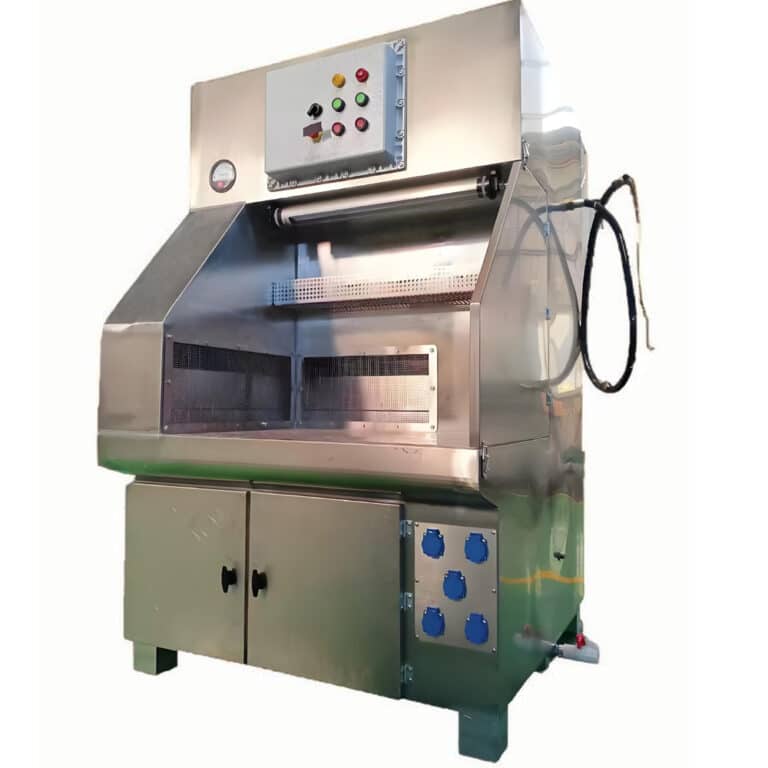
The wet-versus-dry decision is frequently treated as a preference or budget call, but one part of it is not negotiable: NFPA 484 prohibits dry downdraft tables for combustible metals, specifically aluminum, magnesium, and titanium. Using a dry table for these materials is a fire and explosion risk, not a trade-off. If the application involves combustible metal grinding or finishing, the table type is mandated — wet — and specifying dry at any stage of procurement creates a mandatory replacement, not a future upgrade consideration.
Outside that constraint, the trade-off is real and worth working through carefully before finalizing a lifecycle cost estimate.
| Criterion | Dry Table | Wet Table |
|---|---|---|
| Filter maintenance | Periodic cleaning or replacement of fire-retardant cartridge filters; filter loading reduces face velocity over time | No filter cartridges; water filtration maintains constant air velocity |
| Consumable costs | Filter cartridge replacement costs | Lower consumable costs (no cartridges), but requires auto-level water control |
| Water management | None | Requires auto-level water control and regular debris removal from the sump |
| Combustible metal safety | Prohibited by NFPA 484 for aluminum, magnesium, titanium (fire/explosion risk) | Mandatory for NFPA 484 compliance with combustible metals |
The maintenance logic divides at one practical boundary: dry table face velocity degrades progressively as filters load between cleaning cycles, meaning capture performance at month six of operation may be measurably worse than at commissioning — without any visible indicator until escape testing or air sampling reveals the gap. Wet tables avoid this degradation because water filtration maintains constant air velocity regardless of particle accumulation, but they shift the burden to water management: auto-level controls, sump debris removal, and water quality monitoring. Teams that calculate wet table savings on cartridge costs alone frequently underestimate the labor cost of sump management over a full operating year.
For applications where capture consistency over time is the priority — particularly those with regulatory air quality obligations or frequent audit exposure — the wet table’s stable velocity profile is a planning advantage, not just a maintenance preference. For applications with lower dust loading and straightforward filter access, a dry table with a well-designed cleaning schedule may carry lower total lifecycle cost. The decision should be made on both dimensions, not on upfront equipment price alone. See the Industrial Downdraft Grinding Table Complete Guide for a full breakdown of wet and dry system selection across material types.
Provide access for filter service and debris cleaning
Condition-based filter maintenance outperforms fixed-interval schedules for one straightforward reason: filter loading rate varies with material type, production volume, and particle size — none of which stay constant across a shift or a week. A fixed cleaning interval either results in premature cleaning events that interrupt production unnecessarily or, more commonly, extended intervals where face velocity has already degraded before the scheduled maintenance occurs.
The operational tools that make condition-based cleaning practical are differential pressure monitoring and, where the table configuration supports it, automated pulse cleaning.
| Method | How It Works | Impact on Access |
|---|---|---|
| Differential pressure gage (e.g., Magnehelic) | Monitors filter loading; cleaning triggered at manufacturer-specified maximum pressure drop | Enables condition-based cleaning, reducing unnecessary downtime; still requires manual access for cleaning or replacement |
| Self-cleaning pulse system | Compressed-air pulses through sequenced diaphragm valves; on-demand cleaning triggered by preset differential pressure | Reduces manual access requirements and maintains consistent airflow with less frequent operator intervention |
A Magnehelic gage or equivalent differential pressure instrument gives operators a visible indicator of filter loading without requiring airflow testing. The cleaning trigger is the manufacturer-specified maximum pressure drop across the filter element — when that threshold is reached, cleaning or replacement is warranted, not before and not significantly after. On cartridge dust collector systems paired with downdraft tables, automated pulse-cleaning via sequenced diaphragm valves extends filter service intervals and reduces the frequency of direct manual access to the filter housing, which matters in facilities where production schedules limit maintenance windows.
Physical access remains a site-specific check regardless of automation level. Before finalizing a table layout, confirm that the filter housing door or drawer clears adjacent equipment and operator pathways when fully open, that the filter element can be extracted without requiring the table to be repositioned or workpieces removed, and that sump access on wet tables allows debris removal without specialty tooling or confined-space entry procedures. Access problems that are obvious on a CAD layout often become invisible in a busy quotation process and visible again at commissioning.
Accept the table based on capture zone behavior
Commissioning acceptance for a downdraft table should be based on observed capture behavior under representative working conditions, not on datasheet confirmation. A table that meets rated CFM on paper but fails to contain dust under actual workpiece positioning, mat coverage, and ambient air conditions has not passed acceptance — it has passed specification review, which is a different test.
The practical acceptance criterion is that the table demonstrates adequate face velocity at the open work surface with the workpiece in place. Some manufacturers reference a design benchmark of face velocity at least 2× that of competing designs as a performance criterion to verify during selection; treat this as a competitive specification claim to confirm through direct testing or manufacturer-supplied test data, not as a codified regulatory threshold. Smoke visualization or tracer testing with the workpiece positioned at the edge of the coverage zone — where capture is weakest — is a more useful acceptance condition than center-of-table testing, which will always show favorable results.
For dry tables, acceptance should also include a confirmation of face velocity at or near maximum filter loading, not just at clean-filter baseline. The gap between clean-filter and loaded-filter velocity is where the maintenance trade-off from the previous section becomes a commissioning variable. For wet tables, velocity consistency is a design characteristic of water filtration; what warrants verification at acceptance is whether the water level control and sump configuration are operating correctly, since those govern whether the constant-velocity claim holds in practice. The Industrial Dry / Wet Station Downdraft Grinding Table product page provides configuration and specification details relevant to setting acceptance criteria for both table types.
The sequence that consistently produces defensible selections — workpiece geometry, open-area face velocity, blockage check, cross-draft controls, wet-versus-dry trade-off, access planning, and capture-zone acceptance — works because each step conditions the one that follows. CFM numbers that are not tied to a confirmed open area and a verified coverage condition cannot support a reliable capture performance claim, and a table that passes static datasheet review but is accepted without a loaded-condition face velocity test leaves a gap that typically surfaces during the first production audit or air sampling event.
Before finalizing a RFQ, confirm workpiece dimensions against the table’s nominal work surface, calculate effective face velocity at realistic open area, document whether the material processed is combustible under NFPA 484, and specify the filter access and cleaning trigger mechanism in writing. Those four inputs define the scope of what a supplier needs to address — and what you need to verify before taking delivery.
Frequently Asked Questions
Q: What if the workpiece dimensions change between operations — does the table need to cover the largest footprint or the footprint at the point of dust generation?
A: The table must cover the footprint at the point of active dust generation, not necessarily the largest static footprint. A part may fit the table during tack-welding but shift its grinding contact point toward or beyond the edge during finishing passes. Map the full range of operator positioning across every operation in the workflow, identify where dust is actually generated at each stage, and confirm that location stays within the work surface boundary throughout — not just at the part’s resting position.
Q: After commissioning acceptance, what is the first operational check that should be scheduled?
A: The first scheduled check should be a face velocity verification at realistic filter loading, not at the clean-filter baseline recorded during acceptance. Dry table face velocity degrades as filters accumulate dust between cleaning cycles, so the acceptance reading represents the best-case condition the table will ever deliver. Establish the manufacturer-specified maximum pressure drop as the cleaning trigger using a differential pressure gauge, then record face velocity at that threshold during the first full loading cycle to confirm it still meets application requirements under working conditions.
Q: Does the face velocity requirement change for heavier or denser grinding dust compared to fine finishing dust?
A: Yes — denser particles and higher dust generation rates demand higher face velocity to overcome the inertia of particles that resist being pulled downward before they disperse laterally. The baseline CFM-to-open-area calculation remains the same, but the acceptable minimum face velocity threshold increases with particle mass and generation intensity. A table sized for light finishing dust may produce technically adequate velocity readings while still failing to capture coarse grinding swarf from the same surface area. The material type and generation rate should be inputs to the face velocity target, not afterthoughts applied once a CFM figure has already been shortlisted.
Q: Is a backdraft kit worth specifying on every table, or only in specific workspace conditions?
A: A backdraft kit is only worth specifying when the application involves fast-rising contaminants — primarily welding fumes — or when cross-draft sources in the workspace are confirmed and cannot be eliminated. For pure grinding and finishing applications in controlled environments, it adds dimensional complexity and airflow resistance without a corresponding capture benefit. The decision should be based on a site walk that identifies actual cross-draft sources: HVAC diffuser locations, bay door proximity, and adjacent equipment cooling exhaust. If none of those factors create airflow across the work surface above roughly the table’s face velocity, the backdraft kit provides limited practical value.
Q: For a shop that processes both standard steel and occasional aluminum parts, is it practical to run a single dry table for all materials or does the aluminum work require a separate wet table?
A: NFPA 484 makes this non-negotiable — combustible metal grinding, including aluminum, cannot be performed on a dry downdraft table regardless of volume or frequency. A single dry table shared between steel and aluminum work violates the standard and creates a fire and explosion risk. The practical options are a dedicated wet table for all aluminum operations, a wet table that handles both material types, or physically separated stations with clear material routing controls that ensure combustible metals never reach the dry unit. Treating low-volume aluminum work as an exception that can be managed operationally does not satisfy the regulatory requirement.