Stone grinding and polishing operations generate fine respirable dust at the source — and the most common installation failure is not a weak fan, but a table that was sized to fit the room rather than the workpiece and the operator’s movement arc. When part of the grinding zone falls outside the active capture area, no amount of additional airflow recovers containment at the source. The downstream cost shows up at commissioning, when surface velocity measurements fail and the only remedies are a larger replacement table, a full layout revision, or a compromise acceptance that leaves the breathing zone unprotected. Getting the table dimension, CFM basis, and wet-or-dry selection right before procurement is what separates a system that passes acceptance from one that creates a retrofit problem before the first production shift.
Match table area to workpiece size and operator movement
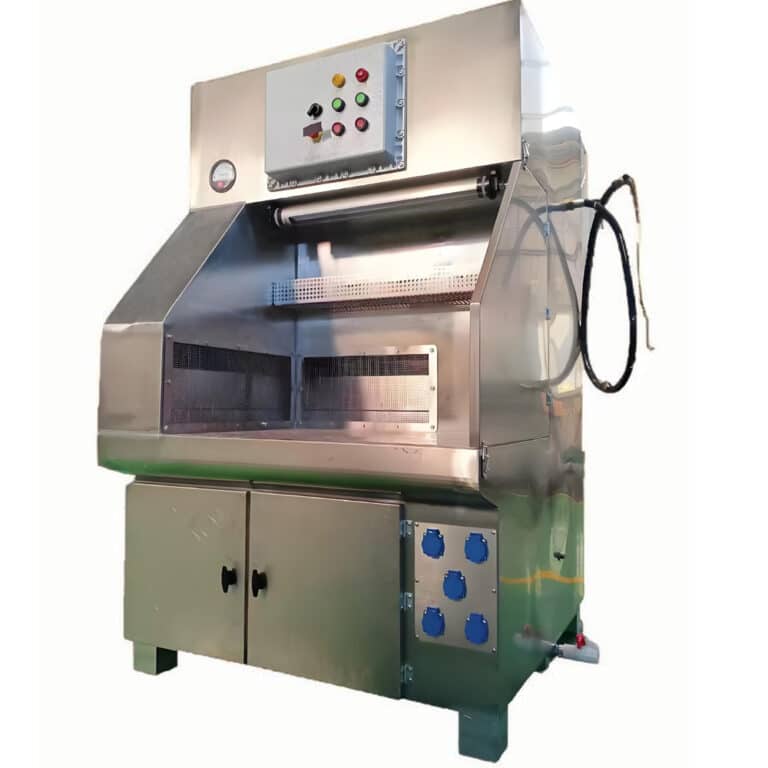
Table area is the first decision, not a secondary specification to fill in after fan selection. The practical dimension range for stone polishing workstations runs from 1200×1200mm for smaller slabs and hand-tool work up to 3000×1200mm for larger pieces requiring operator repositioning. These are selection inputs derived from product practice — they are not regulatory minimums — but the design logic they encode is precise: the entire footprint of the workpiece, plus the lateral reach of the operator’s hands and tool, must remain within the active capture zone throughout the grinding pass.
The failure pattern here is predictable. A buyer selects a 1200×1200mm table because it fits the floor space and the stone slab is nominally 1100mm wide. What the layout doesn’t account for is that the operator’s hands and the grinding tool regularly extend 150–200mm beyond the slab edge during edge work, moving the dust source outside the capture surface at the exact moment it matters most. Undersizing by even a small margin at the perimeter means the table’s CFM is pulling from the wrong location relative to the point of generation.
For operations where the workpiece size is variable or operators need to rotate larger slabs during polishing, the longer table dimension — 2400mm or 3000mm — gives the working margin that makes capture reliable without requiring the operator to reposition themselves relative to the table edge. The fit between table area and workpiece footprint is a planning criterion to confirm during layout, not at acceptance.
Calculate CFM around source capture not room volume
CFM for a downdraft grinding table is a consequence of table area and required capture velocity at the work surface, not a room air-change calculation. A building ventilation estimate gives the total volume exchange rate needed to dilute airborne contamination after it has already escaped the source — for a downdraft table, that is already a capture failure. The airflow must be calculated at the point of generation, pulling downward through the perforated work surface fast enough that dust generated at grinding height is drawn into the table before it disperses laterally.
For a typical 1.3–1.8m table with a 3kW motor, 2400 m³/h represents a reasonable design benchmark for achieving meaningful capture velocity across the surface. That figure is an engineering starting point, not a regulatory floor, and it must be verified against the actual table dimensions and dust load of the specific process. As table size increases, the required airflow scales accordingly.
| Table size (typical) | Fan configuration | Motor power | CFM (m³/h) |
|---|---|---|---|
| Medium (1.3–1.8 m) | Single fan | 3 kW | 2,400 |
| Various (single-fan units) | Single fan | Range | 2,664–5,268 |
| Large table (industrial) | Dual fan (2 × 2.2 kW) | 4.4 kW total | 6,800–8,200 |
The mistake procurement teams make is specifying motor power without first anchoring it to the table area. A dual-fan configuration delivering 6800–8200 m³/h is listed here as a scaling example for large tables, not as a universal requirement — but a team that specifies a single 3kW fan for a 3000×1200mm table will find at commissioning that capture velocity at the table perimeter falls well below what the center of the table achieves. The fan and the table size are a matched pair; separating that specification creates a performance gap that is expensive to close after installation.
For teams working through the airflow calculation before issuing an RFQ, the Downdraft Grinding Table CFM Sizing Calculator provides a structured method for matching airflow capacity to workpiece dimensions and material type.
Decide whether wet or dry table duty fits the process
The wet-versus-dry selection is driven primarily by dust explosibility classification, and getting this wrong creates an unmitigated ignition risk rather than a simple performance shortfall. Dry tables use pulse-jet cartridge filtration and are appropriate for the majority of stone polishing applications — marble, granite, composite stone, fiberglass, and most non-reactive metals generate combustible but not typically explosive dusts under normal grinding conditions. Wet tables suppress dust into sludge using water, which is the required approach when the process generates dust in an explosive particle class, such as aluminum or titanium grinding.
The conditional nature of the wet-table requirement for stone polishing matters here. Most natural stone operations will qualify for dry filtration. A shop that grinds stone alongside aluminum fixtures or uses titanium tooling components may face a different classification for those specific operations, and the selection should be made per material and per workstation, not applied uniformly across the facility.
| Material/process | Explosion/fire risk | Table type | What to confirm |
|---|---|---|---|
| Aluminum, titanium | High (explosive dust) | Wet | Dust dampened into sludge; water supply and sludge handling required |
| Wood, composite, fiberglass, marble, plastic, most metals | Lower (combustible, not explosive) | Dry | Dry filtration system adequate; no water infrastructure needed |
The hidden cost of the wet table choice is infrastructure, not the equipment itself. A wet table requires a continuous water supply connection, a sludge collection point at the base of the unit, access clearance for sludge removal, and a disposal path for the accumulated wet material. None of these appear on the typical floor plan at the point when the table is specified, and all of them create retrofit complications if the layout is finalized before the infrastructure is designed. Dry tables, by contrast, require accessible cartridge changeout space and a clean path for the dust collection drawer — a smaller but equally overlooked layout requirement. Either way, the infrastructure ask must be resolved before procurement, not after delivery.
Check filter loading water handling and sludge access
Dry table filtration for stone polishing typically uses cartridge filters in the 325×500mm size range, with two to six cartridges depending on table size and target airflow. These are product-specification figures to verify against actual airflow and dust loading — not universal filter standards — but they give a useful sizing basis for evaluating whether a quoted configuration matches the throughput demanded by the process. Auto pulse-jet cleaning maintains filter performance by periodically clearing accumulated dust cake from the cartridge surface, and HEPA-grade filtration at 99.9% efficiency down to 5–10 microns is achievable with appropriately specified media.
| System parameter | Dry table | Wet table |
|---|---|---|
| Primary dust capture | Cartridge filters (325×500 mm, 2–6 units) | Water dampening; no dry cartridges |
| Cleaning method | Auto pulse jet | Sludge collection (no pulse jet) |
| Filtration efficiency | HEPA 99.9% at 5–10 micron | Particle capture via water; HEPA not typical |
| Water requirement | None | Continuous water supply needed |
| Sludge handling | Dry dust collection drawer | Sludge drain and access for disposal |
The planning implication that gets missed most often is sludge access on wet tables. A wet table has no cartridge filters to change, but it accumulates sludge in the base chamber at a rate proportional to dust load and water flow. If the sludge access panel or drain is blocked by adjacent equipment, or if the layout places the table in a position where a maintenance technician cannot reach the base, sludge buildup becomes a routine operational constraint that is expensive to correct without moving the table entirely. Caster-mounted tables allow repositioning for floor cleaning and base access, but only if the surrounding layout leaves clearance for the table to roll clear of fixed infrastructure.
Prevent cross-drafts from defeating downdraft capture
A correctly sized table with sufficient CFM can still fail at source capture if ambient air movement across the work surface exceeds the downward capture velocity. Cross-drafts — from HVAC supply registers, open bay doors, adjacent equipment fans, or even the movement of personnel through the workspace — create horizontal air currents at grinding height that carry dust laterally faster than the table pulls it downward. This is the failure mode most likely to go undetected during equipment selection and only become apparent once the table is running under normal shop conditions.
The site-condition variable to assess before finalizing table placement is the ambient airflow pattern at the planned workstation location. HVAC supply diffusers positioned directly above or adjacent to the table are a common problem; so are overhead fans used for worker comfort in warmer months. Even modest horizontal velocities — well below what would feel like a draft to an operator — can reduce effective capture at the table perimeter.
One operational approach for managing return air is the “Regain Air” technique, where filtered exhaust is returned to the work zone in a controlled directional pattern rather than discharged in a way that creates turbulence near the capture surface. This is a practical recommendation for shops that recirculate filtered air rather than exhausting outside — the return air itself becomes a cross-draft source if introduced without attention to flow direction. It is one method for managing this risk, not the only acceptable solution, and it requires directional control of the return supply as part of commissioning, not as an afterthought.
Include maintenance and cleaning room in the layout
Two layout requirements for downdraft tables are consistently underspecified at the design stage: removable dust drawer access at the table base, and clearance for the table to be repositioned during floor cleaning or maintenance. Both are planning criteria rather than regulatory requirements, but their absence creates a maintenance failure risk that compounds over the service life of the unit.
The dust collection drawer on a dry table needs to be pulled clear of the unit for emptying — typically from the front or side of the cabinet base — without requiring the operator to move adjacent equipment or crouch in a space too confined for safe handling of a loaded drawer. The minimum clearance for drawer removal should be confirmed against the actual drawer travel distance during the design phase, before surrounding equipment positions are fixed. For wet tables, the equivalent requirement is sludge drain access with enough working clearance that a technician can safely open, inspect, and clear the collection chamber without a confined-space problem.
Casters on the table base allow repositioning for floor cleaning beneath the unit — stone grinding generates abrasive dust that accumulates under the cabinet and eventually causes floor surface damage and bearing wear in fixed-leg tables. The usable floor plan must include room for the table to move, which means the surrounding equipment arrangement cannot close off the table’s roll path entirely. This is a detail that is straightforward to accommodate during layout design and difficult to retrofit once the floor plan is fixed.
Specify acceptance at the work surface
Acceptance checks for a downdraft grinding table should be conducted at the work surface, not at the fan exhaust. The surface is where capture either succeeds or fails, and the structural and functional properties of that surface determine whether the unit will maintain performance over time.
Panel thickness in the 1.2–1.5mm steel range is a build-quality indicator to verify at inspection — not a value traceable to a published standard, but a minimum threshold below which the table body is likely to flex under load, distort the work surface flatness, and create uneven airflow distribution across the perforated capture area. A flat surface with a dense, uniform distribution of suction ports is the functional requirement: ports clustered at the center of the table and sparse at the edges will produce capture velocity gradients that leave the perimeter of the workpiece undertreated, which is the same failure mode as undersizing the table in the first place.
| What to verify | Acceptance criteria | Why it matters |
|---|---|---|
| Panel thickness | 1.2–1.5 mm steel | Structural rigidity and long-term durability |
| Surface flatness and port density | Flat surface with dense dust suction ports | Even airflow capture across the workpiece |
| Optional surface materials | Anti-static, spark arrestor | Match process hazards (e.g., explosive dust) |
Optional surface materials — anti-static panels, spark arrestor inserts — add cost and procurement lead time but are necessary when the dust classification identified during the wet/dry selection step indicates ignition risk. If aluminum or titanium grinding occurs at the same workstation as stone polishing, the surface specification must reflect the most hazardous material processed, not the most common one. Confirming this during acceptance, rather than assuming the standard steel surface is appropriate for all materials, closes the last gap between equipment specification and actual process hazard.
The sequence matters more than any individual specification: table area first, CFM second, wet-or-dry third, infrastructure fourth. Each step depends on the one before it, and errors propagate forward — a table sized to the room rather than the workpiece produces a CFM basis that doesn’t correspond to the actual capture zone, and an infrastructure plan developed after procurement creates layout constraints that compromise both maintenance access and long-term performance. Before finalizing an RFQ for a downdraft grinding table, confirm the workpiece footprint and operator movement envelope, establish the CFM target against actual table dimensions, classify the dust by explosibility to lock the wet-or-dry selection, and verify that water supply, sludge access, or cartridge changeout clearance — whichever applies — is resolved in the facility layout.
What to confirm next: the site ambient airflow conditions at the intended table location, the dust classification for every material to be processed at that station, and whether the layout as drawn gives adequate maintenance clearance at the table base. Those three items, resolved before equipment is ordered, are what the commissioning acceptance check will test.
Frequently Asked Questions
Q: What happens if the stone slab occasionally extends beyond the table’s capture surface during edge work?
A: Capture fails at that moment regardless of fan power. Dust generated outside the active perforated area is not drawn downward — it disperses into the breathing zone. If edge work routinely takes the grinding tool 150–200mm past the slab boundary, the correct response is to select the next larger table dimension before procurement, not to compensate with higher CFM on an undersized surface.
Q: After the table is installed and running, what is the first field check that confirms the system is actually working as specified?
A: Measure capture velocity at the work surface perimeter, not at the fan outlet. If the perimeter velocity is significantly lower than the center, either the fan is undersized for the table area or a cross-draft is overcoming the downward pull at the edges. Both conditions require correction before the workstation is approved for production use — a passing fan-exhaust reading does not confirm that source capture is occurring where the grinding actually happens.
Q: Does the wet-versus-dry selection apply per workstation, or does one explosive material in the facility require wet tables everywhere?
A: The classification applies per workstation and per material processed at that station. A dry table remains appropriate for a marble-only grinding position even if aluminum grinding occurs elsewhere in the facility. However, if a single workstation processes both stone and aluminum — even occasionally — the surface specification and wet/dry selection for that station must reflect the most hazardous material, not the most frequent one.
Q: How does a downdraft grinding table compare to a local exhaust hood positioned above or beside the work surface for stone polishing?
A: A downdraft table pulls dust downward away from the operator’s breathing zone, which is the direction gravity and the grinding action already favor for heavy stone particles. An overhead or side-draft hood must overcome the dust’s initial downward trajectory and risks drawing contaminated air across the operator’s face on the way to capture. The downdraft configuration is generally preferred for stone polishing specifically because the particle size and the operator’s posture over a flat slab make downward extraction more reliable than lateral or upward extraction — but either approach must still satisfy the source-capture velocity requirement at the point of generation.
Q: Is a standalone downdraft grinding table sufficient for a high-volume stone polishing operation, or does it need to be paired with a separate central dust collector?
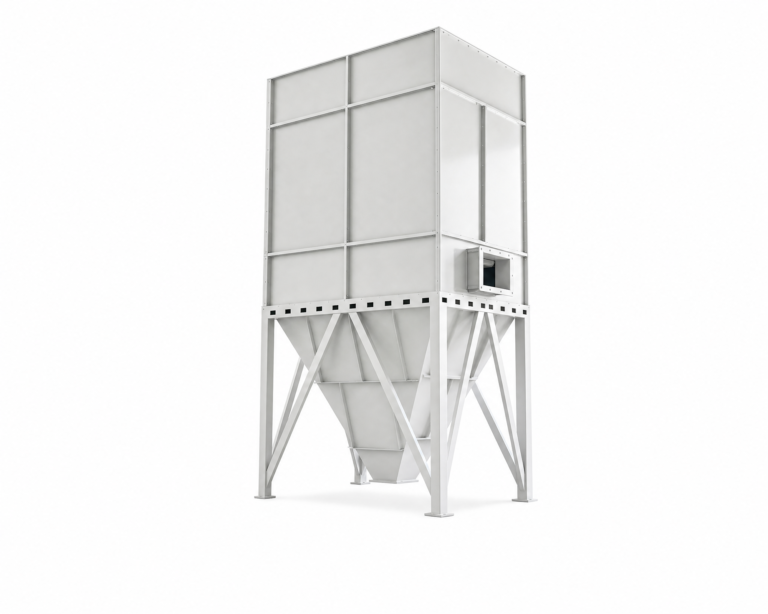
A: For most single-workstation operations, an integrated downdraft table with onboard cartridge filtration handles the dust load without a separate collector. The decision to add a central cartridge dust collector becomes relevant when multiple tables run simultaneously, when the dust load per shift exceeds the onboard filter capacity before the pulse-jet cycle can maintain pressure drop, or when the facility wants to centralize filter maintenance rather than manage cartridges at each individual station. Integrated filtration is the simpler starting point; central collection is the scaling answer when throughput or maintenance logistics outgrow it.