Plants that commission a dewatering press before characterising their feed sludge almost always face the same downstream problem: the cake moisture target cannot be met consistently, and the fix requires either a chemical conditioning program that was never budgeted or a second pass through equipment that was sized for an assumed average. The rework cost is real, but the more persistent consequence is an unstable filtrate return loop — process water quality fluctuates, reuse rates fall short, and the treatment system starts to limit production rather than support it. The decision that prevents that cycle is not choosing between a filter press and a vacuum belt filter; it is confirming solids load, feed variability, grit burden, and cake disposal route before any equipment comparison begins. What follows gives you the technical and commercial anchors needed to make that confirmation credibly.
Define the sludge and slurry boundary for ceramic and stone plants
The first practical boundary to set is where process water ends and treatment feed begins. In ceramic and stone operations, that boundary is not always obvious. Cutting, grinding, polishing, and glazing circuits each generate process water with different solids concentrations, particle size distributions, and contaminant profiles. Mixing them without characterisation creates a feed whose variability is wider than any individual stream, which makes equipment sizing and chemical conditioning difficult to calibrate.
Ceramic sludge typically carries water content in the 60–80% range at the point it enters a dewatering unit, and the solids fraction can include fine clay and feldspar particles alongside heavier grinding residues. The presence of zinc and lead — common in glazing and surface-finishing streams — is not in itself a compliance trigger, but it is a planning signal. Depending on the intended cake disposal or reuse route and local regulation, elevated heavy metal concentrations may require additional pretreatment steps or may restrict which waste-acceptance facilities can receive the dewatered cake. Discovering that constraint after a press is commissioned is expensive; confirming it before procurement shapes both equipment and process design.
Stone processing sludge tends to carry a heavier coarse fraction from saw cutting and grinding, which behaves differently under mechanical dewatering than fine ceramic slurry does. The relevant design variable is not average solids content but the range across shift patterns, seasonal raw material changes, and batch-driven process swings. A feed characterisation that captures only steady-state average conditions will underestimate peak load and produce a system sized for best-case rather than real-case operation. That undersizing shows up at commissioning as throughput shortfalls or inconsistent cake quality, both of which are difficult to attribute clearly and expensive to correct.
Map the treatment train from grit removal to filtrate return
The treatment train for ceramic and stone wastewater is not a fixed sequence — it is a conditional one, and the conditions that justify each stage depend on feed flow rate, solids character, and the plant’s reuse requirements. Selecting stages before those conditions are confirmed produces trains with either redundant equipment or missing capacity at the stages that matter most.
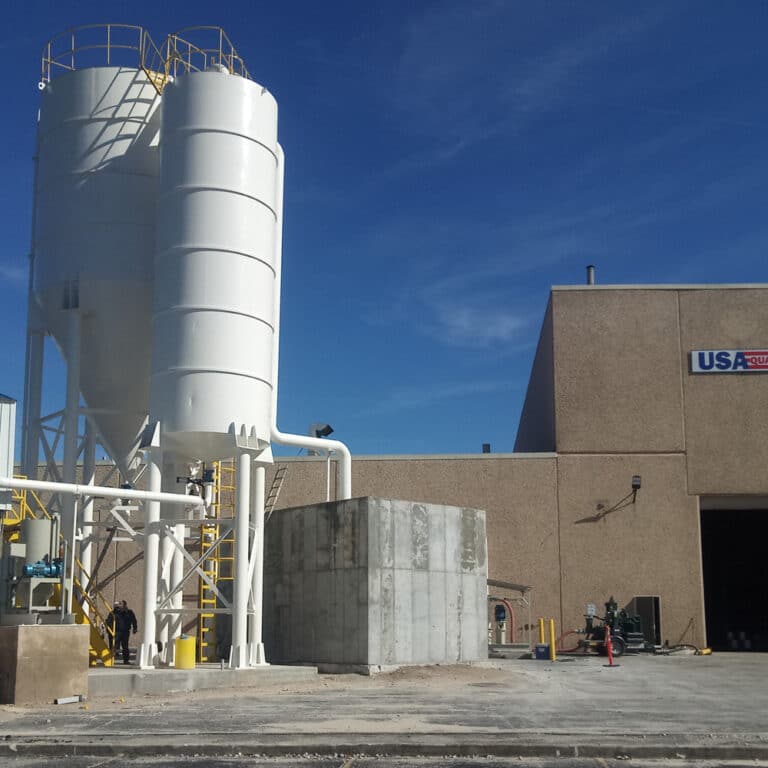
For most mixed-flow ceramic and stone plants, the baseline sequence runs from flow equalization through pH adjustment, lamella clarification, mechanical dewatering, and return of clarified water to the process loop. The lamella clarifier is the stage that most influences downstream dewatering performance: it concentrates and removes the fine suspended fraction before it reaches the press or belt filter, reducing the load on chemical conditioning and improving cake consistency. Typical design inputs for a lamella separator used in this service include an area load of 0.08–0.25 m³/m²·h, a lamella plate spacing of 40 mm, and an inclination of 60° — figures that should be treated as planning criteria for sizing rather than fixed specifications, since actual performance depends on feed solids character. Plants with a high coarse-grit burden, such as those processing plaster or abrasive stone, often need a two-stage approach that removes coarse solids by conveyor screw before the fines fraction reaches the lamella separator; skipping that first stage pushes coarse particle handling into equipment that was not designed for it and accelerates wear.
For lower-flow applications — typically up to around 10 m³/h — where feed solids are suitable for direct filtration, a vacuum belt filter can combine clarification and dewatering into a single unit, bypassing the sedimentation stage entirely. That shortcut reduces capital cost and footprint, but it creates a single-point dependency: the vacuum belt filter’s availability now governs the entire return-water loop. Any unplanned downtime interrupts process water reuse at scale, which in a plant operating a closed-loop system means either stopping production or discharging. The conditional nature of this bypass is worth confirming against feed solids suitability before treating it as a straightforward simplification.
Each of these three variants carries a different set of trade-offs between capital cost, operational risk, and treatment reliability.
| Approach | Suitable Conditions | Key Steps & Design Notes |
|---|---|---|
| Standard treatment train | Higher flows or mixed solids with grit/fines | Flow equalization → pH adjustment → lamella clarifier (area load 0.08–0.25 m³/m²·h, lamella distance 40 mm, inclination 60°) → vacuum belt, filter press, or drainage → clarified water return via pressure booster |
| Direct vacuum belt filter | Flows ≤10 m³/h; feed solids suited to direct filtration | Skips sedimentation; vacuum belt filter for combined clarification and dewatering → filtered water return |
| Two-stage plaster treatment | High coarse-grit burden (plaster/stone grinding) | Conveyor screw removes coarse solids → lamella separator polishes fines to meet effluent purity → water reuse or discharge |
The choice between variants is not primarily a technology decision — it is a consequence of how the plant’s flow rate, grit burden, and uptime requirements interact. Plants that skip that mapping step and select equipment based on a vendor comparison tend to install the right press in the wrong train.
Compare pressure filtration vacuum filtration and belt pressing roles
These three dewatering mechanisms serve different points in the solids-load and moisture-target spectrum, and treating them as interchangeable options for the same feed leads to undersized equipment or unachievable moisture targets. The useful frame is not which technology is best but which one is matched to the feed conditions and the downstream constraint.
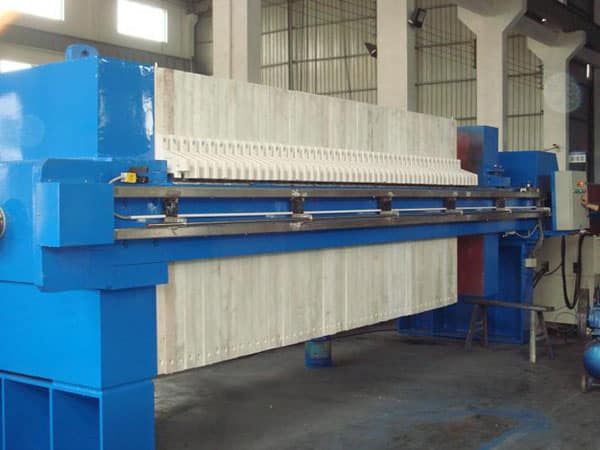
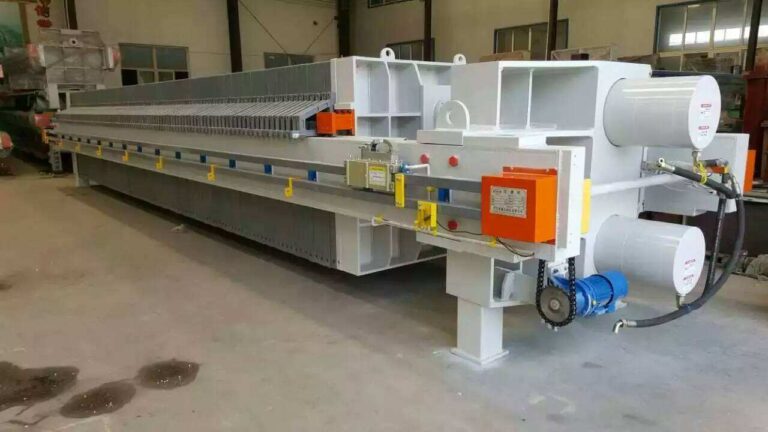
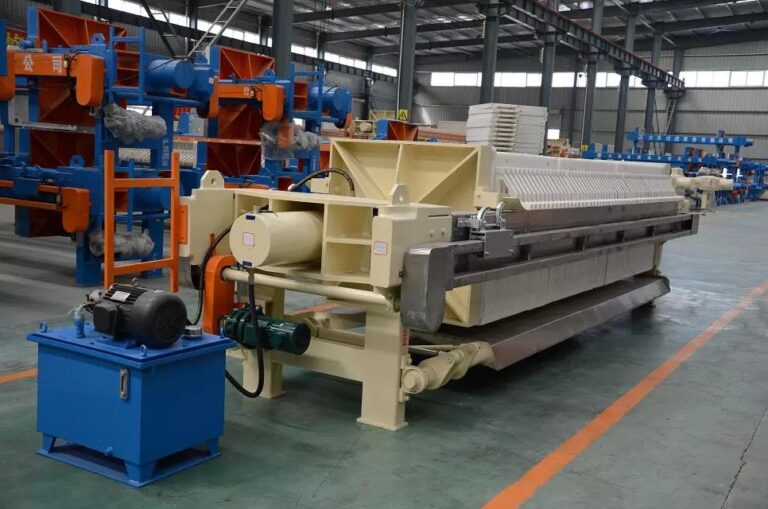
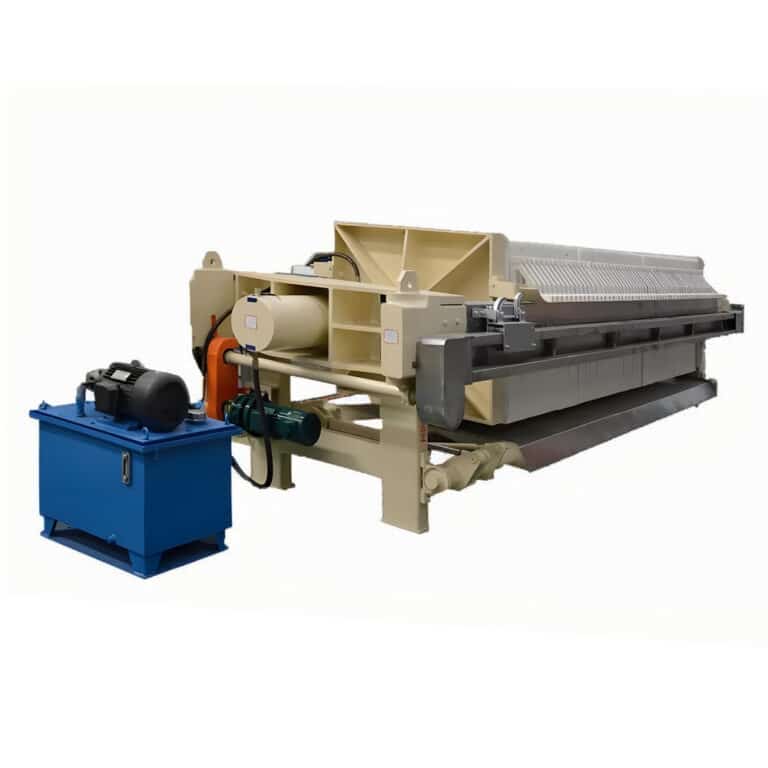
Pressure filtration applies mechanical force through the press to drive moisture from the cake. High-pressure round filter presses operating at 1.6–2.0 MPa can produce cake moisture below 30% from feeds entering at 60–80% water content — a reduction that meaningfully affects haulage cost and cake handling logistics. That performance is a design figure for this class of equipment under suitable feed conditions, not a guaranteed outcome for all pressure filtration. Achieving it consistently depends on feed solids concentration, particle size, compressibility, and the effectiveness of chemical conditioning upstream. A membrane filter press extends this logic further: after initial pressing, an inflatable membrane applies secondary pressure across the cake surface, producing additional moisture reduction without increasing cycle time proportionally. That secondary squeeze is most valuable when the receiving facility’s cake acceptance criteria require consistently low moisture and when the solids load is high enough to justify the additional capital cost.
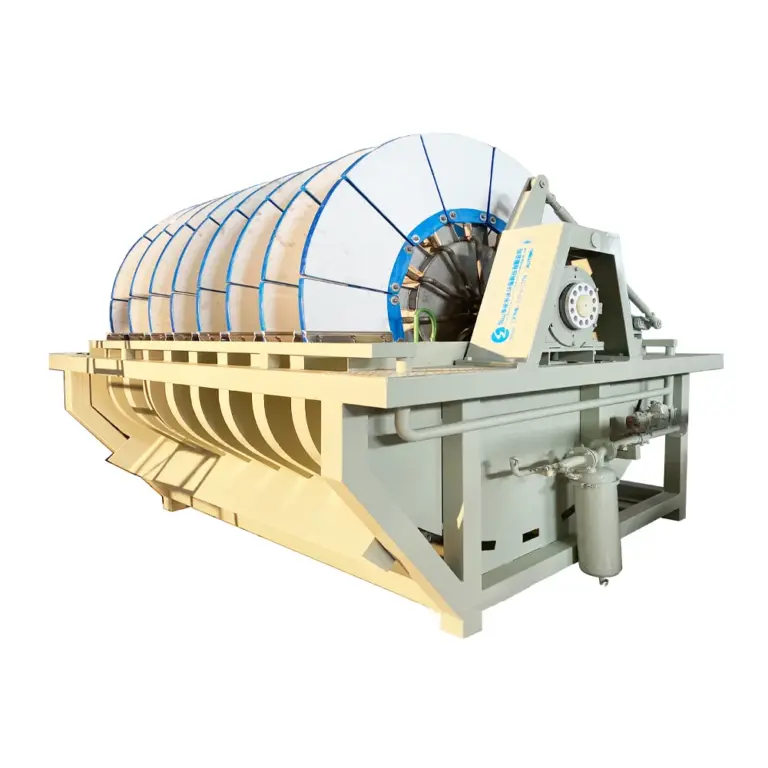
Vacuum filtration occupies a different role. A vacuum belt filter operates under lower applied pressure than a plate press and typically produces a wetter cake, but it can handle higher throughput continuously and combines clarification with dewatering in a single pass when the feed is suitable. Its practical value is in continuous-operation scenarios where cake moisture is a secondary concern compared to throughput and system simplicity, and where the feed solids are fine and relatively uniform — conditions that do not always hold across a full ceramic or stone processing plant.
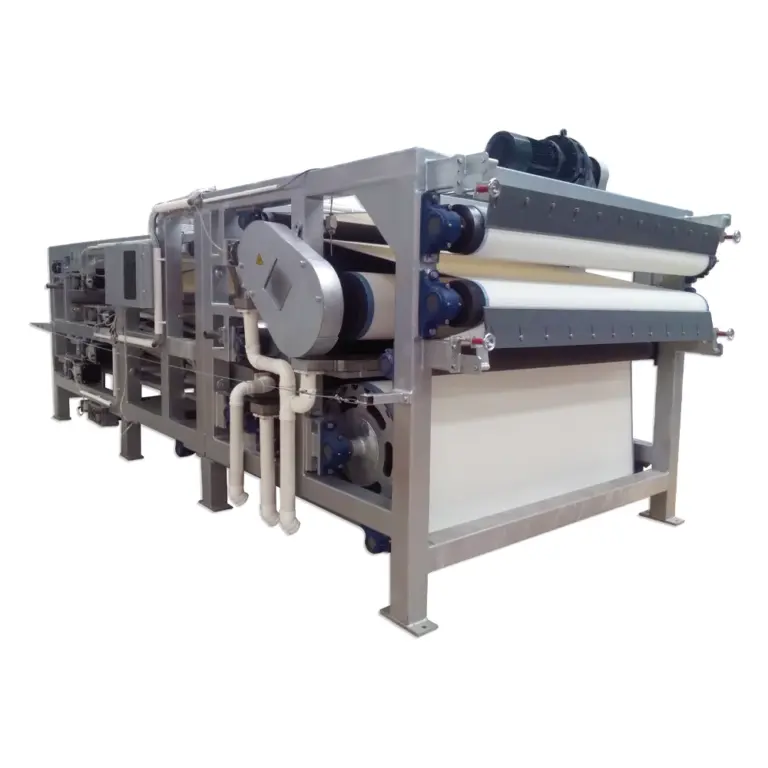
Belt pressing squeezes sludge between two tensioned porous belts and is typically used for higher-volume, lower-solids feeds where rapid throughput matters more than cake dryness. For ceramic and stone sludge with meaningful grit content, belt press performance degrades as coarse particles damage the belt fabric, which is a maintenance and replacement cost that needs to be factored into lifecycle comparisons. The decision between pressure filtration and belt pressing is often framed as a capital cost comparison when it should be framed as a lifetime cost comparison that includes belt replacement frequency, chemical consumption, and disposal cost per tonne of cake produced.
Set cake moisture filtrate and reuse-water targets before selection
Equipment selection conversations in ceramic and stone plants usually start with press model comparisons. The more useful starting point is a set of numeric targets for cake moisture, filtrate suspended solids, and reuse-water quality — because those targets determine whether any given piece of equipment can close the loop reliably, and they often expose constraints that eliminate certain options before the comparison even starts.
Cake moisture is the figure that links mechanical dewatering to disposal cost. A high-pressure round filter press operating at 1.6–2.0 MPa can reduce moisture from 60–80% down to below 30% under suitable conditions, and the reduction in cake mass that follows directly reduces haulage frequency and cost. But that figure only translates into a real cost saving if the cake disposal route was confirmed before procurement. A receiving facility that accepts ceramic waste cake at 35% moisture but not at 28% makes the additional pressing pressure operationally irrelevant — the cost saving exists in the moisture number but not in the disposal invoice. Confirming acceptance criteria at the receiving end before specifying pressing pressure is a straightforward check that is routinely skipped.
Filtrate quality targets matter for a different reason. When clarified water is returned to the process loop, suspended solids in the return flow can accumulate over successive cycles, gradually degrading water quality and affecting product surface finish in polishing or glazing circuits. Setting a maximum suspended solids concentration for return water before selecting the dewatering and clarification stages means the treatment train can be validated against that target during commissioning, rather than adjusted after product quality complaints emerge. Closed-loop recirculation at meaningful flow rates — 1,500 litres per minute is a realistic operating scale for mid-sized stone processing plants — is achievable with correct pH control and flocculant dosing, but achieving it consistently requires that the reuse-water specification was defined and designed to, not approximated during operation.
The third target, reuse-water pH, is often treated as an afterthought but governs scale and corrosion behaviour in return pipework and process equipment. Ceramic and stone process water frequently carries alkaline residues from cutting fluids and abrasives, and without pH correction upstream of the return loop, that alkalinity accumulates. Defining the pH range for return water at the design stage ties the pH adjustment step in the treatment train to a measurable process outcome rather than a generalised water quality objective.
Check chemical conditioning and solids sampling assumptions
Chemical conditioning is the most frequently underspecified element in ceramic and stone wastewater treatment systems, and the gap usually appears not in the choice of flocculant but in the assumption that a single conditioning program will perform consistently across the plant’s actual feed variability.
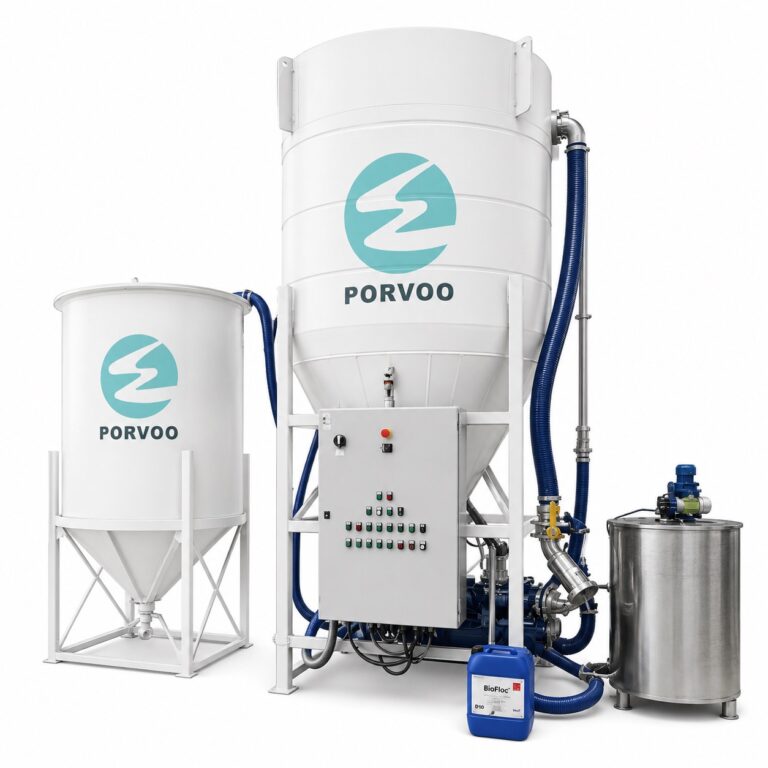
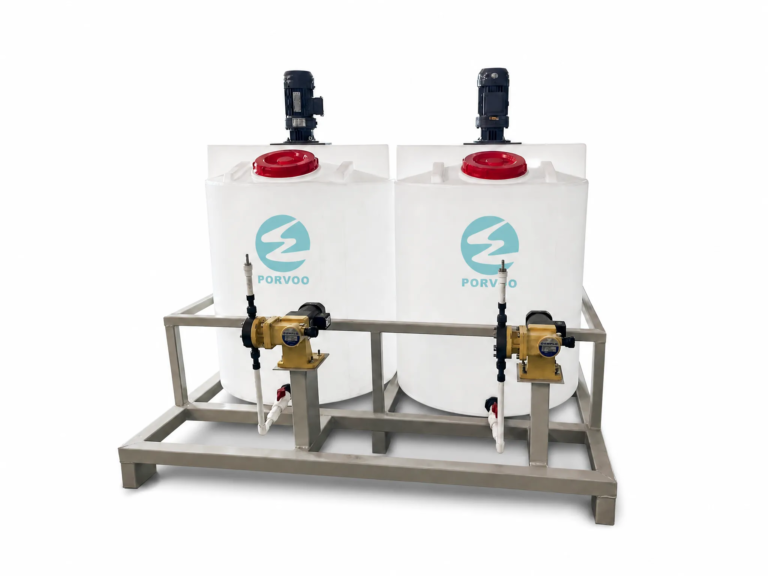
Polyacrylamide (PAM) and polyaluminium chloride (PAC) are commonly used to enhance fine particle cohesion before filtration — PAC as a coagulant that destabilises charge on fine particles, and PAM as a flocculant that bridges particles into settleable aggregates. These are typical options, not prescribed chemicals; the appropriate type, molecular weight, charge density, and dose depend on the specific feed chemistry and can only be reliably determined through jar testing against representative samples. The mistake is not choosing the wrong flocculant initially — it is conducting jar tests on a grab sample taken during a single shift and treating the result as a stable conditioning program. Seasonal changes in raw material composition, shifts between product lines, and variation in upstream water additions can change feed pH, solids concentration, and particle surface chemistry sufficiently to require conditioning adjustments. A PAM/PAC intelligent chemical dosing system that adjusts dose in response to real-time turbidity or flow signals addresses this variability more reliably than a fixed-dose program calibrated on a snapshot sample.
Solids sampling is where this conditioning work lives or fails. ISO 5667-13 provides a framework for sludge sampling that accounts for stratification, temporal variation, and representative sub-sampling — following its logic, if not necessarily its full protocol, is useful for ensuring that jar test inputs reflect the feed range rather than a convenient average. ISO 11923 covers suspended solids determination in water, which is the relevant measurement for filtrate and return-water quality monitoring. Neither standard governs the conditioning process itself, but using a consistent, documented sampling and measurement approach means conditioning program adjustments are based on reproducible data rather than operator judgment about when the water looks right.
The consequence of poor sampling assumptions shows up at commissioning as inconsistent cake moisture: the press performs to specification on the day it is validated but fails to meet targets two weeks later when the feed has shifted. At that point, the problem looks like a dewatering equipment fault when it is actually a conditioning fault — and the remediation path is longer and more disruptive than a conditioning program review conducted before procurement would have been.
Link equipment choice to disposal cost maintenance and acceptance
The disposal cost implication of equipment selection is well understood in general terms — drier cake costs less to haul — but the practical sensitivity is often larger than expected. A 10 percentage point reduction in cake moisture reduces the mass of wet cake per unit of dry solids by a meaningful margin, and across a plant generating several tonnes of sludge per day, that reduction compounds quickly into monthly haulage savings. The calculation is straightforward, but it depends on confirming two numbers before procurement: the expected cake moisture for the selected equipment under the actual feed conditions, and the per-tonne disposal cost on the route the plant will actually use.
The equipment comparison that carries the most procurement consequence in heavy-solids ceramic and stone plants is not press versus belt filter but conveyor screw versus eccentric screw pump for the coarse solids handling stage.
| Equipment | Coarse Particle Handling | Cake Dryness | Impact on Disposal & Maintenance |
|---|---|---|---|
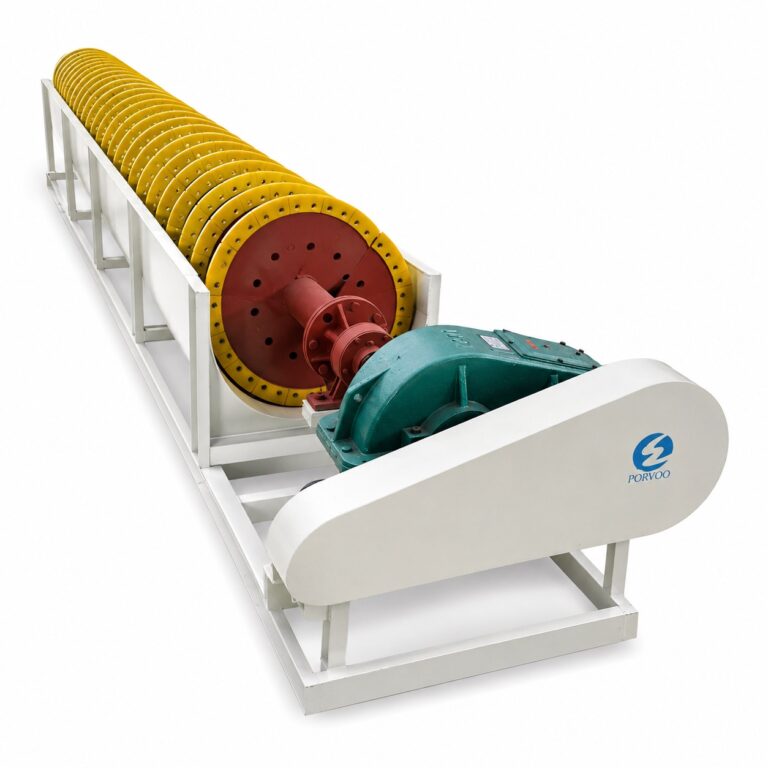
| Conveyor screw | Handles larger, coarse stone grinding solids well | Yields dryer solids | Reduces haulage cost; lowers maintenance issues from large particles |
| Eccentric screw pump | Better suited to smaller particles; larger/coarse solids may cause issues | Typically produces wetter cake | Can increase disposal cost and maintenance when handling coarse grit |
A conveyor screw handles coarse stone grinding solids with lower abrasive wear than an eccentric screw pump and produces drier output, which reduces both disposal mass and the solids burden on downstream treatment stages. An eccentric screw pump may be more familiar from other plant applications, but its susceptibility to wear and blockage from coarse or fibrous particles can increase maintenance frequency and introduce process interruptions that affect the entire treatment train. The preferred choice depends on the particle size distribution confirmed through representative sampling, not inferred from process type. A plant processing fine porcelain and a plant cutting granite may both be described as ceramic or stone operations, but their coarse fractions differ substantially and that difference drives equipment wear differently.
The waste-acceptance dimension deserves equal weight. A receiving facility may have specific requirements for cake moisture, pH, or heavy metal content before it will accept a load. Confirming those criteria during the design phase — not after the first rejected load — means equipment specification can be anchored to an actual acceptance threshold rather than an internal target that may not match external requirements. For plants whose sludge carries elevated zinc or lead concentrations from glazing or coating operations, the acceptance criteria at a standard construction waste facility may not apply; that restriction changes the logistics and cost structure in ways that should be reflected in equipment selection, not discovered post-commissioning.
A recessed plate and frame filter press can serve as a cost-effective pressure filtration option where feed conditions are appropriate and the cake moisture target falls within its operating range, but its lifecycle cost comparison against higher-pressure alternatives should account for cake moisture, cycle time, and the disposal cost differential — not capital cost alone.
Decide which subtopic should become the next page in the cluster
Among the decision areas covered here, chemical conditioning validation — specifically the process of confirming flocculant type, dose, and dosing point against representative feed samples taken across the plant’s actual operating range — is the subtopic with the clearest gap between its treatment depth and its practical consequence. The feed characterisation and equipment selection questions addressed in this article depend directly on whether conditioning assumptions hold across seasonal and batch-driven variability, and that dependency is substantial enough to warrant dedicated treatment.
A page focused on chemical conditioning for ceramic and stone wastewater would serve the cluster by covering jar testing protocol and sampling frequency, how conditioning interacts with lamella clarifier performance, the implications of variable feed chemistry for automated dosing systems, and how to set conditioning review triggers as part of routine operation. That scope connects to the treatment train design logic covered here without duplicating it and addresses the failure mode — inconsistent cake moisture traced to a conditioning program validated on an unrepresentative sample — that is most likely to affect plants following the selection logic in this article.
The second candidate for cluster expansion is the vertical sedimentation and clarified water return loop, which connects to the reuse-water quality targets discussed here and supports a more detailed treatment of how a vertical sedimentation tower integrates with the upstream conditioning and downstream dewatering stages to stabilise return-water quality across variable feed conditions. That topic is narrower in scope but directly adjacent to the reuse-stability questions that ceramic and stone plants treat as a production constraint, not just an environmental one. For a content cluster serving plants at the procurement or system design stage, chemical conditioning validation is the more consequential next page; sedimentation and reuse would follow it logically.
The concrete implication that runs through every section here is that equipment performance in ceramic and stone sludge dewatering is bounded by feed characterisation quality on one side and disposal route confirmation on the other. A press that is correctly specified for its feed can still fail to deliver its projected cost saving if the receiving facility’s acceptance criteria were assumed rather than confirmed, or if the conditioning program was calibrated on a single representative sample rather than validated across the plant’s actual operating range. Before comparing equipment models, the questions that deserve resolution are: what is the solids load and its variability, what is the coarse fraction’s particle size, what conditioning chemistry has been validated against representative samples, what is the cake disposal route and what are its acceptance thresholds, and what is the minimum return-water quality the production process can tolerate. Confirming those five parameters creates a basis for equipment selection that will survive commissioning; skipping any of them shifts the project risk from procurement to rework.
For further background on how grit removal, dosing, and settling stages are sequenced before the dewatering step, the article on wastewater treatment processes for heavy-solids factories covers that sequencing logic in more detail and is useful for teams reviewing treatment train design before specifying individual equipment.
Frequently Asked Questions
Q: Our plant runs multiple product lines with very different water chemistry — can a single conditioning program cover all of them, or do we need separate programs for each stream?
A: A single fixed-dose program is unlikely to perform consistently across chemically distinct product lines. Feed pH, particle surface charge, and solids concentration can shift enough between lines to require different flocculant types, charge densities, or dose rates — and a program validated on one stream may underperform on another. The practical approach is to run jar tests on representative samples from each major product line separately, then assess whether the results are close enough to manage with a single adjustable program or divergent enough to require stream segregation before conditioning. An automated dosing system that responds to real-time turbidity or flow signals handles inter-shift and inter-product variability more reliably than a fixed program calibrated on a single average condition.
Q: At what point does the moisture reduction from high-pressure pressing stop justifying the additional capital cost over a standard recessed plate press?
A: The crossover depends on disposal cost per tonne and daily sludge volume, not on pressing pressure alone. High-pressure operation becomes harder to justify when cake moisture from a standard recessed press already meets the receiving facility’s acceptance criteria, when daily sludge tonnage is low enough that the haulage saving does not recover the capital premium within a reasonable payback period, or when feed solids compressibility is low enough that additional pressure produces marginal further moisture reduction. The calculation requires two confirmed numbers — actual cake moisture for each option under the plant’s real feed conditions, and the disposal rate on the route the plant will use. Using an assumed disposal cost or a vendor-quoted moisture figure for a different feed profile distorts the comparison.
Q: What happens to filtrate return-water quality if the lamella clarifier goes offline for maintenance while production continues?
A: Return-water suspended solids will rise, and the rate at which they accumulate in the process loop depends on sludge load and the absence of any backup clarification. In glazing or polishing circuits, elevated suspended solids in return water can affect surface finish quality — a production consequence that tends to appear before any environmental threshold is breached. Plants operating a closed-loop system without a bypass or buffer clarification stage face a binary choice when the lamella clarifier is unavailable: halt return-water reuse and draw on fresh water, or discharge — neither of which is cost-free. The resilience question is worth resolving at design stage by confirming whether a temporary quality degradation in return water is operationally tolerable, and for how long, so that maintenance scheduling and redundancy decisions are anchored to a real production constraint.
Q: Does the advice here apply to a plant that discharges treated effluent rather than operating a closed loop?
A: The feed characterisation and equipment selection logic applies equally, but the downstream targets change. A closed-loop plant specifies return-water quality to protect product quality and production continuity; a discharge plant specifies effluent quality to meet a permitted limit. The implication for equipment selection is that a discharge plant’s filtrate suspended solids target is set by the discharge consent, not by internal process tolerance — and that target may be stricter or more consistently enforced than a production-driven reuse specification. Chemical conditioning, lamella clarifier sizing, and cake moisture targets all follow the same design logic, but confirming the permitted discharge limit and its monitoring frequency is the anchoring step that replaces the reuse-water quality confirmation described in the article.
Q: How do we know whether our coarse fraction is large enough to warrant a conveyor screw stage before the lamella separator, or whether we can feed directly?
A: The decision should come from particle size data on the actual feed, not from the process description. A grab sample passed through a sieve series will show whether the coarse fraction is present in quantities that would accelerate wear on the lamella separator or pump. As a practical indicator, stone cutting and abrasive grinding streams almost always carry a coarse fraction that justifies pre-separation; fine porcelain or glazing streams often do not. The maintenance cost of misclassifying the feed runs in one direction only — skipping a conveyor screw stage when the feed warrants it accelerates wear on downstream equipment and introduces process interruptions that are difficult to attribute cleanly. Adding it when the feed is genuinely fine increases capital cost but carries no operational penalty.