Does the dewatering circuit need to hit a cake-moisture target, protect a downstream flotation or leaching stage from carryover solids, or free up filtrate for reuse somewhere else in the plant? The answer changes which filtration technology, which capacity assumption, and which acceptance measures belong in the request for quotation. Mineral concentrate dewatering is rarely a single-variable problem, and treating it that way is what causes mismatches between test data and plant performance.
Define the Dewatering Duty Before Comparing Equipment
Before any filtration technology is compared, two project decisions need to be fixed: what cake condition the downstream step requires, and where the filtrate goes once it leaves the machine. These two choices are linked, not independent. A cake destined for bulk transport or storage has different acceptable moisture behavior than a cake that feeds a thermal or further metallurgical step, where residual moisture carries directly into energy or reagent consumption downstream. Similarly, filtrate that returns to the grinding circuit as process water faces a different acceptance question than filtrate that must meet a discharge or environmental release condition.
Where the cake condition is loosely specified, equipment comparisons tend to default to whichever technology produces the lowest moisture number in a vendor test, without regard to whether that moisture level is actually required by the downstream process or whether achieving it costs more in cycle time, consumables, or availability than the project needs to pay. Where the filtrate destination is left undefined, the project risks selecting a filtration technology on cake performance alone, then discovering that the filtrate quality it produces is unsuitable for the intended reuse point, forcing a secondary treatment step that was not in the original scope.
The duty definition also determines how feed variability should be read later. A plant duty defined only around an average or design-basis slurry composition will miss conditions that occur during ramp-up, ore blend changes, or upstream process upsets, all of which change solids content, particle-size distribution, and chemistry at the filter feed. A duty defined with its full expected range stated from the outset gives representative testwork a target to validate against, rather than leaving the test program to define the duty after the fact.
This is also the stage where project information supplied by the buyer, the expected feed range, the required cake condition, and the intended filtrate destination, enters a supplier’s configuration and quotation review. Without these three inputs stated together, a quotation can only be built around assumptions that the buyer has not yet confirmed.
Map Feed Variability and Representative Testwork
| Test-planning element | Uso assistido | Limite de decisão |
|---|---|---|
| Expected feed envelope | Define the range of slurry conditions expected in the plant duty. | Sets the scope that representative testwork must cover. |
| Representative testwork | Evaluate material response across the expected feed envelope. | Supports technology-fit and project-assumption decisions for the defined duty. |
| One slurry sample | Treat the result as sample-specific evidence. | Does not establish the full plant duty. |
Concentrate slurries change character across a plant’s operating life, and dewatering equipment is chosen against the full range it must handle, not against a single sample pulled on one occasion. Particle-size distribution, solids concentration, mineralogy, and surface chemistry of the concentrate all affect how readily a slurry releases water under vacuum or pressure, and each of these variables can shift with ore source, upstream grinding changes, flotation reagent regime, or blending practice.
A single slurry sample describes only the conditions present when it was taken. It can indicate whether a technology is grossly unsuitable, but it cannot establish how that technology will perform across the plant’s full feed envelope, particularly at the extremes where fine-particle content is highest or solids concentration drops. Treating one sample as representative of the whole duty transfers an untested assumption into the capacity and availability figures that follow, and that assumption surfaces later as a gap between test-derived expectations and plant results.
Representative testwork is structured differently. It defines the feed envelope first, drawing on the process data available from plant records, pilot campaigns, or metallurgical characterization, and then evaluates material response across that envelope rather than at a single point. Where the feed envelope is wide, because the ore body is variable or the upstream process has multiple operating modes, the test program needs to cover the range with enough samples to characterize the boundaries, not just the typical case. Where the feed is well-characterized and narrow, a smaller test program can still be representative, provided it captures the conditions that actually occur.
GB/T 30177.2-2024, which covers performance testing methods for vacuum filters, establishes a tested methodology for how vacuum filtration performance is measured, which matters when a project wants test results that can be compared consistently across trials or across vendors. The standard supports the test method itself; it does not certify a particular performance outcome for a given concentrate, and any project-specific capacity or moisture figure still depends on the feed samples actually tested, not on the existence of the test standard.
Compare Vacuum Ceramic and Pressure Filtration Boundaries
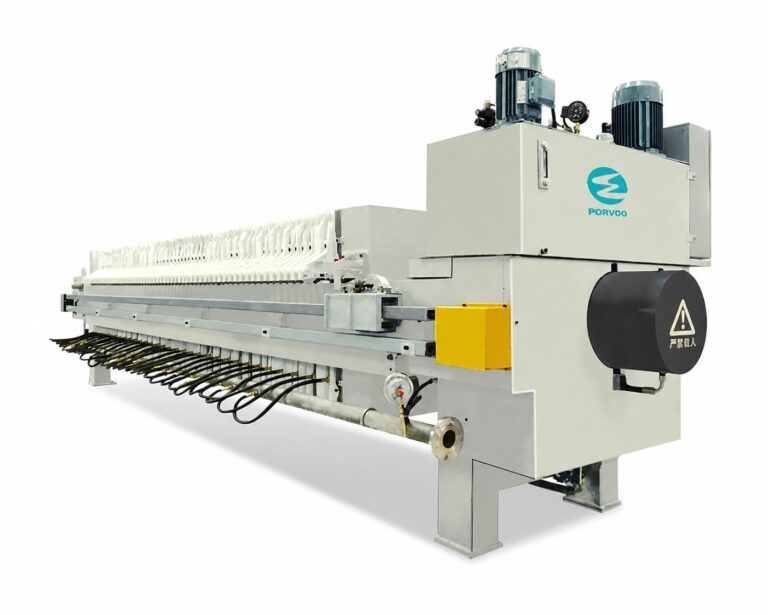
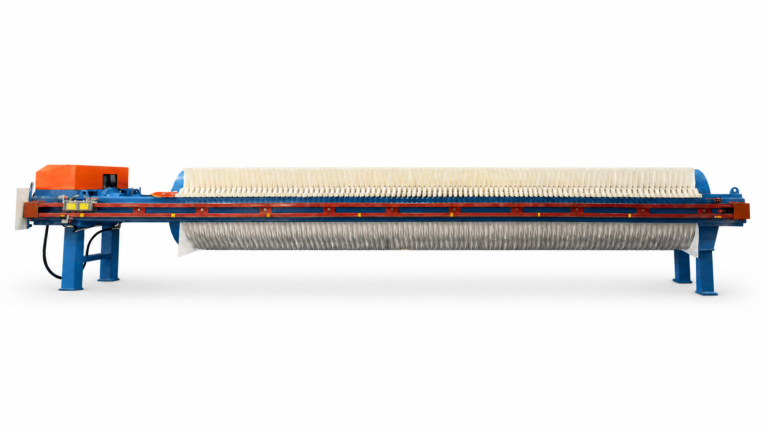
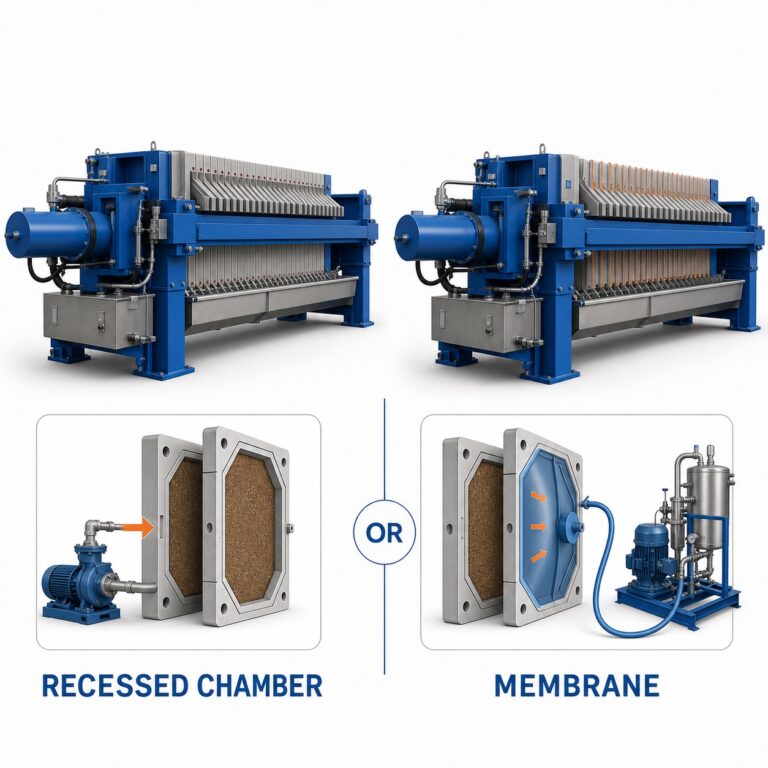
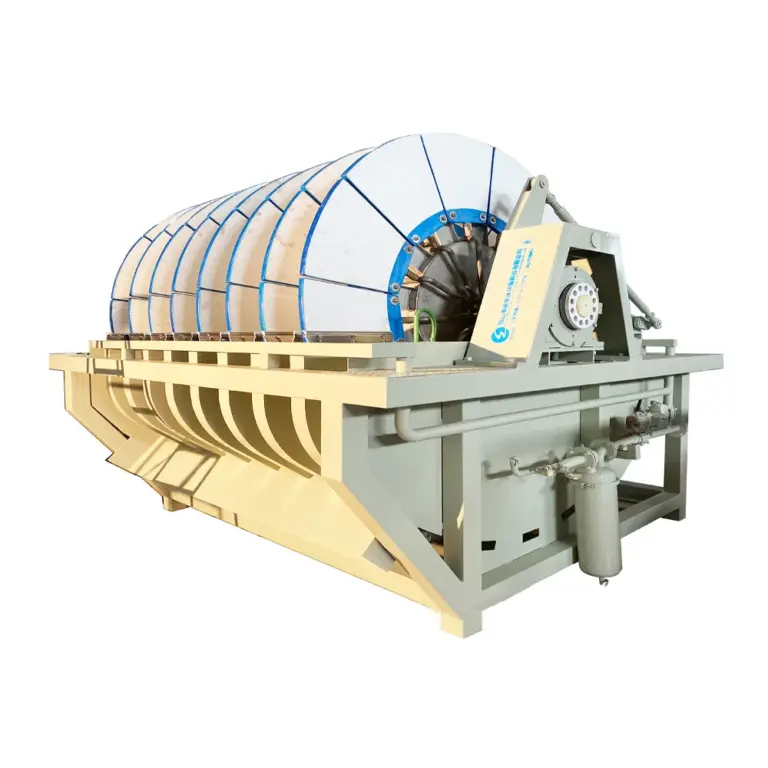
Continuous vacuum ceramic filtration and batch pressure filtration respond to concentrate slurries through different physical mechanisms, and that difference is the starting point for comparing them, not a specific performance number from either side. Vacuum ceramic filtration draws filtrate through a porous ceramic medium under continuous vacuum, with the disk or plate rotating through cycles of cake formation, drying, and discharge in one continuous motion. Pressure filtration instead builds cake in a closed chamber under applied pressure, in a batch cycle of fill, press, and discharge, with the cycle repeating once the chamber is emptied.
This mechanical difference changes how each technology responds to feed variability. Continuous vacuum operation tends to track changes in feed condition smoothly, since the process is ongoing rather than cycle-bound, which matters where the feed envelope includes gradual shifts in solids concentration or particle size. Batch pressure filtration completes a fixed cycle regardless of feed variation within that cycle, which can simplify control in some respects but means that a feed change affects only the next cycle, not the one already underway.
Productive capacity, availability, and maintenance interfaces all follow from this mechanical difference, but none of them can be assigned a specific value without reference to the tested material and the project’s operating assumptions. Vacuum ceramic systems depend on medium permeability and vacuum level, both of which interact with the fine-particle content of the concentrate. Pressure filtration systems depend on chamber fill time, press time, and cake release behavior, which interact with cake compressibility and discharge characteristics. Where a concentrate is especially fine or forms a low-permeability cake, the two technologies can respond very differently, and only representative testwork reveals which response applies to the project’s actual material. Where the feed is coarser and drains more readily, the gap between the two mechanisms narrows and other project factors, such as available footprint, utility supply, or maintenance access, carry more weight in the comparison. The comparison between vacuum ceramic disk filtration and filter press technology for mineral, ceramic, and stone slurries sets out these mechanical distinctions in more detail, but the plant-specific answer still depends on the feed envelope established for this project.
Translate Test Results Into Capacity and Availability
| Dimensão de comparação | Project basis to carry forward | Decisão sobre a qual se baseia |
|---|---|---|
| Material response | Representative testwork across the expected feed envelope | Technology fit for the defined duty |
| Productive capacity | Test results and the stated capacity assumptions | Dry-solids throughput basis |
| Disponibilidade | A project-specific availability assumption | Productive-capacity planning |
| Maintenance interfaces | The maintenance interfaces identified for each equipment option | Equipment selection and availability planning |
Test results describe material response; they do not by themselves describe what a plant will produce over time. Converting test data into a dry-solids throughput basis requires carrying forward the material-response findings from representative testwork and pairing them with a stated capacity assumption, which is a project decision about how the tested cycle time, cake thickness, or filtration rate scales to the full equipment size and configuration being considered.
Availability is a separate variable from material response, and it has to be assumed explicitly rather than inferred from test data. A test program run over a short campaign in controlled conditions cannot demonstrate the plant’s achievable operating time, since availability depends on factors outside the filtration mechanism itself, including feed supply consistency, scheduled maintenance, and the maintenance interfaces specific to each equipment option. Where the project adopts an availability assumption without stating it, the dry-solids throughput figure derived from test results carries an unstated and unverified basis.
Maintenance interfaces differ meaningfully between vacuum ceramic and pressure filtration equipment, and they feed directly into the availability assumption rather than standing apart from it. Ceramic filtration media require a cleaning or conditioning interface appropriate to how the medium loses permeability over operating time. Pressure filtration equipment requires a cloth or plate-related maintenance interface tied to its batch cycle and cake discharge behavior. Where the feed envelope includes conditions that accelerate medium fouling or cloth blinding, the maintenance interface becomes a larger factor in sustained throughput than the nominal filtration rate measured in a short test.
The project basis that should carry forward from testing, therefore, is not a single throughput number but a chain: material response tied to the tested feed envelope, a stated capacity assumption built on that response, a project-specific availability assumption, and the maintenance interfaces that affect whether that availability assumption is realistic. Each link in that chain is a separate decision, and treating a test result as if it already included the availability assumption skips a step that the project team still needs to make explicit.
Set Separate Cake and Filtrate Acceptance Measures
| Área de recebimento | Project-specific measure to agree | Keep separate from |
|---|---|---|
| Dry-solids throughput | Required dry-solids throughput basis | Cake moisture, filtrate condition, and operating stability |
| Umidade do bolo | Required cake condition and its cake-moisture measure | Dry-solids throughput, filtrate condition, and operating stability |
| Filtrate condition | Required filtrate condition for the intended destination | Dry-solids throughput, cake moisture, and operating stability |
| Operating stability | Agreed stability measure for the expected feed envelope | Dry-solids throughput, cake moisture, and filtrate condition |
A dewatering project needs four separate acceptance measures, agreed individually, rather than a single pass or fail judgment applied across the whole system. Dry-solids throughput, cake moisture, filtrate condition, and operating stability each describe a different aspect of performance, and meeting one does not establish the others.
A plant can achieve its required dry-solids throughput while producing a cake moisture above or below what the downstream step was designed around, because throughput and moisture respond to different combinations of cycle time, cake thickness, and vacuum or pressure level. A plant can likewise achieve an acceptable cake moisture during short test runs while filtrate quality drifts outside what the intended destination can accept, since filtrate condition depends on factors such as fine-particle breakthrough that may not track cake moisture consistently.
Operating stability is the measure most likely to be overlooked when the other three are defined only against a design-point feed condition. A system that meets throughput, moisture, and filtrate targets at the nominal feed condition can still perform unevenly across the feed envelope the plant actually experiences, particularly where the envelope includes the variability discussed earlier in feed characterization. An agreed stability measure, defined against that same feed envelope rather than against a single operating point, is what keeps the other three acceptance measures meaningful once the plant is running rather than only during a commissioning test.
Keeping these four measures separate also protects the project during commercial acceptance discussions. Where a supplier offers to demonstrate one measure as evidence that the system meets the overall duty, the buyer needs to confirm whether the other three have been independently demonstrated as well, since strong performance on one measure does not imply acceptable performance on the others.
Integrate Filtrate Routing With Plant Water Quality
| Filtrate-routing question | Evidence to use | O que as evidências comprovam |
|---|---|---|
| What is the intended filtrate destination? | Project-specific routing decision | The destination against which filtrate condition must be assessed |
| What suspended-solids result will be reported? | ISO 11923:1997 measurement by glass-fibre filtration | A suspended-solids result under that measurement method |
| Is the filtrate acceptable for its destination? | The measured condition compared with project-specific acceptance criteria | Suitability for the stated project criteria; the measurement method alone provides no treatment guarantee or universal reuse limit |
Filtrate leaving the dewatering equipment is not automatically compatible with its intended destination, and establishing that compatibility requires answering three separate questions in sequence. The first is a project-specific routing decision: where does this filtrate go, back to grinding, to a tailings circuit, to a discharge point, or to some other reuse within the plant. That destination defines the condition against which filtrate quality must be judged, and it has to be settled before any measurement is useful, since the same filtrate can be acceptable for one destination and unsuitable for another.
The second question is what will actually be measured and reported. Suspended-solids content is commonly the parameter of interest for filtrate destined toward process reuse or toward a discharge point sensitive to solids carryover, and ISO 11923:1997 describes a glass-fibre filtration method for determining suspended solids in water. That standard supports the measurement method, establishing how a suspended-solids figure is obtained and reported consistently, but it does not define what level of suspended solids is acceptable for any particular reuse point or discharge condition. The acceptable level is a project-specific criterion, not a property of the measurement method.
The third question connects the two: is the measured filtrate condition acceptable for the stated destination. Answering this requires comparing the measured result against project-specific acceptance criteria tied to that destination, which might come from process requirements upstream, from environmental release conditions, or from water-balance targets elsewhere in the plant. The measurement method alone, however rigorously applied, does not resolve this question, because it provides a number without a judgment about where that number sits relative to the destination’s requirements.
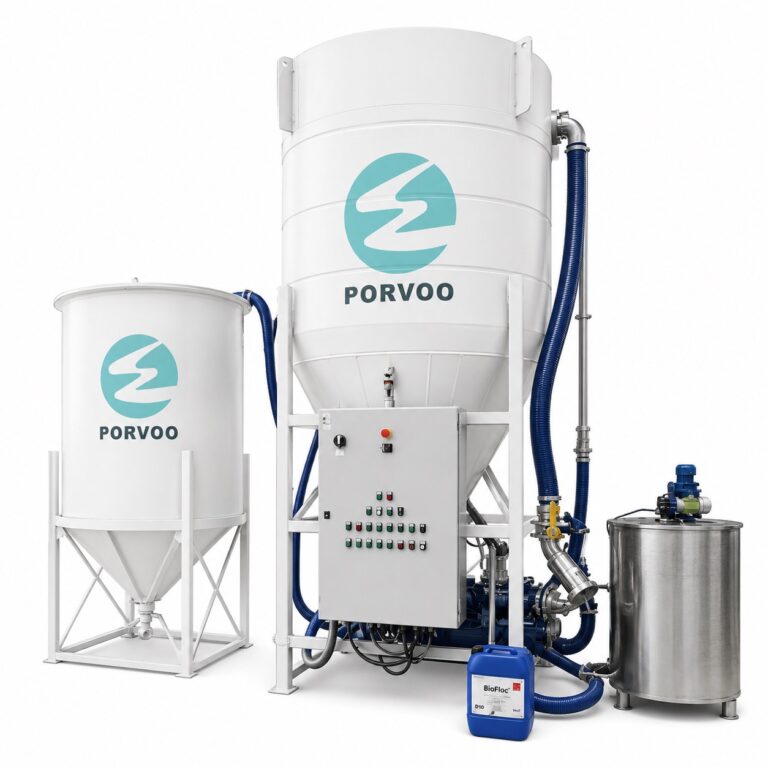
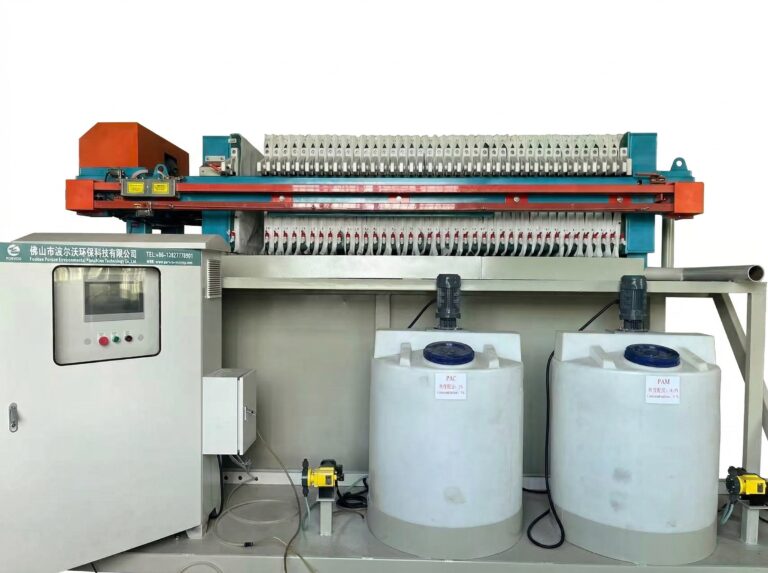
This is also the point in the project where PORVOO’s filtration equipment interfaces with the plant’s broader water-handling decisions, since the filtrate stream leaving a vacuum ceramic or pressure filtration unit becomes an input to whatever water-quality or reuse system the plant operates downstream, and the acceptance criteria for that interface need to be fixed before equipment sizing is finalized rather than discovered afterward.
Build the RFQ and Project Test Plan
An RFQ built from the preceding decisions carries the duty definition, the feed envelope, the testwork findings, the technology comparison, and the four separate acceptance measures into a single document that a supplier can quote against without filling gaps with unstated assumptions. Each element has a place in that document rather than standing as a separate conversation.
The duty definition, required cake condition and intended filtrate destination, belongs at the front of the RFQ, since it frames every other decision that follows. The feed envelope, built from the plant’s actual expected range rather than a single sample, needs to be stated explicitly enough that a supplier can identify whether its proposed testwork program will actually cover the conditions that matter. Where representative testwork has already been completed, its results belong in the RFQ as the material-response evidence, stated together with the feed conditions under which it was obtained, so a reviewing engineer can judge whether the evidence matches the stated envelope or only a narrower slice of it.
The technology comparison, continuous vacuum ceramic filtration against batch pressure filtration, is resolved in the RFQ by stating which mechanical response the project needs, rather than naming a preferred technology without the reasoning behind it; this allows a supplier to confirm or challenge that choice against its own understanding of the feed material. Capacity and availability assumptions carried forward from testing need to be stated as assumptions, not as guaranteed figures, so that the quotation review can test them against the supplier’s own experience with the equipment class.
Finally, the four acceptance measures, dry-solids throughput, cake moisture, filtrate condition, and operating stability, belong in the RFQ as separate line items with their own confirmation requirements, each tied to the feed envelope and the filtrate destination already established. A project test plan that follows this structure gives the reviewing team a basis for judging a quotation against the actual duty, rather than against a generic capability claim that has not been matched to the project’s stated conditions.
Perguntas frequentes
Q: Can one slurry sample be used to select dewatering equipment for the whole plant duty?
A: No. Its result is evidence for that sample only. First define the expected feed envelope, then choose representative samples across that envelope so the comparison reflects the material variability the equipment will need to handle.
Q: How should a plant compare a vacuum ceramic disk filter with a filter press?
A: Compare both options against the same defined duty and representative test program. Carry forward the material response, productive-capacity basis, availability assumption, and maintenance interfaces for each route, while accounting for the distinction between continuous vacuum ceramic filtration and batch pressure filtration.
Q: How can test results be turned into a realistic capacity basis?
A: State the feed conditions covered by the tests, the required dry-solids throughput, and the project-specific availability assumption separately. This prevents a favorable material-response result from being treated as proof of productive capacity across the full plant duty.
Q: Does a suspended-solids result alone show that recovered filtrate is suitable for reuse?
A: No. A result measured under ISO 11923 describes suspended solids under that method; it does not set a universal reuse limit or guarantee treatment performance. Define the intended filtrate destination and compare the measured condition with acceptance criteria agreed for that destination.
Q: What should be included in an RFQ so equipment proposals can be compared on the same basis?
A: Provide the required cake condition, intended filtrate destination, expected feed envelope, representative testwork plan, dry-solids throughput basis, availability assumption, and known maintenance interfaces. Ask each proposal to address separate project measures for throughput, cake moisture, filtrate condition, and operating stability so success in one area does not substitute for another.