Selecting the wrong dewatering technology for a ceramic body slurry or stone-cutting sludge often does not become visible until commissioning — at which point inadequate cake discharge, poor filtrate quality, or an undersized vacuum system forces a redesign that carries full equipment replacement cost. The particle characteristics of these slurries can differ significantly from the mineral concentrates that dominate published performance data for vacuum ceramic disk filters, and transferring benchmark figures without slurry-specific testing is a common path to that outcome. The decision that resolves this is not which technology has better headline specifications, but which one can form a dischargeable cake reliably on the actual slurry at the target throughput. What follows gives you the criteria and trade-offs to judge that question before equipment is specified.
Compare continuous vacuum dewatering and batch pressure filtration
The operating mode difference between these two technologies is not a preference — it is a structural constraint that determines which duty each can serve without compromise.
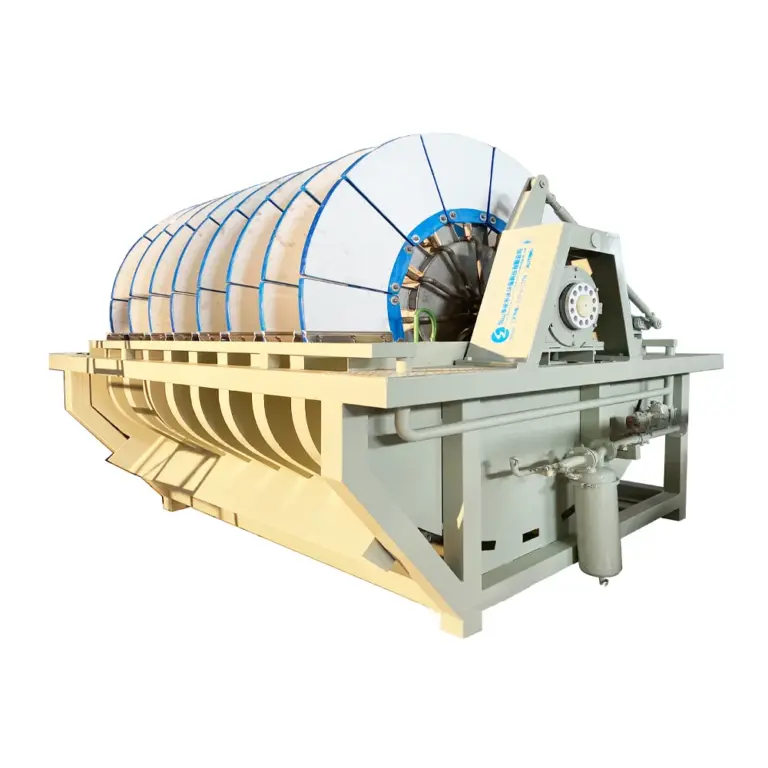
A vacuum ceramic disk filter draws moisture through the ceramic plate under a sustained low vacuum, rotating through slurry and then through discharge and cleaning zones in a continuous cycle. The low vacuum range (0.09–0.098 MPa) means the driving force for dewatering is modest compared to pressure filtration, but the continuous cycle compensates through high surface utilization and throughput capacity. A filter press operates in discrete batch cycles: fill, press, discharge, and reset. The pressure applied during the pressing phase can exceed what vacuum alone achieves, which matters when the slurry requires higher mechanical force to reach target cake moisture.
The practical consequence is that a ceramic disk filter can sustain steady-state feed to downstream conveyors or dryers without buffer tank management between cycles, while a filter press requires the upstream slurry system to accommodate batch discharge intervals — either through storage volume or a staggered press configuration. For production lines that run continuously, the batch constraint of a filter press is a layout and scheduling issue, not just an equipment issue. For duties where throughput is periodic or where cake properties are more important than continuous output, the batch press cycle is an advantage, not a limitation.
| Parâmetro | Vacuum Ceramic Disk Filter (Continuous) | Filter Press (Batch) |
|---|---|---|
| Modo de operação | Contínuo | Lote |
| Operating pressure (range) | 0.09–0.098 MPa (low vacuum) | <85 kPa (batch pressure) |
| Solids throughput (max) | Up to 4,000 kg/m²·h | - |
| Filtration capacity (typical) | 200–5,000 L/m²·h | - |
The throughput figures in the table are design references from equipment specifications and should not be read as guaranteed performance values. The actual achievable throughput for any specific slurry depends on filtration rate testing, not headline capacity claims.
Check feed solids particle size and slurry consistency first
Before any performance comparison is meaningful, the slurry itself must be characterized against the operating window of the ceramic disk filter. This step is routinely skipped when procurement teams rely on equipment category rather than feed-specific data.
The ceramic disk filter operates within a defined particle size range, and slurries that fall outside it — either in particle size or feed solids concentration — may not form a filterable cake at all within the continuous cycle time. Ceramic plate pore size sets the lower retention limit and, when the feed contains particles near or below that threshold, pore blinding becomes a maintenance and recovery concern rather than a performance footnote.
| Parâmetro | Suitable Range / Value | Importância |
|---|---|---|
| Feed particle size | 1–700 μm | Defines the particle size window the filter can handle; outside this, a filter press may be required |
| Feed solids concentration | 5–20% w/w | Ensures adequate cake formation and filter throughput |
| Ceramic plate pore size | 1–5 μm (commonly 1.5–2.0 μm) | Determines the finest particles that can be retained and influences clogging risk |
For ceramic body slurries and stone-cutting sludge, this check matters more than it does for well-characterized mineral concentrates, because the particle size distribution is often wider, the solids content more variable, and the fine fraction more likely to approach or fall below the ceramic plate pore size. A slurry that reads as 5–15% solids by weight but carries a significant sub-micron fraction may behave very differently from a mineral concentrate at the same nominal concentration. If characterization data is not available, filtration testing is the prerequisite — not an optional step.
Use vacuum-filter testing when ceramic disk performance is claimed
A vendor performance claim for a vacuum ceramic disk filter on a specific slurry is only as credible as the testing protocol behind it. Without controlled pilot or laboratory data from the actual feed, throughput and moisture figures should be treated as indicative at best.
The key variables that must be controlled and recorded during testing are feed solids concentration, disc rotation speed, slurry level in the trough, feed temperature, and the vacuum pressure applied during both cake formation and dewatering phases. Changing any one of these shifts the output, and a test conducted at a favorable combination of variables can make a marginal slurry appear well-suited for continuous vacuum filtration. When filtration area exceeds a few square meters, testing should also assess whether cake washing is required and, if so, whether washing efficiency degrades at the rotation speeds needed to hit throughput targets.
GB/T 30177.2-2024 (Methods of Performance Testing for Filters — Part 2: Vacuum Filter) and GB/T 30176-2013 (Filter for Liquid Filtration — Performance Measurement Methods) define how vacuum filter performance should be measured. These standards provide the testing framework against which vendor claims can be evaluated — they are relevant here not as design standards that dictate equipment configuration, but as references for what a properly conducted performance test should control and document. If a vendor cannot supply test data traceable to a structured protocol, the claimed performance figures carry significant uncertainty. Requesting pilot test data from a slurry sample representative of the actual feed — rather than a surrogate mineral slurry — is a reasonable procurement condition before issuing a purchase order for a ceramic disk filter installation. The Filtro de disco cerâmico a vácuo product page provides equipment specifications, but those specifications should be matched against slurry-specific test data before selection is finalized.
Compare cake handling and filtrate targets by duty
Cake moisture and filtrate quality are the two downstream-facing outcomes that most directly affect whether a dewatering unit fits its duty — and both have different implications depending on whether the downstream step is drying, transport, disposal, or water reuse.
For vacuum ceramic disk filters processing mineral concentrates, published operational data shows cake moisture in the 6–12% range, varying by mineral type. These figures are not transferable directly to ceramic body slurries or stone sludge without equivalent tested data, but they provide a reference point for what continuous vacuum dewatering can achieve when the slurry is well-suited to the process.
| Mineral Concentrate | Typical Cake Moisture Range (%) |
|---|---|
| Ouro | 6.5–11.5 |
| Cobre | 6.5–12 |
| Ferro | 6–10 |
Filtrate solids content below 50 ppm — and typically in the 1–5 ppm range — enables direct recirculation of filtrate to process water systems without further clarification. For facilities where water reuse is part of the operating cost structure, this is a meaningful advantage over a filter press, which may produce filtrate that requires additional settling or polishing depending on cloth condition and press cycle management.
| Parâmetro | Value / Detail | Por que é importante |
|---|---|---|
| Filtrate solids content | <50 ppm (typically 1–5 ppm) | Enables direct water reuse without further treatment, reducing total operational cost |
| Minimum cake thickness for discharge | 10–13 mm (3/8–1/2 in.) | Below this thickness, cake discharge may fail |
| Discharge method options | Scrapers or air blow-back; ceramic scraper knives available | Affects equipment longevity and maintenance; ceramic scrapers reduce plate wear |
The minimum cake thickness criterion (10–13 mm) is an operational boundary, not a design safety margin. Below that thickness, the cake does not discharge cleanly from the ceramic disk, which means repeated partial discharges, plate surface contamination, and progressive loss of filtration efficiency. For slurries that form thin or uneven cakes — common in fine-particle industrial sludges with variable feed concentration — this failure mode can develop gradually and appear as declining throughput before it is correctly diagnosed. The discharge mechanism (scraper or air blow-back) also affects plate wear rate, and ceramic scraper knives are worth specifying where abrasive particles are present in the feed.
Include energy vacuum system and maintenance differences
The energy difference between a vacuum ceramic disk filter and a cloth-based vacuum filter of equivalent area is not marginal — and it changes the lifecycle cost argument substantially if the slurry actually suits continuous vacuum dewatering.
At 45 m² of filtration area, a ceramic filter operating at rated conditions draws approximately 15 kW, compared to around 170 kW for a comparable cloth filter. The electricity consumption per ton of solids processed falls below 0.5 kWh/ton at throughput rates above 1,100 kg/m²·h. These are design figures from equipment references, not guaranteed savings applicable to every installation — actual consumption depends on slurry characteristics, vacuum system condition, and operating cycle — but the order-of-magnitude difference is consistent enough to be a meaningful factor in a lifecycle cost comparison when both options are technically viable.
| Métrica de desempenho | Value for Ceramic Filter | Implication vs Cloth Filter |
|---|---|---|
| Rated power for 45 m² area | 15 kW | ~90% lower than a comparable cloth filter (170 kW) |
| Electricity consumption per ton of solids | <0.5 kWh/ton (at >1,100 kg/m²·h) | Demonstrates very low energy cost per unit throughput |
| Plate/media service life | 12–13 months | Reduces replacement frequency compared with cloth media |
| Chemical and temperature resistance | Withstands alkaline, acidic, and high-temperature conditions; non-fibrous porous ceramic | Lower maintenance in corrosive or demanding slurry duties |
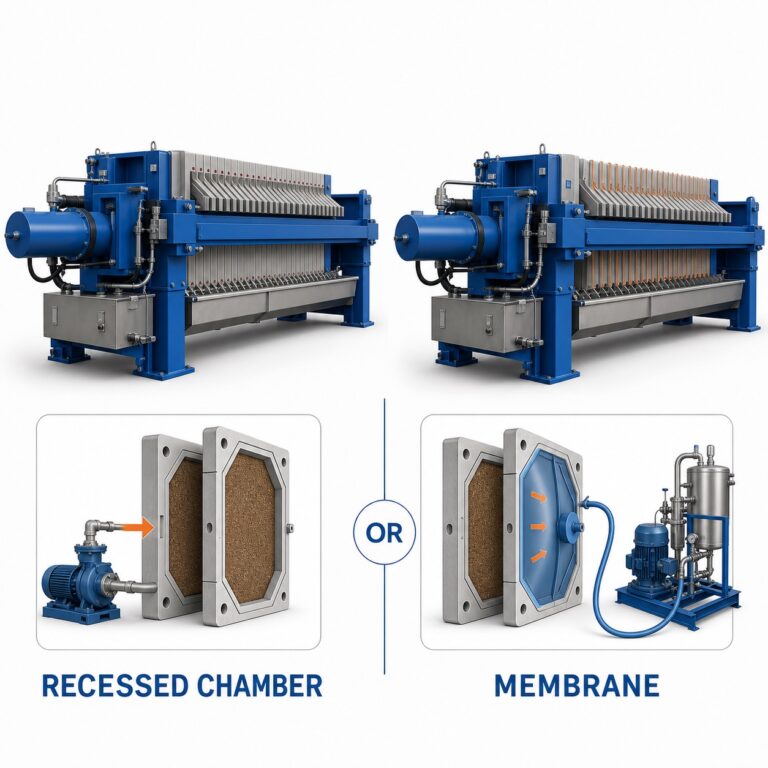
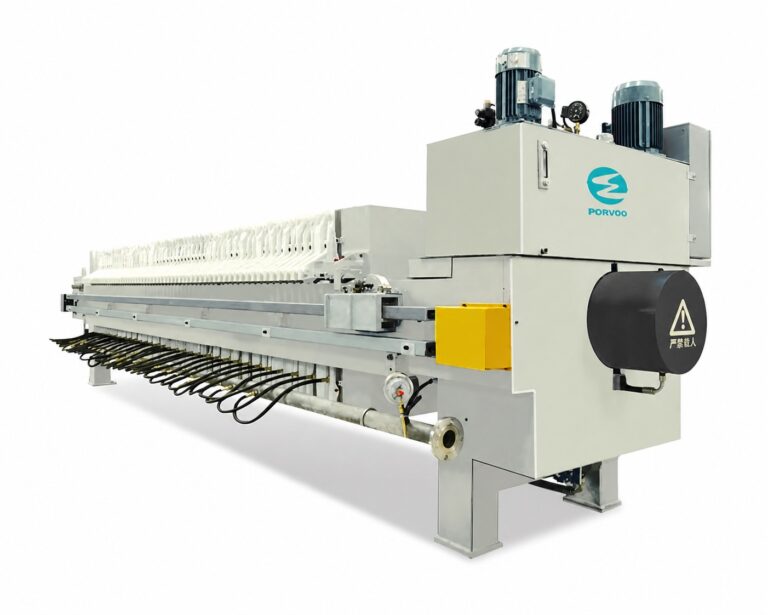
The filter media service life difference also affects total cost of ownership in a way that is often underweighted at the procurement stage. Ceramic plates rated at 12–13 months before replacement compare favorably to cloth filter media on replacement frequency and the maintenance labor associated with media changeovers. For corrosive or high-temperature slurries — conditions common in ceramic production or stone processing with high pH rinse water — the chemical resistance of the ceramic plate reduces the risk of premature media degradation that would otherwise erode both the energy and maintenance cost advantage. A Prensa de filtro de membrana may still be the appropriate choice when higher pressing pressure is needed to reach cake dryness targets, but the operating cost comparison should account for filter cloth replacement cycles, energy per batch cycle, and compressed air consumption during squeeze phases.
Avoid using mining assumptions blindly for ceramic or stone sludge
Performance benchmarks for vacuum ceramic disk filters are predominantly sourced from mineral concentrate duties — iron ore, copper, gold — where particle size distributions, feed densities, and dewatering behavior are well-characterized and relatively consistent within process streams. Applying those benchmarks to ceramic body slurries or stone-cutting sludge without adjustment is a planning error that surfaces at commissioning, not at the equipment selection stage.
Ceramic production slurries can contain fine clay fractions, binders, or deflocculants that affect filtration rate in ways that are not captured by particle size alone. Stone-cutting sludge from wet-process diamond or abrasive cutting carries fine mineral fines at variable feed concentration depending on water recirculation practice in the workshop. Both slurry types may have particle size distributions that overlap with the stated operating range of a ceramic disk filter while still exhibiting poor cake formation due to compressibility, surface chemistry, or inter-particle cohesion that differs from the mineral concentrate reference.
The practical recommendation is to treat the moisture targets, throughput figures, and energy benchmarks cited elsewhere in this comparison as a starting reference, not a performance guarantee for these slurry types. GB/T 30177.2-2024 provides the testing framework that would generate valid, slurry-specific comparison data — and conducting that testing before finalizing the equipment selection is the only reliable way to determine whether the ceramic disk filter’s operating advantages actually apply to the slurry in question. If testing cannot be completed before RFQ, the scope document should specify that equipment performance acceptance is contingent on achieving defined targets on the actual slurry, with test conditions and acceptance criteria agreed before delivery.
Choose based on tested slurry behavior and operating mode
The final selection criterion is not which technology has better specifications on paper — it is which technology forms a reliable, dischargeable cake on the actual slurry under the required operating conditions.
The cake formation rate test provides one of the clearest early-stage signals. If the slurry takes more than five minutes to build a cake to approximately 3 mm (1/8 in.) thickness under controlled vacuum, continuous vacuum filtration is unlikely to sustain reliable discharge in a rotating disk configuration. This is not a formal pass/fail standard — it is a practical indicator from operational experience that, when seen in pilot testing, should prompt a re-evaluation of continuous viability rather than an attempt to optimize around it. Forcing a continuous filter into a duty where cake formation is too slow typically results in partial cake buildup, irregular discharge, and progressive loss of plate surface performance. Switching to a batch filter press at that point — after the continuous filter has been procured and installed — carries full redesign cost for the feed system, discharge conveying, and vacuum infrastructure.
For rapidly settling, high-concentration slurries, the standard top-feed configuration of a ceramic disk filter introduces an additional risk: non-uniform cake formation as coarser particles settle before reaching the filter zone. Bottom-feed rotary disk configurations address this for specific slurry types, but this is a configuration decision that requires feed characterization, not a default option.
| Observed Slurry Behavior | Implication for Filter Choice | Suggested Approach |
|---|---|---|
| Cake formation takes >5 minutes to reach 1/8 in. thickness | Continuous filtration likely not viable | Re-evaluate continuous viability; consider batch filter press |
| Rapidly settling, high-concentration slurry | Settling hinders uniform cake formation with standard top-feed | Consider bottom-feed rotary disc filter to maintain efficiency |
| Higher rotating speed increases throughput | May reduce washing efficiency and raise power consumption | Balance rotating speed with washing quality targets during testing |
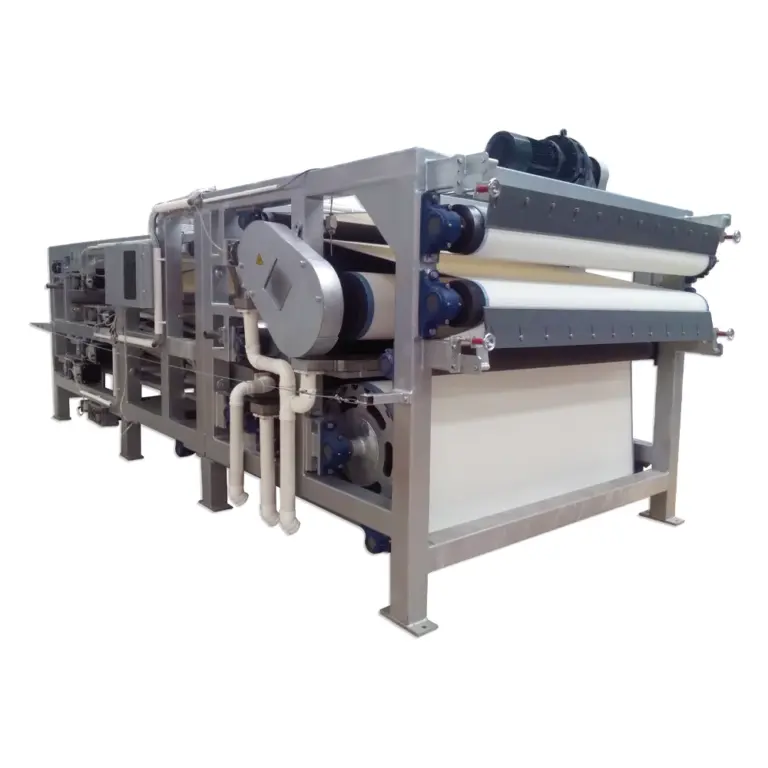
The rotation speed trade-off deserves particular attention when throughput and washing quality are both specified as targets. Higher rotation speed increases the number of filtration cycles per unit time, which raises throughput — but it also reduces the dwell time available for cake washing and may increase power draw enough to undermine the energy efficiency advantage that justified the ceramic filter selection. A unit that is correctly sized for throughput at a given rotation speed may fail filtrate quality or downstream moisture targets when washing efficiency is factored in. This balance should be resolved during testing, not assumed to be manageable through operational adjustment after installation. For facilities where downstream processes are sensitive to filtrate solids or cake moisture variation, the Prensa de filtro de correia offers a continuous-mode alternative with different control parameters, and comparing tested performance across both options is more defensible than selecting on throughput figures alone. Additional context on integrating vacuum ceramic filters with upstream slurry handling is covered in Como integrar filtros de disco cerâmico a vácuo com sistemas existentes de espessamento e manuseio de polpa.
The most useful pre-selection output is a tested cake formation rate and filtrate solids result from a representative slurry sample, evaluated against the target cake moisture, discharge reliability, and filtrate reuse criteria for the specific duty. Without that data, the comparison between continuous vacuum dewatering and batch pressure filtration is a comparison of specifications rather than a comparison of outcomes.
Before issuing an RFQ, define the feed slurry parameters — particle size distribution, solids concentration range, settling velocity, and any chemical properties that affect filtration behavior — and require that vendor performance claims be supported by test data from equivalent or representative feed. If cake dryness, filtrate solids content, and minimum throughput are acceptance criteria, specify them as such in the purchase conditions. The energy and maintenance advantages of the ceramic disk filter are real and significant for slurries that suit the technology; the risk is in assuming suitability rather than confirming it.
Perguntas frequentes
Q: Our stone-cutting sludge has a highly variable solids concentration depending on the day’s cutting volume — does the ceramic disk filter handle feed inconsistency, or does it need a stable feed to perform reliably?
A: Variable feed concentration is a risk factor that requires active management rather than an equipment substitution. A ceramic disk filter depends on consistent slurry level and solids concentration in the feed trough to maintain uniform cake thickness across the disk surface. When feed concentration fluctuates widely, cake thickness varies with it — and below the 10–13 mm minimum, discharge reliability degrades. Before selecting either technology, characterize the full concentration range of your sludge stream and determine whether upstream equalization (a buffer or conditioning tank) can bring the feed within the 5–20% w/w window consistently. If equalization is not feasible and concentration swings are frequent, a batch filter press accommodates variable feed better because each cycle is independent of the previous one.
Q: If pilot testing confirms the ceramic disk filter is viable for our slurry, what should the next step be before issuing the purchase order?
A: The immediate next step is translating the pilot test results into binding acceptance criteria in the purchase conditions — not proceeding directly to RFQ on the basis that testing went well. Specifically, define the minimum cake moisture, maximum filtrate solids content, and minimum throughput as contractual acceptance targets, and require that the vendor demonstrate these on the actual process slurry (not a surrogate mineral feed) under agreed test conditions before delivery is accepted. This step is what converts a promising pilot result into a procurement commitment with enforceable performance accountability. Without it, discrepancies between pilot conditions and full-scale installation have no contractual remedy.
Q: At what point does the energy cost advantage of the ceramic disk filter stop justifying the technology over a filter press?
A: The energy advantage narrows or reverses when throughput drops far enough that the vacuum system runs at low utilization relative to its rated capacity, or when the slurry requires supplementary drying downstream because the vacuum-achievable cake moisture is insufficient. The 15 kW versus 170 kW comparison and the sub-0.5 kWh/ton figure assume the filter is operating above 1,100 kg/m²·h on a well-suited slurry. If your duty runs at significantly lower throughput, or if the vacuum-dewatered cake still requires a downstream dryer that the filter press cake would not, the total energy budget — including drying — may favor the filter press despite its higher per-unit filtration energy. This comparison should be calculated against your actual throughput target and downstream process, not the headline equipment specification.
Q: How does the ceramic disk filter compare to a belt filter press for continuous-mode operation when our priority is consistent cake moisture rather than maximum throughput?
A: When cake moisture consistency is the primary target and throughput is secondary, the two continuous-mode technologies differ in how they achieve dryness control. A ceramic disk filter reaches cake moisture through vacuum dewatering alone, with rotation speed and vacuum level as the primary adjustment parameters — but increasing dwell time for drier cake reduces throughput, and the trade-off is fixed by the disk geometry. A belt filter press applies mechanical compression through roller pressure, which can be adjusted independently of belt speed to tune moisture output, giving more direct control over the dryness–throughput balance. For slurries where moisture specification is tight and variable, the belt filter press offers more adjustment levers after installation. For slurries that suit vacuum dewatering and where the tested moisture result already meets the target, the ceramic disk filter’s energy and filtrate quality advantages are meaningful. The deciding input is the cake moisture result from testing on each technology with your actual slurry — not the control architecture in isolation.
Q: We have a relatively small operation with intermittent production runs — is continuous vacuum filtration worth the infrastructure investment at low scale?
A: For intermittent or low-volume production, the infrastructure cost of a continuous vacuum ceramic disk filter — vacuum pump, piping, acid-wash regeneration system, and controls — is harder to recover than at sustained high throughput. The energy savings and maintenance advantages are proportional to operating hours and volume processed; a system running a few hours per day or several days per week realizes a smaller absolute saving than one running continuously. A batch filter press, by contrast, requires no vacuum system infrastructure and scales more directly to intermittent duty without idle-system losses. The break-even point depends on your actual annual throughput, local electricity costs, and filter cloth replacement frequency for the press — but if production is genuinely intermittent rather than scheduled shift operation, the simpler infrastructure of the filter press typically makes it the more cost-appropriate choice at small scale.