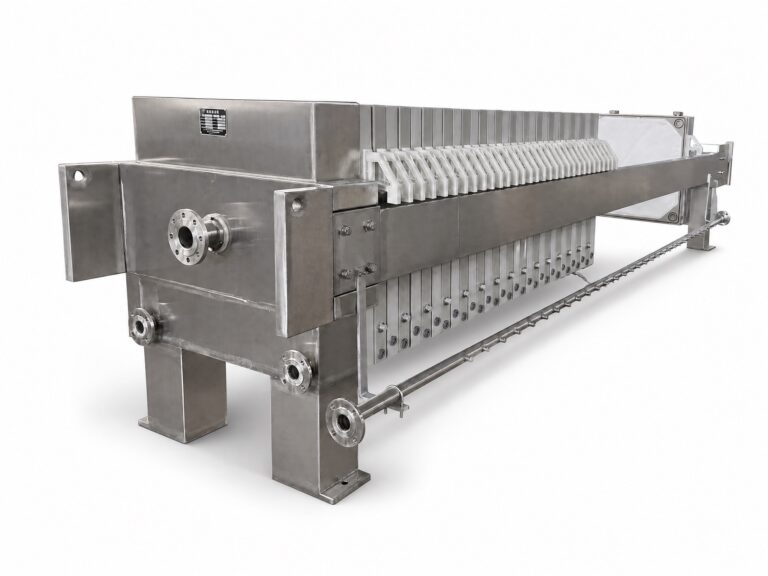
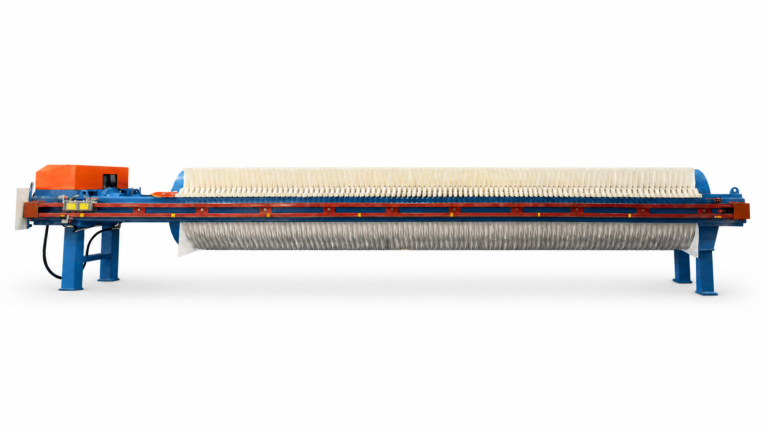
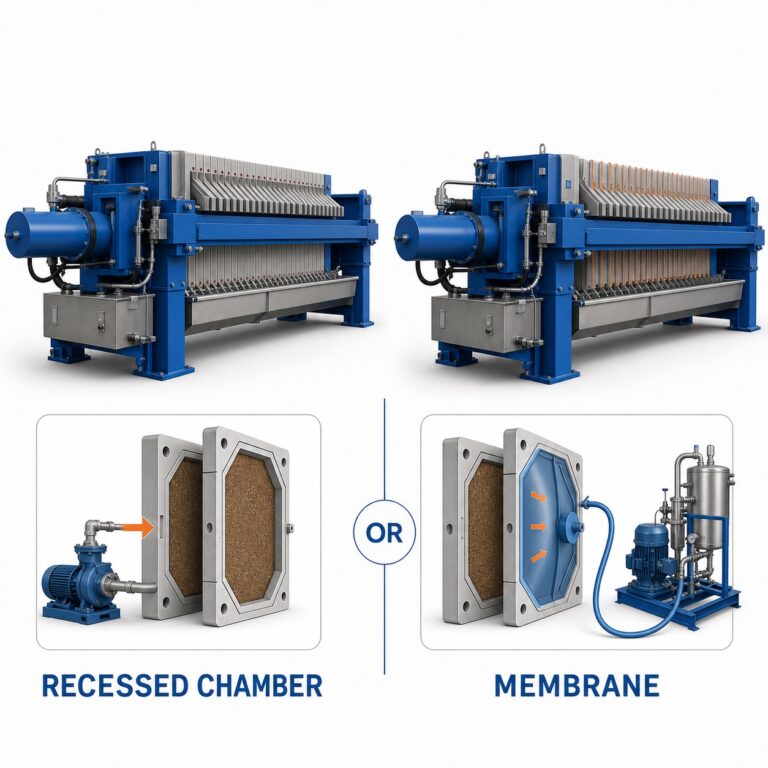
A round-plate press arriving to replace a leaking or undersized unit raises a question that is easy to underestimate: how much of the existing dewatering line actually qualifies for reuse, and how much only looks compatible because it occupies the right space? The answer determines whether the retrofit is a plate-for-plate swap or a wider rebuild of feed, control, and site interfaces.
Existing-system data needed before any reuse decision
| Data set | Éléments à recueillir | Reuse decision it supports |
|---|---|---|
| Feed and slurry basis | Existing feed preparation and the actual slurry condition | Provides the operating basis for checking retained equipment against the proposed press cycle |
| Installed process equipment | Pump duty, piping, valves, and filtrate routing | Identifies the process interfaces that need a compatibility check before reuse |
| Interfaces des installations | Controls, electrical connections, and utilities | Shows which retained interfaces may need modification for the press package |
| Site conditions | Support condition, equipment space, access, drainage, and cake-removal route | Shows whether the existing installation can physically accommodate operation and maintenance |
| Conditions d'acceptation | Interface checks plus project-specific moisture, cycle, and filtrate measures | Prevents retained equipment from being treated as proof of filtration performance |
A reuse decision cannot start from the new press alone. It starts from an accurate record of what the plant already has, because every judgment that follows — pump suitability, piping material, control ownership, site fit — depends on comparing the proposed press cycle against the real condition of the installed system, not against an assumed or outdated one.
The feed and slurry basis sets the terms for every other check. If the slurry condition that the existing feed preparation actually delivers has drifted from what the original system was designed around, then any pump, pipe, or valve downstream of that preparation step is being evaluated against the wrong duty. This is why feed and slurry data has to be gathered first and treated as the reference point, not assumed to match the original design intent of the plant.
Installed process equipment — pump duty, piping, valves, filtrate routing — forms the next layer. Each of these components was selected for a specific combination of flow, pressure, and material characteristics tied to the original press cycle. A proposed round-plate press cycle will differ from that original cycle in some respect, whether in chamber pressure, cycle timing, or cake characteristics, and the only way to know whether a given pump or pipe run still fits is to compare its actual operating envelope against the new cycle, not its nameplate rating against a generic duty point.
Plant interfaces — controls, electrical connections, utilities — belong in the same register because they define where the press package stops being self-contained and starts depending on the plant. Where the existing control system was built around a different press type or a different automation philosophy, the interface itself becomes a variable that must be documented before anyone decides what stays and what changes.
Site conditions close the picture: the physical condition of supports, the space allocated to the equipment, access for operation and maintenance, drainage, and the route cake takes out of the area. These are not process variables, but they govern whether a technically compatible system can actually be installed and operated as planned.
Finally, the acceptance basis has to be defined before reuse decisions are finalized, separating interface checks from the project-specific moisture, cycle, and filtrate measures that will later determine whether the press performs as a dewatering system. Collecting all five data sets up front, rather than discovering gaps during installation, is what turns a retrofit from a sequence of surprises into a planned scope.
Feed pump and piping checks against the proposed press cycle
| Existing item | Check against the proposed press duty | Reuse boundary |
|---|---|---|
| Préparation des aliments pour animaux | Actual preparation arrangement and slurry condition | Use the verified feed condition as the basis for the equipment checks |
| Pompe d'alimentation | Actual operating range compared with the proposed press cycle and slurry condition | Retain only after the operating fit is checked; nameplate proximity alone is insufficient |
| Feed piping | Actual operating range and materials compared with the proposed press cycle and slurry condition | Retain only after both operating fit and material suitability are checked |
The feed pump and feed piping are usually the first candidates for reuse, because they are already installed, already piped into the building, and already familiar to the operating staff. That familiarity is also why they are the easiest components to carry over without an adequate check.
A feed pump was selected for a duty point defined by a flow rate, a discharge pressure, and a slurry condition. A round-plate press cycle imposes its own pressure profile and flow demand, which may rise more steeply, hold longer at peak pressure, or require a different flow at the start of cake formation than the pump’s original duty assumed. Where the proposed cycle asks for a different pressure-time relationship than the pump was sized against, the pump’s rated capacity on a nameplate says nothing about whether it can deliver that profile without cavitating, overheating, or short-cycling. The check that matters is whether the pump’s actual operating range — not its rated range — covers the full profile the new press cycle will demand, under the slurry condition the plant actually produces today.
Feed piping carries a second, independent risk: material suitability. Pipe wall thickness, lining, and fittings were chosen for a slurry’s abrasiveness, chemistry, and solids content at the time of original design. If the slurry has changed, or if the new press cycle runs at higher sustained pressure, piping that was adequate for the original duty may no longer be adequate for the new one even if its physical routing is unchanged. This is a separate question from pump compatibility and needs a separate verification, because a pipe can be perfectly sized for flow and still be unsuitable in material terms for the pressure or chemistry it will now see.
Where both the pump and the piping clear these checks, the plant retains two significant cost and schedule advantages: no new foundation work for a pump skid, and no need to requalify a new pipe run through the facility. Where either fails the check, the retrofit scope grows to include that replacement, and the decision should be made explicitly rather than assumed away. The underlying principle holds regardless of outcome: nameplate proximity between old equipment and new duty is not evidence of compatibility, only a reason to run the actual check.
Electrical, controls, and utility interfaces that may require modification
| Interface | Definition needed at the press-package boundary | Decision enabled |
|---|---|---|
| Sequence control | Sequence ownership between the press package and the plant system | Assigns control of each part of the integrated sequence |
| Permissives and alarms | Required permissives and alarms at the boundary | Establishes what the integrated controls must recognize |
| Manual actions | Actions that remain manual within the operating sequence | Makes operator actions explicit in the integration scope |
| Stop conditions | Conditions that stop the sequence and where they are handled | Defines the stop logic that must cross or remain within the boundary |
| Electrical and utilities | Existing connection points and the press package requirements | Identifies retained interfaces that can stay and those requiring modification |
A round-plate press arrives as a package with its own control logic for cycle sequencing, cake release, and cloth washing. The plant has its own control system governing the rest of the dewatering line and, often, the wider process it serves. The retrofit’s control scope is defined by where these two systems meet, and that boundary has to be made explicit rather than left to be discovered during commissioning.
Sequence ownership is the first question: which steps of the overall cycle are governed by the press package’s own controller, and which are governed by the plant’s distributed control or SCADA system. Where the new press introduces a cycle structure that differs from what the plant’s existing control logic was written to recognize, the ownership boundary has to be redrawn, not just connected at the same wiring points as before.
Permissives and alarms sit next to sequence ownership but are not the same thing. A permissive defines what condition must exist elsewhere in the plant before the press is allowed to proceed to its next step; an alarm defines what condition the operator or the control system must be notified of. Both need to be defined explicitly at the boundary, because a retained plant interlock that assumed the old press’s behavior may not correctly gate the new press’s cycle.
Manual actions — any step in the sequence that an operator performs by hand rather than through automated control — need to be stated plainly as part of the integration scope. Where a manual action was acceptable with the old equipment’s cycle timing but conflicts with the new press’s cycle, that conflict needs resolution before startup, not after.
Stop conditions, and where they are handled, determine what happens when something goes wrong. A stop condition that is recognized and acted upon within the press package behaves differently from one that depends on the plant’s control system reacting to a signal crossing the boundary. Clarifying which is which avoids a gap where neither system is actually responsible for the stop.
Electrical and utility connections round out this section: existing power feeds, instrument air, water, or other utility connections may or may not match what the new press package requires in capacity or connection type. These items are usually straightforward to check, but they need to be checked against the press package’s actual requirements rather than assumed compatible because a utility of the same type already exists nearby. IEC 62381, the standard governing factory, site, and site-integration acceptance testing, defines how this kind of automation acceptance scope and responsibility is agreed and documented, though the dewatering performance itself falls outside that automation-focused agreement and needs its own separately agreed test.
Footprint, support, access, drainage, and cake-handling constraints
| État du site | What to verify on site | Effect on the retrofit decision |
|---|---|---|
| Equipment footprint | Available space for the proposed press arrangement | Confirms whether the equipment can fit in the existing area |
| Support condition | Condition of the existing support for the proposed installation | Determines whether support reuse can be confirmed |
| Operator access | Clearance needed for operation and cake discharge | Shows whether the installed arrangement can be operated as planned |
| Accès pour la maintenance | Space needed to reach and maintain the equipment | Shows whether the retained layout permits maintenance access |
| Drainage and filtrate routing | Existing drainage and the intended filtrate route | Identifies routing constraints that need modification |
| Retrait des gâteaux | Clearance and route for cake discharge and removal | Confirms whether cake can leave the press area without a layout conflict |
Physical compatibility is judged on site, not on a layout drawing, because drawings reflect intended conditions while structures, clearances, and drainage reflect what has actually been built, modified, or worn over the life of the installation.
Footprint is the most visible constraint: does the available space accommodate the proposed press arrangement, including its plate pack length, its frame, and the clearance needed around it. A round-plate press has a different envelope than other configurations, and a footprint that suited the previous equipment does not automatically suit the new one.
Support condition is less visible but equally decisive. A structure or foundation that has carried one piece of equipment for years may show wear, corrosion, or settling that was never a problem under the old load but becomes one under a different weight distribution or vibration pattern from the new press. The Fiche d'information de l'EPA sur le filtre-presse à plaques encastrées, covering US municipal biosolids guidance on plate-chamber, support, and installed-component interfaces, is useful here for understanding how these interface dimensions are typically documented, though its values apply to municipal biosolids conditions and do not substitute for verifying PORVOO’s industrial-slurry equipment against this site’s actual support condition.
Operator access and maintenance access are related but distinct checks. Operator access concerns whether someone can stand, move, and operate controls safely during normal cycling and cake discharge. Maintenance access concerns whether cloths can be inspected or replaced, whether plates can be serviced, and whether the space allows that work without disturbing adjacent equipment. A layout can satisfy one and fail the other.
Drainage and filtrate routing determine whether the liquid leaving the press during each cycle has a clear, intended path, and whether that path conflicts with existing drainage infrastructure designed for a different flow pattern or volume.
Cake removal closes the list: the clearance and route needed for cake to leave the press area, whether by gravity, conveyor, or manual handling, has to match how the new press actually discharges cake, which may differ from how the previous equipment discharged it. A conflict here is a layout problem independent of anything upstream, and it needs its own site verification before reuse of the surrounding structure is confirmed.
Commissioning checks for retained and newly supplied components
| Commissioning area | Components in scope | Evidence to obtain | Evidence limit |
|---|---|---|---|
| Process interfaces | Retained pump and piping connected to the new press | Confirmed fit with the proposed cycle, slurry condition, operating range, and applicable materials | Supports the reuse decision for those interfaces; it does not establish filtration performance |
| Automation boundary | Press-package and plant controls | Agreed test scope covering sequence ownership, permissives, alarms, manual actions, and stop conditions | Supports control-integration acceptance within the agreed specification |
| Physical interfaces | Retained site features and newly supplied equipment | Site checks for support, clearance, access, drainage, filtrate routing, and cake removal | Supports site-integration acceptance for the checked conditions |
| Acceptance documentation | Retained and newly supplied components within the agreed automation scope | Agreed factory, site, and site-integration test activities, responsibilities, and checklists | Does not replace separate agreed tests for dewatering performance |
Commissioning is where the reuse decisions made on paper are tested against installed reality, and the checks differ depending on whether the component in question is retained, newly supplied, or sits across the boundary between the two.
For retained process interfaces — the pump and piping carried over from the existing system — commissioning confirms that the fit established earlier actually holds once the new press is physically connected and running its intended cycle. This confirms the reuse decision for those specific interfaces; it does not, on its own, say anything about how well the press dewaters the material it receives. Treating a successful pump-and-piping commissioning check as evidence of filtration performance conflates two different questions.
For the automation boundary, commissioning tests the agreed scope: sequence ownership, permissives, alarms, manual actions, and stop conditions, checked against the specification both parties agreed to before testing began. This is the domain IEC 62381 addresses, and its scope is explicitly the automation acceptance-test activities and responsibilities for the applicable specification, not a judgment on dewatering outcomes.
For physical interfaces — the site features that were verified earlier plus the newly supplied equipment that now occupies that space — commissioning confirms that support, clearance, access, drainage, and cake-removal routing perform as checked, under actual operating conditions rather than static inspection.
Acceptance documentation ties these together procedurally: an agreed set of factory, site, and site-integration test activities, responsibilities, and checklists, covering retained and newly supplied components within the agreed automation scope. What this documentation does not do is replace a separately agreed test for dewatering performance itself. Where a project team supplies PORVOO with the operating conditions, slurry characteristics, and interface data gathered during the earlier reuse screening, that information enters configuration and quotation review as the basis for matching press specification to the retained system — but the commissioning checklist and the performance test remain two different instruments, aimed at two different questions, and a project’s acceptance plan should keep them separate rather than letting one stand in for the other.
Acceptance boundary between integration success and filtration performance
| Acceptance decision | Evidence to evaluate | What acceptance establishes | What it does not establish |
|---|---|---|---|
| Integration success | Agreed interface checks for connected equipment, physical fit, utilities, and control behavior | The retained and newly supplied components integrate within the agreed test scope | Project-specific cake moisture, cycle, or filtrate performance |
| Performances de filtration | Agreed project-specific moisture, cycle, and filtrate measures | Performance against the separately agreed measures for the tested project conditions | Automatic approval of every retained plant interface |
The distinction that matters most at the end of a retrofit is the one between two acceptance decisions that look similar on a checklist but answer different questions.
Integration success is established by the agreed interface checks: the retained pump and piping fit the new cycle, the physical site accommodates the equipment, utilities connect correctly, and the control boundary behaves as specified. When these checks pass, what has been demonstrated is that the retained and newly supplied components work together within the scope both parties agreed to test. This is a meaningful and necessary result, and it is the result that most commissioning activity is built to produce.
Filtration performance is established by a different set of measures entirely: project-specific cake moisture, cycle time, and filtrate quality, evaluated against values agreed for this project’s actual material and operating conditions. A press can pass every integration check — correct pump duty, correct piping material, correctly defined control boundary, adequate site clearance — and still need its own separate performance verification against the slurry and cycle conditions the plant actually runs.
The reason to hold this boundary firmly is that a passed integration test tends to read, informally, as a signal that the retrofit is complete. Where a buyer or project team treats interface acceptance as equivalent to dewatering acceptance, a press can be declared ready for production use before the filtrate clarity, cake dryness, or cycle duration it produces under real feed conditions has been separately measured and confirmed. The reverse error is equally possible: where a press underperforms on a filtration measure, the cause is not automatically an equipment fault, but could trace back to a retained interface — a pump delivering the wrong pressure profile, a control permissive gating the cycle incorrectly — that passed its individual check but still constrains how the full system performs together.
What the project evidence already supports, once the earlier interface work is done, is a defined and tested integration boundary. What remains open is the filtration performance itself, and the information the buyer still needs is a project-specific test plan — agreed in advance, covering the actual slurry, the actual press cycle, and the actual filtrate and cake targets for this installation — kept distinct from the integration checklist so that passing one is never read as passing both.
Questions fréquemment posées
Q : Can an existing feed pump stay if its nameplate duty looks close to the proposed requirement?
A : Not on that evidence alone. Check the pump’s actual operating range against the proposed press cycle and the verified slurry condition, and check the connected piping materials and operating fit as separate items. Until those checks are complete, record reuse as conditional rather than confirmed.
Q : What should the plant prepare before requesting a firm retrofit scope?
A : Prepare one current interface package that identifies the feed and slurry basis, installed pump, piping and valves, filtrate route, controls, electrical connections, utilities, support condition, available space, drainage, and cake-removal route. Mark measurements or records that still require site verification so assumptions do not become hidden reuse approvals.
Q : How should control responsibility be divided between the new press package and the existing plant system?
A : Assign ownership at each interface before modification work is agreed. The control narrative and test checklist should state who owns each sequence step, which permissives and alarms cross the boundary, which actions remain manual, and where each stop condition is handled.
Q : What if the existing support, access, or drainage information is incomplete?
A : Treat the affected reuse decision as unconfirmed until the site is checked. Verify the support condition, operating and maintenance clearances, cake-discharge space, drainage and filtrate paths, and the cake-removal route; then use the findings to confirm reuse or define a layout or interface modification.
Q : Does a successful site integration test prove the required filtration performance?
A : No. Integration acceptance can confirm the agreed physical, utility, equipment, and control interfaces, while cake moisture, cycle, and filtrate results need separate project-specific measures and tests. Keep both acceptance decisions explicit so a retained component is not treated as evidence of process performance.