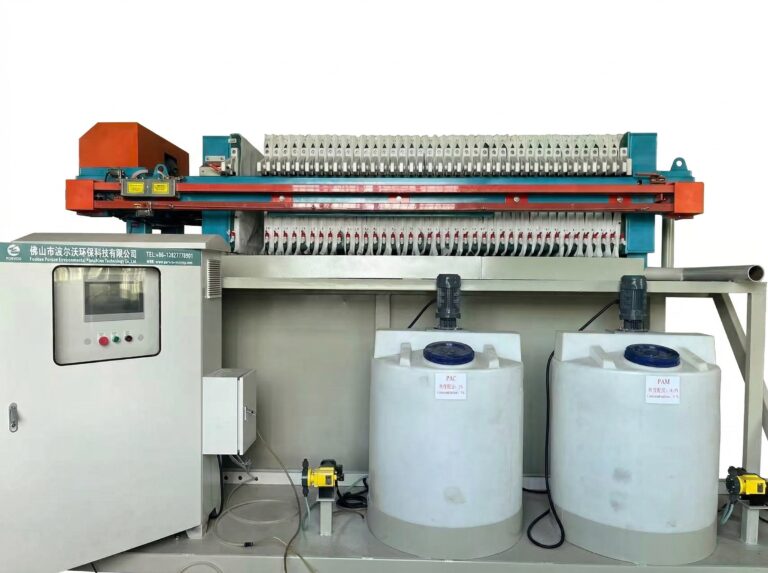
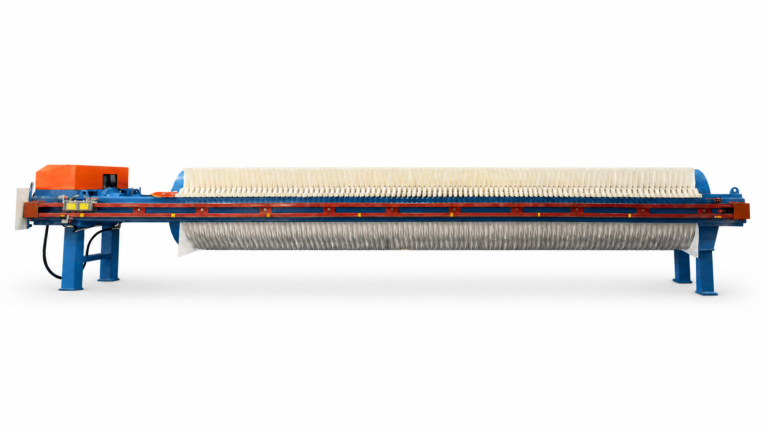
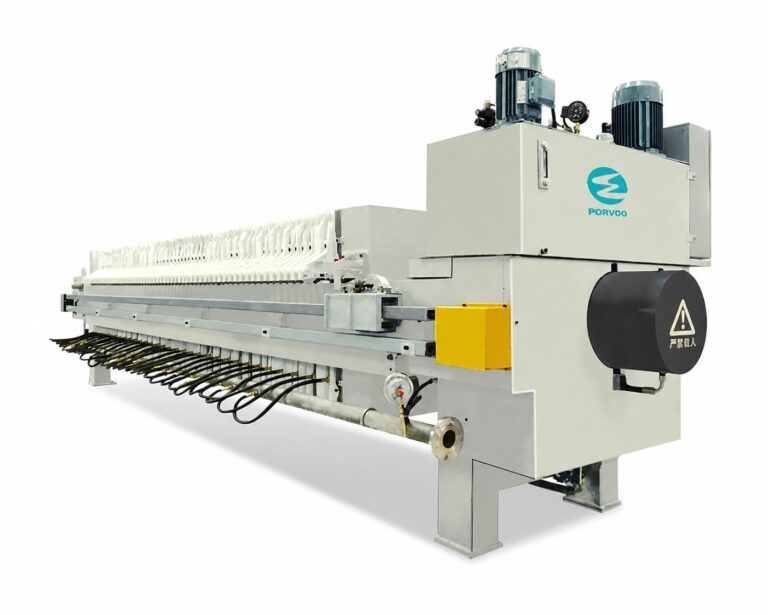
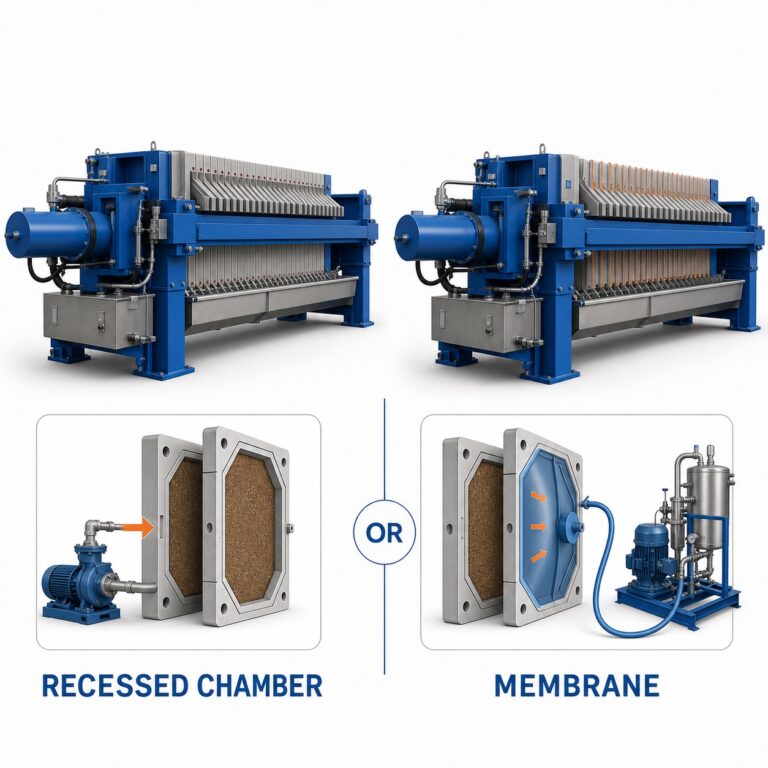
When a quotation calls out a “mixed pack” membrane filter press, the pack name alone does not tell the buyer which chambers carry membrane plates, which carry recessed plates, or where each sits in the sequence. That gap matters because plate position inside the pack changes how squeeze pressure, cake formation, and discharge behave across the cycle, and it changes what the buyer is actually comparing against a full-membrane proposal.
What a Mixed Pack Changes in the Plate Arrangement
A full-membrane pack uses membrane plates at every filtration position, so each chamber receives the same squeeze step once the cake has formed. A mixed pack replaces some of those positions with recessed chamber plates, which rely on feed pressure alone to build and consolidate the cake rather than on a secondary squeeze. The practical effect is that the pack no longer behaves uniformly from one chamber to the next. Where membrane plates are placed, the operator can expect a squeeze-assisted dewatering step; where recessed plates are placed, dewatering depends on feed pressure and cycle time alone.
This distinction matters because the arrangement, not the pack label, determines how the slurry’s filtration behavior translates into cake result and cycle length. A material that dewaters readily under feed pressure may not need membrane assistance in every position, and substituting recessed plates in some positions can reduce membrane-plate count without necessarily compromising the result the project needs. A material that resists consolidation under feed pressure alone may need membrane assistance at more positions, or in a particular sequence, to reach a workable cake in a comparable cycle.
The position of recessed plates relative to membrane plates also affects how pressure and flow distribute through the pack during the squeeze step, because adjacent chambers interact through the manifold and through the mechanical sequence of the press. Where recessed and membrane plates are interspersed instead of grouped, the squeeze step may behave differently than when membrane plates are clustered at one end of the pack. This is a configuration question specific to the material and the feed conditions, not a general rule about which arrangement performs better.
Because “mixed pack” by itself does not specify any of this, the term functions as a category description rather than a design. Two proposals both labeled “mixed pack” can place membrane and recessed plates in entirely different positions, carry different membrane-plate counts, and produce different cake and cycle outcomes even when quoted against the same nominal filtration area. The buyer’s task at this stage is to recognize that the pack arrangement is a design decision requiring its own definition, separate from whatever the proposal calls the pack.
Drawing Details to Define Each Plate Position
The way to resolve the ambiguity in a pack label is to require a drawing that marks the type of plate, membrane or chamber, at every position in the pack, in the sequence the plates will actually occupy between the fixed and moving platens. A drawing that states only a total plate count and a membrane-plate count leaves the sequence undefined, and sequence is what determines how squeeze pressure and feed pressure interact position by position through the cycle.
A marked drawing also fixes the basis for everything that follows in specification and ordering. Once each position is identified as membrane or chamber, the buyer can check that the sequence matches what the supplier’s performance claims assume, that the manifold connections are arranged to serve each plate type correctly, and that any future replacement or expansion plate will go into the correct position type. Without this drawing, two people reviewing the same proposal can reach different understandings of what is being ordered, because the plate arrangement is implicit rather than stated.
This requirement is equally relevant whether the proposal is a mixed pack or a full-membrane pack, but it carries more weight for a mixed pack because a full-membrane pack has only one position type to confirm, while a mixed pack has two types whose relative placement is a variable the supplier has chosen. Asking the supplier to mark every membrane and chamber plate position on the drawing converts an assumption into a checkable specification item before the order is placed, and it gives the buyer a document to hold the delivered equipment against at receipt and at any later plate replacement.
Comparison Inputs for Mixed and Full-Membrane Proposals
| Données de comparaison | Common basis to state | Decision protected |
|---|---|---|
| Zone de filtration | Compare both proposals at the same stated filtration area. | Keeps a plate-count tradeoff from being confused with a change in filtration area. |
| Base alimentaire | Use the same documented feed basis for both proposals. | Separates the layout choice from different feed assumptions. |
| Pression moyenne | State and use the same squeeze medium. | Keeps the layout comparison on a compatible utility basis. |
| Cycle endpoint | Apply the same defined cycle endpoint. | Makes cycle behavior comparable to the same stopping basis. |
| Discharge requirement | Apply the same cake-discharge requirement. | Keeps the downstream handling task consistent across proposals. |
Once the arrangement is defined, the next task is making sure two proposals are actually comparable rather than superficially similar. A mixed-pack proposal and a full-membrane proposal can both be returned against the same inquiry, but if they are not evaluated on the same basis, differences that come from the input assumptions will look like differences in pack performance.
Filtration area is the most direct example: a lower membrane-plate count in a mixed pack can shift the total filtration area unless the proposal is checked against the same stated area as the full-membrane alternative, and a plate-count difference that also changes filtration area is no longer a controlled comparison of pack type alone. Feed basis works the same way, since a proposal calculated against a different solids concentration, particle character, or flow rate will produce a different cycle result regardless of plate arrangement, and that difference should not be attributed to the mixed-versus-full-membrane choice.
Squeeze medium, cycle endpoint, and discharge requirement complete the set of inputs that need to be held constant. The squeeze medium used in the membrane step affects achievable squeeze pressure and therefore cake outcome, so comparing a proposal using one medium against a proposal using another conflates a utility decision with a pack-design decision. Cycle endpoint matters because a cycle stopped at a different point, whether by time, pressure, or filtrate flow, will show a different cake and filtrate result even from an identical pack, so the comparison needs a single defined endpoint applied to both. Discharge requirement affects how the cake needs to release and fall from the pack, which depends partly on plate type and partly on mechanical features unrelated to the membrane-versus-recessed question, so it needs to be stated identically for both proposals rather than left to each supplier’s default assumption.
Where these five inputs are not already normalized across the proposals under review, the comparison is not yet a comparison of mixed versus full-membrane pack design; it is a comparison of two different projects that happen to share an inquiry.
Utilities, Controls, and Spares Across Both Layouts
| Élément du périmètre | What the proposal should make visible | Buyer decision supported |
|---|---|---|
| Compatible utilities | Identify the utility basis required by the proposed pack and squeeze medium. | Check the layout against the project’s available utilities. |
| Manifold routing | Show the manifold routing included with the proposed arrangement. | Compare whether the required routing is inside the commercial scope. |
| Control logic | State the control logic included for the proposed arrangement. | Compare operational scope without assuming both layouts use the same logic. |
| Spare-plate strategy | Describe the spare-plate strategy included in the commercial scope. | Judge whether the delivered arrangement has a workable replacement basis. |
| Plate interchangeability | State which proposed plates are interchangeable. | Align the spare strategy with the actual plate arrangement. |
Beyond the plates themselves, a mixed pack and a full-membrane pack can carry different requirements in the surrounding commercial scope, and these differences affect the buyer’s installation and operating responsibilities as much as the plate arrangement does.
The squeeze medium used for the membrane plates requires a compatible utility supply, and the utility basis needed by a given pack and medium combination should be stated in the proposal so it can be checked against what is actually available at the project site. A full-membrane pack with membrane plates at every position may place a different utility demand profile on the site than a mixed pack where membrane positions are fewer, and this is a site-coordination question independent of filtration performance.
Manifold routing is similarly arrangement-dependent, because recessed and membrane plates connect into the feed, filtrate, and squeeze-medium manifolds differently, and the routing suited to one arrangement is not automatically suited to another. The proposal should show what routing is included so the buyer can confirm it matches the defined plate sequence rather than assuming a generic routing applies.
Control logic is another item that can differ by arrangement, since a pack with mixed plate types may require the control system to sequence the squeeze step differently than a pack where every position squeezes simultaneously. Stating the control logic included with each proposal keeps this operational difference visible rather than assumed to be identical between a mixed and a full-membrane offer.
Spare-plate strategy and plate interchangeability tie back directly to the drawing requirement, because a spare strategy only works if the buyer knows which positions take membrane plates and which take chamber plates, and whether plates proposed as interchangeable actually fit the same position types across the pack. Treating these items as part of the commercial scope, rather than as a question to resolve after delivery, lets the buyer judge at proposal stage whether the arrangement being offered has a workable long-term replacement basis. A mixed pack with plate types that are not interchangeable across positions carries a different ongoing spares requirement than a full-membrane pack where every position is the same plate type, and that difference belongs in the comparison alongside filtration area and cycle endpoint. Where a buyer is reviewing a Filtre-presse à membrane ou un Filtre-presse à chambre encastrée proposal through Porvoo’s quotation process, the project’s documented feed, utility, and discharge information is what allows this scope to be matched to the stated conditions rather than assumed.
Representative Tests for Cake, Filtrate, and Cycle Behavior
| Trial focus | Question to answer on the common test basis | Specification consequence |
|---|---|---|
| Cake outcome | Does each layout close the buyer’s cake task? | Retain only an arrangement that meets the project-specific cake requirement. |
| Filtrate outcome | Does each layout close the buyer’s filtrate task? | Keep the filtrate result visible in selection rather than infer it from the cake result. |
| Débit | Does the representative cycle close the buyer’s throughput task? | Compare throughput before accepting a lower membrane-plate count as a useful tradeoff. |
| Discharge and handling | Does the cake discharge close the buyer’s handling task? | Confirm the selected arrangement works with the required discharge approach. |
| Cycle behavior | How does each proposal behave through the same cycle endpoint? | Compare the layouts at a common endpoint rather than at supplier-specific endpoints. |
A normalized comparison of proposals establishes that two offers are being judged on the same basis; it does not establish that either offer actually closes the buyer’s process requirement. That confirmation comes from a representative test run on the material the project will actually feed, under the same basis used to compare the proposals.
The cake outcome from the test is one thing to check, and the question is simple: does the cake produced by this arrangement meet what the downstream handling or disposal step requires, under the agreed cycle endpoint and squeeze medium. A mixed pack that reaches an acceptable cake only by running a longer cycle than the full-membrane alternative is not demonstrating equivalence; it is trading cycle time for membrane-plate count, and that tradeoff needs to be visible rather than hidden inside a passed or failed test result.
The filtrate outcome is a separate question from the cake outcome, because an acceptable cake does not confirm an acceptable filtrate, and a filtrate result is not something to infer from the fact that the cake test passed. The filtrate should be checked directly against whatever quality or clarity requirement the downstream filtrate handling imposes.
Throughput is the test dimension most directly tied to the mixed-versus-full-membrane question, because a lower membrane-plate count is only a meaningful cost or configuration advantage if the resulting cycle still delivers the throughput the project needs. The Fiche d'information de l'EPA sur le filtre-presse à plaques encastrées frames pressure filtration in general around this kind of operating and cycle comparison, treating cycle-related dimensions as part of the basis for evaluating the equipment rather than as a fixed outcome. If a mixed pack requires a longer cycle to reach the same cake result as a full-membrane pack, the fewer membrane plates do not represent a saving once the cycle’s effect on throughput is accounted for; they represent a different tradeoff that the buyer needs to evaluate against the project’s throughput requirement.
Discharge and handling behavior rounds out the representative test, confirming that the cake actually releases and is handled the way the project’s downstream equipment and process expect, since plate arrangement and plate surface can affect release independent of cake moisture result. Running all of these checks at the same cycle endpoint across the proposals under comparison is what turns a supplier’s reported result into something the buyer can weigh against an alternative arrangement, rather than two independent and non-comparable claims about performance.
Specification Boundary Before the Pack Is Ordered
| Basis | What it can establish | Boundary before order |
|---|---|---|
| Marked pack drawing | The proposed position of each membrane and chamber plate. | The label “mixed pack” alone does not define the delivered arrangement. |
| Common proposal basis | That both layouts are compared using the same filtration area, feed basis, squeeze medium, cycle endpoint, and discharge requirement. | A normalized comparison does not by itself establish the buyer’s cake, filtrate, throughput, or handling result. |
| Representative test | Whether the tested arrangement closes the buyer’s cake, filtrate, throughput, and handling tasks on the stated basis. | General pressure-filtration guidance does not provide transferable performance values for the project. |
| JB/T 4333.4-2013 metadata | The document’s identity, membrane-filter-plate subject, edition, status, dates, and replacement history. | Metadata does not establish technical clauses, conformity criteria, mandatory applicability, certification, or product conformity. |
At the point of ordering, it is worth being precise about what each piece of evidence gathered so far actually establishes, because conflating them leads to specifying a pack on a weaker basis than the buyer assumes.
A marked pack drawing establishes the proposed position of each membrane and chamber plate in the sequence; it does not by itself establish that this sequence will produce an acceptable cake, filtrate, or cycle result for the project’s material. A normalized comparison across proposals establishes that the mixed and full-membrane options are being judged against the same filtration area, feed basis, squeeze medium, cycle endpoint, and discharge requirement; it does not establish which option actually performs better, because normalization removes confounding variables without producing a result.
A representative test, run on the project’s own material under the agreed common basis, is what establishes whether a given arrangement closes the cake, filtrate, throughput, and handling tasks the buyer has defined. This is the evidence that carries weight for the ordering decision, and it is specific to the material and conditions tested; it does not transfer to a different feed or a different site without re-confirmation.
Separately, where a mixed-pack or membrane-plate proposal references the JB/T 4333.4-2013 standard for membrane filter plates, that reference establishes the document’s identity, its subject matter, its edition and status, and its replacement history, as recorded on the SAMR national standards platform. It does not, on its own, establish that the proposed plates meet particular technical clauses, conformity criteria, or certification, and it should not be read as confirming product conformity beyond the metadata it actually documents. A buyer citing this standard in a specification should keep the distinction between acknowledging the standard’s existence and verifying conformity to its content, since the two are not the same evidence. Where a project has already worked through sizing questions such as those addressed when locking data before an RFQ, or has planned the acceptance testing that will check cake moisture, filtrate quality, and cycle time once the press is delivered, the pack arrangement and the evidence behind it should already be fixed before that acceptance stage begins, not left open to be resolved during commissioning.
Questions fréquemment posées
Q : When is a lower membrane-plate count a meaningful reason to choose a mixed pack?
A : Only when a representative trial shows that the proposed arrangement closes the project’s cake, filtrate, throughput, and handling tasks on the same stated test basis. Treat the lower plate count as an open trade-off until all four outcomes are checked separately.
Q : What should a buyer do if two suppliers use the term “mixed pack” for different arrangements?
A : Require each supplier to mark every membrane and chamber plate position on its pack drawing before comparing the proposals. Use those drawings as the arrangement definition, because the label alone does not identify what will be delivered.
Q : Can proposals be compared if they use different squeeze media or cycle endpoints?
A : They are not yet on a common comparison basis. Ask for both proposals to use the same documented feed basis, filtration area, squeeze medium, cycle endpoint, and discharge requirement, or keep each changed assumption visible so its effect is not mistaken for a plate-layout difference.
Q : What should the spare-plate plan confirm before the pack is ordered?
A : Match the spare strategy to the marked plate positions and state which proposed plates are interchangeable. Keep the associated manifold routing, compatible utilities, and control logic in the commercial scope so the replacement basis reflects the arrangement being purchased.
Q : Does citing JB/T 4333.4-2013 establish that a proposed membrane plate complies with the standard?
A : No. The available standard metadata identifies the document, its membrane-filter-plate subject, edition, status, dates, and replacement history; technical clauses, applicability, conformity criteria, certification, and product conformity still need separate verification for the project.