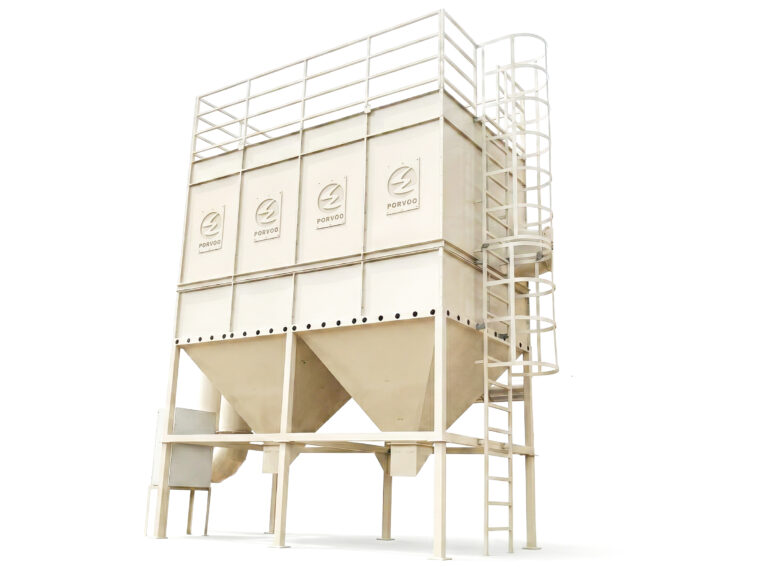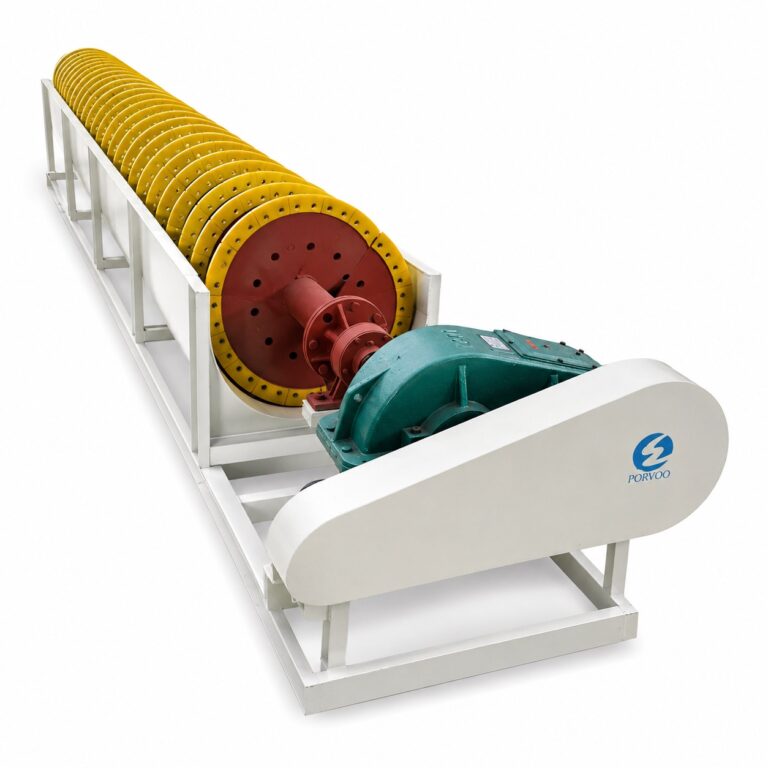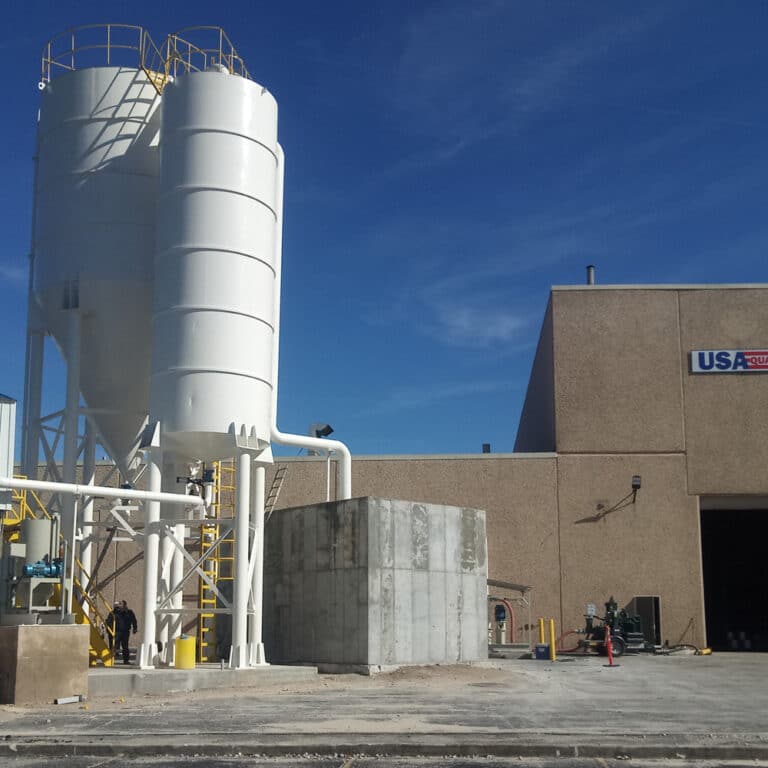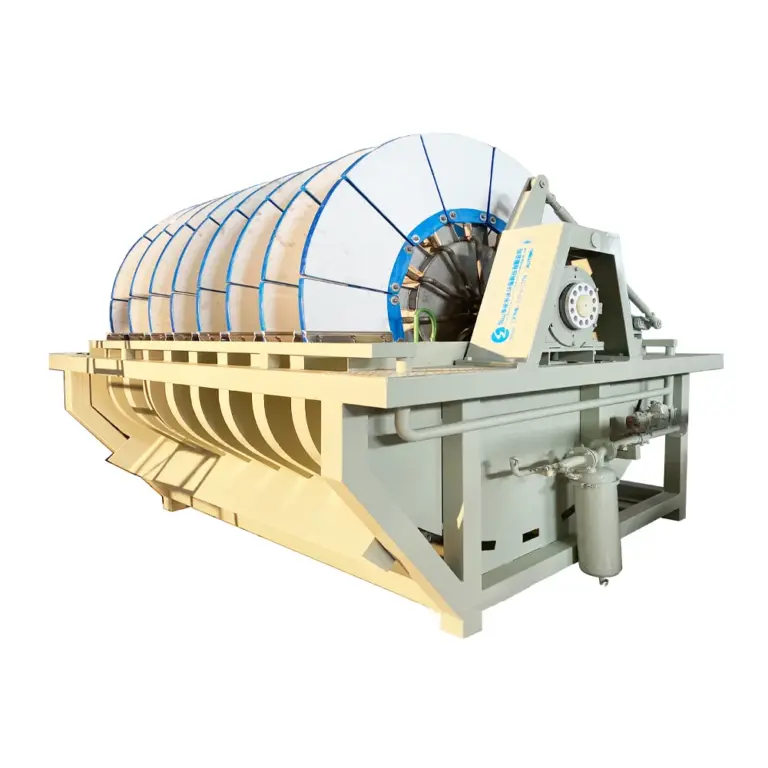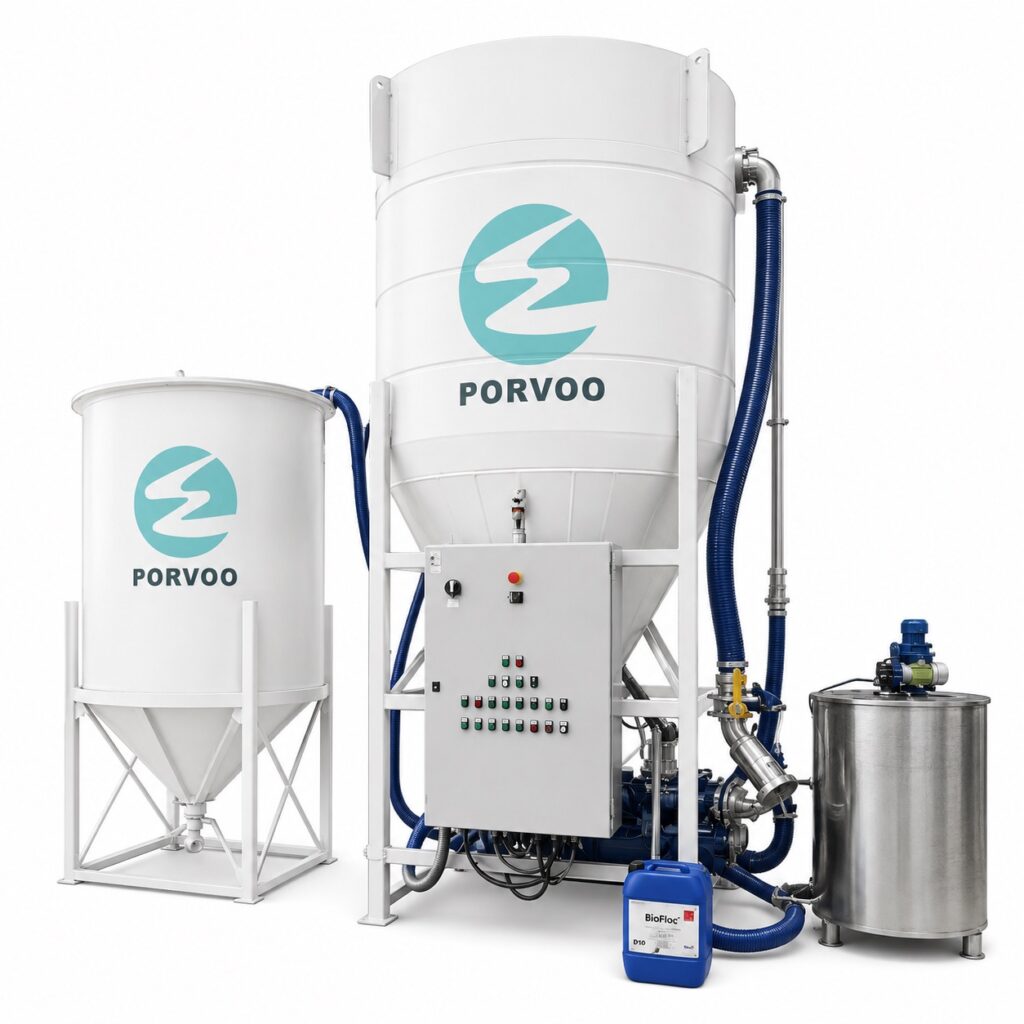
Complete Above-Ground Clarification for Industrial Process-Water Reuse
Recycle water from cutting, grinding, edge finishing, and polishing without constructing an underground wastewater pit or a site-built settling basin.
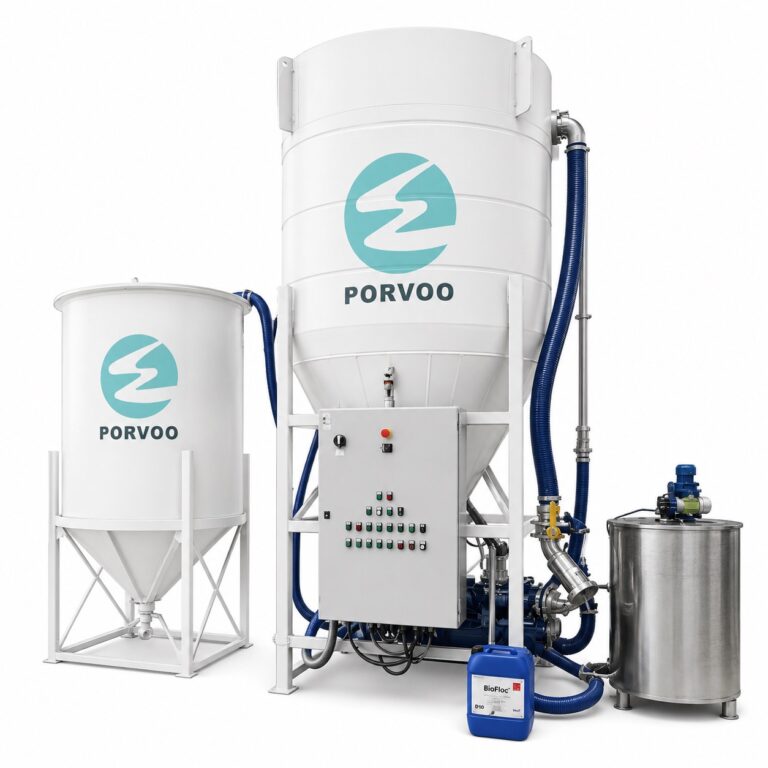
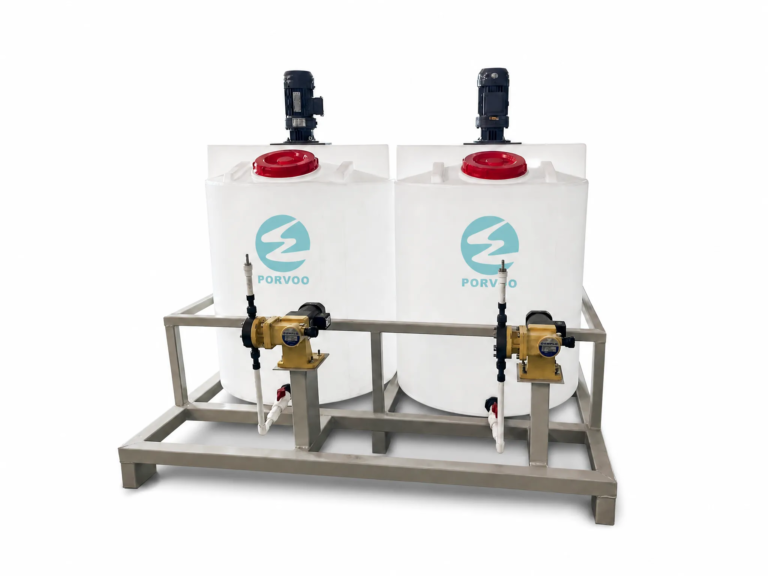
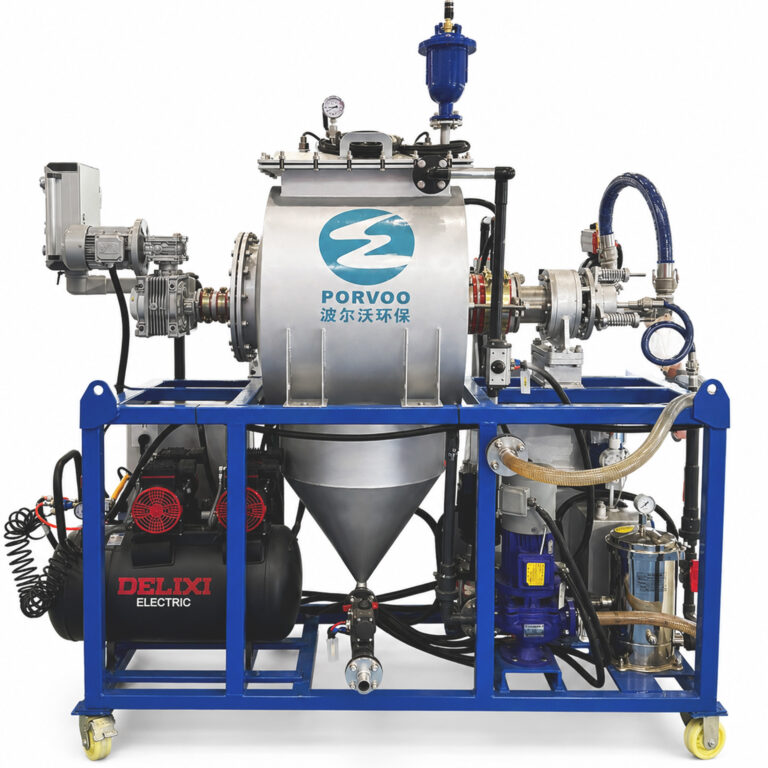
The PORVOO PWR Series integrates wastewater equalization, flow-linked PAC/PAM dosing, mixing, flocculation, vertical-flow clarification, treated-water storage, sludge holding, and sludge transfer in one modular system.
Each unit provides a continuous rated flow of 3–30 m³/h. Multiple units can be engineered in parallel for projects requiring approximately 100–200 m³/h.
- 3–30 m³/h continuous rated flow per unit
- Integrated wastewater and treated-water tanks
- Automatic PAC/PAM dosing linked to flow
- PLC-controlled operation and sludge withdrawal
- Two or three container-shippable modules
- No field welding normally required
- Typical manufacturing lead time of 2–4 weeks
Recycle Process Water Without Building a Conventional Settling Plant
Ceramic and stone production can generate large volumes of wastewater containing fine mineral particles from cutting, sizing, grinding, and polishing.
These particles may remain suspended for long periods. Returning inadequately clarified water to production can affect spray nozzles, pumps, pipes, cutting tools, and surface-finishing processes.
The PWR Series is designed for factories that need a complete but compact water-recycling system without constructing a large sedimentation tower, underground collection pit, or site-built treatment basin.
Unlike a basic settling silo supplied as an individual component, the PWR system includes the principal tanks, dosing equipment, clarification stage, controls, and sludge-transfer equipment required to form a complete treatment loop.
What Is Included in a Complete PWR System?
| Included in the PORVOO supply | Required at the customer’s site |
|---|---|
| Above-ground wastewater equalization tank | Existing level concrete floor |
| PAC preparation and dosing unit | Floor-load and anchoring verification |
| PAM preparation and dosing unit | Main electrical supply |
| Chemical metering pumps | Production wastewater connection |
| Flow meter and level instruments | Treated-water return connection |
| Rapid-mixing chamber | PAC and PAM consumables |
| Flocculation chamber | Safe drainage around the installation area |
| Vertical-flow clarifier | Final onsite connection and commissioning |
| Treated-water tank | Downstream dewatering equipment when required |
| Sistema de recogida de lodos | |
| Sludge holding tank | |
| Sludge transfer pump | |
| PLC control cabinet | |
| Automatic controls and fault alarms | |
| Interconnecting pipework within the supplied modules |
Final tank volumes, pipe interfaces, electrical configuration, and module layout are confirmed in the approved technical proposal.
Field welding is normally unnecessary. Onsite work is generally limited to positioning the modules, bolting them together, connecting the required pipes and electrical supply, and commissioning the treatment process.
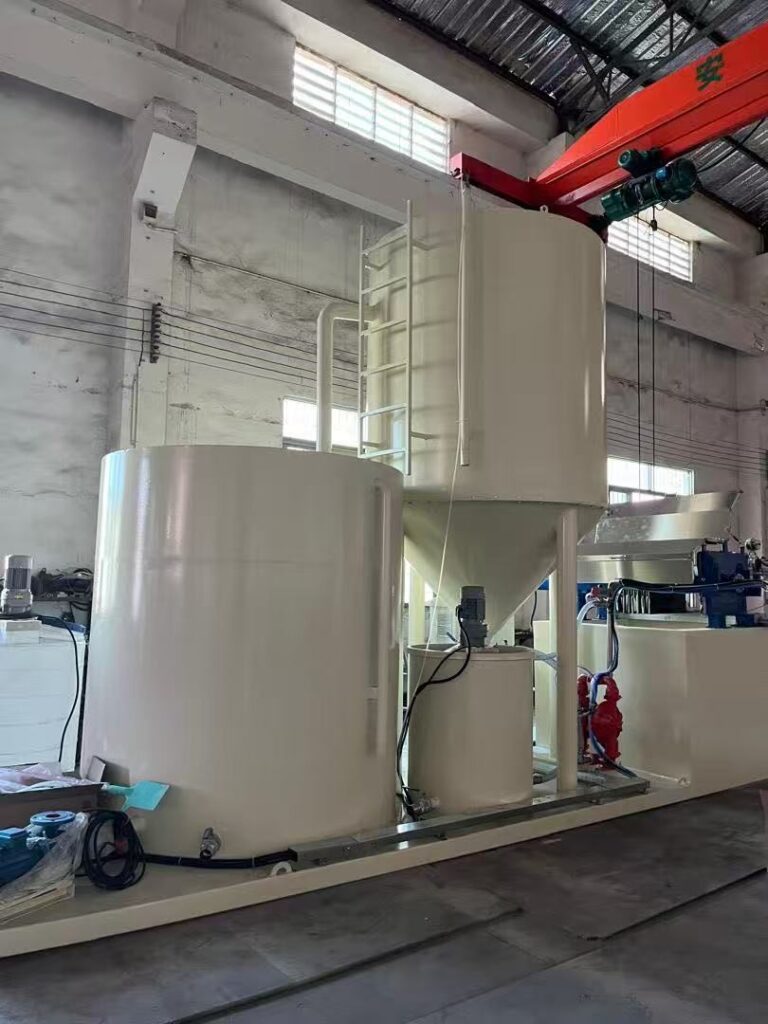
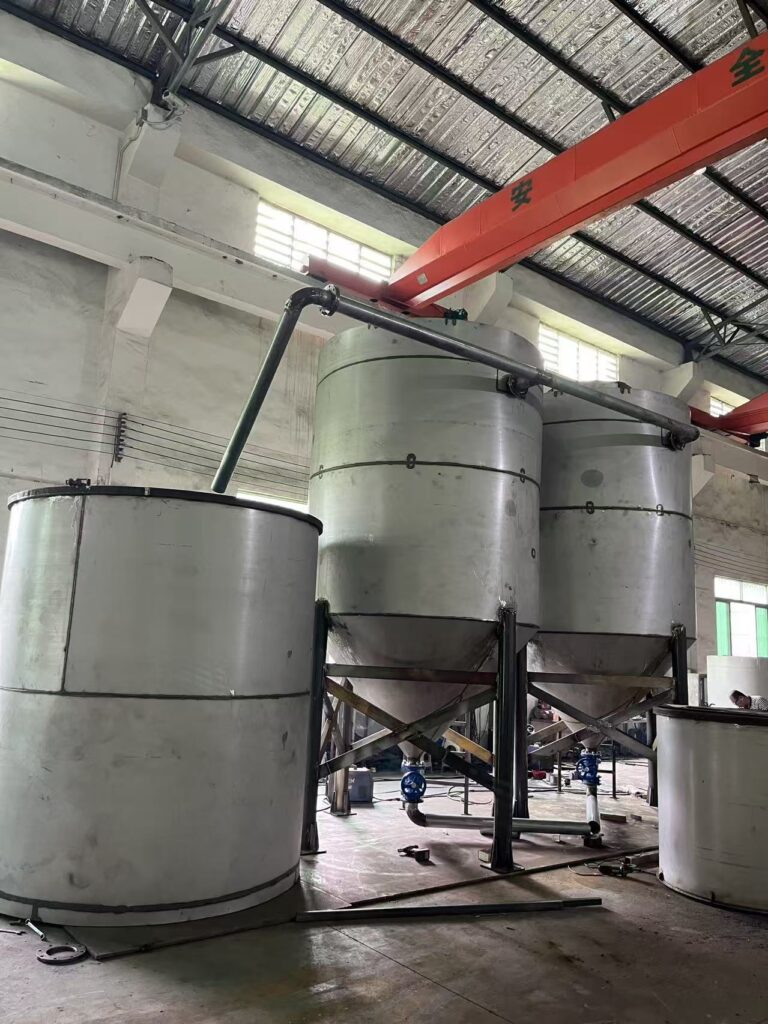
How the PWR Water Recycling Process Works
[PROCESS FLOW DIAGRAM: Process wastewater → equalization → PAC dosing → PAM flocculation → vertical-flow clarification → treated-water reuse and sludge transfer]
1. Wastewater Equalization
Wastewater from cutting, grinding, polishing, or washing enters the above-ground equalization tank.
The tank temporarily stores incoming wastewater and helps stabilize variations in flow and solids concentration before chemical treatment.
Because this tank is included in the system, a typical installation does not require an excavated wastewater pit.
2. Flow Measurement and PAC Dosing
A flow meter sends the current wastewater flow to the PLC.
The control system operates the PAC dosing pump according to the configured treatment recipe. PAC destabilizes fine suspended and colloidal particles so that they can be separated more effectively.
3. PAM Dosing and Flocculation
PAM is introduced during the flocculation stage.
Controlled mixing brings destabilized particles together into larger, heavier flocs while limiting excessive agitation that could break the formed flocs.
Chemical type, preparation concentration, and dosing rate are selected according to the customer’s wastewater characteristics.
4. Vertical-Flow Clarification
Conditioned wastewater enters the vertical-flow clarifier.
As the water moves through the clarification zone, the heavier flocs settle toward the sludge collection area while clarified water continues to the treated-water outlet.
5. Treated-Water Storage
Clarified water enters the integrated treated-water tank.
From there, it can be returned to compatible non-potable production processes such as cutting, grinding, polishing, equipment washing, or material handling.
6. Automatic Sludge Withdrawal
Settled sludge is discharged from the clarification section according to the configured operating sequence.
The PLC coordinates sludge withdrawal to help prevent excessive sludge accumulation inside the clarifier.
7. Sludge Storage and Transfer
Settled sludge enters the sludge holding tank.
A sludge transfer pump sends it to separately selected dewatering equipment or another customer-designated sludge-handling point.
[VIDEO: Close-up of floc formation, clarified-water overflow, and automatic sludge withdrawal]
Designed for Ceramic and Stone Process Wastewater
The PWR Series is primarily intended for wastewater generated by:
- Ceramic tile cutting and sizing
- Tile edge grinding
- Ceramic polishing lines
- Stone cutting and fabrication
- Stone edge finishing and polishing
- Workshop washdown
- Mineral-particle slurry handling
- Glaze and pigment processes dominated by suspended or colloidal particles
- Other industrial processes producing high concentrations of settleable mineral solids
The system is especially suitable for small and medium production facilities that want to reuse process water but do not want to build a conventional wastewater treatment plant.
[IMAGE GALLERY: Ceramic cutting application, stone workshop application, polishing-line wastewater, and treated water returning to production]
What the Clarification Process Can Remove
The PAC/PAM clarification process is designed to separate:
- Suspended mineral particles
- Fine cutting and grinding residue
- Colloidal glaze and pigment particles
- Settleable inorganic solids
- Particle-associated COD
- Metals attached to suspended particles
Where measured COD is mainly associated with suspended glaze, pigment, or mineral particles, clarification may reduce part of the COD load by removing those particles.
The PWR Series is not presented as a universal standalone process for dissolved organic COD or dissolved heavy metals. Wastewater containing substantial dissolved contaminants may require additional chemical, physical, or biological treatment.
PORVOO reviews the wastewater composition and required reuse point before confirming system suitability.
Reference Capacity Selection
| Reference model | Continuous rated flow |
|---|---|
| PWR-3 | 3 m³/h |
| PWR-5 | 5 m³/h |
| PWR-10 | 10 m³/h |
| PWR-15 | 15 m³/h |
| PWR-20 | 20 m³/h |
| PWR-30 | 30 m³/h |
These models provide reference capacities for preliminary selection. Each system is customized according to:
- Average and peak wastewater flow
- Daily operating hours
- Production schedule
- Suspended-solids concentration
- Particle size and settling behavior
- Required equalization volume
- Intended treated-water reuse point
- Producción de lodos
- Área de instalación disponible
- Local electrical supply
- Downstream dewatering requirements
For larger projects, multiple PWR units can be operated in parallel. Projects requiring approximately 100–200 m³/h are configured according to hydraulic distribution, redundancy requirements, available space, and the customer’s operating schedule.
[IMAGE OR DRAWING: PWR-3 to PWR-30 reference model lineup]
[DOWNLOAD BUTTON: Download PWR Series Technical Datasheet]
Carbon-Steel Construction with Anticorrosion Protection
The main PWR tanks and structural components are manufactured from carbon steel with an anticorrosion treatment suitable for the confirmed wastewater and installation environment.
The final material specification and protective coating system are selected according to:
- Wastewater pH
- Exposición química
- Indoor or outdoor installation
- Humedad ambiente
- Operating temperature
- Required service conditions
Material construction and coating details are stated in the approved technical proposal.
[IMAGE: Tank fabrication, surface preparation, and anticorrosion coating details]
PLC-Controlled Operation
The PWR control system coordinates the main treatment stages and reduces repetitive manual operation.
Control functions include:
- Wastewater flow measurement
- Tank level monitoring
- Automatic system start and stop
- PAC dosing linked to flow
- PAM dosing linked to flow
- Mixer operation
- Treated-water transfer
- Sludge withdrawal
- Sludge transfer
- Equipment interlocks
- Fault detection and alarms
Operators remain responsible for checking chemical levels, observing floc formation, monitoring treated-water quality, and adjusting the treatment recipe when wastewater conditions change.
PORVOO configures the initial control sequence according to the approved process conditions.
[IMAGE: PLC control cabinet, flow meter, level instruments, dosing pumps, and alarm indicators]
[VIDEO: Operator starting the PWR system and demonstrating normal automatic operation]
Modular Delivery and Minimal Onsite Assembly
Depending on the selected capacity and shipping restrictions, a PWR system is divided into two or three factory-assembled modules.
The modules are designed for container shipment and efficient onsite assembly.
Typical onsite work includes:
- Unloading and positioning the modules
- Checking floor level and load capacity
- Installing any required anchors
- Bolting the modules together
- Connecting the inter-module pipework
- Connecting the wastewater inlet
- Connecting the treated-water return
- Connecting the sludge outlet
- Connecting the electrical supply
- Filling the chemical preparation tanks
- Commissioning the system and adjusting the dosing recipe
No field welding is normally required.
The system can usually be installed on an existing level concrete industrial floor, provided that floor loading, levelness, anchoring, access, and drainage have been checked.
[IMAGE: PWR modules separated for container loading]
[IMAGE: Container loading or export packing]
[VIDEO: Modules being positioned, bolted together, and connected onsite]
Lower Civil-Construction Requirements
A typical PWR installation does not require:
- An excavated wastewater collection pit
- A site-built concrete settling basin
- A large fixed sedimentation tower
- Customer-supplied equalization tanks
- Customer-supplied treated-water tanks
- Onsite tank fabrication
- Field welding of the main equipment modules
An existing concrete floor is still required. Its bearing capacity, levelness, anchoring requirements, and drainage must be verified before equipment installation.
This above-ground arrangement also makes future inspection, modification, and relocation easier than a treatment layout built around permanent underground tanks.
[TECHNICAL DRAWING: Typical PWR installation footprint and customer connection points]
Treated Water Returned to Production
Clarified water can be reused in compatible non-potable production processes, helping the factory reduce its dependence on incoming process water.
Possible reuse points include:
- Ceramic cutting
- Stone cutting
- Edge grinding
- Pulido
- Equipment washing
- Floor and workshop cleaning
- Other production stages that can accept clarified process water
Final reuse suitability depends on the remaining suspended solids, chemical conditions, production-equipment requirements, and any additional polishing treatment specified for the project.
PORVOO does not assign a universal reuse-water quality to every PWR installation. Treatment targets are confirmed from the actual wastewater and intended reuse point.
[VIDEO: Clarified water being returned to operating cutting, grinding, or polishing machinery]
[IMAGE: Incoming wastewater and clarified water shown side by side]
Sludge Handling and Optional Dewatering
The standard PWR system includes:
- Settled-sludge collection
- Automatic sludge withdrawal
- Sludge holding tank
- Sludge transfer pump
Final sludge dewatering is not included in the base PWR supply.
Where filter-cake production is required, PORVOO can separately evaluate suitable sludge-dewatering equipment according to:
- Sludge volume
- Solids concentration
- Características de las partículas
- Daily operating schedule
- Required cake condition
- Available labor
- Disposal or material-recovery method
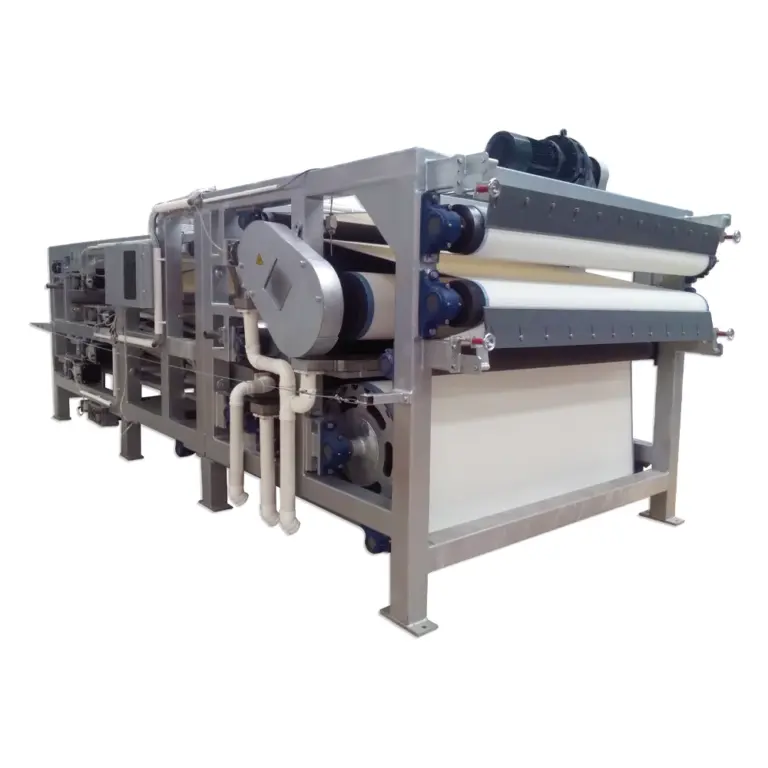
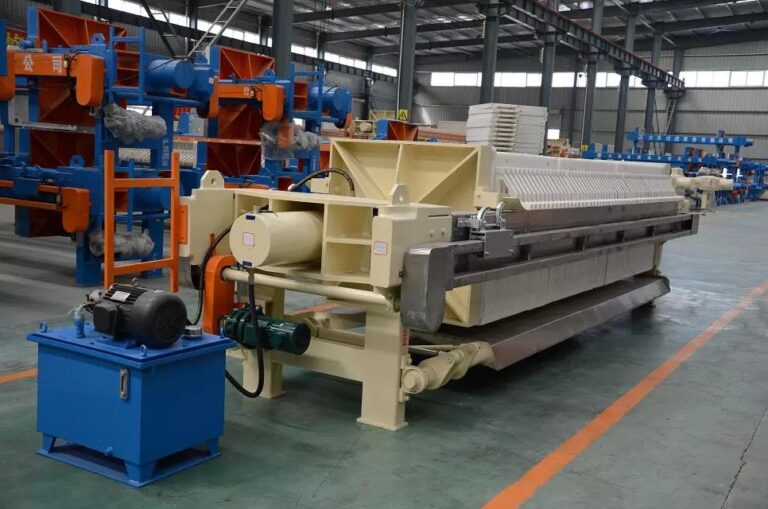
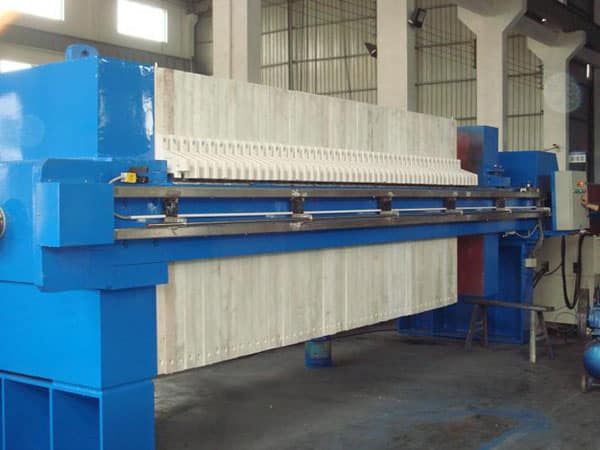
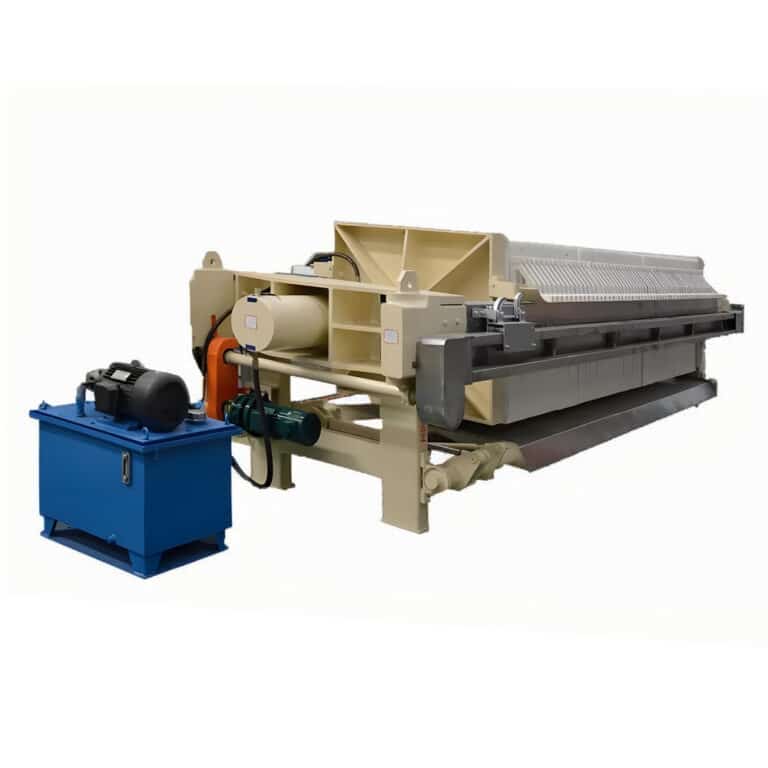
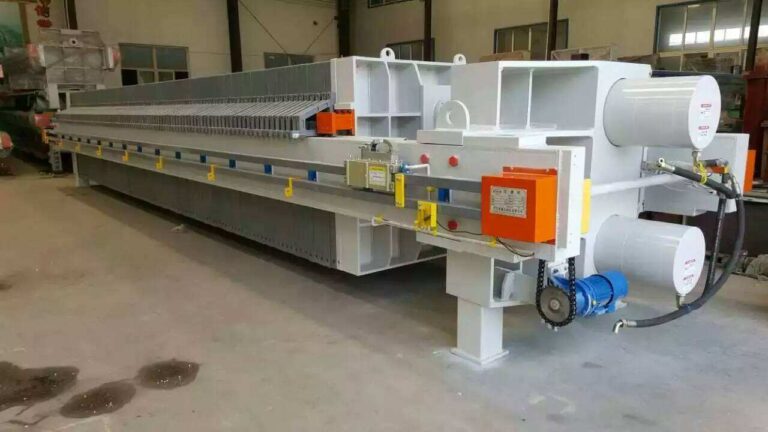
Depending on the application, the separately selected equipment may include a plate-and-frame, recessed-chamber, membrane, fully automatic, or other suitable dewatering system.
[IMAGE: PWR sludge outlet connected to separately supplied PORVOO dewatering equipment]
[VIDEO: Sludge transfer from the holding tank to downstream dewatering equipment]
[INTERNAL LINK BUTTON: View PORVOO Filtration and Sludge-Dewatering Equipment]
Designed for Current Needs and Future Expansion
A PWR system can be configured for a single production line or as part of a larger modular water-recycling installation.
Parallel units can provide:
- Additional treatment capacity
- Phased factory expansion
- Separate treatment for different wastewater streams
- Operational flexibility during maintenance
- Easier capacity adjustment as production changes
Future expansion should be considered during the initial layout stage so that sufficient space, hydraulic distribution, pipe connections, and control provisions can be reserved.
[DIAGRAM: Example of multiple PWR units operating in parallel]
Typical Manufacturing Lead Time
The typical manufacturing lead time is 2–4 weeks after:
- Wastewater conditions have been reviewed
- The technical configuration has been confirmed
- The equipment layout has been approved
- Commercial terms have been agreed
- The deposit has been received
Shipping, customs clearance, onsite positioning, connection, and commissioning time are separate from the manufacturing period.
The confirmed delivery schedule is stated in the project quotation.
Wastewater Sample Testing and Custom Configuration
Wastewater that appears similar can behave very differently during chemical treatment.
Particle size, surface charge, pH, glaze additives, pigments, production chemicals, and solids concentration can all affect floc formation and settling.
PORVOO can evaluate a customer-provided wastewater sample to:
- Observe natural settling behavior
- Screen PAC and PAM combinations
- Establish an initial dosing range
- Assess floc strength
- Review clarified-water appearance
- Estimate sludge formation
- Determine whether additional treatment is required
- Support system sizing and process configuration
Sample testing does not replace final onsite commissioning, because full-scale flow conditions may differ from laboratory conditions. It provides a stronger basis for equipment and chemical selection.
[VIDEO: Jar testing or wastewater sample testing performed by PORVOO]
[IMAGE: Wastewater samples before dosing, during flocculation, and after settling]
Information Required for System Selection
To prepare a preliminary PWR configuration, send PORVOO:
- Required flow in m³/h
- Average and peak wastewater flow
- Operating hours per day
- Production schedule
- Wastewater source
- Available TSS or turbidity data
- pH
- Available COD data
- Known metals or production chemicals
- Photos or videos of the wastewater
- Intended treated-water reuse point
- Available installation dimensions
- Local power supply
- Preferred sludge-handling method
- Required project delivery location
A wastewater sample is recommended when the process contains glaze, pigments, unusual production chemicals, highly variable solids, or special reuse-water requirements.
[CTA BUTTON: Submit Your Process Conditions]
[CTA BUTTON: Ask About Wastewater Sample Testing]
Preguntas frecuentes
What is the treatment capacity of the PWR Series?
Reference models provide continuous rated flows of 3, 5, 10, 15, 20, or 30 m³/h per unit.
Larger projects can use multiple units in parallel. Final capacity is confirmed according to wastewater flow, solids loading, operating hours, and the required reuse point.
Is this a batch or continuous system?
The PWR Series is rated for continuous flow. The integrated equalization tank and automatic start/stop controls also support factories with intermittent production schedules.
Does the system require an underground wastewater pit?
A typical PWR installation does not require an underground wastewater pit because an above-ground equalization tank is included.
The final inlet arrangement depends on the factory’s existing wastewater collection and pipe elevations.
Does it require a special foundation?
The equipment can normally be installed on an existing level concrete industrial floor.
The floor’s load capacity, levelness, drainage, access, and anchoring requirements must be reviewed before installation.
Are the wastewater and treated-water tanks included?
Yes. The typical PWR supply includes an above-ground wastewater equalization tank, treated-water tank, and sludge holding tank.
Final tank volumes are customized for the project.
Does the system include chemical dosing?
Yes. PAC and PAM preparation and dosing equipment are included.
Dosing operation is linked to measured wastewater flow through the PLC control system.
Does it include a polishing filter?
No polishing filter is included in the base clarification process.
If the intended reuse point requires lower residual suspended solids, PORVOO can evaluate a separate polishing stage.
Is a filter press included?
No. The PWR system includes sludge collection, a sludge holding tank, and a sludge transfer pump.
A suitable filter press or other sludge-dewatering machine can be selected and supplied separately.
Can it treat high-COD wastewater?
It can reduce COD associated with suspended and colloidal particles, including certain glaze and pigment solids.
It is not a universal treatment for dissolved organic COD. Additional treatment may be required when the wastewater contains a substantial dissolved organic load.
Can it remove heavy metals?
The clarification process can help remove metals attached to suspended particles.
It should not be used as a universal standalone treatment for dissolved heavy metals. Wastewater containing metals must be evaluated according to the specific metal, concentration, pH, dissolved fraction, and required treated-water quality.
Can the treated water be reused directly?
It can be returned to compatible non-potable industrial processes when the clarified-water quality meets the requirements of that reuse point.
PORVOO confirms the treatment target after reviewing the wastewater and production process.
How is the equipment shipped?
The system is normally divided into two or three container-shippable modules, depending on capacity and transport restrictions.
Is onsite welding required?
Field welding is normally unnecessary. The modules are positioned, bolted together, connected to the required pipes and power supply, and then commissioned.
How long does manufacturing take?
The typical manufacturing lead time is 2–4 weeks after technical confirmation and receipt of the deposit.
Can PORVOO test our wastewater?
Yes. Customers can provide a wastewater sample for treatment evaluation and equipment configuration.
See the PWR System Operating in a Real Factory
The most useful proof of a water-recycling system is not an isolated equipment photograph. It is the complete treatment loop operating under actual factory conditions.
The following project media shows the PWR system receiving production wastewater, dosing PAC and PAM, separating solids, returning clarified water, and transferring settled sludge.
[PRIMARY PROJECT VIDEO: Full PWR treatment cycle operating in a ceramic or stone factory]
[PROJECT IMAGE GALLERY: Installed system, wastewater inlet, dosing equipment, clarifier, treated-water tank, sludge tank, and production-water return]
Request a PWR Water Recycling Proposal
Send us your flow rate, operating schedule, wastewater information, intended reuse point, and site dimensions.
PORVOO will review the process conditions and prepare a preliminary system configuration covering:
- Recommended PWR capacity
- Number of treatment units
- Tank arrangement
- Chemical-dosing configuration
- Control functions
- Equipment layout
- Customer connection points
- Sludge-handling boundary
- Optional dewatering equipment
- Manufacturing and delivery schedule
[FINAL CTA IMAGE: Complete PWR system installed and operating]
[CTA BUTTON: Request a Technical Proposal]
[CTA BUTTON: Send Your Wastewater Conditions]
[CTA BUTTON: Contact PORVOO]