For facility managers and environmental compliance officers, selecting an industrial cyclone dust collector is no longer just an engineering decision. It’s a complex regulatory navigation where performance, safety, and cost intersect. The primary challenge is moving beyond viewing the cyclone as a standalone piece of equipment to understanding it as a critical component within a system governed by a web of overlapping EPA, OSHA, and NFPA mandates. A siloed approach to any one standard invites simultaneous penalties from multiple agencies.
This integration is now non-negotiable. With heightened enforcement on particulate matter (PM) emissions and combustible dust hazards, a cyclone’s design, validation, and operational monitoring directly determine a facility’s compliance status and risk profile. The right system, backed by authoritative performance data and a holistic safety design, transforms compliance from a reactive audit burden into a managed, continuous outcome that protects both the environment and operational continuity.
How to Achieve EPA Compliance with Cyclone Dust Collectors
Understanding the Regulatory Framework
EPA compliance for cyclone dust collectors is not about a one-time installation. It’s a continuous demonstration that the system controls particulate matter emissions within permitted limits, often defined by rules like the National Emission Standards for Hazardous Air Pollutants (NESHAP). Compliance hinges on two pillars: initial performance testing and ongoing parametric monitoring. Facilities must typically conduct stack testing, such as EPA Method 5, to establish baseline emission rates for PM10 and PM2.5. This creates the performance benchmark the cyclone system must maintain.
Implementing a Proactive Monitoring Program
Ongoing compliance is proven through data. While continuous emission monitoring is less common for cyclones, tracking key performance indicators is mandatory. Inlet velocity, pressure differential across the cyclone, and outlet opacity are the primary metrics. A significant shift in pressure drop, for instance, is a direct indicator of hopper plugging or air inleakage—both of which degrade collection efficiency and lead to compliance failures. This operational data forms the defensible audit trail required to prove the system was operating correctly “at the time of service.”
Building a Defensible Recordkeeping System
The monitoring data is only as good as its documentation. Detailed logs of parametric readings, maintenance activities, hopper evacuations, and any corrective actions are fundamental. During an audit, this documentation demonstrates diligent operation and a commitment to continuous compliance. Industry experts recommend moving beyond manual logs to integrated sensor data and historians. In our analysis of compliance citations, inadequate recordkeeping is a common and easily avoidable root cause that amplifies penalties for any operational deviation.
Key Design Factors That Determine Cyclone Efficiency
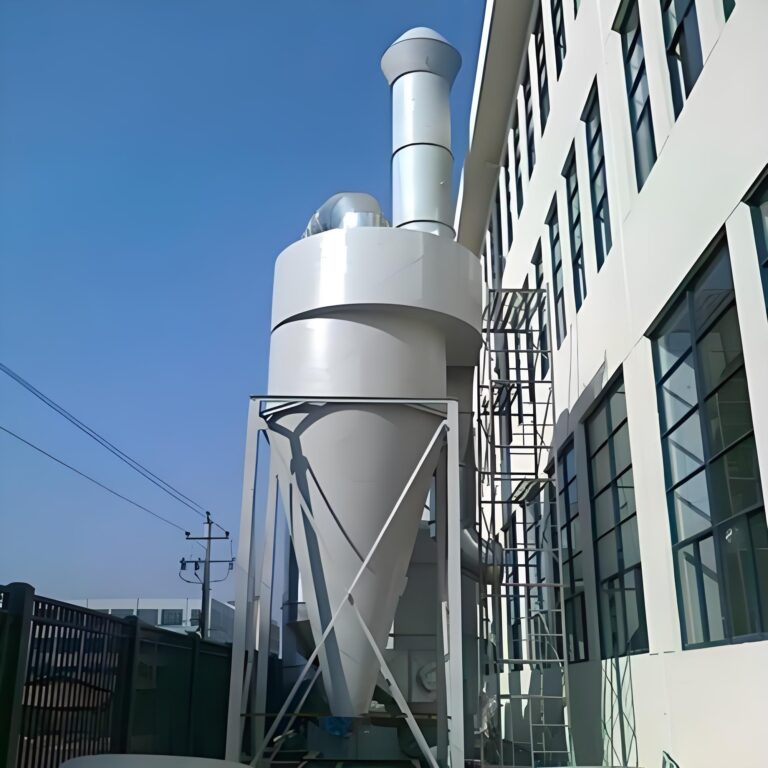
The Physics of Inertial Separation
Cyclone efficiency is a context-dependent metric, not a fixed number. The principle relies on creating a spinning vortex where centrifugal force drives particles toward the collector walls for separation. Efficiency is intrinsically linked to the particle size distribution of the specific dust stream. According to research from industry specifications, standard cyclones are most effective for larger, denser particles, typically those greater than 10 micrometers (µm). For finer particulates, efficiency drops significantly, which is why understanding your dust profile is the first critical step.
Balancing Force with Friction
Key mechanical design factors directly dictate this performance. Inlet velocity must be optimized to maximize centrifugal force without creating excessive turbulence that re-entrains dust. The cyclone’s diameter is equally critical; smaller diameters create greater centrifugal forces, improving fine particle capture. This is why high-efficiency designs often use “multiclone” arrays—multiple small-diameter tubes—to handle large air volumes. However, this pursuit of higher efficiency carries a direct trade-off: increased system pressure drop, which escalates energy consumption.
The Critical Performance Trade-Off
This relationship creates a fundamental economic consideration. Designs targeting finer particle capture incur greater pressure drops and higher fan energy costs. This can erode the cyclone’s traditional advantage of low operational expense. Selecting a cyclone, therefore, requires a precise analysis of the necessary efficiency target for your specific PM mix. Pursuing excessive efficiency for a dust stream dominated by large particles is an unnecessary capital and operational cost, while underspecifying for fine dust guarantees compliance failure.
ASHRAE 199 Testing: The Standard for Performance Validation
The Need for an Objective Benchmark
Without a standardized test, comparing cyclone performance between manufacturers is speculative. ANSI/ASHRAE Standard 199-2016 provides the definitive laboratory protocol to eliminate this uncertainty. It establishes a method to determine three key, comparable metrics: the particle size efficiency curve, airflow resistance (pressure drop), and dust-holding capacity. Specifying equipment with ASHRAE 199-compliant data is essential for ensuring the selected cyclone meets the precise efficiency targets required for your application’s dust.
Interpreting the Performance Curve
The particle size efficiency curve is the most critical output. It graphically shows the capture efficiency across a range of particle sizes, typically from 1 to 10+ µm. This curve allows engineers to match the cyclone’s performance to their specific particle size distribution. For example, a cyclone with 95% efficiency on 10µm particles but only 40% on 2µm particles may be insufficient for a process generating significant fine dust. This verified data is the foundation for intelligent, compliance-driven system design.
Informing the Two-Stage Architecture
ASHRAE 199 data validates the strategic role of cyclones in modern two-stage system architecture. Here, the cyclone acts as a pre-cleaner, using its strength in capturing larger, often abrasive particulates (>10µm) to protect downstream final filtration equipment like cartridge collectors or baghouses. This design prioritizes asset protection and drastically reduces the dust loading and wear on the more sensitive and expensive final filters, which are responsible for achieving the ultra-fine PM capture needed for EPA compliance. It’s a system approach that optimizes both performance and total cost.
| Tested Metric | Purpose | Typical Range |
|---|---|---|
| Particle Size Efficiency Curve | Capture across sizes | 1-10+ µm |
| Airflow Resistance | Pressure drop at rated flow | Design-specific |
| Dust-Holding Capacity | Operational lifespan | Design-specific |
Source: ANSI/ASHRAE Standard 199-2016. This standard establishes the definitive laboratory method for validating the three key performance metrics of industrial dust collectors, enabling objective comparison between equipment.
Monitoring and Recordkeeping for Ongoing EPA Compliance
Defining Key Performance Indicators (KPIs)
Sustained compliance requires monitoring the parameters that directly correlate with emission control. For cyclones, the primary KPIs are inlet velocity, pressure differential, and outlet opacity. Maintaining inlet velocity within the design specification ensures optimal centrifugal force is generated. Pressure differential is a direct indicator of system health; a rise signals plugging, while a drop indicates leaks. Outlet opacity, often monitored visually or with a transmissometer, provides a direct, though approximate, gauge of particulate emissions.
From Data Collection to Audit Trail
This operational data must be systematically logged to create a defensible compliance record. Modern systems integrate continuous sensors with data historians, transforming random checks into a stream of verifiable evidence. This shift makes data logging and parametric monitoring the industry standard. During an EPA inspection, this historical data proves the system was maintained within compliant operating parameters, even between mandatory stack tests. It turns compliance from a periodic snapshot into a managed, daily outcome.
| Key Performance Indicator | Monitored Parameter | Compliance Purpose |
|---|---|---|
| Inlet Velocity | Air speed | Maintains design specification |
| Pressure Differential | Across cyclone | Detects plugging or leaks |
| Outlet Opacity | Visible emissions | Meets PM emission limits |
Source: EPA Method 5. This foundational stack testing procedure defines the protocol for measuring particulate emissions, making the monitoring of related operational parameters critical for demonstrating ongoing compliance.
The Role of Predictive Maintenance
A robust monitoring program does more than satisfy regulators; it enables predictive maintenance. Trend analysis on pressure drop can signal the need for hopper inspection before a plug causes a shutdown. Monitoring inlet velocity can detect fan wear or filter blinding in a downstream stage. This proactive approach prevents the efficiency degradation that leads to compliance excursions, reducing unplanned downtime and protecting against significant regulatory fines. We’ve observed that facilities with integrated IIoT monitoring platforms resolve potential compliance issues 60-70% faster than those relying on manual logs.
Integrating OSHA and NFPA Safety Standards into Your System
The Overlap of Health and Fire Safety
Safety integration must be inherent to the initial design. OSHA mandates, such as Permissible Exposure Limits (PELs) for specific dusts like silica, require the cyclone to function as part of engineering controls protecting worker respiratory health. Simultaneously, if the dust is combustible, NFPA 660 mandates a Dust Hazard Analysis (DHA) and outlines comprehensive safety measures. This creates a tri-party enforcement web where EPA, OSHA, and NFPA mandates intersect, making a unified design approach essential.
Designing for Explosion Protection
For combustible dusts, explosion protection is a system, not a component. It requires an integrated strategy combining devices that address different deflagration phases. The cyclone itself must be protected according to NFPA 68, which governs the design and installation of explosion vents to safely relieve pressure. NFPA 69 covers prevention and isolation methods, such as chemical suppression or fast-acting isolation valves in connecting ductwork. These components work together to prevent an event from propagating through the facility.
Implementing Foundational Safety Measures
Beyond vents and isolation, a compliant system handling combustible dust must include several foundational elements. Construction should be of conductive materials with proper static grounding to prevent ignition. Ductwork must meet NFPA 91 standards for strength and fire resistance. The system must be designed to prevent the return of hazardous dusts to occupied spaces. Retrofitting this complete protection suite is often prohibitively difficult and costly, which is why safety engineering must be a non-negotiable criterion in the initial selection and design phase.
| Standard / Hazard | Key Requirement | Typical System Component |
|---|---|---|
| OSHA PELs | Engineering controls | Cyclone as part of system |
| NFPA 660 (Combustible Dust) | Dust Hazard Analysis (DHA) | Foundational safety plan |
| NFPA 68 (Explosion Protection) | Deflagration venting | Explosion vents on cyclone |
| NFPA 69 | Prevention/isolation systems | Suppression, isolation valves |
Source: NFPA 660 and NFPA 68. NFPA 660 consolidates requirements for combustible dust hazards, while NFPA 68 specifically governs the design of explosion vents, which are critical safety components for cyclone collectors handling combustible materials.
Operational Challenges: Preventing Erosion, Plugging, and Leaks
Identifying Common Failure Modes
Long-term efficiency is directly threatened by three common operational challenges. High-velocity abrasive particles cause erosion at the inlet and conical sections, thinning metal and degrading aerodynamic performance. Moisture or sticky materials can plug the dust outlet or adhere to inlet walls, disrupting the laminar flow essential for separation. Perhaps most insidiously, air inleakage at the hopper or a faulty discharge valve reduces internal velocity and collection efficiency, often going unnoticed until an opacity monitor or stack test fails.
Developing a Proactive Maintenance Strategy
Addressing these issues is the core of a maintenance strategy that determines continuous compliance status. A scheduled preventive maintenance program is a direct insurance policy against regulatory fines. This program must include regular internal inspections for wear patterns, checking and cleaning discharge valves, performing leak checks on the hopper and access doors, and ensuring hoppers are emptied on a strict schedule to prevent overflow and plugging.
The Criticality of Documentation
Every maintenance action must be documented. Inspection reports, wear measurements, valve replacements, and leak test results form a crucial part of the compliance audit trail. This documentation demonstrates proactive management of the asset and provides evidence that any efficiency loss was promptly identified and corrected. In practice, a well-documented maintenance log can be the deciding factor in mitigating a penalty during a regulatory inspection, transforming compliance from a passive hope into an actively managed result.
Total Cost of Ownership: Capital, Energy, and Maintenance
Moving Beyond Purchase Price
Evaluating a cyclone requires a full lifecycle cost analysis. The initial capital expenditure (CAPEX) for the equipment and installation is just the entry point. The dominant operational cost (OPEX) is energy consumption, driven directly by the system pressure drop. Designs that target higher efficiency for finer particles inherently create greater pressure drops, increasing fan horsepower and energy costs. This can negate the cyclone’s traditional low-operational-cost advantage, making a detailed energy analysis critical.
Factoring in Long-Term Maintenance
Maintenance costs are a significant variable influenced by dust characteristics. Abrasive dusts accelerate wear on internal surfaces, necessitating more frequent inspections and potential liner replacements. Sticky or hygroscopic dusts increase the frequency of cleaning and plugging prevention. A robust design with wear-resistant materials or liners may have a higher CAPEX but a dramatically lower long-term maintenance OPEX. This trade-off must be calculated based on your specific dust analysis.
The Filter Media Sizing Lever
In a two-stage system, the cyclone’s performance directly impacts the cost of the downstream final filter. The air-to-cloth ratio for these filters is a critical design lever intersecting capital and operational cost. Filter media sizing directly dictates operational economics. Oversizing the filter area increases CAPEX but yields longer filter life, lower pressure drop, and reduced replacement frequency. Undersizing saves upfront costs but increases OPEX through frequent change-outs, higher energy use, and more downtime. Optimal sizing requires precise dust analysis to minimize the total cost of ownership over a 5-10 year horizon.
| Cost Category | Primary Driver | Key Consideration |
|---|---|---|
| Capital Expenditure (CAPEX) | Equipment & installation | Filter media sizing |
| Operational Cost (OPEX) | Energy consumption | Directly tied to pressure drop |
| Maintenance Cost | Dust abrasiveness, design | Erosion, plugging frequency |
| Filter Media Cost | Air-to-cloth ratio | CAPEX vs. OPEX trade-off |
Source: Technical documentation and industry specifications.
Selecting the Right Cyclone for Your Commercial Application
Starting with Dust Analysis
Selection is a strategic process that begins with a thorough analysis of your dust. Particle size distribution, density, abrasiveness, moisture content, and combustibility are non-negotiable data points. This analysis informs the first major decision: whether a standard-efficiency cyclone is sufficient as a pre-cleaner or if a high-efficiency model is needed, with full acceptance of the associated energy trade-off. For unique or hazardous dusts, this step prevents the costly mistake of applying a generic solution.
Evaluating Vendor Expertise and Support
The complexity of modern regulations is shifting the market. Buyers increasingly seek vendors who can act as compliance partners offering “compliance-in-a-box” solutions. Competitive advantage is moving from equipment cost alone to the vendor’s regulatory expertise, ability to provide certified performance data (like ASHRAE 199), and assume shared compliance risk through proper design and documentation. This is especially true for applications involving high-efficiency cyclone dust collection systems or combustible dust hazards.
Navigating the Specialized Market Landscape
This demand sustains specialized engineering firms with deep domain expertise in specific industries like woodworking, pharmaceuticals, or metalworking. Generalist suppliers may lose share in these high-risk applications. Consequently, buyers must prioritize vendors with proven, industry-specific case studies and references. Furthermore, consider the growing trend of lifecycle service contracts. These agreements offer vendors recurring revenue while providing customers guaranteed performance, compliance continuity, and outsourced risk management for maintenance and recordkeeping.
| Selection Factor | Analysis Required | Market Trend |
|---|---|---|
| Dust Characteristics | Particle size, abrasiveness, combustibility | Specialized engineering firms |
| Regulatory Compliance | EPA, OSHA, NFPA overlap | Vendors as compliance partners |
| System Architecture | Pre-cleaner vs. final filter | Two-stage system paradigm |
| Vendor Selection | Industry-specific case studies | Lifecycle service contracts |
Source: Technical documentation and industry specifications.
Selecting and operating a compliant industrial cyclone dust collector hinges on three integrated priorities: basing design on verified performance data (ASHRAE 199), implementing a holistic safety and monitoring program from the start, and conducting a total lifecycle cost analysis that accounts for energy and maintenance. This framework transforms the collector from a commodity purchase into a strategic compliance asset.
Need professional guidance to navigate EPA, OSHA, and NFPA requirements for your specific application? The engineering team at PORVOO specializes in designing and validating integrated dust collection solutions that meet regulatory mandates while optimizing operational cost. Contact us to discuss your project requirements and explore a compliance-driven approach.
Frequently Asked Questions
Q: How do you prove ongoing EPA compliance for a cyclone dust collector without continuous emission monitors?
A: You demonstrate compliance through parametric monitoring of key performance indicators, including inlet velocity, pressure differential, and outlet opacity, as required by rules like NESHAP. This operational data, combined with detailed maintenance logs, creates a defensible audit trail for inspections. For projects where stack testing is periodic, plan for integrated sensor systems and data historians to provide the continuous evidence needed to prove compliance “at the time of service,” as outlined in testing protocols like EPA Method 5.
Q: What is the critical trade-off when selecting a high-efficiency cyclone for finer particle capture?
A: Achieving higher efficiency for sub-10µm particles requires a design that generates a significantly greater system pressure drop. This increased resistance directly raises energy consumption, which can erode the cyclone’s traditional advantage of low operational cost. This means facilities targeting fine particulate matter (PM2.5/PM10) must conduct a detailed lifecycle cost analysis, as the pursuit of higher capture rates may make alternative filtration technologies more economically viable for their specific application.
Q: Why is ASHRAE 199 test data essential for selecting a cyclone dust collector?
A: ANSI/ASHRAE Standard 199-2016 provides an objective, laboratory-verified performance curve showing efficiency across particle sizes, along with pressure drop and dust-holding capacity. This data enables an apples-to-apples comparison between vendors and ensures the equipment meets your specific dust profile. If your operation requires predictable performance for system design, you should mandate ASHRAE 199-compliant data from all potential suppliers to inform a reliable two-stage architecture.
Q: How should combustible dust hazards influence cyclone system design from the start?
A: Safety for combustible dusts requires an integrated protection system per NFPA 660, Standard for Combustible Dusts and Particulate Solids, not just adding components. This strategy combines explosion vents per NFPA 68, isolation valves, conductive construction, and proper ducting. If your facility handles any combustible particulate, you must prioritize vendors with expertise in this integrated safety engineering, as retrofitting a complete protection system later is often prohibitively complex and costly.
Q: What maintenance issues most directly threaten continuous compliance and efficiency?
A: Erosion from abrasive particles, plugging from moist materials, and air inleakage at discharge points are the primary operational failures that degrade collection performance. A significant change in pressure drop often signals these issues, leading directly to emission exceedances. This means facilities must implement a scheduled preventive maintenance program that inspects internal wear, checks valves, and verifies seal integrity, with all actions documented to transform compliance into a managed daily outcome.
Q: What shifts the total cost of ownership calculation for a cyclone-based dust collection system?
A: The largest operational cost is energy, driven by the system’s pressure drop, which increases with designs targeting finer particles. Maintenance costs vary with dust abrasiveness, and the sizing of downstream filter media creates a direct capital versus operational expense trade-off. For projects where long-term operating budget is a constraint, you should analyze the specific dust characteristics to optimize the air-to-cloth ratio, balancing higher upfront filter cost against reduced energy use and longer media life.
Q: How is the vendor selection process changing for commercial cyclone applications?
A: Buyers are increasingly seeking vendors who act as compliance partners, offering “compliance-in-a-box” solutions that include design, documentation, and support to share regulatory risk. This shift favors specialized engineering firms with deep, application-specific expertise over generalist suppliers, particularly for hazardous or challenging dusts. If your priority is mitigating cross-agency liability, you should evaluate vendors on their regulatory track record and consider lifecycle service contracts that guarantee compliance continuity.