Adding a cyclone pre-separator to a stone dust collection system looks straightforward on paper, but the decision that often causes rework happens before any equipment is specified: teams skip the particle size assessment and install a cyclone based on material name alone. The result is a two-stage system that carries the pressure drop penalty of the cyclone — typically 1.9 to 2.3 inches w.c. depending on flow rate — without delivering enough separation to offset it, and the downstream filter loads up almost as quickly as it would have without the pre-separator. Catching that mismatch during design costs nothing; catching it during commissioning, after ductwork is routed and equipment is mounted, costs significantly more. What follows is a section-by-section review of the conditions, thresholds, and failure risks that determine whether a cyclone pre-separator genuinely earns its place in a stone dust system.
Identify coarse particle sources before fine filtration
The case for a cyclone pre-separator is strongest when the dust stream contains a meaningful coarse, abrasive, silica-bearing fraction. Stone cutting, grinding, crushing, and similar operations typically produce that kind of bi-modal distribution — coarse chips and grit alongside finer airborne particles — and that coarse fraction is what a cyclone is positioned to intercept before it reaches filter media. The downstream consequence of misidentifying dust type is not just reduced separation efficiency; it is a system that actively performs worse than a single-stage collector would have, because the cyclone contributes pressure drop without returning a commensurate reduction in filter loading.
The failure pattern to watch for is specifying pre-separation based on the material name rather than the actual size distribution at the pickup point. A polishing or fine-grinding operation on stone may produce predominantly sub-10-micron dust even though the base material is abrasive. A cyclone in that scenario sees very little that it can centrifugally separate, passes most of the dust through to the downstream filter, and still consumes pressure budget.
| Dust Characteristic | Pre-Separator Suitability | Reason |
|---|---|---|
| Coarse, abrasive, silica-bearing | Likely beneficial | Reduces abrasive loading on downstream filters |
| Fine, light, or sticky | May not benefit | Adds pressure drop without adequate separation gain |
Where the coarse fraction is genuinely present and confirmed, the downstream filter is protected from abrasive loading that would otherwise degrade media and shorten cleaning intervals. Where it is absent or minimal, the trade-off runs the other direction: added complexity, added pressure drop, and no measurable benefit to filter life.
Check whether cyclone pressure drop is acceptable
Pressure drop is not a minor system parameter that can be reconciled later — it directly affects whether hood or pickup-point capture velocity is maintained across the full system. A cyclone adds resistance between the pickup points and the fan, and if the available static pressure budget does not accommodate it, the fan will either be undersized for the combined resistance or it will pull less airflow through the hoods than the original design assumed.
Published pressure drop figures for specific cyclone models provide a practical reference for this check. As an example, one manufacturer’s design data shows approximately 2.3 in. w.c. at 900 CFM and 1.9 in. w.c. at 1500 CFM for different model sizes. These are model-specific figures, not universal thresholds applicable across all cyclone types, and they are cited here to illustrate the order of magnitude, not as a specification floor. What matters for any given installation is whether the actual cyclone selected at the actual system flow rate fits within the pressure budget that still delivers adequate capture velocity at every pickup point. ISO 10780:1994 provides a recognized measurement methodology for gas stream velocity in stationary sources, which is relevant when verifying actual airflow conditions rather than relying on calculated estimates alone.
The practical check is this: before specifying a cyclone, run the static pressure balance with the cyclone’s published pressure drop included. If adding the cyclone requires upsizing the fan to maintain hood performance, that fan energy cost becomes a permanent operating expense — one that has to be recovered through extended filter life to justify the addition.
Size airflow and inlet velocity for real pickup points
Cyclone sizing must follow actual airflow demand at the pickup points, not a round number selected from a product range. The consequences of getting this wrong in either direction are operational, not just theoretical. An undersized cyclone at peak load can develop blockages as accumulated material exceeds the unit’s throughput capacity. An oversized cyclone passes air through too quickly for adequate centrifugal separation — residence time drops, the coarser fraction that the cyclone was meant to intercept carries through, and the downstream filter loads faster than expected.
Manufacturer and application guidance for industrial cyclones covers a wide capacity range — from roughly 300 to 13,000 CFM — with recommended inlet velocities between 3,500 and 7,000 FPM for reliable separation efficiency. Staying within that inlet velocity range is not just a performance consideration; operating significantly outside it changes the centrifugal separation behavior enough that the published efficiency figures no longer apply.
| Design Parameter | Recommended Range | Risk if Out of Range |
|---|---|---|
| Airflow capacity (CFM) | 300–13,000 CFM, matched to pickup point | Undersized: clogging; Oversized: energy waste, dust carryover without adequate separation |
| Inlet velocity (FPM) | 3,500–7,000 FPM for high efficiency | Efficiency loss; may pull dust through without separation |
Duct design between the pickup points and the cyclone inlet affects separation independently of the cyclone’s own geometry. Sudden diameter changes, abrupt transitions, and tight-radius elbows introduce turbulence and uneven velocity profiles at the inlet that degrade separation performance even when the cyclone itself is correctly sized.
| Duct Design Issue | What to Avoid | Why It Matters |
|---|---|---|
| Diameter changes | Sudden drops or expansions | Disrupts airflow, reduces separation efficiency |
| Transitions | Abrupt or poorly matched transitions | Causes turbulence and pressure fluctuations |
| Elbows | Sharp, tight-radius elbows | Increases pressure drop, degrades cyclone performance |
For systems with multiple pickup points, the CFM demand needs to be calculated from actual transport and capture requirements at each point rather than summed from nameplate figures. The article on calculating CFM requirements for multi-point pickup systems addresses this in detail and is relevant before finalizing any cyclone sizing for multi-branch stone dust systems.
Plan hopper discharge and dust handling
The hopper and discharge system is where pre-separator performance is most frequently lost in the field, and it is almost always underspecified at the layout stage. Two failure patterns dominate.
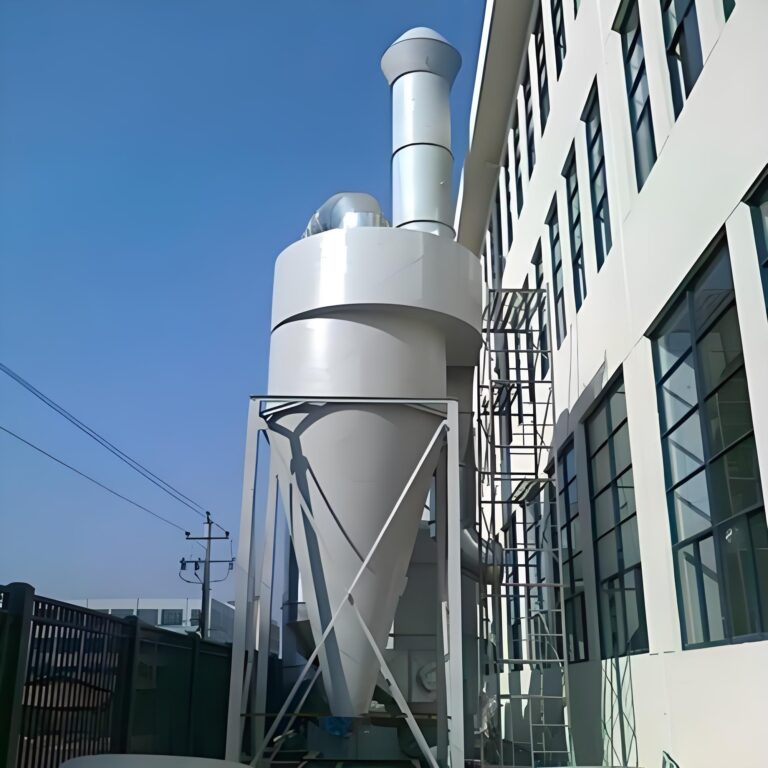
The first is geometry. Cone discharge clearance needs to be at least four times the discharge diameter to allow material to flow freely without restriction. This is a design figure from application guidance, not a regulatory minimum, but deviating from it creates a restriction that backs material up into the separation zone and degrades the cyclone’s ability to shed separated particles cleanly. Teams that compress the hopper height to fit equipment into a low-ceiling space often create exactly this problem without realizing what they have changed.
The second is air leakage. The discharge system operates under negative pressure, and any unsealed connection at the cone bottom — a loose rotary valve flange, an incorrectly gasketed cleanout — allows ambient air to enter from below. That inward air disrupts the downward spiral flow inside the cone, partially re-entrains separated material, and reduces separation efficiency across the whole unit. The performance loss is real and measurable, but it rarely triggers an obvious fault; instead, downstream filter differential pressure climbs gradually and the cause is misattributed to increased process loading.
| Requirement | What to Verify | Consequence of Failure |
|---|---|---|
| Cone discharge clearance ≥ 4× discharge diameter | Measure actual clearance | Restriction reduces separation efficiency |
| Discharge system sealed under negative airflow | Check for air leaks at connections | Air entering the bottom reduces separation efficiency |
| Regular checks of discharge valves and hoppers | Include in maintenance schedule | Blockages cause dust backups, increased system pressure, reduced efficiency |
Discharge valve condition and hopper clearance should be added to the maintenance inspection schedule from commissioning, not added reactively when downstream filter performance degrades. The blockage risk from an unchecked valve is compounded in stone dust applications because the material is typically dense and does not bridge loosely — once a blockage forms, system pressure can rise quickly before anyone identifies the source.
Keep downstream filters for fine particulate capture
A cyclone pre-separator does not eliminate the need for a downstream collector — it reduces the loading that collector must handle. Design figures for industrial cyclones typically show 80 to 95% removal of larger particles under conditions suited to the cyclone’s design range, but fine dust under approximately 10 microns passes through with much lower collection efficiency. In stone dust operations, that fine fraction includes the respirable silica-bearing particles that represent the highest downstream concern, and a cyclone alone is not an adequate final stage for those particles.
The practical planning implication is that the downstream baghouse or cartridge filter must be sized and selected to handle the full fine particle load, not a reduced load derived from optimistic assumptions about cyclone pre-separation efficiency. For installations processing mixed stone types or variable feed conditions, the cyclone efficiency at the coarse end can shift significantly, and the downstream filter design should not be built around best-case pre-separation performance.
ISO 16890-3:2024 provides a gravimetric efficiency testing framework for air filters used in general ventilation, which is relevant context for understanding how downstream filter efficiency is characterized in terms of particle size fractions — useful when evaluating the performance claims of cartridge or bag media proposed for the secondary stage.
Pulse jet bag collectors and cartridge collectors both operate as secondary stages in pre-separator arrangements. The pulse jet dust collector handles high-volume continuous-duty applications; the cartridge dust collector is typically used where airflow is lower or where compact layout is a constraint. The choice between them depends on airflow, dust loading at the secondary stage, and cleaning cycle frequency requirements — all of which are affected by how much coarse fraction the cyclone has actually removed.
Compare energy cost with filter life improvement
Pre-separation only pays back its pressure drop penalty if the coarse fraction it removes is large enough and abrasive enough to have been shortening filter life and increasing cleaning frequency in a measurable way. The mechanism is straightforward: coarse abrasive particles accelerate media wear by abrasion at high inlet velocity, they can cause pinholes in woven bag media, and they contribute to rapid differential pressure buildup that triggers more frequent pulse cleaning cycles. Removing that fraction before it reaches the filter slows all three degradation mechanisms.
The trade-off that teams underestimate is that the energy cost of the cyclone’s pressure drop is fixed and continuous, while the filter life benefit is variable and depends entirely on what the cyclone is actually intercepting. If the coarse fraction is modest — because the stone operation is fine-grinding rather than rough cutting — the abrasive loading on the downstream filter may already be low, and the cyclone’s contribution to media protection is correspondingly small. In that scenario, the energy cost of running the additional resistance permanently is not recovered through any meaningful extension of filter life or reduction in cleaning cycles.
The analysis that justifies pre-separation should be based on measured or reliably estimated dust loading data, not on the assumption that stone equals coarse. Where loading data shows a dominant fine fraction, the energy arithmetic does not close in favor of adding a cyclone. The pressure drop analysis for cyclone dust collectors covers the fan power and operating cost implications in more detail and is a useful reference before committing to a two-stage design.
Use pre-separation only where loading data supports it
Pre-separation should be treated as a design decision that requires supporting data, not a default add-on for any stone dust application. The data that actually supports or contradicts the decision comes from a short checklist of parameters that must be assessed before specifying the cyclone.
Particle size distribution is the first and most important input. If a reliable size distribution is not available, the decision cannot be made with confidence — the coarse fraction that justifies the cyclone may or may not be present, and specifying without it is an assumption that can only be verified during commissioning. Particle density matters alongside size: light materials with low density may not develop enough centrifugal force to separate adequately even at the correct inlet velocity. Abrasiveness determines how much wear the coarse fraction would actually impose on downstream media — it is the mechanism through which pre-separation delivers a return on its pressure drop cost.
Airflow at the pickup points needs to be matched to the cyclone’s capacity range before any model is selected. System pressure budget determines whether the cyclone’s resistance can be absorbed without degrading capture velocity at the source. Maintenance strategy affects whether the hopper discharge system will be reliably monitored — a cyclone that is not regularly inspected for discharge blockages and air leakage will underperform in ways that are difficult to diagnose remotely.
| Parameter | What to Assess | Why It Matters |
|---|---|---|
| Particle size | Confirm coarse fraction present | Fine dust may bypass cyclone, reducing benefit |
| Particle density | Assess whether particles are dense enough to settle | Light dust may not separate adequately |
| Abrasiveness | Evaluate abrasive loading | Protects downstream filter media from premature wear |
| Airflow (m³/h) | Match required airflow to cyclone capacity | Avoids undersizing (clogging) or oversizing (energy waste, carryover) |
| System pressure (Pa) | Determine available pressure budget | Cyclone adds pressure drop that affects system design |
| Maintenance strategy | Compare benefit vs added maintenance | If dust is mainly fine, light, or sticky, cyclone may add loss without benefit |
Where dust is predominantly fine, light, or sticky, the case for pre-separation collapses. This is not a minor caveat — a cyclone in that situation adds permanent pressure drop, increases system complexity, and introduces two additional failure points (discharge and air leakage) without delivering adequate separation to offset any of those costs. A single well-sized downstream collector is the better starting point, and the decision to add a cyclone should require the loading data to affirmatively support it before the specification is written.
The core judgment this article is meant to support is a procurement and design-stage check, not a commissioning fix. Before a cyclone pre-separator appears in any stone dust system specification, the particle size distribution at the actual pickup points should confirm that a coarse, abrasive fraction is genuinely present in sufficient proportion to justify the pressure drop cost. That data point, combined with a static pressure balance that includes the cyclone’s published resistance at actual system flow rate, determines whether the two-stage arrangement pays back its added complexity through measurable downstream filter protection.
If that data is not available, the lower-risk path is to design around a well-matched single-stage collector, confirm actual dust loading during early operation, and revisit pre-separation as an upgrade decision once real performance data is in hand. Retrofitting a cyclone upstream is straightforward compared to rebuilding a system whose pressure budget was sized around a cyclone that should not have been there.
Frequently Asked Questions
Q: The article focuses on stone cutting and grinding operations — does cyclone pre-separation apply to stone polishing or lapping lines that also handle silica-bearing materials?
A: Probably not. Fine polishing and lapping operations on stone typically produce a predominantly sub-10-micron dust distribution even though the base material is abrasive silica-bearing rock. A cyclone has very little coarser fraction to intercept in that scenario, so it contributes pressure drop without meaningful separation. The deciding factor is the actual particle size distribution at the pickup point, not the material name — and polishing lines should be treated with the same skepticism as any fine-grinding application until size data confirms a coarse fraction worth separating.
Q: If loading data confirms that a cyclone is justified, what is the right next step before writing a specification?
A: Run a static pressure balance that includes the cyclone’s published pressure drop at the actual system flow rate before selecting any model or sizing the fan. This check determines whether the cyclone’s resistance — typically in the range of 1.9 to 2.3 in. w.c. depending on flow rate and model — can be absorbed within the existing pressure budget while still maintaining adequate capture velocity at every pickup point. If the balance shows the fan must be upsized to compensate, that permanent energy cost needs to be factored into the payback calculation before the specification is finalised.
Q: At what point does a multi-branch stone dust system become too variable in airflow demand for reliable cyclone sizing?
A: When pickup points operate intermittently or at significantly different duty cycles, the actual CFM reaching the cyclone inlet can fall well below the design flow rate during partial operation. If that reduced flow drops inlet velocity below approximately 3,500 FPM, centrifugal separation efficiency degrades and the published performance figures no longer apply. For systems with high flow variability, this needs to be modelled across the expected operating range — not just at peak demand — before committing to a fixed cyclone size.
Q: How does the choice between a pulse jet bag collector and a cartridge collector for the secondary stage change once a cyclone pre-separator is in the system?
A: The cyclone shifts the secondary stage’s loading profile rather than eliminating the decision criteria. With coarse abrasive particles removed upstream, cartridge media becomes a more viable option in applications where it might otherwise suffer accelerated surface wear — but the downstream unit still needs to handle the full fine particle load, including sub-10-micron respirable silica, sized around realistic rather than optimistic pre-separation efficiency. High-volume continuous-duty stone operations generally still favour pulse jet bag collectors at the secondary stage; cartridge collectors suit lower-flow or space-constrained layouts where the reduced abrasive loading from pre-separation makes the media more practical.
Q: Is there a dust loading threshold below which adding a cyclone pre-separator to a stone dust system is unlikely to recover its energy cost through filter life improvement?
A: The article does not specify a universal threshold, and one does not exist independent of the coarse fraction’s actual abrasiveness and proportion. What the energy arithmetic requires is that the coarse fraction removed by the cyclone must have been causing measurable abrasive wear, differential pressure buildup, or increased cleaning cycle frequency at the downstream filter. If measured or estimated loading data shows the coarse fraction is modest — because the process is predominantly fine-grinding — the abrasive stress on the downstream filter is already low, and there is no meaningful filter life improvement for the cyclone’s fixed pressure drop cost to recover against. The decision should not proceed without loading data that affirmatively shows a problem worth solving.