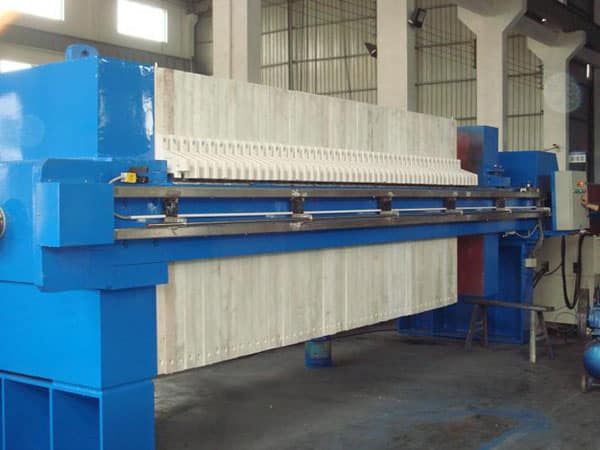
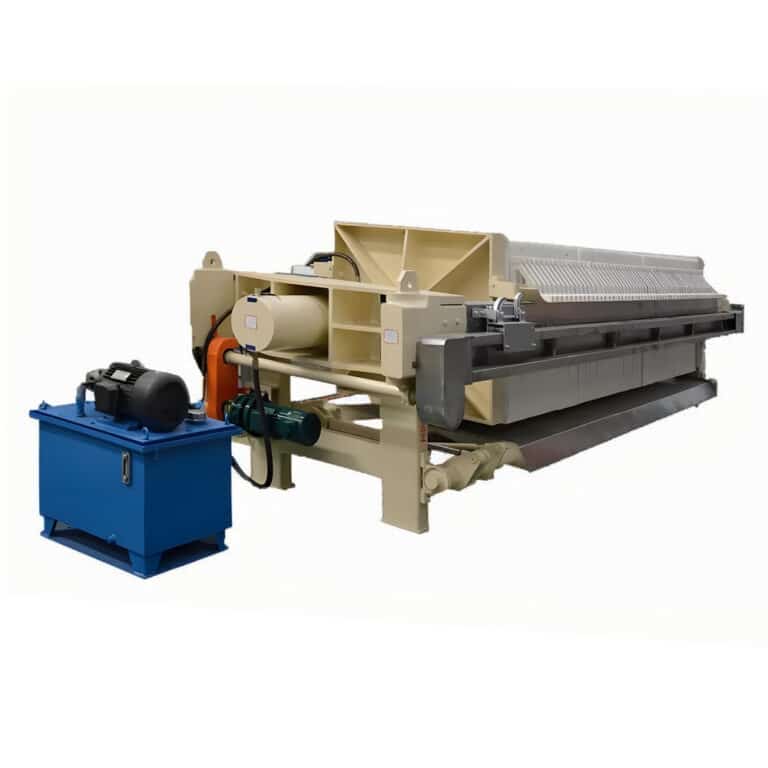
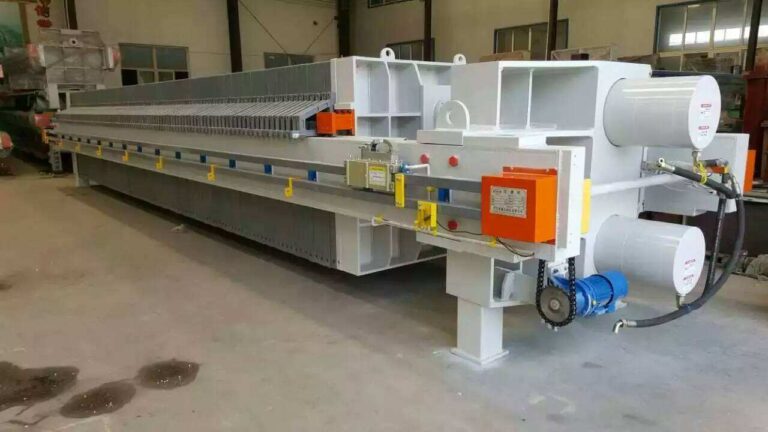
Equalization tanks that are undersized compress the entire treatment chain downstream. Equalization tanks that are oversized allow solids to settle out and arrive at the lamella separator or dosing stage as slugs rather than a consistent feed — creating turbidity spikes, floc instability, and sludge batches that are harder to dewater. The filter press is where those upstream decisions become visible: wet cake, extended cycle times, and excessive polymer consumption are usually symptoms of misaligned stages upstream, not press malfunctions. What follows is a stage-by-stage examination of where decisions have lasting consequences, so you can confirm the sequencing logic before equipment is specified rather than after commissioning reveals the gaps.
Start with influent solids grit pH and flow variability
Flow variability in ceramic and stone facilities is not a minor design consideration — it is the first variable that either stabilizes or undermines everything downstream. Grinding, polishing, and cutting operations generate wastewater in batches, and the suspended solids concentration can shift sharply between shift changes, equipment cycles, or raw material changes. An equalization tank absorbs those fluctuations and supplies a consistent feed to downstream treatment, but only if it is configured to keep solids in suspension rather than allowing them to settle out and re-enter the system as concentrated slugs.
The practical problem with equalization tank sizing is that teams frequently resolve the flow variability question without fully addressing the solids management question inside the tank itself. For facilities handling heavy mineral fines, agitation — whether mechanical or pneumatic — is often necessary to maintain uniform suspension. Without it, a correctly sized tank can still deliver inconsistent feed solids to the lamella separator or dosing point. Oversizing the tank to create additional buffer time can worsen this outcome by reducing velocity and allowing finer particles to accumulate at the bottom between cleaning intervals.
pH variability compounds the solids problem because PAC performance is sensitive to inlet pH. If the equalization stage delivers feed that is chemically inconsistent, the dosing stage cannot be optimized through jar testing alone — the test results will not reflect operating conditions. Confirm the pH range and suspended solids concentration across the full production cycle before the equalization tank volume is finalized, and treat agitation as a configuration input to be decided based on measured solids loading rather than omitted because the tank appears to be functioning normally during commissioning.
Separate large particles before chemical conditioning
Chemical dosing cannot compensate for grit that has not been removed. When coarse particles — sand grains, large mineral fragments, unhydrated binder particles — enter a lamella separator or settling tank alongside fine suspended solids, they accelerate wear on moving components, create uneven sludge accumulation in the funnel zone, and can physically bridge across the plate channels. The result is reduced effective settling area and inconsistent sludge withdrawal — both of which appear downstream as poor floc separation and thicker-than-expected sludge.
Lamella clarifiers can operate without flocculants during an initial pass, which creates a practical opportunity: using the clarifier as a pre-conditioning step rather than applying chemical dosing to a mixed stream that includes particles heavy enough to settle unaided. This is not a universal operating rule — it depends on particle size distribution and specific gravity of the incoming solids — but where mineral content is high, the benefit of reducing coarse particle load before PAC and PAM are introduced can include measurably lower chemical consumption and more predictable floc structure.
| Pre-treatment Step | Method & Conditions | Benefit Before Chemical Dosing |
|---|---|---|
| Coarse particle removal | Conveyor screw removes large plaster debris; used in plaster wastewater | Protects lamella from clogging, reduces mechanical load |
| Initial fine particle separation | Lamella clarifier operated without flocculants | Cuts chemical consumption and improves settling downstream |
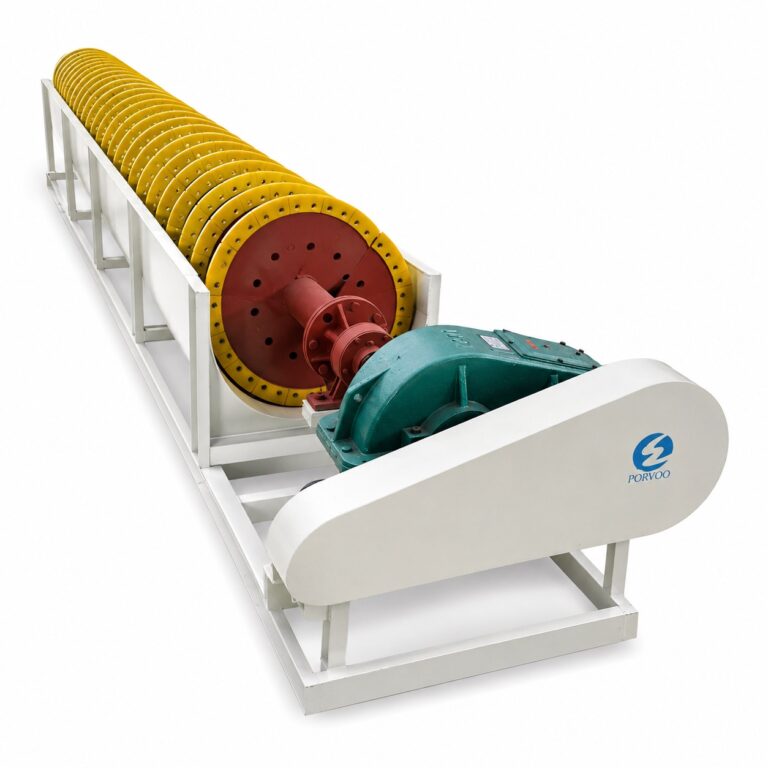
The staged approach matters particularly in applications where conveyor screws or screw classifiers handle coarse debris — a configuration seen in plaster wastewater where unset plaster must be separated mechanically before the lamella receives the fine-particle fraction. Combining these steps inappropriately — feeding large particles directly to the chemical conditioning stage — shifts the burden onto flocculant to bridge gaps that physical separation handles more efficiently and at lower operating cost. The large particle grit removal function is therefore a sequencing decision, not simply an add-on.
Align PAM/PAC dosing with settling and sludge withdrawal
Chemical conditioning in ceramic wastewater treatment carries more accountability than most system designs explicitly assign to it. The dosing stage influences settling rate, sludge volume, and — critically — the moisture content of the cake that exits the filter press. That last point is frequently treated as a press performance variable when it is partly a chemical conditioning variable. A flocculant that builds light, voluminous floc may achieve good turbidity removal but produce sludge that dewaters poorly under press pressure, increasing cycle time and leaving moisture above disposal thresholds.
A PAC plus anionic PAM combination achieves over 90% removal of turbidity and suspended solids across the majority of ceramic wastewater streams encountered in practice. That benchmark is a useful starting point for system design, not a guaranteed outcome — influent chemistry, temperature, and organic loading can all shift the effective dose range. Jar testing is the non-negotiable step between that general benchmark and a site-specific dosing specification. It is also the mechanism that aligns chemical selection with sludge withdrawal timing: a flocculant that settles rapidly may be well-matched to a system with frequent withdrawal intervals, but poorly matched to a system where sludge is held longer before pumping, allowing floc structure to degrade and release trapped water back into the supernatant.
| Dosing Factor | What to Confirm | Why It Matters for Sludge Withdrawal |
|---|---|---|
| PAC + anionic PAM combination | Achieve >90% removal of turbidity and suspended solids; effective in >90% of ceramic wastewater streams | Sets baseline; if not met, settling and sludge quality suffer |
| Flocculant selection | Verify impact on final sludge cake volume and dryness | Directly affects disposal costs and dewatering press output |
| Jar testing | Conduct jar tests to determine optimal type and dosage for the specific stream | Prevents over-/under-dosing, ensures settling aligns with sludge withdrawal timing |
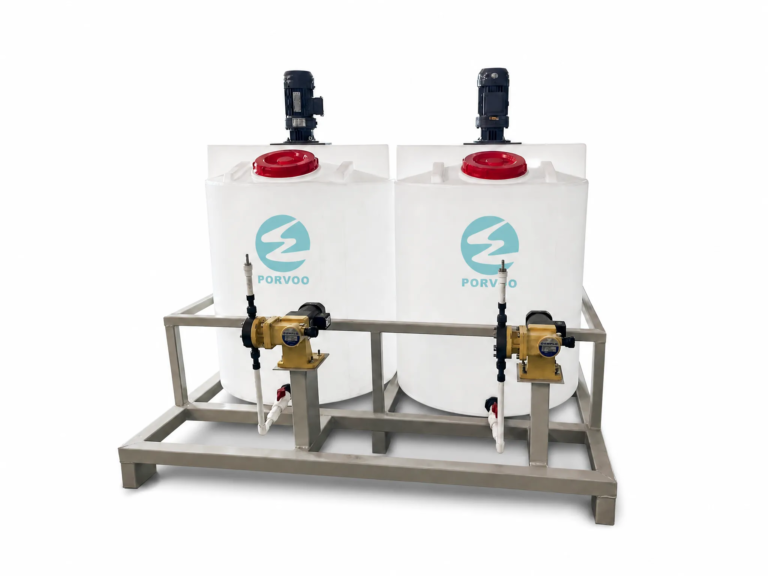
The dosing stage’s accountability for sludge cake dryness is worth making explicit before the system is built. If the flocculant choice is made independently of filter press specifications — a common procurement pattern when civil, mechanical, and chemical supply packages are sourced separately — the press may be specified correctly for the sludge volume but not for its compressibility characteristics. That mismatch becomes visible only under operating conditions and is difficult to correct without re-running jar tests, adjusting polymer, or modifying press cycle programs. The PAM/PAC intelligent chemical dosing system exists at the intersection of those two outcomes, and its configuration should be treated as a shared input to both the settling and dewatering stages.
For a broader look at how coagulation, settling, and sludge handling interact before water reuse, this overview of chemical dosing systems and clarifiers covers alignment logic across the full sequence.
Size filtration around thickened sludge not raw wastewater guesses
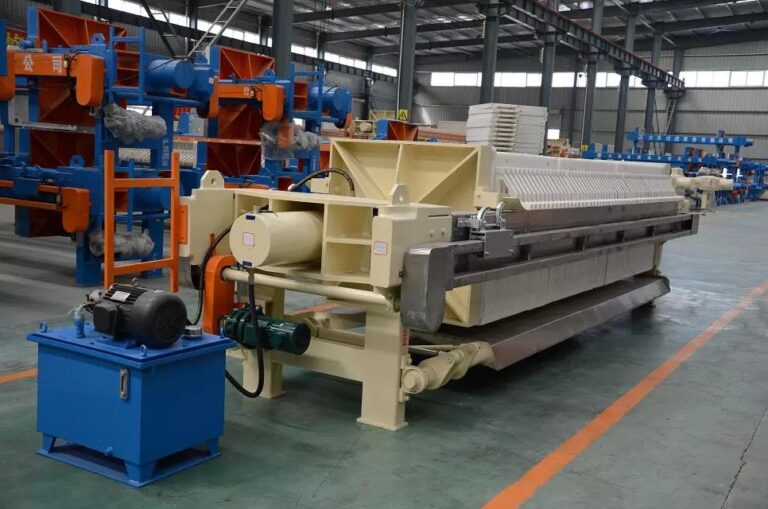
Filter press sizing is often calculated from influent flow rates and general suspended solids estimates at an early stage when measured sludge characteristics are not yet available. That decision path introduces error that compounds. The compressibility, specific resistance, and solids content of thickened sludge — the actual feed to the press — can differ substantially from what raw influent data predicts, particularly in ceramic facilities where grinding aid chemistry, mineralogy, and firing kiln residues all affect sludge behavior.
The correct sizing input is thickened slurry properties, measured after the sedimentation stage, not before chemical conditioning. Deep cone thickeners or rake thickeners concentrate sludge to a feed solids content that the press can actually handle at a predictable cycle time. If the press is sized against raw influent estimates and the thickened sludge arrives at higher-than-expected solids concentration or worse compressibility, the result is either extended cycle times that reduce daily throughput or press capacity that is inadequate to handle sludge accumulation rate — both of which become maintenance and operational problems rather than equipment problems. The Ceramic Manufacturing Industry BREF provides process-reference framing for this principle, identifying sludge characterization as a functional input to dewatering equipment selection rather than a post-installation adjustment.
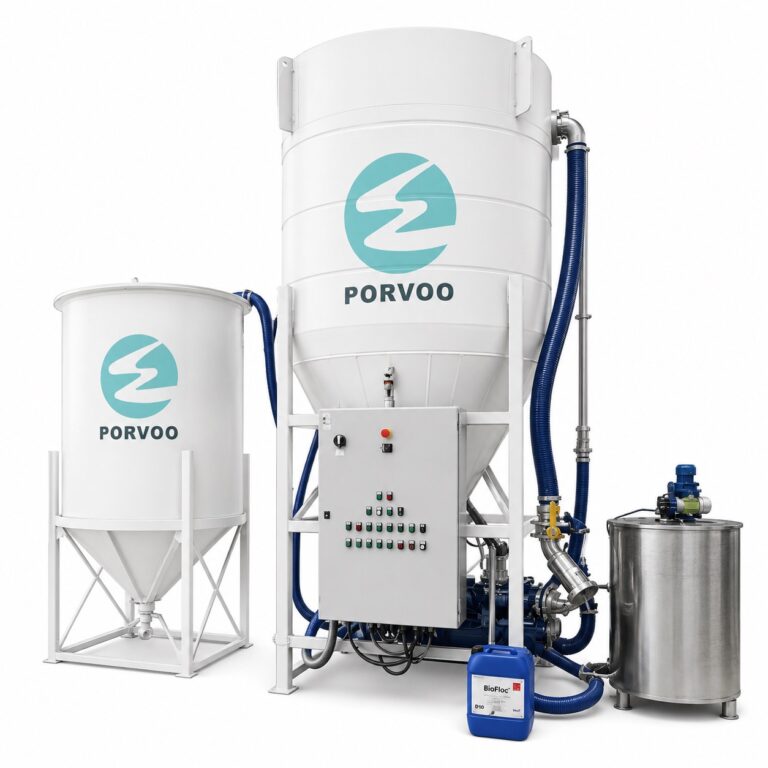
The practical check here is to confirm that the sedimentation stage — whether a vertical sedimentation tower or a conventional thickener — is sized to produce a defined thickened slurry specification, and that press selection follows from that specification rather than preceding it. Where a vertical sedimentation tower is used as the concentration step, its underflow solids content and withdrawal rate should be the primary filter press sizing inputs.
Track filtrate quality before returning water to production
Closed-loop water reuse in ceramic and stone facilities closes a production-cost loop, but it also creates a contamination path back into manufacturing if filtrate quality is not confirmed before the water re-enters process machines. Suspended solids or turbidity that passes through the filtration stage — whether from a degraded filter cloth, poor floc formation, or a press seal failure — flows directly into grinding, polishing, or spray systems, where it can leave deposits on finished surfaces or contaminate spray circuits.
The most reliable approach is not to monitor return water at the storage tank outflow, but to track it at the lamella separator outlet and again after the press filtrate combines with clarified overflow before entering the storage circuit. ISO 10523 and ISO 11923 provide testing frameworks for pH and suspended solids respectively — relevant reference points for designing a monitoring protocol, though their application depends on what the facility’s operating permit and production specifications actually require rather than being universal return-loop compliance standards.
If filtrate turbidity exceeds the acceptable range for production water, the failure trace almost always runs upstream: floc that was weakly formed, grit that passed through pre-treatment, or a sludge withdrawal interval that was stretched too long and allowed fine particles to re-enter the overflow. Filtrate quality is therefore a useful diagnostic signal — not just a reuse criterion. A filtrate problem that is persistent across press cycles is more likely a dosing or settling problem than a press problem, and troubleshooting it at the press level alone will extend the diagnosis unnecessarily.
Identify where cycle time and sludge storage create bottlenecks
Operational timing in ceramic wastewater treatment is where well-designed systems accumulate failures. Equipment can be correctly sized and properly sequenced but still create production-blocking bottlenecks if sludge withdrawal intervals, press cycle scheduling, and end-of-shift shutdown sequences are not defined and enforced as part of daily operations rather than as commissioning documentation that is later ignored.
The most common timing failure is delayed sludge withdrawal from the lamella separator funnel zone. Sludge that is left to accumulate past its design interval becomes compacted, loses fluidity, and resists pump withdrawal — which forces manual clearing or extended downtime. The problem compounds when the facility’s production schedule creates irregular accumulation periods: a lamella operating with consistent 20-minute withdrawal intervals during a full shift may receive no withdrawal at all during a partially attended shift, allowing funnel accumulation to reach a level that affects settling geometry in the plate pack above.
| Process Step | Timing Requirement / What to Clarify | Risk of Non-Compliance |
|---|---|---|
| Sludge withdrawal from lamella separator funnel | Pump sludge at regular intervals during operation | Solids settlement and clogging in funnel, disrupting flow |
| Rabble rake operation after production stops | Continue rabble rake run for a set time post-production | Premature shutdown causes solids to settle and block the system, creating a maintenance bottleneck |
The end-of-production rabble rake shutdown sequence is a specific timing dependency that must be defined per system design during commissioning and reinforced operationally thereafter. Stopping the rabble rake simultaneously with the production feed is a reasonable assumption for operators who are not otherwise instructed — it is also a reliable path to solids settling in the underflow cone, requiring mechanical intervention to clear before the next production run. The correct shutdown sequence typically requires the rake to continue running for a defined period after feed stops, allowing settled solids to migrate toward the withdrawal point before the mechanism is powered down. What that defined period is depends on tank geometry and solids loading — it is a commissioning parameter, not a general rule, and it needs to be recorded and trained rather than left to operator judgment.
Confirm which stage owns each acceptance metric
When systems underperform, responsibility tends to migrate toward the most visible stage — which in ceramic wastewater treatment is usually the filter press. Wet cake, slow cycle times, and high polymer consumption are press outputs, so the press receives the operational scrutiny. But each of those outcomes has an upstream cause that the press cannot resolve on its own, and if that accountability is not mapped before the system is handed over, it will be debated rather than diagnosed after the first operational problems appear.
Sludge cake moisture is the metric most commonly misassigned. It is affected by press parameters — cycle pressure, membrane squeeze pressure, cycle duration — but it is also directly influenced by flocculant type and dosage. A flocculant that creates compressible floc with good initial settling but poor structural integrity under pressure will produce cake that remains wet regardless of how the press is programmed. The dosing stage partly owns the moisture outcome, and that ownership should be reflected in how jar testing results are translated into press cycle specifications — not treated as two independent optimization problems.
Turbidity in return water and cycle time at the press are similarly shared metrics. Turbidity traces back to settling performance and, before that, to floc quality and grit removal completeness. Cycle time traces back to sludge feed consistency, thickener underflow concentration, and press cloth condition. Establishing at handover which upstream stage is accountable for each acceptance metric — and what the diagnostic path looks like when a metric fails — prevents the operational pattern where each stage operator confirms their equipment is running correctly while the system as a whole does not meet performance targets.
The most durable risk in ceramic and stone wastewater system design is the assumption that each stage will be optimized independently and that the overall system will perform as intended when those stages are combined. In practice, the filter press receives the accumulated consequences of every upstream decision: grit that was not fully removed, pH that was inconsistent, floc that was not validated against actual sludge withdrawal timing, and thickener underflow that was never characterized before press capacity was finalized. Those decisions are recoverable, but correcting them after commissioning typically costs more in time, chemical waste, and production disruption than resolving them during the design and specification phase.
Before finalizing equipment sizing or chemical conditioning protocols, confirm the sequence: characterize thickened sludge before specifying the press, run jar tests before committing to flocculant selection, define sludge withdrawal intervals and shutdown sequences as part of commissioning deliverables, and assign acceptance metrics to the stages that actually control them. The performance gap in most ceramic wastewater systems is not missing equipment — it is unresolved sequencing logic that shows up as operational cost after start-up.
Frequently Asked Questions
Q: What happens if jar testing was skipped during procurement and the system is already installed?
A: Re-run jar testing under live operating conditions as the first corrective step — it is not only a pre-installation tool. Feed actual thickened sludge from the settling stage, not raw influent, and test flocculant type and dosage against the press cycle parameters currently in use. If wet cake or long cycle times are the presenting problem, the jar test results will identify whether the issue is polymer selection, dosage rate, or withdrawal timing, which narrows the fix to a chemical or scheduling adjustment rather than a mechanical one.
Q: Does this treatment sequence apply if the facility runs dry-process ceramic production lines alongside wet-process lines?
A: The sequence applies only to wastewater-generating wet-process operations — grinding, polishing, cutting, and glaze application. Dry-process lines produce particulate air emissions rather than process wastewater, so they require air pollution control rather than liquid treatment. If both line types share a facility, the wastewater system should be sized and characterized around wet-process flow and solids loading only, and influent variability mapping should account for which production shifts actually generate liquid discharge rather than averaging across all lines.
Q: At what point does it make more sense to separate wastewater streams by process rather than treating them as a combined influent?
A: Stream separation becomes worth evaluating when two or more process lines generate wastewater with significantly different pH ranges, solids loadings, or chemical compositions that would require conflicting dosing conditions in a combined equalization tank. For example, a glazing line generating high-TDS wastewater with organic binders behaves differently under PAC and anionic PAM than a clean-cut mineral slurry. Combining them forces a dosing compromise that often underperforms on both. If jar testing on combined influent consistently requires higher polymer doses than either stream tested individually, stream separation typically recovers that chemical cost faster than the additional civil and piping investment implies.
Q: How should sludge cake disposal costs factor into the decision between a membrane filter press and a belt filter press for this application?
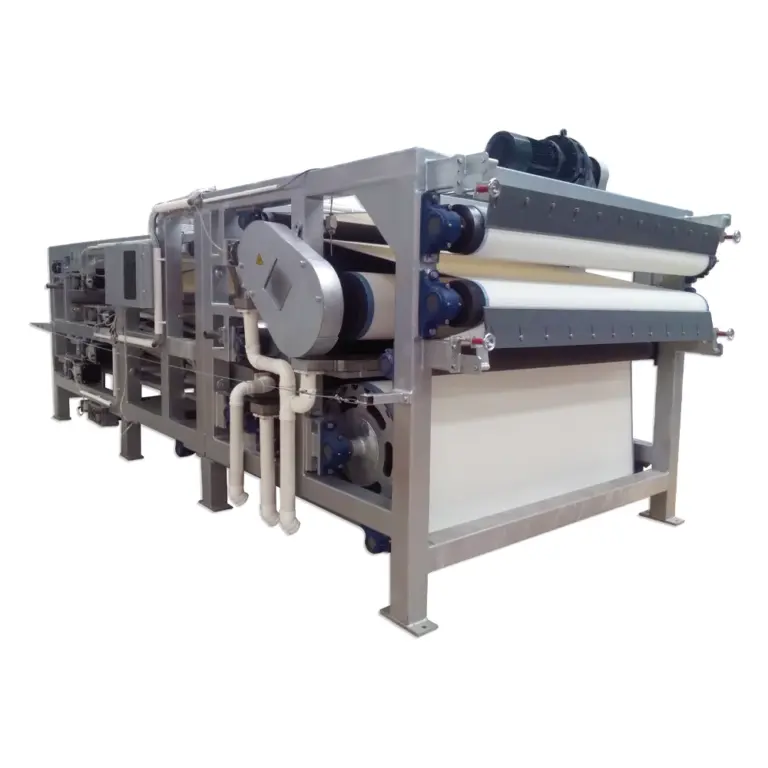
A: A membrane filter press generally produces drier cake in ceramic and stone applications, which directly reduces disposal weight and transport cost — but the advantage only materializes if upstream floc quality supports it. A belt filter press operates continuously and may suit facilities with high sludge generation rates and limited storage capacity, but it typically leaves higher residual moisture and requires more diligent cloth washing. If disposal is priced by weight or volume and the facility generates sludge with variable compressibility due to mixed mineral inputs, the membrane press is the more defensible choice on total operating cost, provided the chemical conditioning stage is configured to produce floc with adequate structural integrity under squeeze pressure.
Q: Once the system is commissioned and operating within spec, what is the most reliable early indicator that upstream performance is degrading before it affects production water quality?
A: Monitor press cycle time as the leading indicator — it responds to changes in sludge feed consistency, thickener underflow concentration, and floc quality before those changes are visible in filtrate turbidity or cake moisture. A gradual increase in cycle time across consecutive press batches, without any change in press programming, almost always traces back to a shift in sludge compressibility or feed solids content. Investigating at that point — checking thickener underflow concentration, reviewing recent dosing rates, confirming sludge withdrawal intervals were maintained — allows the upstream cause to be corrected before it propagates into filtrate quality or causes a production interruption.