A dust control system that passes its pre-installation review and then fails at the grinding wheel is one of the more expensive misunderstandings in industrial ventilation procurement. The fan moves air, the commissioning check confirms flow at the inlet, and the specification appears satisfied — yet worker exposure at the source can run two to ten times higher than a correctly designed setup because velocity was never verified where it actually needs to exist. The decision that resolves this is straightforward in principle but frequently deferred in practice: capture velocity must be specified, designed, and confirmed at the point where dust is generated, with every downstream design choice — hood placement, duct sizing, fan reserve, and ongoing monitoring — working backward from that requirement. What follows will help you define a specification that survives installation, filter loading, and real operating conditions without relying on fan-curve assumptions alone.
Specify capture velocity at the dust source
The specification needs to name a velocity at the grinding wheel itself, not at a duct connection or equipment outlet. For grinding and cutting operations, industrial ventilation practice commonly targets 2,000–2,500 fpm at the point of dust generation — a range established to overcome the momentum of particles ejected by the wheel and prevent the dust plume from escaping the capture zone. Treat this as a widely used design figure, not a regulatory mandate, but understand that specifying anything below it without compensating geometry creates a system that may look adequate on paper and perform poorly in use.
The consequence of under-specification here is not marginal. Under-velocity at the hood can increase worker exposure by a factor of two to ten compared to a setup that meets the threshold — a range wide enough to reflect how much workpiece geometry, material type, and grinding direction vary across installations. That variability is exactly why the specification must anchor to the source, not to a system average. A system sized for adequate fan flow but with an inadequately specified hood velocity has no verified connection between the two.
Account for distance from source to pickup
Hood placement is the variable most frequently left unresolved at the time of equipment quotation, and it is the one that destroys capture performance fastest. Air velocity does not remain constant as it travels away from a hood face — it drops sharply with even small increases in distance. At half a duct diameter from the pickup face, velocity is already roughly 70% lower than at the hood; at one full diameter, approximately 90% has been lost.
| Distance from Pickup (Duct Diameters) | Velocity Relative to Hood Face | Capture Impact |
|---|---|---|
| 0.5 diameter | 70% lower (≈30% remains) | Capture severely reduced; plume control compromised |
| 1.0 diameter | 90% lower (≈10% remains) | Negligible capture; effective source control lost |
What this means practically is that a hood specification without a locked-in maximum standoff distance is incomplete. If the hood is positioned at one duct diameter from the dust source — a gap that looks minor on a layout drawing — effective capture has essentially collapsed regardless of what the fan is delivering. Hood distance must be minimized as a design constraint, not adjusted for convenience after installation. If the workpiece geometry makes close hood placement difficult, that constraint should force a geometry change — an enclosure, a repositioned pickup, or a different table configuration — not a relaxed velocity target.
Include workpiece blockage and cross-drafts
Two conditions that rarely appear in equipment quotations but consistently degrade real-world performance are workpiece obstruction and ambient cross-drafts. Large or irregularly shaped workpieces partially block the hood face, reducing the effective capture area and redirecting the dust plume away from the pickup. The specification should account for this by treating the unobstructed hood area as a variable, not a fixed value, and by requiring that hood sizing reflect the worst-case obstruction the workpiece creates.
Cross-drafts are harder to quantify but equally consequential. Any lateral air movement across the workspace — from an open door, a nearby fan, HVAC supply registers, or the movement of personnel — can deflect the dust plume before it reaches the pickup. As a planning criterion, cross-draft velocity should be kept well below the capture velocity at the source; where that is not achievable through layout alone, partial enclosure is the more reliable solution. Adding enclosure panels around a grinding station reduces the exposure of the capture zone to ambient air movement without necessarily requiring higher airflow — a geometry intervention that is often more cost-effective than upsizing the fan.
Neither of these factors has a single universal correction factor that can be applied at the specification stage. The honest approach is to flag them explicitly in the RFQ so that the equipment supplier must account for actual workstation conditions rather than assuming an ideal open-bench configuration.
Convert capture needs into CFM and duct design
Once capture velocity and hood geometry are defined, airflow volume can be calculated. The planning formula widely used in industrial ventilation — Q = V × (10X² + A), where Q is volume flow, V is the required capture velocity, X is the distance from the hood face to the emission source, and A is the hood face area — converts those inputs into a CFM or m³/min figure that the duct and fan system must deliver. The ASHRAE Handbook on industrial local exhaust systems treats this type of relationship as foundational to hood design methodology. What the formula makes explicit is that increasing hood distance (X) raises the required airflow nonlinearly, which is why minimizing distance is a more efficient solution than simply specifying a larger fan.
Duct design introduces its own minimum threshold: grinding dust requires a minimum transport velocity of approximately 15–23 m/s to remain suspended and move through the duct without settling. Fan sizing must also reserve capacity for filter loading — a planning criterion of 4–6 inches W.C. of additional pressure allowance ensures the system can maintain capture velocity when filters are partially loaded, not only when they are clean.
| Specification | Minimum Requirement | Consequence of Underperformance |
|---|---|---|
| Capture velocity at source (grinding wheel) | 2,000–2,500 fpm | Worker exposure increases 2–10 times above adequate levels |
| Duct transport velocity | 15–23 m/s (≈2,500–3,000 fpm) | Dust settling and duct blockage; 40–60% system efficiency drop; exposure spike 2–3 times above limits |
| Dirty-filter pressure allowance | 4–6 in. W.C. | Inability to maintain capture velocity as filters load, causing progressive performance degradation |
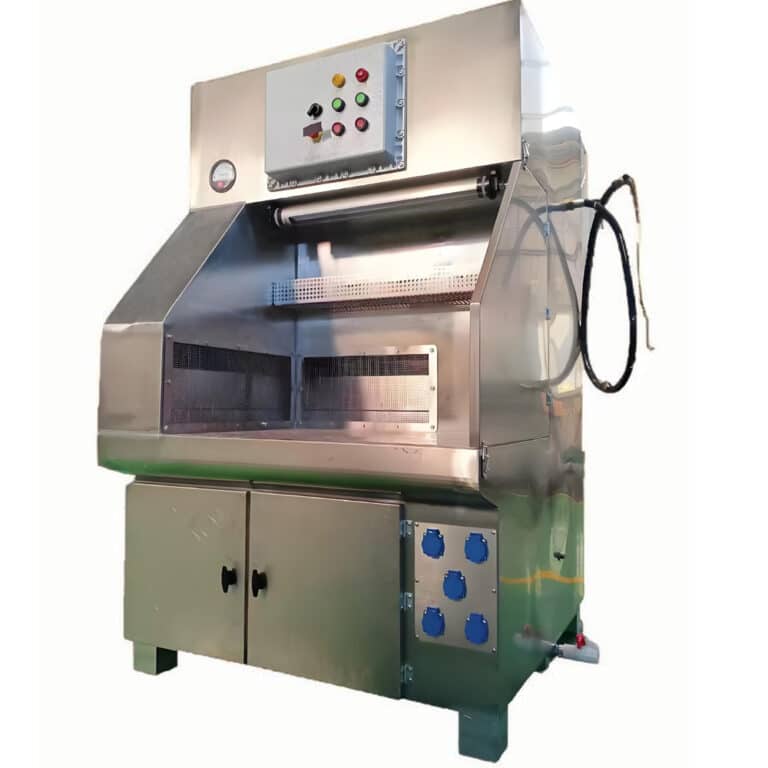
The sequencing implication matters for procurement: fan selection cannot be finalized until hood geometry, duct routing, and filter type are known. Specifying fan capacity in isolation — without confirmed duct length, bend count, and filter pressure drop — produces a system that may meet its nominal rating under ideal conditions and drift below threshold within weeks of startup. For applications where the workpiece changes size or orientation regularly, variable-geometry hood configurations tied to a downdraft grinding table may simplify this calculation by containing the dust field rather than requiring the capture zone to chase it.
Verify velocity after installation not only before quote
Fan-curve review at commissioning confirms that the fan is moving air. It does not confirm that air is reaching the dust source at the velocity the specification requires. These are two different measurements, and conflating them is the most common reason a system passes acceptance and then fails in use.
| Measurement Location | What It Confirms | What It Misses (Critical Limitation) |
|---|---|---|
| Fan inlet (or fan outlet) | Fan is moving air and meeting design volume | Does not confirm air is reaching the capture point; system performance can degrade due to filter loading, hose resistance, bends, hood shrouds, or leaks |
| Hood capture point (at dust source) | Capture velocity is actually delivered where dust is generated, protecting the worker | Fan-inlet alone gives a false sense of security; failure to verify at the hood is where most systems fall short |
The practical directive is that velocity measurement at the hood face — at the actual dust generation point, with the workpiece in place — should be a named acceptance criterion in the equipment specification, not an optional commissioning step. Filters, flexible hoses, bends, and hood shrouds all add resistance that reduces delivered airflow below what the fan curve predicts for clean-duct conditions. A system sized only against clean-filter flow figures will typically perform below its capture velocity threshold within a short operating period. Verifying at the hood after installation, with a representative workpiece obstructing part of the face, is the one check that confirms the specification actually translated into real-world performance. ISO 10780 provides a methodology framework for velocity measurement in stationary duct systems if a traceable measurement approach is required for the acceptance record.
Set alarms or checks for declining airflow
Capture velocity is not a commissioning-day property — it degrades continuously as filters load, and a system that met specification on day one may be significantly under-performing within a normal operating cycle without any visible indication. The practical mechanism for catching this early is differential pressure monitoring across the filter bank using a magnehelic gauge or equivalent instrument. Rising differential pressure indicates filter loading; without a defined setpoint that triggers cleaning or replacement, the system will progressively starve the hood of airflow while appearing to operate normally.
| What to Check | Method / Trigger | Monitoring Purpose |
|---|---|---|
| Differential pressure across filters | Magnehelic gauge; monitor for increase beyond design setpoint | Detect filter loading early; trigger cleaning or replacement to restore airflow and maintain capture velocity |
| Hood capture velocity | Quarterly airflow measurement at the hood | Verify that capture velocity has not dropped below specification due to cumulative system resistance, wear, or unnoticed blockage |
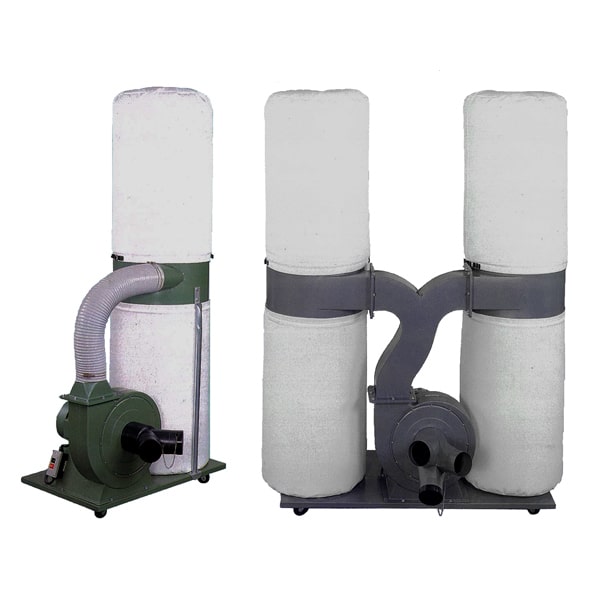
Quarterly hood velocity checks are a reasonable operational interval for most grinding workstations, not because a regulation prescribes it, but because it is the interval at which cumulative resistance from wear, partial blockages, and filter condition typically becomes detectable before it becomes severe. The check should be performed at the hood face with the system operating under normal load conditions, not with filters recently cleaned or replaced. Both instruments — the differential pressure gauge and the periodic hood measurement — serve different functions: one detects the leading indicator of filter loading, the other confirms whether the downstream effect has reached the capture point. Neither substitutes for the other. For installations where a portable dust collector is used at multiple workstations, the same monitoring logic applies to each deployment position, since hose length and configuration vary and alter delivered velocity at each location.
Tie specification to the real workstation geometry
The required airflow to achieve a given capture velocity is not fixed — it is determined by the geometry of the workspace around the dust source. A grinding booth with side panels and a partial roof contains the dust field and reduces the influence of ambient air movement, which means the same capture velocity can be achieved with less total airflow than would be needed at an open bench. This is a direct engineering trade-off with cost and energy implications: enclosure investment reduces fan size, duct capacity, and operating energy over the life of the installation.
The practical consequence for specification writing is that a CFM requirement written without reference to the actual workstation configuration is ambiguous. An open-bench setup and a semi-enclosed booth require different airflow volumes to achieve the same source capture outcome. Specifying CFM without specifying enclosure geometry gives a supplier room to quote a system optimized for one condition that will be installed in the other. The specification should name the workstation geometry explicitly — table dimensions, enclosure panels if present, maximum workpiece size, and expected operator position — so that the airflow calculation is grounded in the actual installation rather than an assumed default. The NIOSH guidance on controlling hazardous dust during concrete grinding reinforces this point directly: proximity of the collection inlet to the dust source, and the geometry of the grinding shroud or enclosure, are treated as primary control variables, not secondary details to be resolved after equipment selection.
The specification decisions that determine whether a dust control system actually protects workers at the grinding wheel are mostly made before equipment is quoted: where the hood sits relative to the source, what enclosure geometry surrounds the workstation, how much pressure reserve the fan carries for dirty-filter conditions, and what transport velocity the duct must maintain to keep particles moving. Each of these inputs changes the required equipment in ways that a fan-curve review at commissioning cannot retroactively fix.
Before issuing an RFQ, confirm that the specification names capture velocity at the hood face, maximum standoff distance, workstation geometry, and a post-installation hood measurement as an acceptance condition. These four items distinguish a specification that can be verified from one that can only be reviewed on paper — and that distinction is where most underperforming systems trace their failure back to.
Frequently Asked Questions
Q: What if the workstation layout cannot be changed and the hood cannot be positioned close to the grinding wheel?
A: Distance is the strongest lever against capture performance, so if standoff cannot be reduced, the geometry must compensate elsewhere. A partial enclosure — side panels, a back wall, or a shroud around the workpiece — contains the dust field and reduces the airflow volume needed to achieve the same capture velocity at a greater distance. Accepting a fixed large standoff without enclosure compensation means the required CFM climbs nonlinearly and the fan must be significantly upsized; that cost typically exceeds the cost of adding enclosure panels, making geometry investment the more practical corrective path.
Q: At what point does specifying a higher capture velocity stop improving outcomes and start creating new problems?
A: Capture velocity above approximately 2,500 fpm at the grinding wheel can begin to re-entrain settled dust from surrounding surfaces and draw it toward the worker rather than into the hood — the opposite of the intended effect. High face velocity also increases noise and energy consumption without proportional capture benefit. The 2,000–2,500 fpm range represents a design band where ejected particle momentum is overcome without triggering re-entrainment; exceeding it meaningfully should prompt a geometry review rather than continued velocity escalation.
Q: Is a downdraft grinding table a better choice than a freestanding hood for controlling cross-drafts and workpiece obstruction?
A: For workpieces that change size or orientation frequently, a downdraft table generally handles both problems more reliably than a repositionable hood. The table draws air downward through the work surface, which means the capture zone moves with the workpiece rather than requiring the operator to reposition the pickup. This geometry is also inherently less sensitive to cross-drafts because the capture direction opposes lateral air movement rather than competing with it. The trade-off is that downdraft tables are fixed workstations; where portability across multiple locations is required, a portable collector with a well-fitted shroud is the more practical option, though it demands stricter monitoring of delivered velocity at each deployment position.
Q: Once the specification passes post-installation hood velocity measurement, what should the buyer do next to protect that baseline?
A: Establish a documented baseline measurement record on day one — hood face velocity with a representative workpiece in place, differential pressure across the filter bank, and duct configuration as-installed — so that future quarterly checks have a confirmed reference point to compare against rather than the original design figure alone. Without that as-installed baseline, it becomes difficult to distinguish normal filter loading from a configuration change or partial blockage that has shifted the system away from its commissioned state. This record also supports any future regulatory or audit review without requiring re-derivation from the original specification.
Q: Does this specification approach apply equally to wet grinding operations, or does water suppression reduce the capture velocity requirement?
A: Wet suppression reduces airborne dust concentration at the source but does not eliminate the need for exhaust capture, and it introduces different complications — mist and humidity load the filter differently and can cause duct corrosion if transport velocity or drainage is not accounted for in the design. The capture velocity thresholds referenced for dry grinding apply to dry operations; wet grinding systems require a parallel humidity and mist management specification rather than simply a lower capture velocity target. Treating wet suppression as a substitute for exhaust specification rather than a complement to it is a common planning gap that leaves residual fine-particle exposure uncontrolled.