Treating filtrate as inherently reusable because it looks clear is one of the more common process assumptions that creates problems downstream. A filter press can produce visually transparent effluent while still carrying fine suspended solids, off-spec pH, or residual conditioning chemistry — none of which is visible, and all of which can degrade a downstream process, foul recirculation equipment, or produce an audit record that cannot be defended. The actual reuse decision depends on concurrent measurement of at least three parameters, and missing any one of them at the sampling stage means the routing call is made on incomplete information. By the end of this article, you should be able to identify which filtrate streams are candidates for direct return, which need buffering or clarification first, and what conditions should trigger diversion rather than reuse.
Separate filtrate clarity from complete reuse readiness
Clarity is a necessary condition for reuse, not a sufficient one. The distinction matters operationally because plants that have qualified a filtrate stream for reuse under one set of conditions often continue routing it to the process loop after upstream changes — a recipe adjustment, a conditioning agent switch, a cloth wear cycle — without re-verifying that the filtrate still meets the criteria it was originally qualified against.
Solids ppm and pH are the minimum measurement pair that defines whether clarity translates into actual reuse readiness. A filtrate stream measuring below a defined solids threshold with pH in the acceptable band for the receiving process is a candidate for direct return. A stream that passes a visual check but has not been sampled for both of these parameters has not been evaluated — it has been assumed. The difference matters most at the point when something changes upstream, because that is precisely when a previously compliant stream may quietly shift out of tolerance.
Reuse readiness should be treated as a condition that is re-verified against actual process state, not a one-time qualification that holds permanently. Plants that build this into their operating procedure — including documenting what triggered the last re-check — tend to have a much easier time demonstrating that their reuse routing is defensible when an EHS review or audit requires it.
Test pH solids and turbidity before direct return
Direct return should not begin until at least pH, suspended solids, and turbidity have been measured on an actual sample from the press under operating conditions. Each of these tests addresses a different failure mode, and they are not interchangeable.
pH matters because filtrate that is outside the tolerance of the receiving process — a reaction tank, a rinse circuit, a recirculation loop — can shift the chemistry of that system incrementally before anyone notices. Final pH adjustment may be required before filtrate can be returned or discharged, and this step should be treated as a design requirement for the reuse circuit rather than an afterthought. For turbidity measurement methodology, ISO 7027-1:2016 provides a reference framework; for suspended solids determination, ISO 11923:1997 covers the applicable method — neither governs reuse eligibility directly, but both support the measurement consistency needed to make the reuse routing defensible.
High fine-particle content — silt, clay, or fine mineral residue — is a risk that solids testing catches before it causes cloth degradation or clarity failure at the point of return. Slurries with elevated fines tend to produce filtrate that reads visually clear while still carrying enough suspended material to affect downstream equipment. Testing at commissioning is not enough; the solids content of filtrate can shift as feed composition changes or as cloth condition deteriorates.
| Test | Why It Matters | Potential Consequence if Skipped |
|---|---|---|
| pH | pH must be within process tolerance before reuse or discharge; final adjustment may be required | Out-of-spec pH can harm downstream processes or violate discharge limits |
| Solids (turbidity) | High fine particles (silt, clay) can clog filter cloths and compromise filtrate clarity | Undetected solids lead to cloth degradation, poor clarity, and reuse-quality failure |
When all three parameters are within defined limits, direct return is supportable. When any one falls outside, the routing decision needs to account for that gap — either through treatment before return, or through diversion to a lower-sensitivity destination.
Route unstable filtrate through buffer or clarification
Not all filtrate is stable enough to return to the process loop without an intermediate step. Streams that show intermittent pH excursions, variable solids loading, or inconsistent turbidity between press cycles are candidates for a buffer or clarification stage rather than direct return.
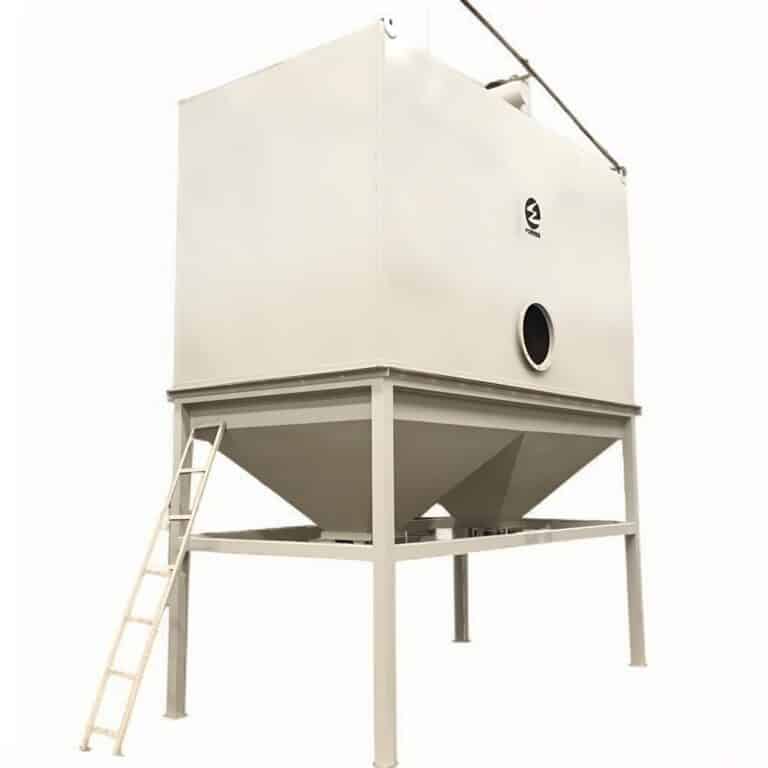
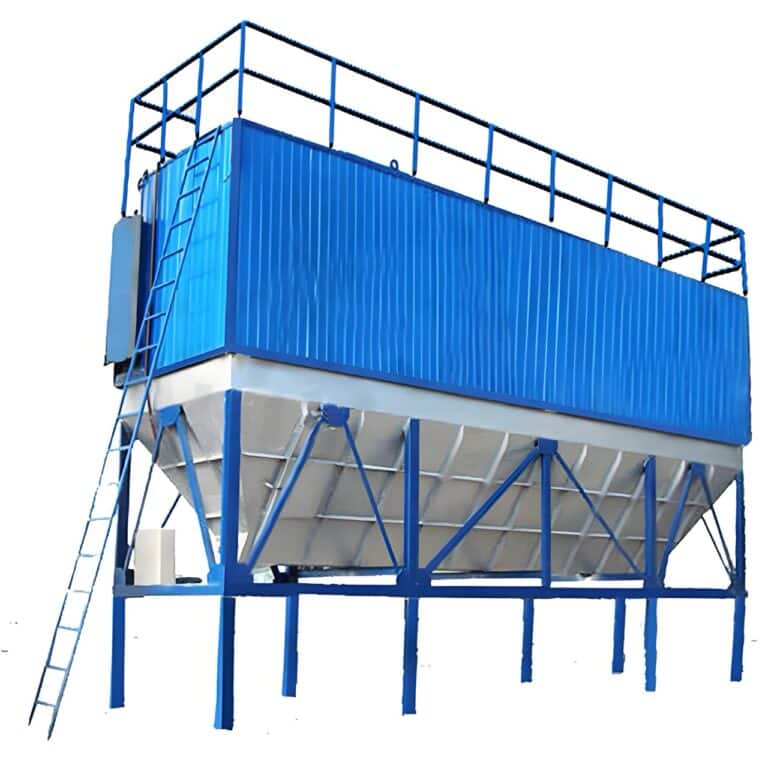
A buffer tank introduces residence time, which allows solids to settle and pH to be corrected before the water enters the reuse circuit. This is a practical design choice for systems where the feed to the press varies between batches or shifts — the buffer absorbs the variation before it propagates downstream. For systems with higher solids carryover or wider pH swings, a clarification step may be more appropriate. A vertical sedimentation tower used in the reuse circuit can provide the settling capacity needed to bring intermittent filtrate streams within tolerance before they reach sensitive process points.
The practical trade-off is footprint and operating complexity versus protection of the reuse loop. A buffer tank adds residence time but does not actively treat chemistry. A clarification stage adds both settling capacity and the possibility of chemical correction, but requires dosing management. The choice between them depends on how wide the variability is and how sensitive the downstream process is to incoming water quality — neither is universally correct, and the right answer depends on what the filtrate is actually doing under operating conditions.
Watch chemical carryover from conditioning changes
Carryover from conditioning agents is the failure mode that tends to surface late. When dewatering aids or pH-adjustment chemicals are introduced or changed upstream of the press, the filtrate composition shifts in ways that are not visible and are unlikely to be caught unless sampling is done specifically after the change.
The risk is not theoretical but it is not guaranteed in every case. Whether carryover reaches a level that harms the reuse process depends on the additive, the dosing rate, how completely it reports to the cake, and what the downstream process is sensitive to. What makes it a reliable planning concern is that the shift happens at the moment of the change, and plants that sample filtrate on a routine schedule — rather than after a specific trigger — may miss the window when carryover is highest.
| Source of Carryover | Typical Additives | Why Monitoring Matters |
|---|---|---|
| Dewatering aids | Perlite, diatomaceous earth, hydrated lime | Additives can change filtrate composition and contaminate water intended for reuse |
| Data center cooling blowdown | Biocides, corrosion inhibitors, anti-scaling chemicals | Chemical residuals may harm sensitive reuse processes if not evaluated |
The practical monitoring implication is straightforward: any time conditioning chemistry is introduced or changed, filtrate sampling should be repeated before the stream continues to the reuse loop. This applies to initial commissioning of a new additive, to dosing adjustments made in response to poor cake dryness, and to changes in feed composition that prompt a conditioning chemistry review. The filtrate management guidance applicable to filter press operations gives further context on how to structure this monitoring within normal press operating cycles.
Match filtrate return to tank volume and production demand
Filtrate return is a hydraulic balance problem as much as a quality problem. If the press cycle produces filtrate faster than the reuse circuit can absorb it, the excess has to go somewhere — and if that destination is not defined in advance, it typically ends up being routed informally in ways that create audit problems later.
The volume of filtrate a press generates per cycle depends on feed solids concentration, press chamber volume, cycle frequency, and cake dryness. In high-throughput operations running multiple press cycles per shift, the aggregate return volume can be substantial relative to a recirculation tank, particularly if that tank also receives process water from other sources. Sizing the buffer or return tank to accommodate the filtrate contribution without overflowing or diluting the process stream to the point of affecting quality is a design step that is easy to underweight during layout.
The production demand side of the balance matters equally. A reuse tank that is sized to accept filtrate return but feeds a process with intermittent draw — batch washing, periodic rinse cycles — will accumulate volume during idle periods and may not cycle fast enough to prevent stagnation or quality drift. Matching return flow rate and tank volume to the actual draw pattern of the downstream process is a commissioning check that should be verified under real production conditions, not estimated from design flow rates alone.
Keep press operation from shocking the reuse loop
Each press cycle has a hydraulic signature — filtrate flows out unevenly across a cycle, with higher flow rates early and lower flow rates as the cake builds and resistance increases. If the reuse loop is not designed to absorb this pulse, each cycle becomes a small shock to tank level and, potentially, to process chemistry in the receiving vessel.
Filtration pressure is the operational variable with the clearest quality implication. Operating above roughly 1.5 to 2 bars can push fine particles through the filter cloth, degrading filtrate quality without triggering any press fault or alarm. This is a design figure derived from operational experience rather than a universal regulatory limit — the exact threshold at which fine particle breakthrough becomes significant depends on cloth specification, feed particle size distribution, and the press configuration in use. What it means practically is that a press running at elevated pressure while appearing to operate normally may be sending off-spec filtrate to the reuse loop without any visible indication that something has changed. Pressure control and periodic filtrate sampling during high-pressure operation are the checks that catch this before it affects the downstream process.
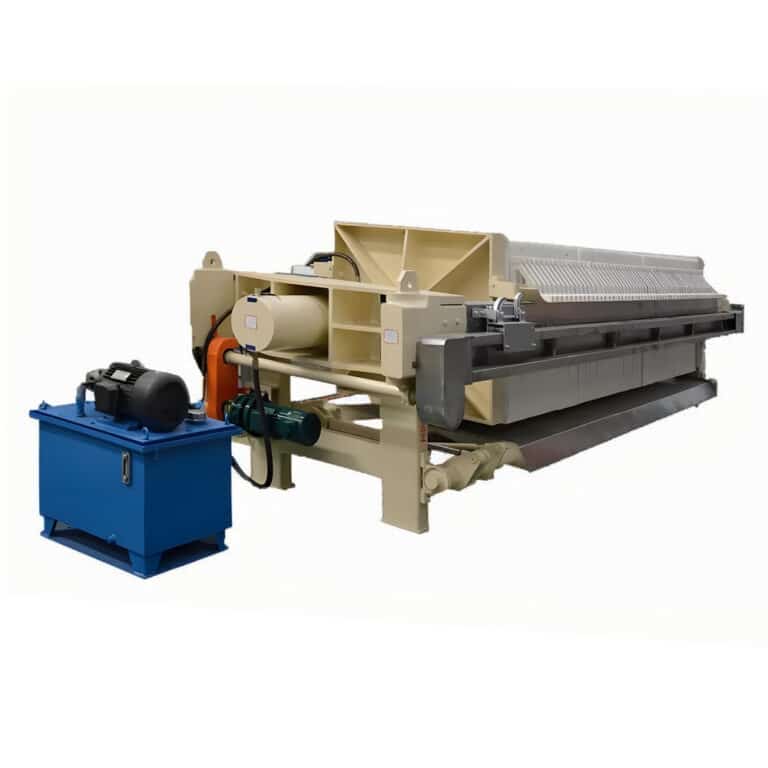
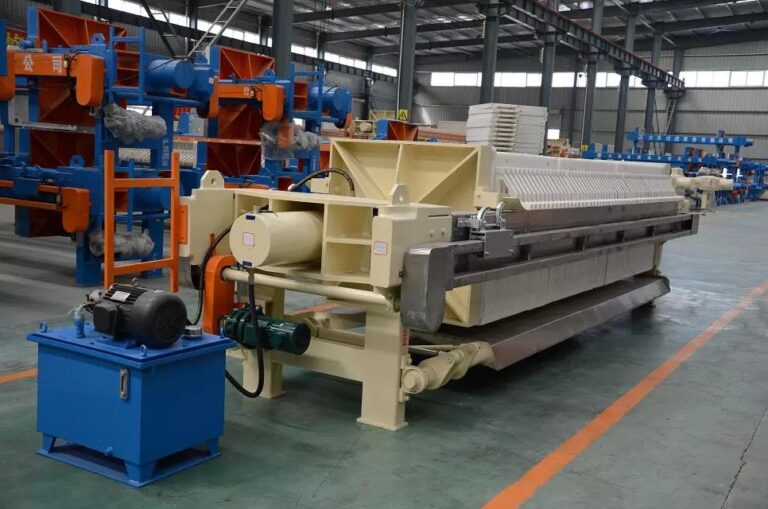
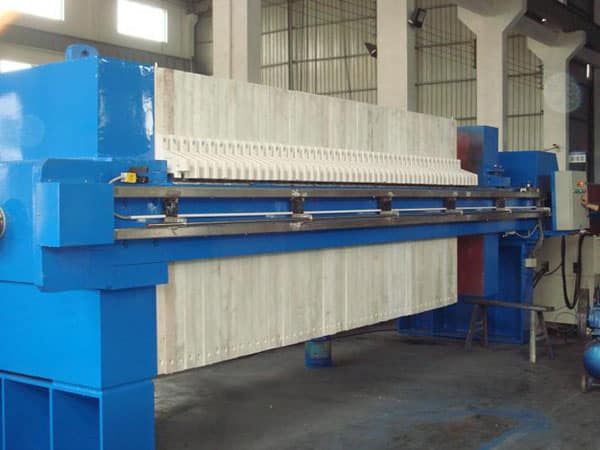
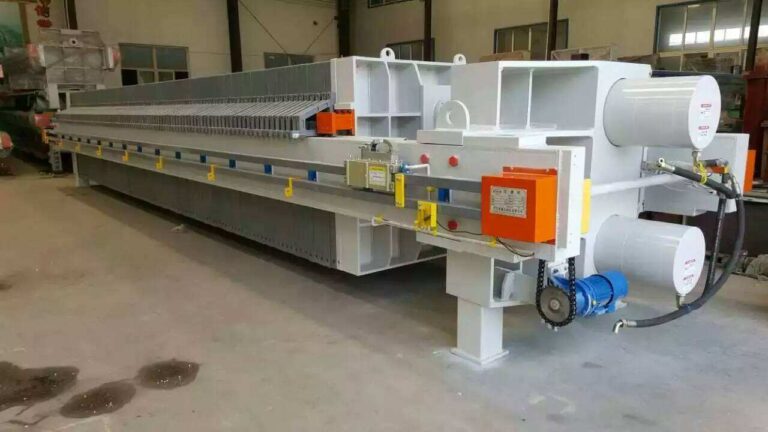
Membrane press configurations can help here because the membrane squeeze step can consolidate the cake and reduce late-cycle pressure requirements for equivalent cake dryness — but this depends on feed properties and press setup. For operations where cake dryness and filtrate quality both matter, a membrane filter press gives more control over the pressure profile across a cycle than a recessed plate design, which is worth considering when the reuse loop is sensitive to filtrate quality variation between cycles.
Define the rule for when filtrate is diverted
Every reuse system needs a defined diversion rule — a set of conditions under which filtrate is redirected rather than returned, and a specified destination for that diverted stream. Systems that operate without this rule tend to work informally until an audit, a downstream process upset, or a personnel change makes the informal routing impossible to reconstruct or defend.
The diversion trigger should be expressed in measurable terms. Solids ppm is the most practical primary metric because it can be measured directly and compared against a defined threshold — the specific cutoff should be set per system based on downstream process tolerance, not adopted as a universal number. pH outside a defined band and turbidity above a set level serve as secondary triggers. The key is that the threshold is written down, the measurement is being taken, and the person operating the system knows what to do when the number is exceeded.
Diversion destinations determine what happens to out-of-spec filtrate without interrupting press operation. The three practical options are non-critical reuse — rinse water for non-process surfaces, for example — pH correction followed by return, or routing back to the head of the wastewater treatment system for reprocessing. Each of these has different implications for operating cost, tank capacity, and treatment system loading. The choice among them should be made during design rather than during an upset event, because an upset is precisely the moment when informal decisions create records that are difficult to justify afterward. For context on how coagulation, settling, and reuse routing interact at the system level, the chemical dosing and clarifier alignment article addresses how these stages connect upstream of the press and can affect what arrives at the filtrate end.
The central implication of managing filtrate return is that reuse eligibility is not a stable property of the press — it is a condition of the filtrate stream at a given moment under a given set of process inputs. Establishing direct return as a qualified route at commissioning is a starting point, not a permanent clearance. The conditions that qualified it — feed composition, conditioning chemistry, cloth age, operating pressure — will drift, and the reuse routing decision needs to be re-evaluated whenever any of those conditions changes materially.
Before defining your filtrate return scheme, confirm what downstream process the filtrate will feed and what its actual quality tolerances are for solids, pH, and turbidity. Define the diversion trigger and the diversion destination before commissioning, not after the first upset. And treat any change in upstream conditioning chemistry as an automatic prompt to resample the filtrate — it is the category of change most likely to produce a quality shift that is invisible until it has already affected something downstream.
Frequently Asked Questions
Q: Our ceramic wastewater feed composition changes significantly between production runs — does that mean filtrate reuse eligibility needs to be re-evaluated for every batch?
A: Yes, re-evaluation is required whenever feed composition changes materially. Filtrate quality is a condition of the current process state, not a stable property of the press. A batch with different solids loading, particle size distribution, or conditioning chemistry can produce filtrate that falls outside the tolerances established during a previous qualification run, even if the press itself is operating identically. The practical approach is to treat any significant feed change as an automatic trigger to resample pH, suspended solids, and turbidity before continuing direct return.
Q: If filtrate meets the pH and solids thresholds but the reuse tank is already at capacity, what is the least disruptive diversion path that avoids creating an audit problem?
A: Routing the excess filtrate back to the head of the wastewater treatment system is the most defensible option when tank capacity is the constraint rather than water quality. This keeps the volume within the documented treatment boundary, avoids informal disposal decisions made under time pressure, and does not require a separate quality justification for the diverted stream. The important step is defining this path before commissioning — a diversion destination decided during an upset event is difficult to reconstruct and justify afterward.
Q: Does switching from a recessed plate configuration to a membrane press meaningfully reduce the risk of sending off-spec filtrate to the reuse loop?
A: It can, but only under the right feed conditions. A membrane press gives more control over the pressure profile across a cycle because the membrane squeeze step can consolidate the cake without requiring the elevated filtration pressure that tends to push fine particles through the cloth. However, the quality benefit depends on feed particle size distribution and press setup — it is not automatic. If filtrate quality variation between cycles is the primary concern for a sensitive reuse loop, a membrane configuration is worth evaluating specifically for that scenario rather than assumed to resolve it by default.
Q: What happens to filtrate quality when the filter cloth is approaching the end of its service life but has not yet failed outright?
A: Cloth wear is a gradual failure mode that can degrade filtrate quality before any press fault or alarm signals a problem. As the cloth ages, its ability to retain fine particles decreases, which means solids ppm in the filtrate can rise incrementally without any visible change in press operation. This makes periodic filtrate sampling during normal operation — rather than only at commissioning or after an obvious process change — the only reliable way to catch cloth-related quality drift before it reaches the reuse loop or downstream equipment.
Q: Is there a point at which the treatment and monitoring overhead of a filtrate reuse circuit outweighs the water savings, particularly for smaller ceramic operations?
A: For smaller operations with low press cycle frequency, the overhead of buffer tanks, clarification equipment, and structured sampling protocols can approach or exceed the cost value of the recovered water, especially if municipal or process water supply costs are low. The break-even depends on local water costs, discharge compliance obligations, and whether a clarification stage would have been required for discharge anyway — in which case the marginal cost of qualifying the treated stream for reuse rather than discharge is much lower. Operations where discharge treatment is already mandatory tend to find filtrate reuse easier to justify because the core treatment infrastructure is not an additional cost.