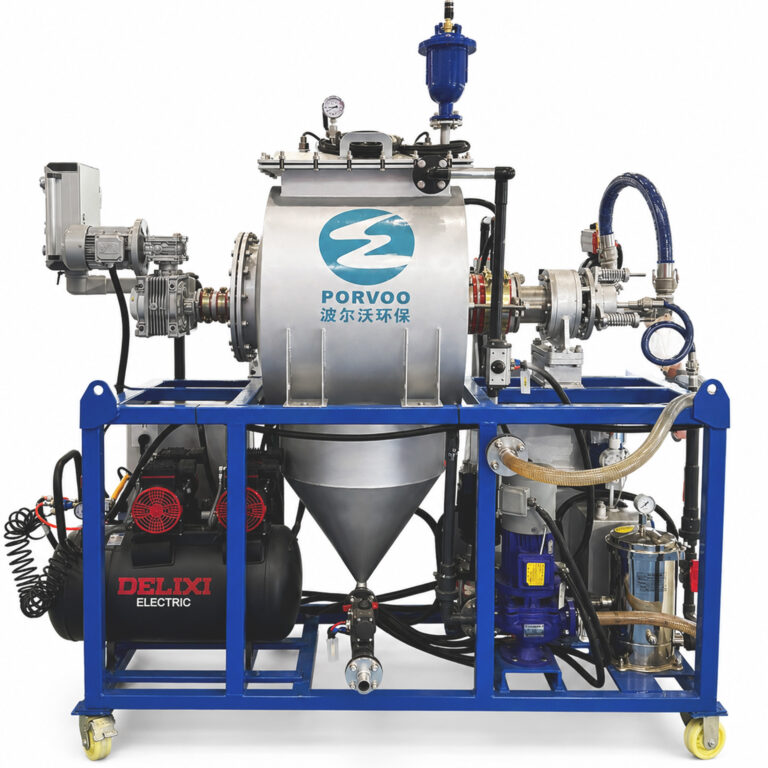
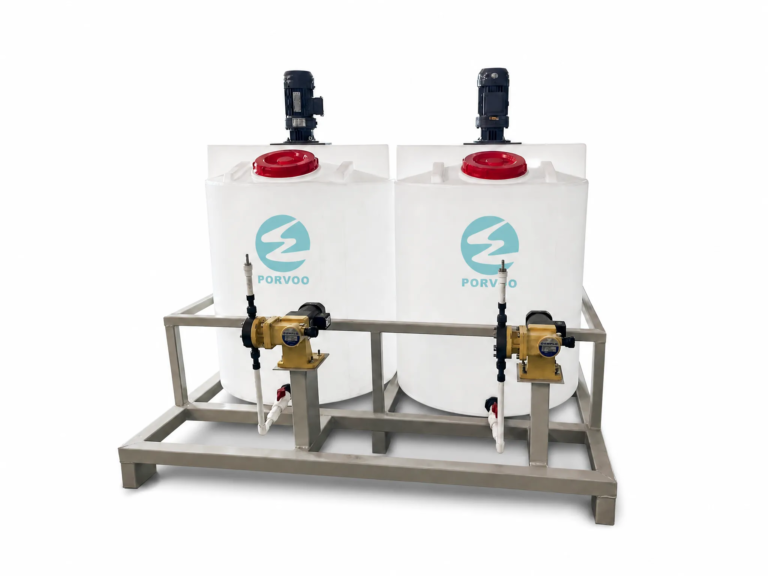
Buying grit removal, dosing, sedimentation, and pressing equipment as separate line items—without confirming the sequence first—is where most stone cutting wastewater projects accumulate rework. Pumps that see coarse abrasives before any separation stage wear ahead of schedule, coagulation tanks loaded with sand-sized particles cannot produce the clean decant that reuse circuits depend on, and filter presses fed inconsistent sludge density cycle inefficiently or produce wet cake that creates a secondary disposal problem. The sequence itself is the design: each stage sets the feed condition for the next, and a gap or inversion in that order propagates downstream in ways that are expensive to correct after layout is fixed. What follows gives process engineers and procurement teams a way to judge whether a proposed system is sequenced correctly before committing to equipment.
Remove grit before chemical treatment and fine clarification
Coarse grit entering a coagulation tank is not a process problem that chemistry can solve—it is an abrasion and loading problem that chemistry will make worse. Al₂(SO₄)₃ and PAM are formulated to aggregate fine suspended particles in the colloidal and silt range. When stone chips, saw dust, and angular grit larger than 200 μm are present in the same vessel, the coagulant demand rises unpredictably, floc structure is disrupted by settling coarse material, and the abrasive fraction accelerates wear on impellers, pump casings, and any instrumentation in the line.
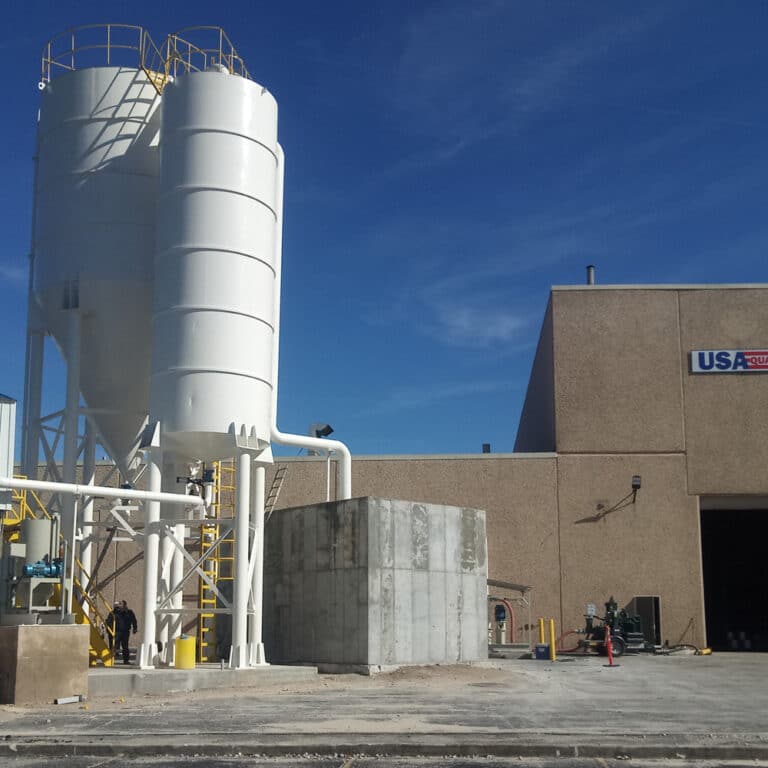
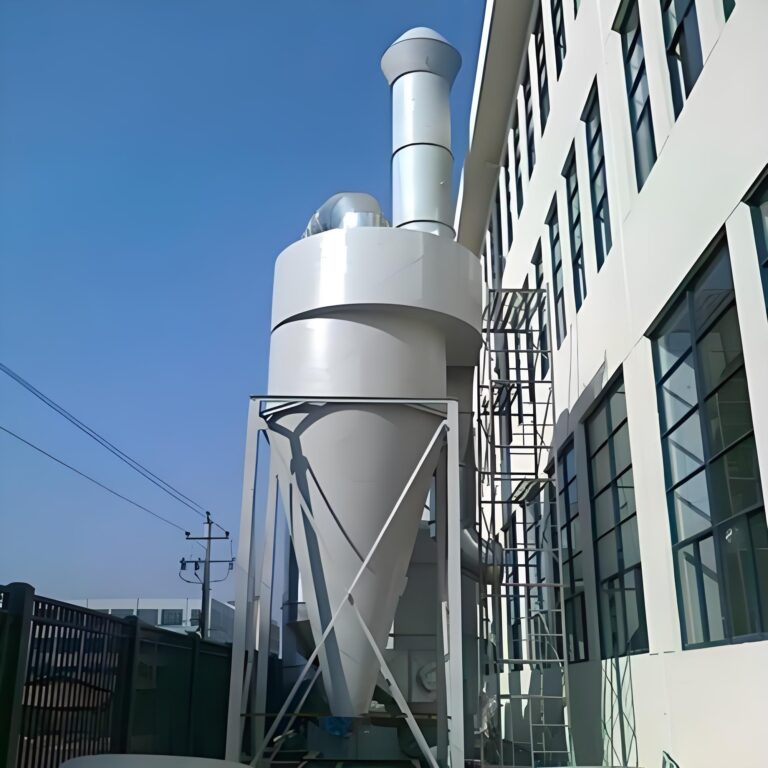
Hydrocyclone-based grit removal can achieve 90–90.4% separation efficiency for particles below 200 μm, with separation improving as input pressure increases. That range is a design-planning input, not a guaranteed outcome for every influent condition; actual efficiency depends on particle density, size distribution, and feed consistency. The more operationally relevant figure is throughput capacity: the two common hydrocyclone geometries carry maximum passing flow rates of 203 ml/s and 268 ml/s respectively, both increasing with pressure. For a shop running at the high end of typical daily volumes, a single hydrocyclone unit may be undersized, and staging or parallel units needs to be evaluated during system design rather than added as a field modification after commissioning.
| Параметр | Значение | Примечания |
|---|---|---|
| Separation efficiency (particles <200 μm) | 90–90.4% | Improves with increasing input pressure |
| Max passing flow rate (Geometry 1) | 203 ml/s | Increases with input pressure |
| Max passing flow rate (Geometry 2) | 268 ml/s | Increases with input pressure |
The downstream implication of undersizing this stage is not just equipment wear—it is that the dosing and settling stages inherit a feed stream they were not sized for. Grit that bypasses the separation stage settles in the sedimentation tank as a dense, abrasive sediment layer that interferes with conical withdrawal and shortens withdrawal valve service intervals. Treating grit removal as a cost-reduction candidate in a value-engineering exercise typically transfers the cost to pump replacement and settling tank maintenance within the first operating year.
Use PAM/PAC dosing to settle fine stone solids
After grit is removed, the remaining suspended load consists of fine stone particles—silica dust, mineral fines, slurry carryover—that do not settle by gravity alone within any practical tank residence time. This is where coagulation and flocculation chemistry does its work, and where mismatched dosing creates the most visible operational failure: a settling tank that produces cloudy decant instead of clarified water.
Aluminum sulfate has a well-documented limitation in this application: its hydrolysis rate is extremely slow under the pH and temperature conditions typical of stone cutting wastewater. Slow hydrolysis means the coagulant charge neutralization that initiates particle aggregation is delayed, and fine stone particles remain in suspension longer than the tank’s hydraulic retention time allows. Treating this as an edge case rather than a baseline operating condition leads operators to underdose PAM on the assumption that the coagulant is doing more work than it actually is. The consequence is a floc that is too weak to settle efficiently, recycled water that carries enough residual fines to damage diamond tooling and precision surfaces, and a sedimentation tank that accumulates unsettled solids until turbidity in the decant exceeds reuse tolerance.
| Химические | Role | Ключевое соображение |
|---|---|---|
| Aluminum sulfate (Al₂(SO₄)₃) | Коагулянт | Extremely low hydrolysis rate causes slow settling; flocculant pairing is critical |
| Polyacrylamide (PAM) | Флокулянт | Aggregates fine stone particles; dose must match coagulant performance |
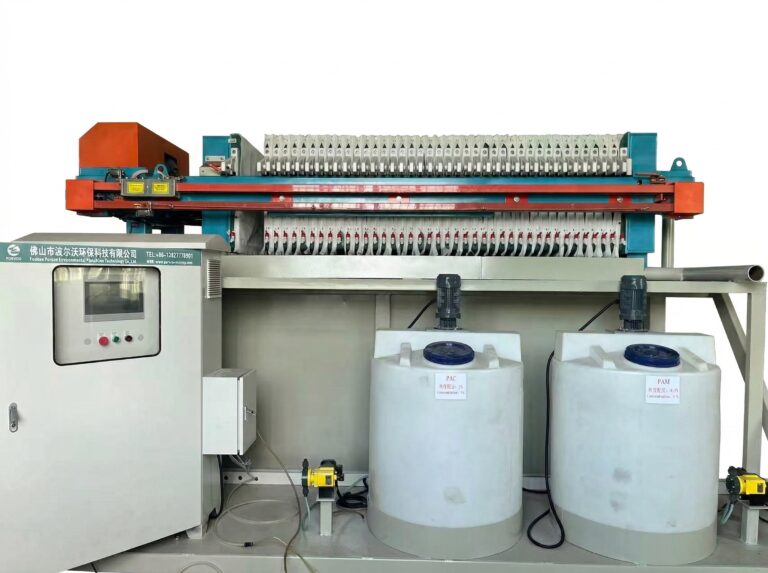
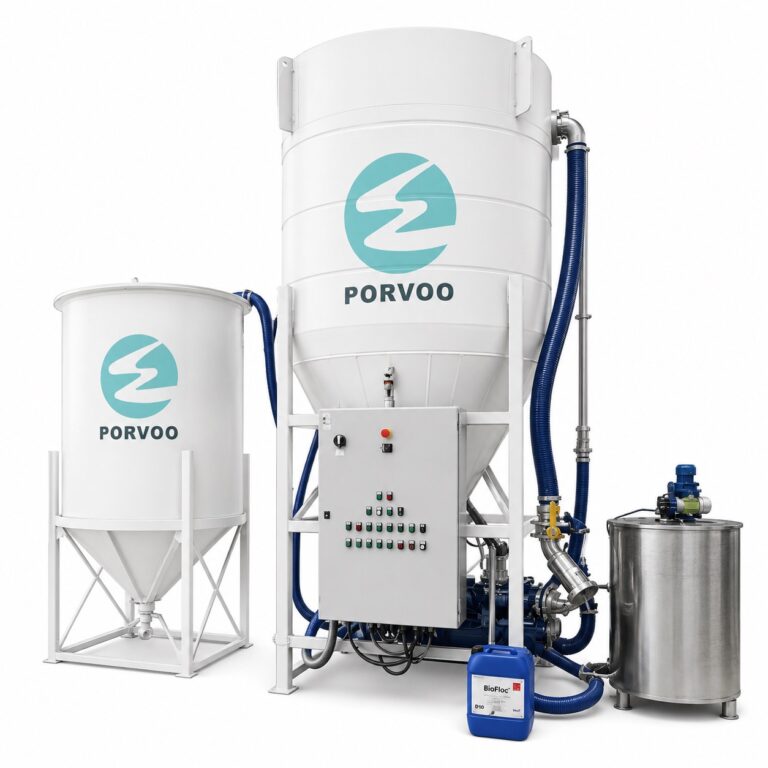
PAM dose must be calibrated against actual coagulant performance under site conditions, not against a generic flocculant dosing table. The practical check is jar testing with the actual influent before finalizing dosing pump sizing—an интеллектуальная система дозирования PAM/PAC that adjusts feed rate based on real-time flow and turbidity feedback reduces the risk of under- or over-dosing as influent quality varies across a production shift. Over-dosing PAM creates its own problems: excess polymer in the filtrate increases chemical oxygen demand, complicates reuse routing, and may require additional treatment before discharge.
Keep sedimentation and sludge withdrawal synchronized
Sedimentation tank performance is commonly evaluated at the water surface—turbidity of the decant is visible, measurable, and easy to report. What is less visible is whether the sludge accumulation rate at the tank floor is being matched by withdrawal rate, and this mismatch is where a system that looks stable on clarified water quality quietly develops a feed problem for the filter press.
Conical tank geometry concentrates settled solids at the base, which is a practical configuration choice that makes timed or continuous withdrawal mechanically straightforward. The operational risk is not in the geometry—it is in the withdrawal schedule. If sludge is withdrawn too infrequently, solids inventory builds until the tank’s effective clarification volume shrinks, residence time decreases, and decant quality deteriorates. If withdrawal is too frequent relative to settling rate, dilute sludge enters the thickening stage before adequate consolidation has occurred, reducing the density benefit that thickening is supposed to provide before pressing.
The synchronization problem becomes most acute when production volume fluctuates across shifts. A stone cutting facility running at 60% capacity in the morning and full capacity in the afternoon generates different sludge accumulation rates that a fixed withdrawal interval will not track correctly. Withdrawal timing should be reviewed against actual settling observations, not set once during commissioning and left unchanged. In systems where the sedimentation tank feeds directly to a filter press without an intermediate thickener or buffer tank, the margin for withdrawal timing error is narrow: a withdrawal lag of even a few hours at high production rates can result in the press receiving sludge at a consistency outside its operating range.
Press sludge without starving or flooding the system
Filter press operation depends on receiving sludge within a defined feed density window. Outside that window—too dilute or too concentrated relative to the press’s design feed—the press either cycles without filling chambers effectively, or accepts an overloaded feed that produces wet cake exceeding the target moisture threshold.
Thickening sludge in a settlement tank before pressing can reduce volume by up to 50%, which functions as a buffer that normalizes feed density and prevents the press from being flooded during peak sludge generation periods. This figure is a planning input from operational practice, not a guaranteed outcome; actual volume reduction depends on solids concentration, particle characteristics, and retention time. Its design value is that it decouples the sedimentation stage’s variable output from the filter press’s need for consistent feed, reducing the frequency of incomplete press cycles. Without this buffer, a press connected directly to a high-production sedimentation tank will experience feed-density variation that produces inconsistent cake, increased cycle time, and higher residual moisture than the system’s target.
| Сцена | Цель | Примечания |
|---|---|---|
| Thickening in settlement tank | Volume reduction up to 50% | Prevents overloading the filter press |
| Filter press dewatering (typical) | Water content around 20% | Sets the operational moisture target |
| Filter press dewatering (optimal) | Residual moisture below 15% | Higher-performance benchmark |
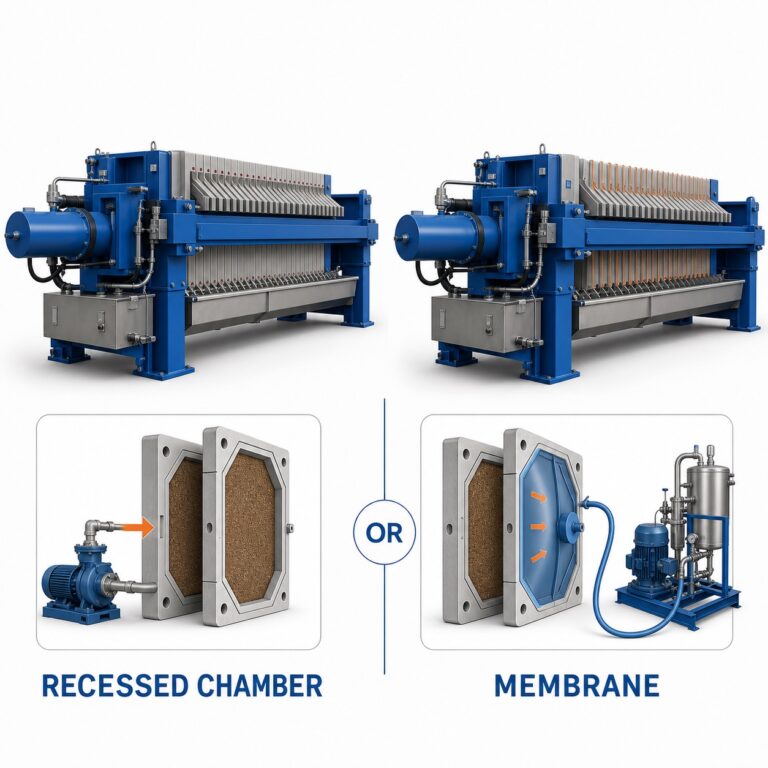
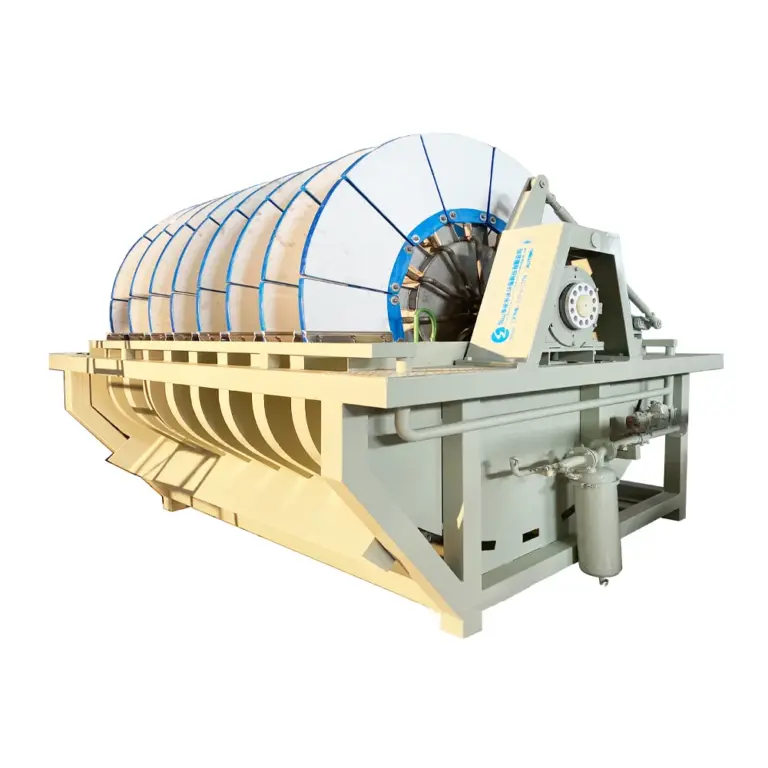
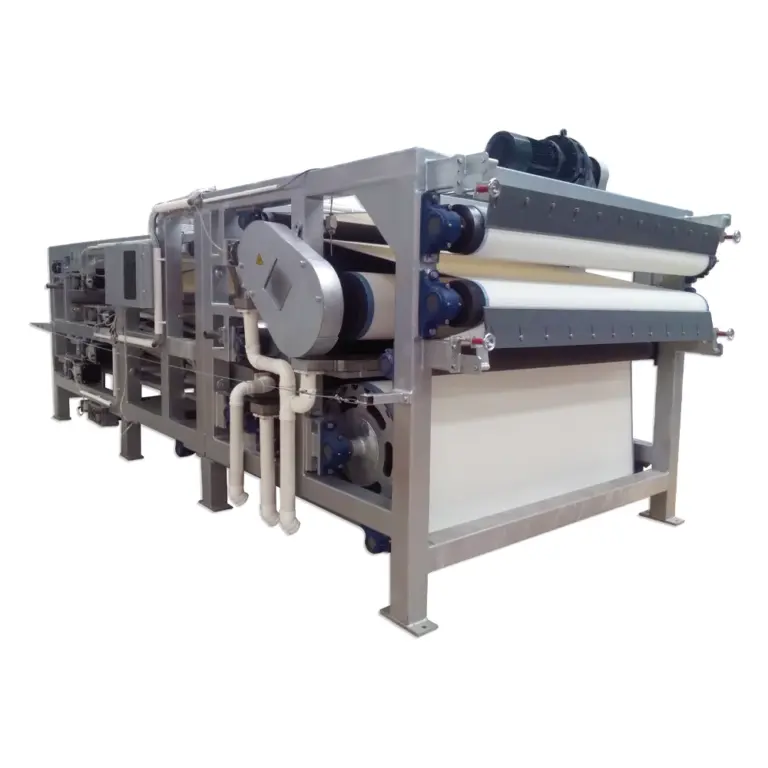
For stone cutting sludge, filter press dewatering to around 20% water content is an operational target that most recessed plate configurations can achieve under consistent feed conditions. Below 15% residual moisture is achievable as a higher-performance benchmark but requires feed density to remain within a narrower range throughout the press cycle. The practical trade-off is that chasing the lower moisture figure places more demand on the thickening and withdrawal synchronization upstream—any disruption to feed consistency propagates directly into cake quality. Teams specifying a пластинчато-рамный фильтр-пресс с углублением for stone cutting sludge should confirm that the feed pump sizing and press chamber volume are matched to the thickened sludge density, not to the raw sedimentation tank output.
Route filtrate by quality and reuse tolerance
A 90% water recovery rate under favorable conditions is a reasonable planning ceiling for this type of treatment sequence, but it should be used to justify investment in filtrate routing infrastructure, not to set a guaranteed operating target. The figure is sensitive to influent quality, chemical dosing accuracy, press performance, and whether the clarified decant and press filtrate are treated as a single combined stream or routed separately.
The routing decision matters because clarified water from the sedimentation decant and filtrate from the filter press are not equivalent in quality. Decant from a well-performing sedimentation stage is typically lower in suspended solids and suitable for direct reuse in cutting water circuits or equipment washdown where some residual turbidity is acceptable. Press filtrate, depending on cake formation quality and cloth condition, may carry higher fines concentrations and require routing to the influent of the treatment train rather than directly to reuse. Treating both streams as interchangeable at the reuse collection point without measuring them separately is a common design shortcut that causes reuse water to carry more suspended solids than tooling and saw blades can tolerate.
Side-decant from a sedimentation vessel is one straightforward mechanism for separating clarified water from the settling zone, but the routing decision has to be made upstream of layout—not retrofitted after the reuse tank is already plumbed to a single combined return line. If the facility needs to segregate high-quality reuse water from lower-quality return-to-treatment streams, that separation has to be built into the piping and tank arrangement from the beginning. Adding segregation after installation typically requires re-routing lines, adding tankage, and re-commissioning the dosing control logic.
Monitor turbidity pH and solids through the train
Monitoring at a single point—usually the sedimentation decant, because it is the most visible—gives an incomplete picture of where the treatment train is performing or degrading. Each stage transition carries diagnostic information that a single endpoint measurement cannot recover.
Post-grit-removal turbidity and suspended solids give early warning if the hydrocyclone stage is underperforming or if a geometry is undersized for the current production rate. Post-dosing conditions, particularly pH, indicate whether coagulant hydrolysis is proceeding under favorable chemistry; Al₂(SO₄)₃ performance is pH-sensitive, and a pH shift caused by influent composition changes can suppress coagulation without any other visible symptom until decant turbidity deteriorates. Post-settling measurement before the sludge withdrawal stage confirms whether the sedimentation tank is producing the clarified decant the reuse circuit requires or whether dosing needs adjustment. Press filtrate should be checked separately from sedimentation decant, as described above.
Turbidity measurement methodology should follow a consistent test protocol across the train to make stage-to-stage comparisons meaningful; ISO 7027-1:2016 provides a reference framework for turbidity determination in water quality testing. For wastewater sampling practice, ISO 5667-10:2020 describes sampling procedures relevant to industrial wastewater streams. Neither standard constitutes a compliance requirement specific to stone cutting facilities—they are testing-framework references that support consistent measurement across the train, which is what makes stage-transition monitoring operationally useful rather than just procedurally present.
Confirm the sequence before buying separate modules
The most common procurement error in stone cutting wastewater systems is purchasing equipment by function—a grit unit here, a dosing skid from a different supplier, a settling tank from a third, a press from a fourth—without confirming that those modules produce compatible output at each handoff. Incompatibility shows up at commissioning: grit unit discharge that is too dilute or too high-volume for the dosing stage’s retention time, a settling tank that is sized for the dosing chemistry but not for the grit unit’s throughput, a filter press that receives sludge at a density the chamber volume was not designed for.
The standard sequence—collect wastewater, separate solids to form slurry, decant clarified water, dewater sludge—defines the handoff conditions between modules, not just the order of steps. Each module’s output specification has to match the next module’s input specification before procurement is finalized. For a facility operating near 15,000 gallons per day—a reasonable scale reference for an average-sized stone shop—this matching exercise is not complex, but it requires that one person or team holds the full train specification rather than each module being specified in isolation by a different procurement contact.
| Контрольная точка | Что необходимо подтвердить |
|---|---|
| Standard process sequence | Ensure modules follow: collect wastewater → separate solids to form slurry → decant clarified water → dewater sludge |
| Skid-mounted availability | Confirm whether compact, turnkey filter-press plants are offered for quick installation |
| Daily water volume | Size the system for an average shop usage of up to 15,000 gallons per day |
Skid-mounted, pre-sequenced systems reduce integration risk by shipping the grit, dosing, settling, and pressing stages with confirmed handoff interfaces. This is a procurement and layout planning consideration, not a performance claim—a pre-configured system eliminates some of the inter-module specification work, but the buyer still needs to verify that the pre-configured sizing matches their actual daily volume and influent solids concentration before accepting a standard configuration. For operations with variable production schedules or seasonal stone type changes, confirming that the pre-configured sequence can handle the range of operating conditions is more important than confirming the nominal peak capacity alone.
For teams evaluating how this sequence integrates across different industrial solids-handling scenarios, the planning logic discussed in Процессы очистки сточных вод для заводов с тяжелыми твердыми частицами: Как последовательно проводить удаление песка дозированием, отстаиванием и прессованием provides additional context on stage-compatibility criteria.
The central judgment this process demands is not which equipment brand or pressure rating to select—it is whether each stage’s output is defined precisely enough to serve as the next stage’s design input. Grit removal efficiency sets the suspended solids load entering dosing. Dosing performance sets the floc quality entering settling. Settling rate and sludge withdrawal timing set the feed density entering the press. Press feed density sets whether cake moisture meets reuse or disposal targets, and filtrate quality sets which reuse circuit can accept the recovered water.
Before issuing RFQs for individual modules, confirm three things: the full sequence is agreed and documented as a single system specification rather than a collection of individual unit specs; the handoff parameters between each stage—flow rate, suspended solids concentration, pH range, sludge density—are written into the procurement scope rather than left to each supplier to assume; and the daily volume and solids load figures used for sizing reflect the actual operating range, not just the nominal design point. Those three confirmations prevent most of the commissioning rework and reuse-quality failures that this type of project encounters.
Часто задаваемые вопросы
Q: What happens if our stone cutting facility runs well below 15,000 gallons per day — does the full four-stage sequence still make sense at smaller volumes?
A: Yes, the sequence remains valid at lower volumes, but module sizing and whether each stage justifies a dedicated unit both change. Below a certain daily throughput, a single compact or skid-mounted unit may combine grit separation and settling into a shared vessel rather than running four fully separate pieces of equipment. The sequence logic — grit removal before dosing, dosing before settling, settling before pressing — does not compress away at smaller scale; what compresses is the physical footprint and the number of discrete units required to execute it. The key check is whether the combined unit’s internal stage separation maintains compatible handoff conditions, specifically that coarse solids are removed before chemistry is introduced.
Q: After commissioning is complete, what is the first operational parameter teams should track to know the system is running as designed?
A: Post-dosing turbidity measured before sedimentation is the highest-value early indicator. It confirms whether coagulant hydrolysis and floc formation are occurring under actual site conditions — influent pH, temperature, and solids load — rather than under the jar-test conditions used during design. If post-dosing turbidity is not dropping meaningfully relative to the grit-unit discharge, the problem is in coagulant chemistry or dose rate, and it can be corrected before the settling tank accumulates unsettled fines that require draining to remove. Catching this at the dosing-to-settling transition is significantly less costly than diagnosing it from cloudy decant at the reuse collection point.
Q: Does the advice about pre-sequenced skid-mounted systems still apply when the facility processes multiple stone types with significantly different mineral compositions?
A: Only partially. Pre-configured skids reduce integration risk for facilities with a stable, consistent influent, but variable stone types — granite versus marble versus engineered quartz, for example — produce fines with different particle densities, surface charges, and coagulant demand profiles. A standard skid configuration sized and chemically tuned for one stone type may produce wet cake or cloudy decant when the input changes substantially. For operations with meaningful stone type variation, the dosing stage needs to be adjustable in real time rather than set to a fixed rate, and the pre-configured sizing should be verified against the full range of anticipated influent compositions, not just the nominal stone type used during system design.
Q: Is a filter press the right dewatering choice for stone cutting sludge, or are there conditions where a different dewatering method would outperform it?
A: A recessed plate filter press is well-matched to stone cutting sludge specifically because stone fines are relatively incompressible and form a cake structure that supports high pressing pressure without blinding the filter cloth. For facilities where sludge volume is very low and batch processing is acceptable, a press is efficient. Where a press becomes less competitive is in continuous high-volume operations that generate sludge faster than batch press cycles can clear it — in that scenario, a buffer thickening tank becomes essential to decouple production rate from press cycling, or a continuous dewatering alternative such as a belt press may warrant comparison. The article’s 50% volume reduction from thickening is the buffer mechanism that makes a plate press viable at variable production rates; without that buffer, press cycle inconsistency increases and the <15% cake moisture benchmark becomes harder to sustain.
Q: If the reuse water quality still exceeds turbidity tolerance for precision cutting even after a correctly sequenced system is running, what is the most likely cause?
A: The most likely cause is that press filtrate and sedimentation decant are being combined into a single reuse stream rather than routed separately. Press filtrate — particularly early in a press cycle or when filter cloth is worn — carries a higher fines concentration than a well-performing sedimentation decant, and mixing the two raises the suspended solids load of the combined reuse water above what either stream would carry individually. The corrective action is to measure both streams independently per ISO 7027-1:2016 turbidity methodology, then route press filtrate back to the treatment train inlet rather than directly to reuse until cloth condition and cycle performance are confirmed. This routing separation has to be built into the piping layout; it cannot be managed by adjusting dosing chemistry alone.