A feed pump sized only to a nominal flow and pressure rating can still be the wrong pump for a фильтр-пресс с углубленной камерой, because the press does not accept feed at a constant rate and pressure through the batch. The duty changes continuously from the moment filling begins to the moment the chambers are full, and the pump proposal needs to answer for that whole sequence, not a single operating point. Deciding what the pump actually has to do during the cycle is the starting point for comparing quotations that otherwise look similar on paper.
What the feed pump must do during a batch cycle
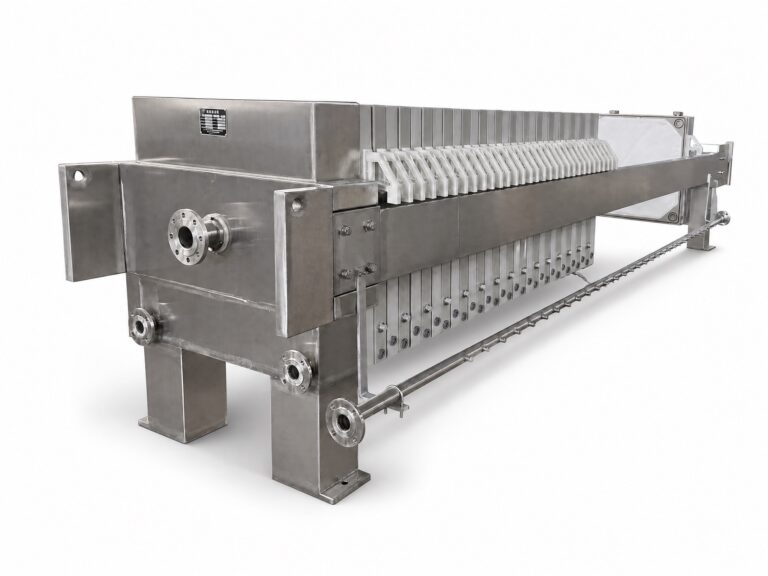
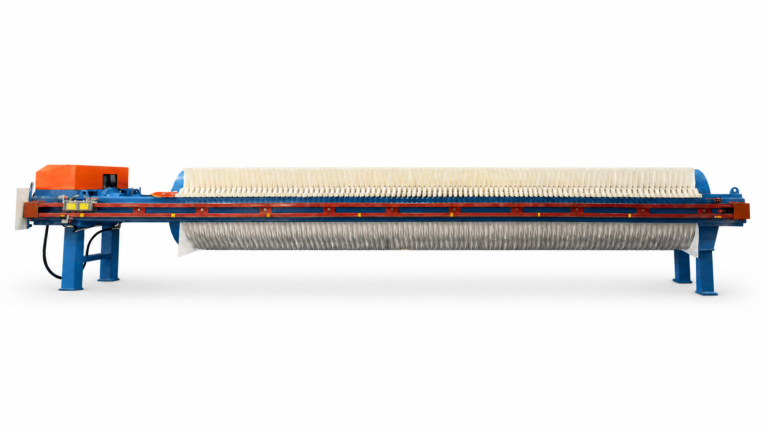
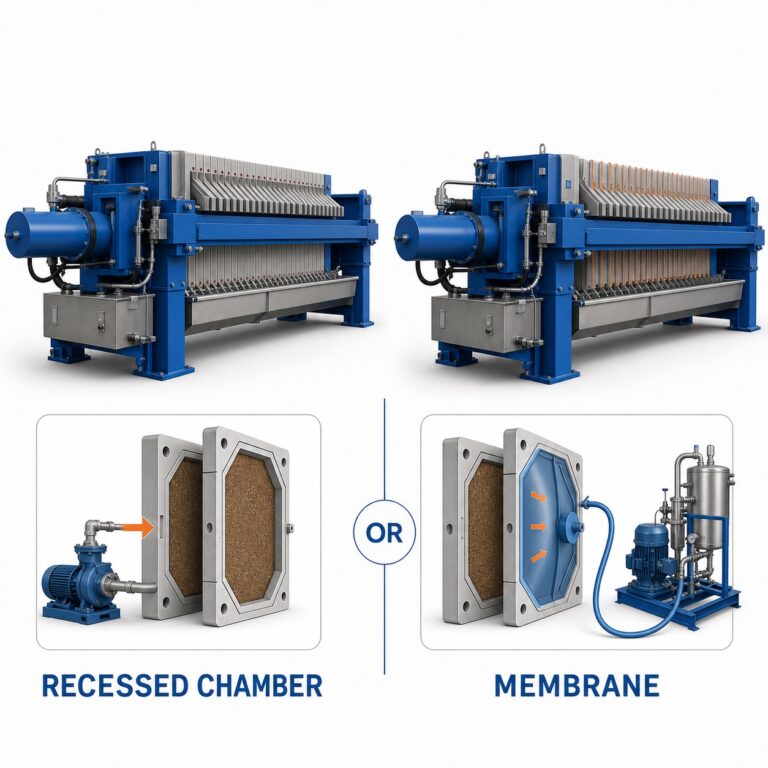
A recessed-chamber filter press processes slurry in a single batch, and the feed pump is the component that drives slurry into the chambers against a resistance that keeps changing. Early in the cycle, the chambers are empty or nearly so, and the pump is mainly moving volume to fill the available space between the plates. As the filter cake builds on the cloth and the chambers approach their holding capacity, the resistance the pump works against increases, and the pump’s role shifts from moving volume to building and holding pressure against that resistance. The transition between these two conditions is not a fixed point common to every project; it depends on how the slurry dewaters, how the chambers are configured, and how the press operator or control system defines the end of the cycle.
This matters for pump selection because a pump chosen only for its ability to deliver a stated flow at a stated pressure may describe only one of these conditions well. A pump that fills quickly but cannot sustain pressure as resistance builds will leave the press short of its intended cake formation. A pump that builds pressure effectively but was not sized for the filling phase may extend the time needed to bring the chambers to a full condition before pressure build-up can even begin. Because the press and the pump are proposed by parties who may not share the same assumptions about where filling ends and pressure build-up begins, the buyer’s task is to establish that both proposals are describing the same batch behavior rather than two different partial descriptions of it.
This is also where the interface between the filter press and its feed pump becomes a selection question in its own right, distinct from sizing either piece of equipment in isolation. A pump proposal that states only a nominal duty point does not establish that the pump will perform acceptably across the full range of conditions the chambers present during a cycle. The buyer needs the duty described as a sequence, with the pump’s expected behavior tied to the filling condition and the pressure-build condition separately, before comparing pumps on that basis.
Slurry and duty data needed before pump comparison
| Ввод данных для принятия решения | What the quotation should state | Why it matters to the comparison |
|---|---|---|
| Expected feed condition range | The range used as the basis for the proposed pump | Establishes the operating range being compared |
| Intended filling sequence | How the press is expected to be fed through the batch | Connects the pump proposal to the planned chamber-filling duty |
| Representative slurry evidence | The slurry evidence used by the press and pump suppliers, where available | Makes the proposal basis and any evidence gap visible |
| Nominal flow and pressure | Any quoted nominal values and the part of the duty they describe | Prevents two nominal values from being treated as the complete batch duty |
Before any pump quotation can be meaningfully compared to another, the slurry and batch duty need to be defined in terms that both the press and pump sides of the project can work from. A single reported flow or pressure value does not describe a batch process, because the feed condition itself is not constant — slurry concentration, particle content, and viscosity can vary across the source material, and the filling sequence intended for the press determines how the pump is expected to respond to that variation.
The expected feed condition should be stated as a range, with the quotation identifying which part of that range the proposed pump is based on. A pump selected against the lean end of the range may not perform the same way against the denser end, and if the quotation does not say which condition was used as the basis, the comparison between two pump proposals is not actually comparing the same thing. Similarly, the intended filling sequence — how the press is meant to be brought from empty to full chambers — needs to be stated explicitly, because a pump sized for one filling strategy may be mismatched to a different one even at the same nominal flow.
Where representative slurry evidence exists, from testing or from comparable operating experience, it should be identified as the basis for the proposal rather than left implicit. Where it does not exist, that gap should be visible in the comparison rather than papered over by a confident-sounding nominal value. This connects directly to slurry characterization work done ahead of sizing the press itself — the same kind of data needed to lock in before an RFQ for ceramic or stone slurry filtration applies here, because the feed pump duty and the press duty are derived from the same slurry behavior.
Two pump quotations that each state a nominal flow and pressure are not comparable unless the quotation also says what part of the batch cycle that nominal value represents. A number without a stated basis is not evidence of fitness for the duty; it’s a starting point for a question the buyer needs answered before treating one quotation as equivalent to another.
Pump behavior to confirm across filling and pressure build-up
| Cycle point | Confirmation to request | Использование решения |
|---|---|---|
| Первоначальное заполнение | How the proposed pump is expected to behave as chamber filling begins | Check alignment with the intended filling sequence |
| Pressure build-up | How pump behavior is expected to change as pressure builds | Check whether the proposal describes more than one nominal duty point |
| End condition | How the end condition is identified and what the pump is expected to do | Check that pump behavior and cycle control use the same end point |
Once the duty basis is established, the next judgment is whether the proposed pump’s behavior at each stage of the cycle matches what the press requires at that stage. This is a different question from whether the pump can hit a nominal duty point — it asks how the pump is expected to behave as the condition changes from initial filling through pressure build-up to the end of the batch.
At initial filling, the relevant question is how the pump behaves as the chambers begin to accept slurry: whether its delivery is matched to the filling sequence the project has defined, and whether that delivery is suited to the chamber geometry and the rate at which the press is meant to be brought to a full condition. A mismatch here does not necessarily show up as an outright failure — it can show up as uneven filling or a filling phase that behaves differently than assumed when the press was sized.
As pressure builds, the pump’s required behavior changes. The pump must now work against increasing resistance as the forming cake restricts flow, and the way the pump responds to that resistance — whether its output changes in a controlled way as discharge pressure rises — is a separate question from how it behaved during filling. A proposal that only describes a single nominal duty point gives no basis for judging this transition; the buyer needs the supplier to describe how pump behavior is expected to change as pressure builds, not just what the pump can do at one condition.
The end condition closes the cycle, and how that end condition is identified matters as much as how the pump behaves there. If the press and pump sides of the project do not use the same definition of the end condition — whether that’s a pressure level, a flow condition, or some other signal — the pump’s expected behavior at that point and the control logic that is meant to act on it will not be describing the same moment. Establishing that the pump behavior and the cycle’s end-condition definition are aligned is a prerequisite for the control coordination that follows later in the project, and it is also the point where a pump that performed acceptably during filling can still be the wrong choice if its behavior as pressure builds was not separately confirmed.
Materials, sealing, wear, and cleanout questions
| Question area | Evidence or definition to request | Граница принятия решения |
|---|---|---|
| Wetted materials | Proposed wetted materials and their basis in the actual slurry | Compatibility remains project-specific rather than a generic pump claim |
| Solids passage | How the proposed pump addresses the solids in the actual slurry | Suitability depends on the representative feed condition |
| Sealing arrangement | The proposed sealing arrangement and its basis in the slurry and duty | The arrangement must be evaluated for this project |
| Cleanout access | The cleanout access included in the proposed arrangement | Confirm that required access is present in the quoted configuration |
| Wear exposure | The wear exposure considered for the proposed pump | Confirm that the quotation addresses the actual slurry rather than a general wear statement |
Separate from how the pump performs across the cycle, the slurry itself raises questions about what the pump is made of, how it handles solids, how it is sealed, how it is cleaned, and where it is exposed to wear. These are project-specific questions because the answer depends on the actual slurry being handled, not on a general claim about the pump model.
Wetted-material compatibility is the first of these: the materials in contact with the slurry need to be evaluated against the actual chemistry and abrasiveness of that slurry, not accepted on the basis of a generic compatibility statement from the pump supplier. A material that performs acceptably with one slurry composition may not with another, even within the same general industry.
Solids passage is a related but distinct question — whether the pump’s internal geometry can pass the solids present in the feed without blockage or excessive wear, which depends on the particle size distribution and solids loading of the representative feed condition established earlier. A pump that handles a lean, fine slurry without difficulty may not be suited to a feed with coarser or more variable solids content.
Sealing arrangement, cleanout access, and wear exposure follow from the same logic. The sealing arrangement needs to be evaluated against the slurry and the duty it’s being proposed for, since different sealing approaches carry different implications for leakage, maintenance access, and compatibility with abrasive or corrosive content. Cleanout access matters because a pump that is difficult to open and clean between batches, or when a blockage occurs, creates a maintenance burden that may not be apparent from a performance specification alone — the buyer should confirm that the access included in the quoted configuration meets what the project needs, not assume it. Wear exposure should be addressed specifically for the actual slurry rather than described in general terms, since wear life in one application does not establish wear life in another with different solids content or abrasiveness.
Control signals and safe fault response at the interface
| Элемент интерфейса | What the control narrative should define | Bid check |
|---|---|---|
| Press-ready signal | The signal used to show that the press is ready for pump operation | Both proposals use the same readiness condition |
| Pump start | How the start action relates to the press-ready signal | The start logic is included and coordinated |
| Slowdown or stop | The trigger and expected pump response as the cycle approaches its end condition | The proposed pump behavior supports the intended sequence |
| Fault response | The expected pump and press response to an interface fault | The two suppliers describe a consistent response |
| Pressure release | Where pressure release sits in the agreed stop or end-condition sequence | The sequence covers pressure release without an interface gap |
The feed pump and the filter press are typically proposed by different parties, which means the control logic connecting them needs to be described as a single coordinated sequence rather than assembled from two independent descriptions that happen to be compatible. This is a distinct judgment from pump performance — a pump that performs correctly in isolation can still create an unsafe or unreliable interface if its control signals are not coordinated with the press’s control logic.
The press-ready signal is the starting point: the condition that indicates the press is prepared to receive feed, and the pump proposal needs to state how its start action relates to that signal rather than assuming a generic “pump on” command is sufficient. Where the press and pump are supplied by different parties, this signal needs to be defined once and used identically by both sides of the proposal.
As the cycle approaches its end condition, the pump’s behavior needs to change — whether that means slowing down or stopping — and the trigger for that change needs to be defined in the same terms the press uses to identify its own end condition, consistent with the alignment discussed earlier. A control narrative that describes the pump’s slowdown or stop logic independently of how the press identifies the end condition leaves a gap between the two systems.
Fault response is a safety-relevant part of this coordination. If an interface fault occurs — a loss of signal, an unexpected pressure condition, or some other disruption — the pump and the press need to respond in a way that is consistent with each other, and the buyer should confirm that both suppliers describe the same expected response rather than assuming compatibility. Pressure release belongs in this same narrative: where pressure release sits in the stop or end-condition sequence determines whether the system reaches a safe state in a predictable order, and a control narrative that does not explicitly place pressure release within that sequence leaves an interface gap that may not be visible until the system is operating. According to the Информационный бюллетень Агентства по охране окружающей среды США (EPA) о фильтр-прессе с утопленной пластиной, the feed-pump, plate-chamber, filtrate-removal, and cake-discharge functions are distinct parts of the batch pressure-filtration route, which is consistent with treating the pump-press control interface as its own coordination task rather than an extension of either equipment’s internal controls.
Bid-scope checks for pump, piping, instruments, and startup
| Scope element | What to record in each bid | Gap made visible |
|---|---|---|
| Насос | Supplier and the duty basis used for the proposed pump | Unclear responsibility for the pump selection |
| Instruments | Supplier and the instruments included for the agreed control narrative | Missing instrumentation needed by the interface logic |
| Клапаны | Supplier and the valve scope included at the pump-press interface | An unassigned valve package |
| Трубопроводы | Supplier and the included pump-to-press piping scope | An incomplete physical connection between the packages |
| Контролирует | Supplier and the included signals and control integration | An unassigned control interface |
| Сопровождение вводки в эксплуатацию | Supplier and the startup or commissioning support included | A support gap when the pump and press are commissioned together |
Once the duty, pump behavior, slurry compatibility, and control narrative have been worked through, the remaining task is confirming that the bid package actually assigns responsibility for every element the interface depends on. A technically sound pump proposal and a technically sound press proposal can still leave a gap if neither party’s scope includes the piping, instruments, valves, or controls that connect them.
The pump itself should be recorded against the duty basis used to propose it, so that the selection can be traced back to the slurry and batch duty data established earlier rather than treated as a standalone item. Instruments need the same treatment — the control narrative developed for the interface depends on specific signals being available, and if the instruments required to generate those signals are not clearly assigned to either supplier, the control logic cannot be implemented as described.
Valves and piping are often the elements most likely to fall into a scope gap, because they sit physically between the pump and the press and may be assumed by each party to be the other’s responsibility. Recording which party supplies the pump-to-press piping and the associated valve package makes that assumption visible before it becomes a site problem — this is the kind of interface question that also arises wherever upstream protection equipment, such as grit removal ahead of pumps and filter presses handling stone slurry wastewater, is proposed by a separate party from the press itself.
Controls and commissioning support close the scope check. The control narrative is only as good as the integration work that implements it, and commissioning support determines whether the pump and press are brought into coordinated operation by parties who understand both sides of the interface. Where project information about the slurry, duty, and intended configuration has been supplied consistently to the parties involved, that information is what Porvoo or any equipment supplier uses to review configuration and quotation scope against the project’s actual requirements — which is why the scope matrix is worth completing before, not after, the bid comparison is finalized.
Часто задаваемые вопросы
Q: Can feed pumps be compared by nominal flow and pressure alone?
A: No. Use those values only as part of a common duty basis, then compare how each proposed pump is expected to behave during initial filling, pressure build-up, and the agreed end condition for the representative slurry.
Q: What should the buyer do if representative slurry evidence is not available at the RFQ stage?
A: Define the expected feed-condition range, identify which parts of it lack representative evidence, and make the affected pump decisions conditional on later confirmation. The quotation should state the assumed slurry basis so the evidence gap is visible before purchase.
Q: How should bids be compared when suppliers have used different slurry or cycle assumptions?
A: Do not rank them as equivalent offers yet. Ask each bidder to restate its proposal against the same feed-condition range, filling sequence, end condition, and scope boundary, then record any remaining exceptions as bid risks.
Q: Must the pump and filter press come from the same supplier?
A: They can be supplied separately if the interface is explicitly coordinated. Assign ownership for the pump, piping, valves, instruments, controls, and commissioning support, and require both proposals to use one agreed sequence for readiness, start, slowdown or stop, faults, and pressure release.
Q: What quotation details should trigger clarification before a pump is selected?
A: Clarify a bid that gives only one nominal duty point, makes generic slurry-compatibility claims, leaves the end condition undefined, or does not assign an interface item. Each gap can hide a different selection, control, or supply assumption that prevents a fair comparison.