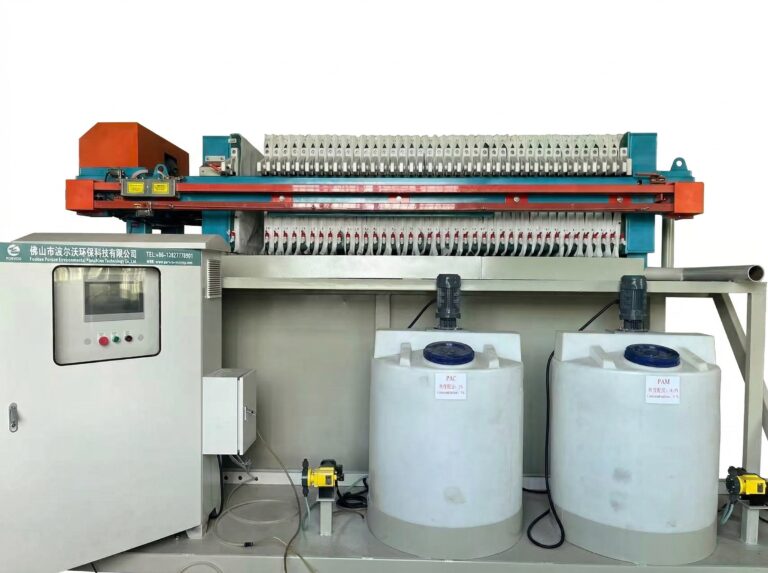
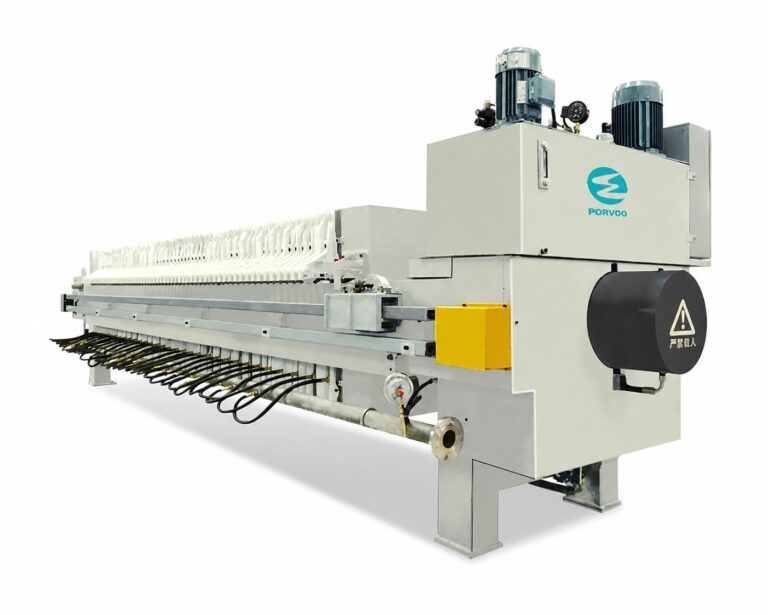
A filter press quotation is only as reliable as the test evidence behind it. When two bidders return different cake moisture numbers, different cycle times, and different capacity claims from what looks like the same slurry, the gap is rarely in the equipment design alone — it is in what was tested, how, and under what conditions, and whether that work was disclosed completely enough to compare. Buyers who ask for a filter press quotation without first defining what test evidence must accompany it are left comparing numbers that may not describe the same thing.
Evidence Suppliers Need Before Sizing and Pricing
A filter press proposal rests on a chain of evidence: a sample, a test run on that sample, a set of results, and a scale-up from those results to a full-size design. Each link in that chain can introduce a gap between what was demonstrated and what is being proposed. A supplier can run a technically competent test and still deliver a proposal that does not fit the actual feed, if the sample tested does not represent the material the plant will generate in operation. A test can produce accurate cake and filtrate data and still be unusable for comparison, if the record omits the equipment, cloth, or sequence that produced those numbers. And a proposal can state a capacity and cycle time with confidence while leaving the scale-up assumptions and design margins unstated, so the buyer cannot tell how much of the quoted number came from measurement and how much came from engineering judgment.
Because filter press performance depends on the interaction of feed characteristics, conditioning, cloth selection, chamber design, and operating sequence, no single data point establishes that a given configuration will perform as proposed. A cake moisture result means one thing when it comes from a feed at the conditioning state the plant will actually run, and another thing when it comes from a feed prepared differently for test convenience. A cycle time means one thing when the full operating sequence — fill, press, cake discharge, cloth cleaning — is recorded, and another thing when only the press phase is reported. The RFQ stage is where the buyer sets the expectation that every number arrives with the conditions that produced it, rather than treating evidence as the final sizing step.
The categories that follow give that expectation a structure: where the sample came from and what it represents, how the test was run and recorded, what results were obtained, what assumptions carry the results into a full-size design, and how bidders should present all of this so their commitments can be compared side by side.
Sample Provenance and Feed Bounds Attached to the RFQ
| Elemento de prova | RFQ attachment content | Boundary established |
|---|---|---|
| Sample source | Identify where the tested sample came from | Traces the test evidence to its material source |
| Collection context | State the context in which the sample was collected | Defines the circumstances represented by the collected lot |
| Feed characterization | Attach the available characterization of the tested feed | Defines the feed evidence available for sizing and pricing |
| Conditioning state | State the conditioning state of the tested sample | Distinguishes the tested condition from other possible feed conditions |
| Lot representativeness | Attach evidence that the tested lot represents the intended design case | Shows the basis for applying the test evidence to the RFQ design case |
A test result is only as representative as the sample it was run on. The first judgment a buyer has to make is not about the filter press itself but about whether the tested material stands in for the feed the equipment will actually process. Where a sample is drawn from a single batch, a single point in a variable process, or a feed stream that has since changed, the resulting test describes that moment rather than the operating range the equipment must handle over time. A supplier’s cake and filtrate results can be entirely accurate and still misrepresent the project, if the sample’s relationship to the intended design case is left unstated.
Sample source and collection context matter because they establish what the material was and where it came from in the process — upstream of a particular treatment step, from a blended stream, from a specific production condition. A buyer evaluating a bid needs to know this to judge whether the tested lot reflects the feed variability the plant actually generates, or only one slice of it. Feed characterization — particle size, solids concentration, chemistry, and related properties available at the time of testing — defines what is actually known about the material, separate from what the test outcomes later claim to demonstrate.
Conditioning state is a distinct and frequently overlooked variable. A slurry tested as received behaves differently from the same slurry after chemical conditioning, thickening, or blending, and a filter press configuration suited to one conditioning state does not necessarily suit another. Where the RFQ does not specify the conditioning state under which the sample was tested, a bidder’s results cannot be assumed to transfer to a feed conditioned differently in actual operation. The buyer’s task at this stage is to request evidence that the tested lot — in its source, its characterization, and its conditioning — represents the design case the plant intends to run, not simply that a test was performed on “the feed.”
Test Configuration, Methods, and Complete Run Records
| Record category | Detail to attach | Comparison boundary preserved |
|---|---|---|
| Test equipment | Identify the equipment used for the test | Ties the run data to the tested equipment configuration |
| Tecido filtrante | Identify the cloth used in the test | Keeps cloth selection visible when test records are compared |
| Chamber | Identify the chamber used in the test | Keeps chamber configuration visible in the test basis |
| Bomba | Identify the pump used in the test | Keeps the pumping configuration linked to the run record |
| Sequência operacional | Provide the sequence followed during the test | Shows how the recorded run was conducted |
| Métodos de medição | State the methods used for the reported measurements | Shows how the attached results were obtained |
| Complete run records and exclusions | Attach the complete records and explain any exclusions | Prevents unexplained omissions from being treated as complete evidence |
Once the sample is established, the next judgment concerns the test itself: what equipment produced the numbers, and whether the record is complete enough to interpret them. A filter press result is a function of the specific equipment configuration used to generate it — a different filter cloth, a different chamber design, or a different pump can all shift cake formation, dewatering rate, and cycle time even when the feed is identical. A bidder reporting results without identifying the test equipment, cloth, chamber, and pump used is reporting an outcome without its cause, and the buyer has no basis for judging whether that outcome would repeat with a different configuration.
The operating sequence followed during the test is equally load-bearing. A filter press cycle involves distinct phases — filling, pressurization, cake formation, discharge, and cloth cleaning — and a result drawn from only part of that sequence describes only part of the process. Where a bidder reports a dewatering result without stating whether it includes the full cycle or only the pressing phase, the number cannot be compared against a competing bid that reports the complete cycle.
Measurement methods matter because the same term — moisture content, flow rate, pressure — can be obtained through different procedures with different accuracy and different assumptions. A buyer comparing bids needs to know not just the reported value but how it was measured, so that two “cake moisture” figures can be confirmed to mean the same thing.
Finally, the completeness of the run record determines whether the evidence can be trusted at all. Reference material such as the EPA Biosolids Technology Fact Sheet on recessed-plate filter presses describes the installed components and operating interfaces that bench or vendor pilot testing is meant to represent — equipment that a complete test record should correspond to. Where a bidder excludes certain runs, certain cycles, or certain conditions from the reported data, that exclusion needs an explanation. An unexplained gap in the record does not mean the missing data was unfavorable, but it does mean the buyer cannot treat the remaining data as the complete picture, and should request the omitted runs or a stated reason for their absence before relying on the bid.
Cake, Filtrate, Cycle, Pressure-Flow, and Handling Results
A filter press test produces several distinct kinds of outcomes, and the central risk at this stage is that a bidder collapses them into a single summary claim — “the press achieved X” — without showing which outcome that number describes. Cake condition, filtrate quality, cycle duration, the pressure-flow relationship during the run, how the cake discharged from the chamber, how the cloth was cleaned, and how many operator interventions the run required are not interchangeable measures of performance. A press can produce a well-formed cake while requiring a cycle time that makes the proposed capacity optimistic, or can run a short cycle while leaving a cake condition that complicates downstream handling. Reporting only one of these dimensions, or reporting an average that blends them, hides exactly the trade-offs a buyer needs to see.
Cake results and filtrate results answer different questions: one addresses solids handling and disposal or reuse downstream, the other addresses water quality and whether filtrate meets its own discharge or recycle requirement. A supplier’s claim about dewatering performance does not, by itself, establish filtrate quality, and the two need separate reporting even when they come from the same test run.
Cycle time and the pressure-flow relationship together describe throughput — but a cycle time quoted without the corresponding pressure profile leaves open whether that time was achieved under the pressure regime the full-scale equipment will actually use. Where test pressure and flow do not match the operating envelope the proposed press will run at, the cycle time cannot be assumed to scale directly.
Cake discharge behavior and cloth cleaning performance speak to operational reliability rather than dewatering quality, and operator interventions recorded during the test reveal whether the run proceeded as an automated sequence or required manual correction. A test that needed frequent intervention to complete successfully describes a different operating reality than one that ran unattended, even if the final cake and filtrate numbers look similar. Asking each bidder to report these elements separately prevents a single blended claim from standing in for the full set of outcomes the project needs to evaluate.
Scale-Up Assumptions and Remaining Supplier Design Work
Test results describe a bench or pilot run; a proposal describes a full-size filter press. The distance between the two is bridged by scale-up assumptions, and that bridge is where supplier judgment enters the process most heavily. A chamber volume, plate count, and cycle time proposed for the full-size unit are derived from the test data through assumptions about how cake formation, flow distribution, and pressure behavior change with scale — assumptions that are not fully testable at bench scale and that vary by filter press design and by feed characteristics.
Where a bidder states these assumptions explicitly, the buyer can judge whether they are conservative or aggressive relative to the test evidence. Where a bidder does not state them, the proposed capacity and cycle time carry an invisible margin of uncertainty that the buyer cannot evaluate. This is also where design margin belongs in the conversation: a margin applied generously absorbs more of the uncertainty between test and full-scale operation, while a margin applied narrowly leaves more of that uncertainty for the buyer to discover during commissioning. Neither choice is inherently correct — it depends on how much risk the project is willing to carry at startup versus how much capacity or cost the buyer is willing to add upfront — but the choice needs to be visible, not buried inside a single quoted number.
Supplied scope and remaining tests follow directly from this. A bid should state plainly what equipment and services are included, and separately, whether any additional testing — on a different feed condition, a different conditioning regime, or a longer duration run — is still required before the design can be finalized with confidence. Where a supplier identifies remaining tests rather than presenting the current evidence as sufficient, that disclosure tells the buyer where the proposal’s confidence is lower, not that the proposal is deficient. The same project information that establishes feed bounds, sample provenance, and test records at the RFQ stage is what a supplier such as Porvoo uses during configuration and quotation review to determine how much of the design can be committed to the submitted evidence and how much remains open pending further testing or confirmation. The buyer’s task is to ask for that distinction directly rather than infer it from a single capacity figure.
Bid Response Format for Comparable Commitments
| Bid response section | Bidder entry | Comparison purpose |
|---|---|---|
| Feed evidence used | Identify the sample provenance, feed bounds, and conditioning state relied on | Shows whether the bid uses evidence representing the intended design case |
| Test basis used | Identify the test equipment, cloth, chamber, pump, operating sequence, measurement methods, complete run records, and explained exclusions relied on | Makes the test basis visible across bids |
| Reported test outcomes | Report cake, filtrate, cycle, pressure-flow, cake discharge, cleaning, and operator interventions separately | Prevents unlike outcomes from being collapsed into one claim |
| Premissas de ampliação | State the assumptions used to move from test evidence to the proposed design | Exposes the basis of the proposed scale-up |
| Design margins | State the design margins included in the proposal | Makes bidder margin choices comparable |
| Supplied scope | Define the scope included in the bid | Separates included supply from other work |
| Remaining tests | Identify any tests still required | Shows which design questions remain unresolved |
| Proposed acceptance conditions | State the conditions proposed for acceptance | Makes the proposed acceptance basis explicit |
Evidence gathered under the prior headings only helps the buyer if every bidder presents it in a structure that allows direct comparison. Two filter press proposals built on different test protocols, different sample conditions, and different scale-up assumptions can both look complete while resting on incompatible foundations. A consistent bid response format closes that gap by requiring each bidder to state, in the same order, what feed evidence it relied on, what test basis produced its results, what those results were reported separately rather than blended, what assumptions and margins carried the results into the proposed design, what scope is included, what testing remains open, and what conditions the bidder proposes for accepting the equipment at startup.
This structure does not resolve which bidder’s filter press configuration is better suited to the project — that depends on how the feed behaves, what cake and filtrate requirements the site has downstream, and what cycle time the plant’s production schedule can accommodate. What the structure does is prevent a bid from looking stronger simply because it reports fewer details or blends outcomes that should stay separate. Where one bidder’s feed evidence traces clearly to the intended design case and another’s does not, that difference becomes visible in the comparison rather than buried under a single attractive capacity number. Where one bidder states its scale-up assumptions and design margin explicitly and another states only a final output figure, the buyer can see which bid carries more disclosed uncertainty and which carries more hidden uncertainty.
Acceptance conditions deserve particular attention in this comparison, because they determine what happens if the installed filter press does not reproduce the tested performance. A bidder proposing acceptance conditions tied closely to the disclosed test basis is making a narrower, more verifiable commitment than one proposing acceptance based on a broad capacity claim with no stated test lineage. Reviewing bids against this common structure — alongside the feed data and sizing inputs a project will also need to lock down before issuing the RFQ — gives the buyer a basis for choosing between configurations on the evidence each bidder actually produced, rather than on the confidence of the number each bidder chose to lead with.
Perguntas frequentes
Q: Can test evidence from one feed lot support an RFQ for the intended design case?
A: Only when the lot’s source, collection context, characterization, and conditioning state provide a clear basis for treating it as representative. If that link is uncertain, identify the evidence as limited and keep the need for further testing visible in the RFQ.
Q: Does a complete filter press test record guarantee the final supplied system’s performance?
A: No. The record establishes the tested basis, while each bidder must still disclose how it scales that evidence, what design margins it uses, what scope it includes, and which design questions remain open.
Q: How should an RFQ handle omitted or excluded test data?
A: List each exclusion and its reason alongside the complete run record. Ask bidders to state whether the remaining evidence is sufficient for their proposal and which additional tests they need before confirming the proposed acceptance basis.
Q: Why should cake, filtrate, cycle, pressure-flow, and handling observations be reported separately?
A: Separate reporting prevents different outcomes from being compressed into one favorable claim. It also lets buyers see whether cake discharge, cleaning, or operator intervention affected the conditions behind the recorded result.
Q: How can buyers compare bids that use different scale-up approaches?
A: Require every bidder to answer the same response structure and state its scale-up assumptions, design margins, supplied scope, remaining tests, and proposed acceptance conditions. Compare those entries against the same feed evidence and test basis before comparing commitments.