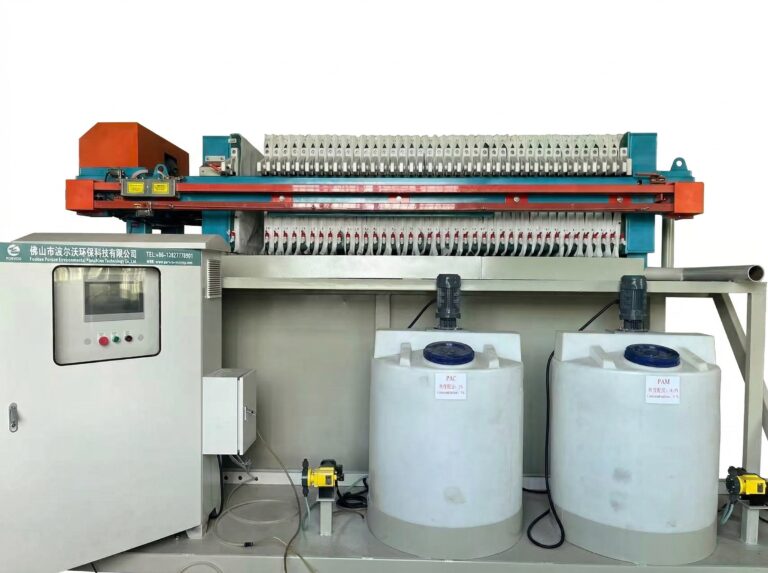
A specification sheet that lists “round plate” tells a buyer almost nothing about how the press will perform on their slurry. Before comparing suppliers or prices, the real question is whether the plate geometry even addresses the dewatering problem at hand, and what still has to be defined before that geometry becomes a working machine.
What a round plate label does and does not define
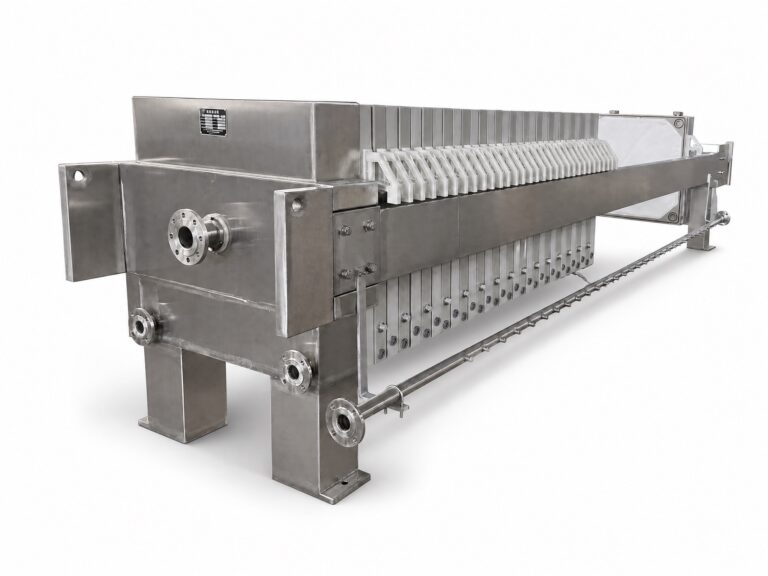
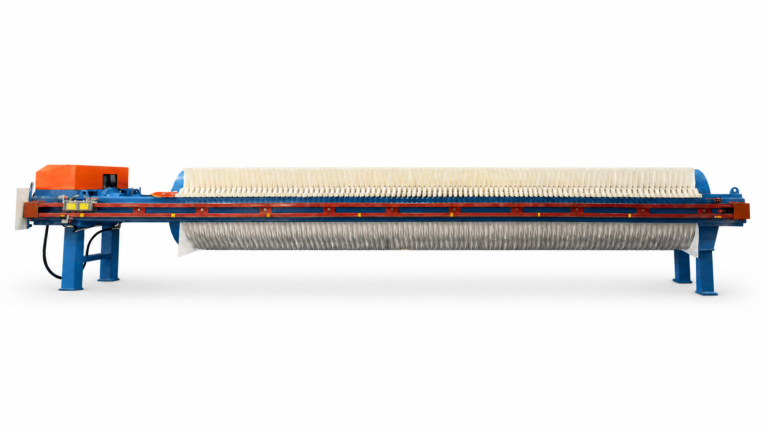
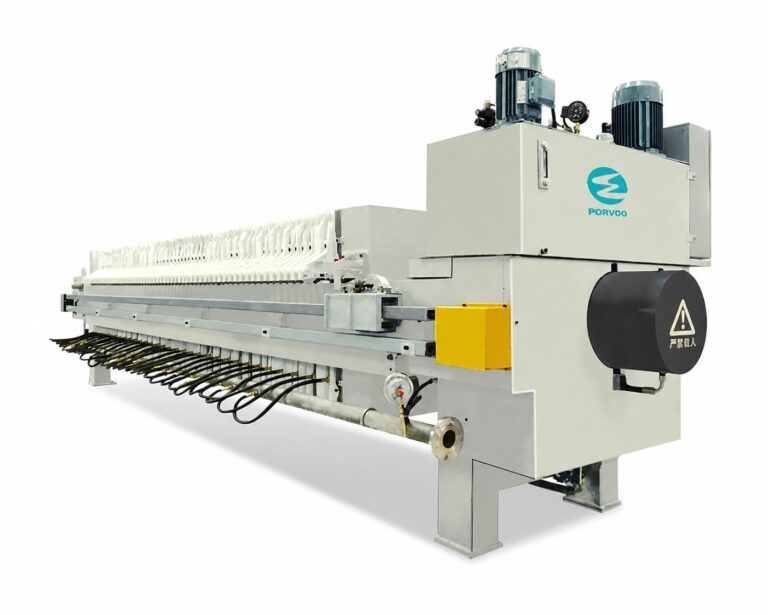
Round plate describes the shape of the plate and, by extension, certain aspects of how plates stack, seal, and move through the press frame. It says something about footprint, plate handling, and the mechanical architecture of the press. It says nothing about how the slurry will actually dewater inside that architecture.
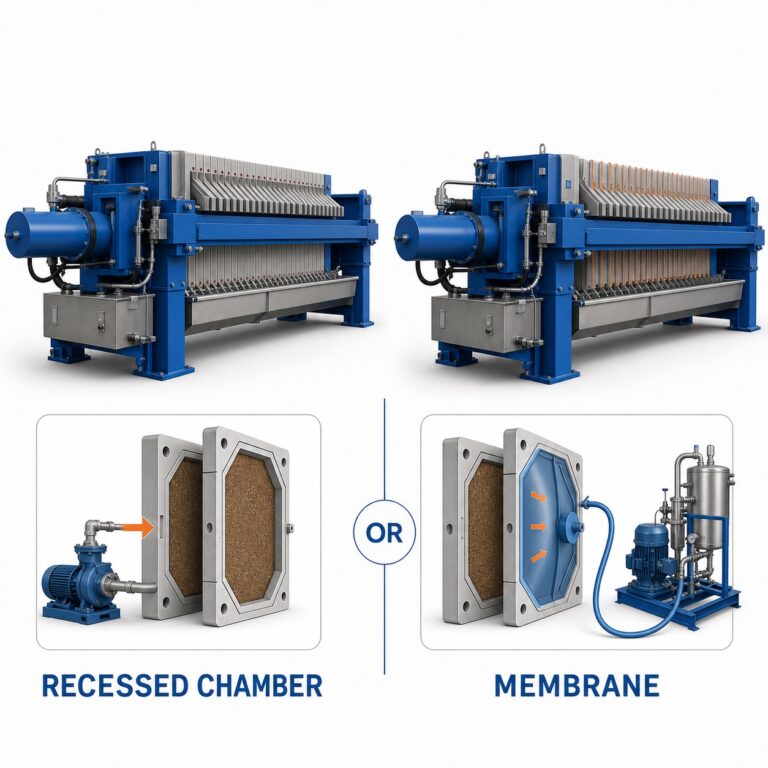
The chamber arrangement is a separate design decision from plate shape. A round plate can be built as a recessed-chamber plate, where cake forms and fills a cavity as filtrate is pushed out under feed pressure, or as a membrane plate, where a flexible membrane applies additional squeeze pressure to the cake after the initial fill. These are different operating mechanisms with different pressure profiles, different cake-moisture outcomes for a given feed, and different mechanical and control requirements. A proposal that specifies “round plate” without specifying which chamber arrangement applies has described the frame, not the process.
This distinction matters because the chamber arrangement interacts directly with the feed material. A slurry that compresses readily under applied feed pressure may dewater adequately in a recessed-chamber arrangement. A slurry that reaches a pressure limit quickly and stops releasing filtrate may need the additional mechanical pressure a membrane stage provides to reach a usable cake condition. Choosing between the two without first characterizing how the actual feed responds to pressure treats the shape label as if it were the process decision, when it is only the starting point for one.
The practical consequence for a buyer is that any round plate quotation should be read as a partial answer. The shape establishes a family of plate and frame options; it does not establish how the press will behave on a given slurry, what cycle time the operation can expect to work toward, or what the discharged cake will look like. Those questions sit downstream of the chamber-arrangement decision, which itself sits downstream of how the feed material behaves under test conditions. A buyer who accepts a round plate specification as a complete answer has skipped the step where the actual selection gets made.
Slurry conditions that make pressure filtration worth evaluating
| Condição do projeto | What to establish for the evaluation |
|---|---|
| Representative slurry behavior | The behavior of the actual feed that the proposed press will need to handle |
| Required cake handling | How the project needs the discharged cake to be handled |
| Destino do filtrado | Where the filtrate must go after it leaves the press |
| Achievable cycle pattern | The cycle pattern that can be supported for the representative feed and proposed arrangement |
| Available operating time | The operating time available for the required cycle pattern and output basis |
Before comparing press configurations, the underlying question is whether pressure filtration is the right dewatering mechanism for the material at all. That judgment rests on a handful of project conditions that have to be established from the actual slurry and the actual site, not assumed from a similar-looking material elsewhere.
Representative slurry behavior is the starting condition because everything else depends on it. A slurry that releases water readily under modest applied pressure behaves differently inside a press than one that resists pressure and continues holding moisture past the point other technologies would have released it. The same nominal material description can conceal very different pressure responses depending on particle size distribution, chemistry, and how the material was generated upstream. Without a representative sample, any statement about expected performance is an assumption dressed as a specification.
Required cake handling changes what “successful” dewatering means. A cake that will be landfilled has different acceptable characteristics than a cake that must be reprocessed, trucked off-site in a particular form, or handled by downstream equipment with its own material requirements. The cake-handling requirement should inform the dewatering target, not the other way around.
Filtrate destination matters because it sets a quality expectation on the output stream, not just the solid. Where filtrate returns to a process loop, its clarity and chemistry carry forward into that loop. Where it discharges elsewhere, different constraints may apply. Either way, the filtrate side of the press is a project requirement, not a byproduct to be ignored while sizing is discussed.
Achievable cycle pattern and available operating time close the loop between the material’s behavior and the plant’s schedule. A press that can produce a given cake quality over a long cycle may not fit an operation that needs shorter, more frequent cycles, and the reverse is equally true. These five conditions, taken together rather than individually, form the basis on which pressure filtration can be evaluated as a fit at all, before any plate geometry or chamber arrangement is discussed. Related groundwork on locking these inputs before a request for quotation is covered in filter press sizing guidance for ceramic and stone slurry.
Recessed-chamber and membrane paths within the round format
Within a round plate press, the recessed-chamber and membrane paths represent two different ways of applying pressure to the same feed, and the choice between them follows from how that feed responds rather than from a general preference for one over the other.
A recessed-chamber arrangement relies on feed pressure alone to build the cake and push filtrate through the cloth. As cake accumulates inside the recessed cavity, the resistance to flow increases, and the cycle approaches its natural end point when the feed pressure can no longer force meaningful additional filtrate through the thickening cake. For a slurry that continues to release water under that feed pressure until a workable moisture content is reached, this arrangement can complete the dewatering task without additional mechanical stages.
A membrane arrangement adds a second pressure-application step after the initial fill. Once the chamber has filled with cake under feed pressure, a flexible membrane applies mechanical pressure directly against the cake face, squeezing additional filtrate out in a step that does not depend on pushing more feed through an increasingly resistant cake bed. This matters for slurries that reach a point under feed pressure alone where further filtrate release becomes impractical within the available cycle time, but that can still yield meaningful additional dewatering under direct mechanical compression.
The consequence for configuration is that the two paths are not interchangeable defaults; they respond to different feed behaviors. A feed that compresses well under moderate pressure may not justify the added mechanical complexity of a membrane stage. A feed that resists further filtrate release under feed pressure alone may fail to reach a usable cake condition without one. Where the representative testing has not yet characterized this pressure response, neither path can be confirmed as correct, and a round plate quotation that names only the plate shape has not yet reached this decision. The supplied material does not establish a side-by-side performance comparison between the two paths; it establishes that the choice between them is a defined, separate decision that the project’s feed behavior must resolve.
Feed, cloth, filtrate, and cake-handling interfaces to verify
| Interface | What the configured proposal should identify |
|---|---|
| Feed-pump interface | How the feed-pump interface fits the proposed operating route |
| Plate and cloth arrangement | The plate and cloth arrangement selected for the project |
| Filtrate path | The path from the press to the project-specific filtrate destination |
| Descarga de bolo | The method used to discharge the cake for the required handling route |
| Controles | The controls included in the connected operating route |
| Serviços públicos | The utility limits that apply to the proposed route |
A press does not operate as an isolated vessel; it operates as one point in a connected route that begins at the feed pump and ends at cake handling and filtrate disposition. Evaluating a proposal means checking whether each interface along that route has been defined in relation to the others, not whether each component individually carries an adequate specification.
The feed-pump interface sets the pressure and flow characteristics the press will actually see. A pump capable of generating and sustaining the pressure the chosen chamber arrangement needs, matched to the flow behavior of the representative slurry, is a different requirement for a recessed-chamber cycle than for one that also depends on a membrane squeeze stage. Specifying the press without confirming the feed pump is compatible with its pressure and cycle requirements leaves a gap between two pieces of equipment that must function as one system.
Plate and cloth arrangement determines how filtrate separates from solids at the chamber surface, and cloth selection responds directly to the particle characteristics of the feed. A cloth that blinds or degrades under the specific slurry chemistry and particle size in use changes cycle time and cake release behavior regardless of how well the plate and chamber were chosen.
The filtrate path has to connect to wherever that filtrate is actually meant to go, whether back into a process loop or to another destination, and the piping, pumping, and any treatment along that path belong in the proposal rather than left as a site-supplied afterthought. Cake discharge method has to match the handling route the project requires downstream of the press, since a discharge method suited to one handling approach may not suit another. Controls need to manage the cycle appropriate to the chosen chamber arrangement, and utility limits at the site, including available pressure, power, and space, constrain what configuration can actually be installed and operated. A proposal that addresses each of these in isolation, without showing how they function together as one operating route, leaves the buyer to discover the gaps after installation rather than before it.
Representative tests that turn estimates into a project basis
| Test evidence | What it supports in the project basis |
|---|---|
| Representative feed behavior | A feed basis tied to the slurry evaluated in the test |
| Cloth response | A cloth-response basis for the representative feed and tested arrangement |
| Cycle observations | A cycle basis drawn from the representative test rather than an unconditional estimate |
| Site-relevant output measures | An output basis limited to the measures recorded under the tested conditions |
Any number offered before representative testing is an estimate conditioned on assumptions about the feed; it becomes a project basis only once those assumptions are checked against the actual material under conditions that resemble the project’s own.
Representative feed behavior is the foundation because the test sample has to reflect the slurry the press will actually handle, including its variability, not a single favorable grab sample. A feed basis built on unrepresentative material produces conclusions that do not transfer to the operating slurry, regardless of how carefully the test itself was run.
Cloth response has to be observed with the representative feed and the arrangement under consideration, because cloth behavior, including how readily it releases cake and how its performance holds up over repeated cycles, is a function of the specific combination of cloth and slurry rather than a generic property of the cloth alone. Cycle observations recorded during representative testing establish what cycle pattern the material supports under the tested arrangement; treating a vendor’s general cycle-time figure as applicable before this observation has been made substitutes an assumption for a measurement. Site-relevant output measures, meaning whatever cake and filtrate characteristics matter for the project’s downstream handling and discharge requirements, need to be recorded under the tested conditions so that the output basis is tied to evidence rather than extrapolated from a different material or a different scale.
This sequence matters because each piece of evidence depends on the one before it: a cycle observation is only meaningful if the feed was representative and the cloth response was recorded against that same feed, and an output measure is only meaningful if it was captured within that same tested cycle. Skipping a step in this chain does not just weaken the evidence at that step; it undermines the basis for everything built on top of it. The Ficha técnica do filtro-prensa de placas recuadas da EPA describes this general pressure-filtration cycle, including feed-pump, plate-chamber, cloth, filtrate, and cake-discharge dimensions, alongside representative-testing as a step in establishing performance; that guidance addresses US municipal biosolids applications and is useful here for route mechanics and comparison dimensions, not as a source of figures or guarantees applicable to an industrial slurry project.
Proposal evidence buyers need before selecting a configuration
Selecting a configuration means confirming that the plate geometry, chamber arrangement, and connected interfaces have each been matched to evidence from the actual project, rather than confirming that a proposal contains a plate shape and a set of individual component specifications.
Where representative testing has already established how the feed responds to feed pressure alone and that response reaches a workable cake condition within the project’s required cycle time, a recessed-chamber arrangement has support as the simpler mechanical path. Where that same testing shows the feed reaching a point under feed pressure where further filtrate release becomes impractical before an acceptable cake condition is reached, a membrane arrangement has support as the path that adds mechanical compression to close that gap. Neither conclusion can be drawn from the plate shape alone, and neither should be assumed from a similar material at a different site.
Once the chamber arrangement has evidence behind it, the connected interfaces need their own confirmation: that the feed pump matches the pressure and flow the chosen cycle requires, that the cloth has been selected and observed against the representative feed, that the filtrate path reaches the project’s actual destination, that the cake discharge method suits the required handling route, and that controls and utilities fit the site as it exists rather than as a generic installation. This is the information that a configuration and quotation review needs from the buyer’s side: the representative sample, the site’s utility limits, the required cake-handling route, and the filtrate destination, supplied clearly enough that the proposed equipment can be matched against them rather than offered as a standard package.
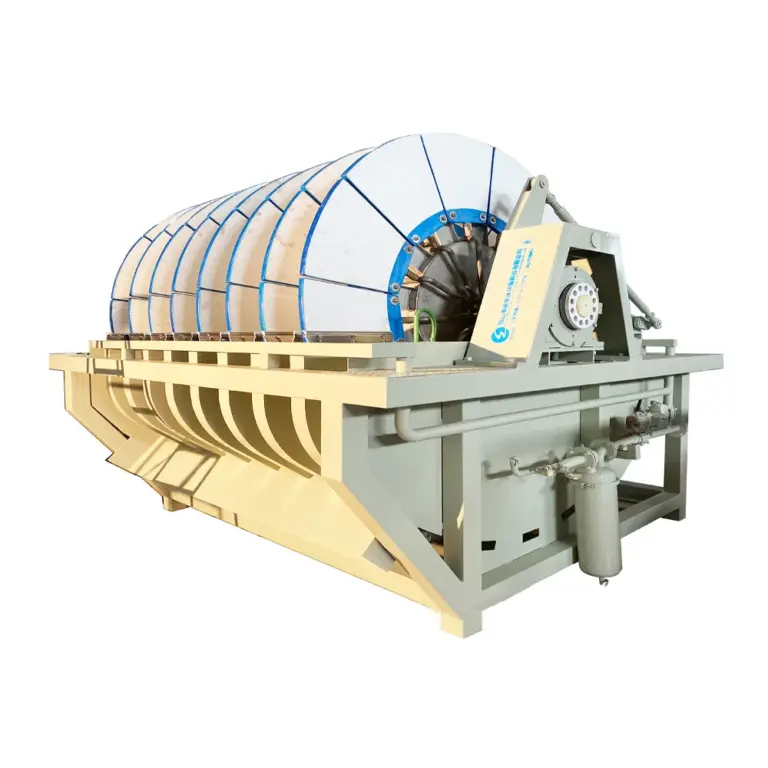
Where any of these conditions remains unconfirmed, the honest position is not to select a configuration but to identify what representative testing or site information is still missing and what it would change. A buyer who has representative test results showing cake and filtrate behavior under the tested arrangement is in a position to compare configurations on that evidence. A buyer who has only a plate-shape specification and a general cycle-time claim is still at the point of gathering the inputs the decision actually requires, including the kind of ceramic and stone slurry data discussed in relation to sizing, or the broader comparison between pressure filtration and alternative mechanisms such as vacuum ceramic disk filtration for similar mineral slurries. The configuration decision follows the evidence; it does not substitute for it.
Perguntas frequentes
Q: Can I compare two round-plate filter press proposals by plate shape or size alone?
A: No. First align the proposed chamber arrangement and the complete operating route, including the feed-pump interface, plate and cloth arrangement, filtrate path, cake discharge, controls, and utility limits. A geometry-only comparison can hide differences that matter to how each proposal would operate at the site.
Q: Does choosing a round-plate format determine whether the press should use recessed chambers or a membrane arrangement?
A: No. The round label describes plate geometry, while the chamber arrangement remains a project choice. Ask each proposer to name the arrangement, connect it to the representative slurry and required cake-handling route, and state which parts of that basis have been supported by testing.
Q: What should buyers give every supplier so the proposals can be compared on the same basis?
A: Use one project brief that defines the representative feed, required cake handling, filtrate destination, available operating time, feed-pump interface, utilities, and the output measures the site will use. Require each proposal to state its assumptions and any departure from that brief so apparent differences are not caused by different starting conditions.
Q: When does a representative test become useful for configuration selection?
A: It becomes useful when the tested feed represents the project and the record links cloth response, cycle observations, and site-relevant output measures to the tested arrangement. Carry those conditions into the proposal; results without the feed and configuration context should not be treated as a general project basis.
Q: How should a buyer use supplier cycle or output estimates before representative testing?
A: Treat them as conditional inputs for preliminary comparison. Check that each estimate uses the same feed basis, chamber and cloth arrangement, operating-time basis, and output measures, then identify what the representative test must confirm before the estimate is used for configuration selection.
Q: What proposal gap should be resolved before selecting a configured press?
A: Resolve any missing link between the press and its surrounding route. A proposal that names components but leaves the feed-pump interface, filtrate destination, cake discharge method, controls, or utility limits undefined does not yet describe a complete operating route for the project.