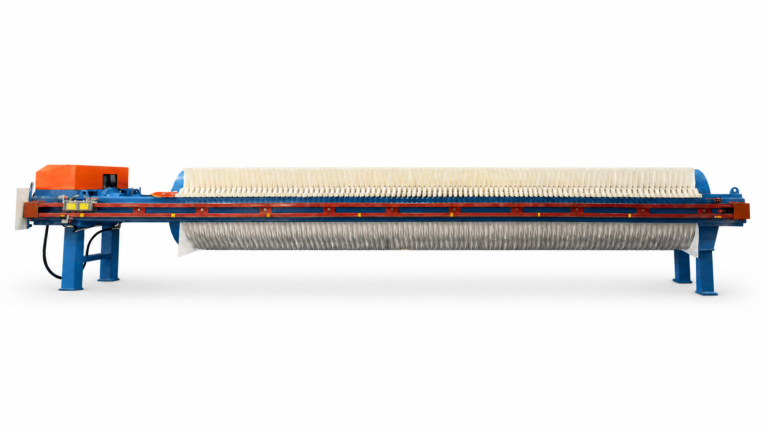
An uneven cake in a recessed-chamber press rarely has one obvious cause, and guessing at a fix before gathering evidence often changes the wrong variable. The question is not just where the unevenness appears, but whether that location is fixed, moving, or tied to a specific operating condition — and each answer points the investigation in a different direction.
What to record before diagnosing an uneven cake
| Plate or chamber position | Espessura do bolo | Cake completeness | Lançamento do bolo | Filtrate appearance | Point in the cycle |
|---|---|---|---|---|---|
| One row per inspected position | Record the observed thickness | Record whether the cake is complete or incomplete | Record the observed release condition | Record the observed filtrate appearance | Record when the pattern was observed |
Before anything is adjusted, the press needs a structured record of what is actually happening, because an uneven cake can present in several different ways that each suggest a different mechanism. Thickness alone does not describe the problem: a chamber can produce a thin but complete cake, a thick cake that fails to release cleanly, or a cake that appears normal in thickness but shows a filtrate quality that signals bypass or cloth damage. Recording cake thickness, completeness, release behavior, and filtrate appearance together — for each inspected plate or chamber position — prevents the common error of fixing a description to a single symptom when two or three conditions are actually overlapping.
The point in the cycle when the observation was made matters as much as the observation itself. A chamber that appears underfilled partway through the feed stage may simply be behind the fill sequence of the rest of the pack, while the same appearance at the end of cycle indicates a real volume or flow problem at that position. Without recording cycle timing alongside the physical observation, two very different conditions can look identical on paper.
This record also needs to be built before any setting is changed. If feed pressure, conditioning dosage, or cycle time is adjusted before the baseline pattern is mapped, the original evidence is lost, and any later pattern could be the result of the adjustment rather than the original fault. The map does not need to explain the cause; its purpose is to preserve what was actually observed, position by position, so that the next stage of inspection has something reliable to narrow against. A partial or inconsistent record at this stage tends to produce a longer diagnostic path later, because branches that could have been ruled out early stay open.
Plate-position patterns that narrow the inspection
| Pattern on the plate-by-plate map | What the map establishes | Next inspection branch |
|---|---|---|
| The pattern repeats at one plate position | The symptom is fixed to a specific position | Check the plate, cloth, and ports at that position against the supplier’s intended arrangement |
| The pattern follows one side | The symptom is associated with one side of the mapped pack | Compare the plate, cloth, port, and feed-distribution observations between sides |
| The pattern occurs at an end of the pack | The symptom is associated with an end position | Verify the intended pack arrangement and closing sequence before adjusting feed behavior |
| The pattern changes location between cycles | The symptom is not fixed to one mapped position | Compare feed condition, conditioning records, pump sequence, and cycle end condition across the affected cycles |
Once the position-by-position record exists, the first useful judgment is whether the pattern is fixed to a location or not, because this single distinction separates mechanical causes from process or feed-related causes. A pattern that repeats at one specific plate position across multiple cycles points toward something physically different about that position — a plate, cloth, or port condition that differs from its neighbors — rather than toward the feed stream or pump behavior, since the feed stream reaches every chamber under the same pumped conditions.
A pattern that follows one side of the pack suggests a different kind of cause again. Feed distribution within a recessed-chamber press depends on the internal flow paths formed by the plates and ports in sequence, so a side-wide pattern can indicate an asymmetry in how feed or filtrate moves through that half of the pack, rather than a fault isolated to a single plate. This is a meaningfully different branch from a single fixed position, because correcting one plate does nothing for a condition that is distributed across a side.
A pattern concentrated at an end of the pack raises a third possibility: the end chambers in a recessed-chamber press often experience different closing pressure or flow distribution than chambers in the middle of the pack, simply because of their position relative to the fixed and moving head. An end-position pattern does not by itself confirm a mechanical fault; it is equally consistent with the intended pack arrangement behaving as designed under a particular closing sequence. This is why the arrangement itself needs verification before any corrective action is taken at that position.
The fourth pattern — a location that changes between cycles — rules out a fixed mechanical cause at a single position or side. If the same chamber is sometimes affected and sometimes not, the explanation is more likely to lie in something that varies cycle to cycle: feed condition, conditioning, pump sequence, or how the previous cycle ended. A changing-location pattern redirects the inspection away from individual plates and cloths and toward the operating record of the cycles themselves.
Mechanical arrangement and cloth checks before adjustment
Where the position-pattern analysis points toward a fixed location — one plate, one side, or one end of the pack — the next step is to verify the physical arrangement before changing any feed or cycle setting. This sequencing matters because feed-side adjustments are easy to make and easy to reverse, which makes them tempting to try first, but a mechanical mismatch will not respond to a feed change and the attempted correction only adds noise to the next comparison.
Verification means confirming that the plates, cloths, ports, and closing sequence at the affected position match the supplier’s intended arrangement — not assuming that the pack is correctly assembled because it has been running. Plates can be rotated or positioned out of their intended sequence during reassembly after cloth replacement or maintenance; a cloth can be installed with a port misaligned relative to the plate’s drainage path; and a closing sequence that differs from the intended arrangement can leave a chamber under different compression than its neighbors even when every component is individually undamaged. Each of these produces a different downstream symptom, but all of them are arrangement issues rather than process issues, and all of them should be ruled out or confirmed before the feed side is touched.
Cloth condition deserves separate attention from cloth position. A cloth that is correctly positioned but worn, blinded, or distorted from repeated cycles can produce an uneven release or an altered filtrate appearance at that position without any error in assembly. Distinguishing a positioning problem from a condition problem at the same location determines whether the corrective step is reassembly or replacement, and conflating the two leads to the wrong corrective action being taken first. Where the arrangement and cloth condition at the flagged position both check out against the intended configuration, the fixed-location branch has been exhausted, and the investigation should return to the position-pattern record to confirm that the pattern is genuinely fixed rather than coincidentally repeated.
Feed condition and pump-sequence comparisons
| Comparison field | Earlier cycle | Later cycle | What the comparison can show |
|---|---|---|---|
| Condição da ração | Record the observed condition | Record the observed condition | Whether feed condition differed when the cake pattern differed |
| Conditioning record | Record the applicable entry | Record the applicable entry | Whether conditioning differed between the two cycles |
| Pump sequence | Record the sequence used | Record the sequence used | Whether the pump sequence changed with the observed pattern |
| Cycle end condition | Record the end condition | Record the end condition | Whether the cycles ended under comparable conditions |
| Uneven-cake map | Record position, thickness, completeness, release, and filtrate appearance | Record position, thickness, completeness, release, and filtrate appearance | Whether the pattern repeated at the same location or moved |
Where the position-pattern record points toward a changing location rather than a fixed one, the comparison shifts from physical arrangement to operating conditions across cycles. The reasoning here depends on holding the cake-observation map alongside the operating record for the same cycles, rather than treating either one alone as sufficient.
Feed condition — including how the material entering the press has been conditioned — can change the rate and uniformity of cake build-up across the pack. If conditioning varies between cycles, chambers that filled evenly under one set of conditions may fill unevenly under another, even though nothing about the press itself has changed. Comparing the conditioning record from a cycle that showed the uneven pattern against a cycle that did not is one of the few ways to test this branch directly, rather than inferring it from the symptom alone.
Pump sequence is a separate variable with its own mechanism. The rate and staging at which feed is introduced affects how evenly chambers fill relative to one another, particularly in the earlier part of a cycle before the full pack is under compression. A sequence that differs between two cycles — whether by operator action, control setting, or equipment variation — can produce a different fill pattern even with identical feed material, which is why pump sequence needs to be recorded and compared independently of feed condition rather than assumed to be constant.
Cycle end condition closes the comparison. How a cycle was ended — whether it reached its intended completion point or was stopped early for an unrelated reason — affects what the final cake looks like independent of anything upstream. A cycle ended before its intended point can show an apparent unevenness that has nothing to do with feed, conditioning, or pump sequence, and excluding this variable from the comparison risks attributing a cycle-ending artifact to a process cause.
The comparison is only useful when it holds the cake-pattern map from each cycle next to its own operating record, field by field, so that the reader can see which conditions actually differed alongside which cycles showed the pattern and which did not.
Controlled cycle changes that can confirm a branch
A comparison across past cycles can narrow the field of candidate causes, but it cannot always confirm which one is responsible, particularly where two conditions changed together in the historical record. Where the comparison leaves more than one plausible branch open, the next step is to run additional cycles in which only one factor is changed at a time, holding every other recorded condition constant.
The logic of changing one factor at a time is straightforward but easy to violate under operating pressure: if conditioning and pump sequence are both adjusted in the same trial cycle because both were suspected, and the pattern changes, there is no way to know which adjustment was responsible. Where the pattern does not change, both branches remain open rather than one being ruled out. A single-factor trial costs more in cycle time than a combined change, but it is the only approach that produces evidence rather than another ambiguous data point.
The choice of which factor to test first should follow from the position-pattern and operating-record comparison already completed, rather than from convenience. If the historical comparison showed conditioning varying consistently with the pattern while pump sequence stayed constant, conditioning is the factor to isolate first. If both varied together in every available cycle, the controlled trial becomes the only way to separate them, since the historical record cannot do it.
Each controlled cycle should be documented with the same plate-by-plate map used earlier — position, thickness, completeness, release, filtrate appearance, and cycle timing — so that the result of the controlled change can be compared against the same structure as the original observations. A controlled cycle that is documented less thoroughly than the original diagnostic record weakens the conclusion that can be drawn from it, because the reader is then comparing a detailed baseline against a vague trial result.
Where a single-factor change produces a consistent and repeatable shift in the pattern across more than one trial cycle, that factor has been confirmed as at least a contributing condition, even if it does not explain the entire original symptom. Where no single factor produces a clear change, the remaining branches — including the mechanical arrangement questions addressed earlier — need to be reopened rather than assumed closed.
Escalation evidence for supplier-assisted diagnosis
| Evidence | O que incluir | How it supports the diagnosis |
|---|---|---|
| Plate-position map | Cake thickness, completeness, release, filtrate appearance, and cycle observation point by position | Shows whether the pattern is fixed to a position, follows one side or an end, or changes location |
| Photographs | Photographs linked to the mapped positions and observed cycle | Preserves the visible condition associated with the mapped pattern |
| Operating records | Feed condition, conditioning records, pump sequence, and cycle end condition for the compared cycles | Lets the supplier test an operating-condition branch against repeated-cycle evidence |
| Cloth history | The relevant cloth history for the affected positions and cycles | Lets the supplier test a cloth-related branch against the position map |
| Recent maintenance | Maintenance relevant to the observed positions and cycles | Gives the supplier recent mechanical context for a bounded explanation |
Where the position mapping, mechanical checks, and controlled cycle comparisons have narrowed the possibilities but not resolved them, escalating to the equipment supplier is a reasonable next step — provided the escalation carries evidence rather than a description of the symptom. A report that simply states the cake is uneven gives a supplier no more to work with than the original observation, and invites a generic response rather than a diagnosis matched to the specific pattern already established.
The plate-position map is the foundation of a useful escalation, because it shows the supplier whether the pattern is fixed to a position, associated with a side or end of the pack, or changing between cycles — the same distinction that shaped the inspection sequence described earlier. Photographs tied to the mapped positions and the cycle in which they were taken preserve visual detail that a written description loses, particularly for release and completeness conditions that are difficult to describe precisely in words.
Operating records — feed condition, conditioning, pump sequence, and cycle end condition for the cycles being compared — let the supplier test an operating-condition explanation against the same evidence the plant has already gathered, rather than asking the plant to repeat observations that already exist. Cloth history for the affected positions and cycles allows the supplier to weigh a cloth-related explanation against the position map, and recent maintenance activity gives mechanical context that may explain why a previously stable position has started showing a pattern.
Supplying this evidence set changes what the conversation with the supplier can produce. A symptom description alone can only generate a bounded set of generic possibilities, most of which the plant may have already ruled out through its own inspection; a full evidence package lets the supplier test a specific, bounded explanation against data from the actual press. The EPA’s Recessed-Plate Filter Press biosolids technology fact sheet frames the feed-pump, plate-chamber, cloth, filtrate-removal, and cake-discharge interfaces as mechanisms needing regular operating attention, which supports treating each of these interfaces as a distinct diagnostic dimension rather than as a single combined system — though that fact sheet describes a municipal biosolids route and does not establish a universal cause or corrective setting for a given uneven-cake pattern. For configuration-specific questions about how a particular filtro prensa de câmara embutida is built and where its interfaces sit, the plant’s own position map and operating records — not the symptom name — are what let a supplier move from general troubleshooting toward a cause specific to that press.
Perguntas frequentes
Q: Should I change feed settings as soon as I find a thin or incomplete cake?
A: No single observation is enough to justify that change. First establish whether the pattern repeats at one plate, follows one side or an end of the pack, or moves between cycles, and verify the plate, cloth, port, and closing arrangement before testing feed behavior.
Q: How should I distinguish a cake-formation problem from a cake-release problem?
A: Record thickness, completeness, and release as separate observations rather than combining them under “uneven cake.” Link each observation to its plate position, filtrate appearance, and point in the cycle so the next inspection addresses the symptom actually observed.
Q: When is a comparison between two press cycles useful for diagnosis?
A: It is useful when the same positions are observed at comparable points in the cycle and only one investigated factor is changed. If feed condition, conditioning, pump sequence, and cycle end condition all differ, the comparison cannot isolate which branch deserves the next test.
Q: What should I do if the uneven pattern moves to different positions between cycles?
A: Treat the moving location as a reason to compare cycle conditions before assigning the problem to one plate. Align the feed condition, conditioning record, pump sequence, cycle end condition, and position map for the affected cycles, then choose one factor for the next controlled check.
Q: Do I need to identify the cause before asking the press supplier for help?
A: No. Escalate once the observations are organized well enough to test a bounded explanation: provide the position map, linked photographs, operating records, cloth history, and relevant recent maintenance, while stating which patterns repeat and which remain uncertain.