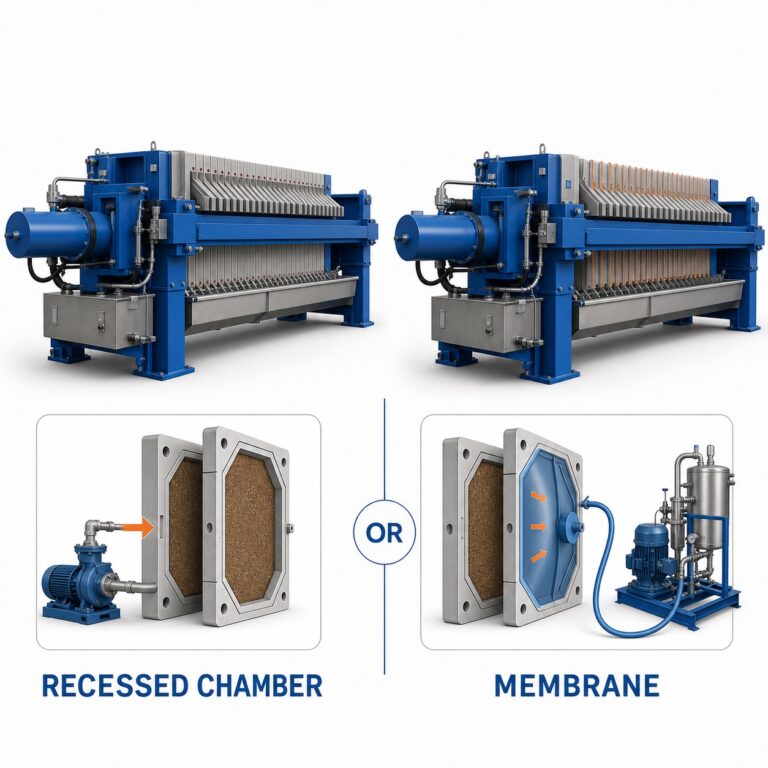
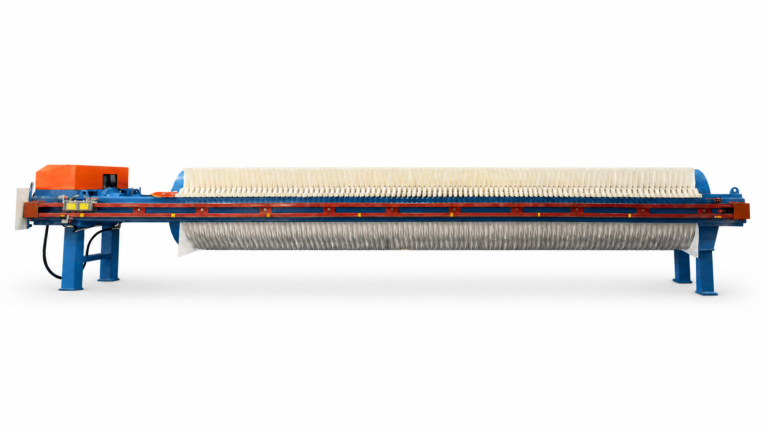
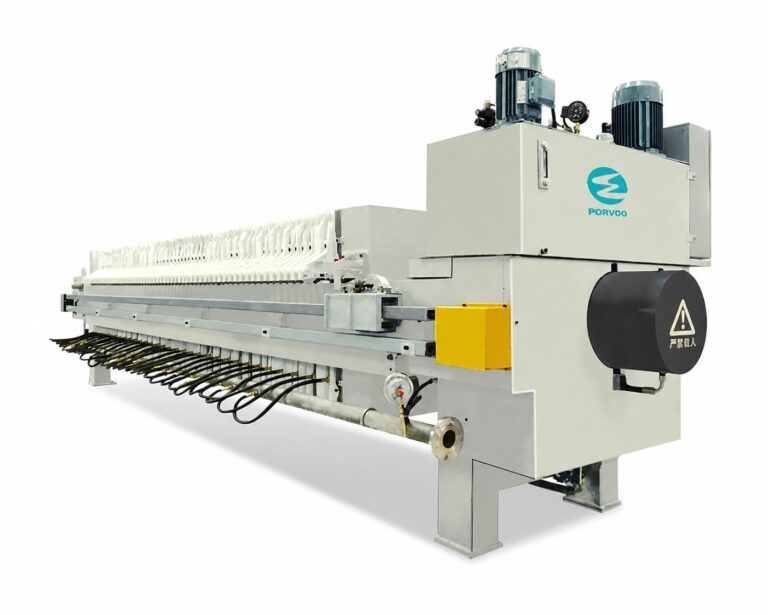
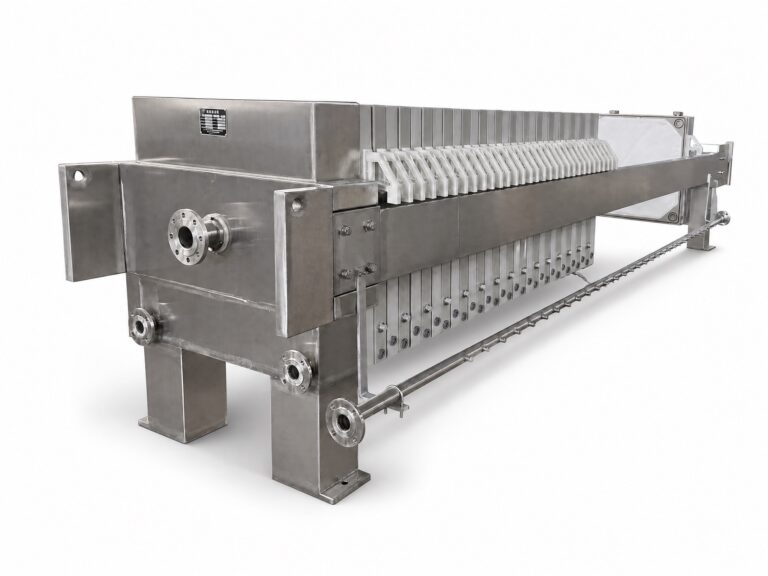
A plant that already owns a filter press often sees a membrane plate retrofit as the fastest route to drier cake, but the retrofit question is not whether membrane plates exist in the right size — it is whether the existing press, as built and as aged, can carry the modification. Answering that requires engineering information the catalog page for a new press does not need to provide. The decision changes depending on what the existing machine was designed for, how it has been operated since, and what records still describe it.
Existing Press Data Needed Before Feasibility Screening
Before anyone compares plate options, the existing press needs to be described as it actually is, not as it was originally specified. A press that has operated for years may carry wear, prior repairs, or field modifications that never made it back into the original documentation. Feasibility screening starts with establishing what is verifiably true about the machine today: its frame dimensions and available internal space, its current plate pack arrangement, its manifold and connection points, its closing mechanism and hydraulic system, and any structural history that could affect how much additional load or modification it can accept.
This matters because a retrofit proposal is really two designs overlaid on each other — the proposed membrane pack and the machine that must accommodate it. If the existing-press data is incomplete, every downstream judgment about compatibility becomes provisional. A buyer who skips this step and moves straight to selecting plate geometry is effectively asking a supplier to design against an unknown frame, which shifts risk rather than removing it.
The practical implication is that the retrofit conversation should open with documentation, not with a plate quotation. Where original design drawings, hydraulic schematics, and maintenance or modification records exist, they shorten the screening process because they establish traceable baseline conditions. Where they do not exist, the project needs an engineering review of the as-found machine before any plate-length or geometry discussion can be treated as more than preliminary. This is also where the condition of the press changes the judgment: a machine maintained to its original specification supports a more direct compatibility check, while a machine with undocumented field changes requires that those changes be identified and evaluated before they can be assumed compatible with anything proposed.
This intake data feeds directly into the physical, engineering, and integration checks that follow, and it is also the information a supplier needs in hand before any configuration or quotation review can be meaningful — incomplete or assumed data at this stage tends to resurface later as a compatibility problem rather than disappearing.
Frame, Pack Length, and Discharge-Space Compatibility
| Compatibility check | Existing-press evidence | Proposed-retrofit evidence | Feasibility decision |
|---|---|---|---|
| Frame space and pack length | Available frame space and current pack arrangement | Proposed pack length | Can the existing frame accept the proposed pack? |
| Plate geometry | Existing frame and plate geometry | Proposed plate geometry | Are the proposed plates physically compatible with the frame? |
| Manifolds and connections | Existing manifolds and connection interfaces | Proposed manifolds and connections | Can the proposed filtration interfaces connect to the existing press? |
| Cake-discharge clearance | Clearance available in the existing machine and plant layout | Discharge clearance after the proposed pack is installed | Will the modified arrangement preserve enough space for cake discharge? |
Once the existing press is documented, the first hard constraint is physical space. A membrane plate pack is not interchangeable with a standard plate pack purely because both fit the same frame width; membrane plates add thickness, connections, and sometimes different manifold routing, all of which consume space the original design allocated for something else. The frame was sized for a specific pack length, and that allocation does not automatically expand because a different plate type is substituted.
The condition that changes this judgment is how much margin the existing frame actually has. Where the frame was specified with spare length beyond the original plate pack, there may be room to accommodate a longer or different-geometry pack without structural change. Where the frame was sized tightly to the original pack, any additional plate thickness or connection hardware can eliminate clearance that the press depends on for normal operation, particularly at the cake-discharge end. Cake discharge is not a static clearance; it is a function of plate separation during opening, and if the installed pack reduces that separation or changes the discharge geometry, the press may close the gap needed for cake to fall freely or be removed without interference.
Manifolds and connections raise a related but separate question. Even where the plates themselves fit the frame, the proposed filtration interfaces — feed, filtrate, and any membrane squeeze connections — must align with or be adapted to the existing manifold layout. A plate that is geometrically compatible with the frame but incompatible with the manifold connections is not a workable substitution; it becomes a secondary engineering problem involving new piping runs or manifold modification, which changes the scope of the retrofit beyond a plate purchase.
This is the point at which a retrofit project stops being a comparison of plate specifications and becomes a comparison of two integrated systems — the proposed pack and the receiving frame — checked at every interface where they must physically agree. A compatibility screen that only checks plate dimensions against frame width, without checking pack length against available frame space, manifold alignment against existing connections, and discharge clearance against the as-installed arrangement, has not actually established that the retrofit will fit.
Closing System, Hydraulics, and Structural Review
| Review item | Required project basis | Feasibility implication |
|---|---|---|
| Closing-system loads | Original or responsible engineer review of the proposed pack and modification loads | Determines whether closing-system compatibility has been established |
| Hydraulic interfaces | Engineer confirmation of the existing and proposed hydraulic interfaces | Determines whether the hydraulic integration is acceptable for the project |
| Stored-pressure controls | Engineer review of stored-pressure controls for the modified machine | Determines whether the control and safety review can be completed |
| Structural changes | Engineer definition and review of any structural modification | Shows whether feasibility depends on a project-specific structural change |
| Catalog similarity | Similarity may support an initial screen only | Does not establish design compatibility for the existing press |
Fit is a necessary condition for a retrofit, but it is not sufficient. A plate pack that physically occupies the available frame space must also be held closed under the pressures the membrane squeeze function generates, and the mechanism doing that holding is the existing closing system — hydraulic cylinder, closing frame, and the structural members that react against the closing force. None of these were necessarily sized with a membrane retrofit in mind if the press was originally specified for a different plate type or process duty.
The load path changes meaningfully depending on what the membrane squeeze function adds. If the modification introduces additional pressure, additional plate mass, or a different force distribution across the pack, the closing system has to react that difference without exceeding whatever margin its original design carried. A closing system designed with margin for its original duty may absorb the change; one designed close to its working limit may not, and the only way to know which condition applies is engineering review, not comparison against a similar machine in a catalog.
This is why practitioner guidance treats catalog similarity as, at most, a screening tool rather than a design basis. Two presses that appear similar in frame size or plate count can differ in how their closing system, hydraulic circuit, and structural members were sized, especially if one has a service history that included prior modification. Confirming that a retrofit is structurally sound requires the original engineer, or another engineer taking responsibility for the design, to review the proposed pack and modification against the actual closing loads, hydraulic interfaces, and stored-pressure controls of the specific machine — not against a nominally similar unit.
Stored-pressure controls deserve particular attention because they govern what happens when pressure is present in the system but the press is not actively cycling. A modification that changes pressure levels, add connections, or changes the control sequence without a corresponding review of stored-pressure handling leaves a gap between what the machine is doing and what its safety controls assume it is doing. Reference material such as the Fiche d'information de l'EPA sur les technologies relatives aux biosolides : les filtres-presses à plaques encastrées describes pressure filtration mechanics and representative testing as a design basis, without extending performance values across installations — the same logic applies here: understanding the general mechanics of pressure filtration does not substitute for a project-specific review of this machine’s closing and pressure-control systems. Where any structural change is required to accommodate the retrofit, that change needs its own engineering definition and review, not an assumption that the frame will simply absorb it.
Squeeze Utilities, Manifolds, and Control Integration
| Integration element | Existing-machine or plant check | Retrofit definition needed | Décision approuvée |
|---|---|---|---|
| Squeeze utility | Existing plant utility interface and available layout space | Utility needed for the proposed squeeze function | Whether the added utility can be integrated into the project layout |
| Manifolds and valves | Existing manifolds, connections, and valve interfaces | Proposed manifolds, connections, and added valves | What interface changes are included in the retrofit |
| Instruments | Existing instrument interfaces | Instruments added for the proposed modification | Whether the required instrument integration is defined |
| Control states | Existing machine control states | Added squeeze and valve control states | Whether the modified controls can be integrated with the existing machine |
| Operator access | Existing access around the machine | Access needed after the added equipment is placed | Whether the integration layout preserves workable operator access |
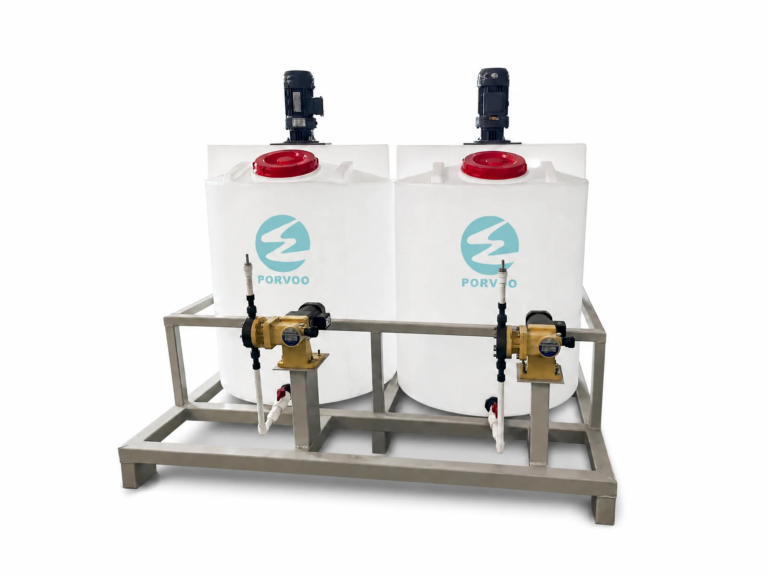
Assuming the frame and closing system can accept the retrofit, the next layer of feasibility is utility and control integration — the parts of the project that extend beyond the press itself into the surrounding plant. A membrane squeeze function requires a utility to pressurize the membrane, and that utility has to originate somewhere in the plant’s existing infrastructure and route through new or modified piping, valves, and instruments to reach the press.
The condition that determines how straightforward this is depends on what already exists at the installation site. Where compatible utility capacity and routing space are already available near the press, integration may be a matter of extending connections. Where the plant has no equivalent utility in proximity, or where available capacity is already committed to other equipment, the retrofit scope expands to include new utility provision, which is a different and larger category of work than adding plates to a frame.
Manifolds, valves, and instruments added for the squeeze function also have to be mapped against what the existing machine already has. An added valve needs a control signal, a control signal needs to be integrated into the machine’s existing control states, and the machine’s control logic needs to recognize the new states without conflicting with its original sequencing. A press that cycles automatically based on a defined set of states cannot safely treat an added squeeze step as an afterthought bolted onto the control panel; the control integration has to define where the new states fit in the existing sequence and what interlocks govern the transitions.
Operator access is the layout consequence of all of this. Adding utility piping, valves, and instruments around an existing press consumes space that may have supported operator movement, inspection points, or maintenance access before the retrofit. A compatibility check that confirms the plates fit the frame but does not confirm that the added hardware leaves workable access around the machine has only solved part of the integration problem. This is also where Porvoo’s role as an equipment and solution supplier becomes relevant to the buyer’s process: the project-specific utility, control, and layout information the buyer assembles at this stage is what a supplier needs in hand to evaluate configuration options and prepare a quotation that reflects the actual retrofit scope, rather than a generic plate substitution.
Safeguards, Access, and Maintainability After Modification
A retrofit that passes the physical, engineering, and integration checks can still create a machine that is harder to safeguard, inspect, or maintain than the one it replaced. Guarding on a filter press is typically positioned relative to moving plates, closing mechanisms, and discharge zones as they exist in the original configuration. Adding membrane connections, squeeze piping, or control hardware changes the physical envelope around those zones, and guarding that was adequate for the original configuration may no longer cover the modified one.
The relevant condition is whether the added hardware intrudes into a zone that guarding or access planning previously treated as clear. Where new piping or valves are routed outside the press’s moving envelope and away from operator pathways, existing guarding may remain adequate with minor adjustment. Where added hardware sits near the plate pack, the closing mechanism, or the discharge area, the guarding and access plan has to be reassessed against the modified geometry rather than assumed to still apply.
Maintainability follows a similar logic. A press is serviced over its operating life, and that servicing depends on being able to reach plates for inspection or replacement, reach the closing system for maintenance, and reach any added squeeze components for their own upkeep. A retrofit that satisfies the fit and control checks but places new components where they block routine access to an existing service point creates a standing maintenance burden that will recur for as long as the modified machine operates. This is a layout decision, not a performance question, and it needs to be resolved with the same attention given to the discharge-clearance and control-integration checks, because the same physical space is often being contested by all three requirements at once.
Test and Acceptance Basis for the Retrofit Decision
| Dimension décisionnelle | Evidence to use | Project-specific judgment |
|---|---|---|
| Résultat du gâteau | Cake outcome from representative slurry trials | Does the expected cake value meet the project acceptance plan? |
| Cycle result | Cycle outcome from representative slurry trials | Does the expected cycle value meet the project acceptance plan? |
| Handling result | Cake-discharge and handling outcome from representative slurry trials | Does the expected handling value meet the project acceptance plan? |
| Integration work | Defined frame, hydraulic, utility, control, safeguard, and access scope | Do the combined cake, cycle, and handling benefits justify the integration work? |
Everything established so far answers whether the retrofit can physically and mechanically be done. It does not answer whether it should be, and that is a separate judgment resting on whether the modification delivers enough improvement to justify the integration work it requires. The way to answer that is with representative slurry trials conducted against the specific material the press will handle, evaluated against a project acceptance plan defined before the trial runs.
The reason representative trials matter here, rather than reference performance from a similar installation, is that cake behavior, cycle behavior, and discharge behavior are all functions of the specific slurry characteristics as well as the press configuration. A membrane retrofit evaluated against one material’s behavior does not establish what it will do with a different material, and feasibility conclusions drawn from a dissimilar reference case carry that mismatch forward into every downstream decision. This is consistent with the broader principle that laboratory or trial evidence, design assumptions, and actual operating variability represent different categories of evidence — a representative trial narrows that gap but does not eliminate the need to confirm performance once the modified press is operating.
Where the acceptance plan defines what counts as sufficient cake condition, sufficient cycle improvement, and sufficient handling behavior before the trial runs, the trial results can be compared against a fixed standard rather than judged after the fact against whatever outcome occurred. This ordering matters: an acceptance plan written after seeing trial results tends to rationalize whatever the trial produced rather than testing it against the project’s actual requirements.
The final judgment weighs the trial-supported cake, cycle, and handling outcomes against the integration work defined earlier — the frame modification, hydraulic and structural review, utility and control integration, and any guarding or access changes. Where the expected improvement in cake dryness, cycle duration, or handling behavior is substantial relative to the scope of integration work required, the retrofit case strengthens. Where the integration work is extensive relative to the improvement the trials demonstrate, the same data may support evaluating a different configuration instead, including the alternative of a new press built around the intended duty from the outset. A filter press acceptance testing framework covering cake moisture, filtrate quality, and cycle time provides one basis for structuring this comparison once trial data exists, and a filtre-presse à chambre encastrée remains a relevant comparison point where the acceptance evidence suggests the retrofit’s incremental value does not clear the integration threshold the project has set.
Questions fréquemment posées
Q : Is a membrane plate pack that fits the existing frame enough to establish retrofit feasibility?
A : No. Physical fit is only one gate; the review must also resolve closing loads, hydraulic interfaces, squeeze utilities, manifolds, controls, safeguards, operator access, and cake-discharge clearance for the modified press.
Q : What information should the plant prepare before requesting a retrofit proposal?
A : Prepare the current frame space and pack arrangement, plate and connection geometry, manifold interfaces, discharge clearances, closing and hydraulic information, available utility interfaces, control states, and layout or access constraints. This gives the responsible parties a project-specific basis for defining the modification instead of relying on catalog resemblance.
Q : Can similarity to a catalog machine be used to approve the retrofit design?
A : Use similarity only for an initial screen. The original or responsible engineer still needs to confirm the proposed loads, hydraulic interfaces, stored-pressure controls, and any structural changes for the actual press.
Q : When should the project be treated as a wider machine integration job rather than a plate-only purchase?
A : Treat it as an integration job as soon as the squeeze function requires added utilities or changes to manifolds, valves, instruments, control states, safeguards, access, or structure. Define those interfaces and the responsible party for each before deciding that the retrofit scope is complete.
Q : How should a buyer decide whether the retrofit work is commercially worthwhile?
A : Set a project acceptance plan first, then use representative slurry trials to assess the expected cake, cycle, discharge, and handling results. Compare those project-specific results with the full frame, hydraulic, utility, control, safeguard, and access work required for the modification.