For facility managers and process engineers, the efficiency of a pulse jet dust collector is often reduced to a single metric: outlet emissions. This focus overlooks the critical truth that sustained high performance and low operating cost are products of three interdependent stages working in concert. A failure in pre-separation, surface filtration, or hopper discharge compromises the entire system, leading to premature media failure, spiraling energy costs, and compliance risks.
Understanding the distinct roles and optimization levers within each stage is no longer just technical nuance—it’s a direct lever on total cost of ownership. With fan energy consuming 60-80% of operational expenses, the strategic management of system pressure drop across these stages is the primary determinant of long-term economic and operational success.
How a Pulse Jet Dust Collector’s Filtration Cycle Works
The Core Automated Sequence
A pulse jet dust collector operates on a continuous loop of filtration and media regeneration. Dirty gas enters the housing, where an initial velocity drop allows for gravitational pre-separation. The gas then passes through filter media, where particles are captured, forming a porous dust layer called a filter cake. This cake itself becomes the primary filtration medium. As it builds, resistance—measured as pressure drop—increases. To restore flow, a short, high-pressure air pulse injects into the clean-air side of the filter, flexing the media and dislodging the cake into the hopper below. The cycle repeats automatically.
Balancing Contradictory Demands
The system’s genius and its central challenge lie in balancing online operation with effective cleaning. The filter cake is essential for high efficiency (>99.9%) but also the main source of pressure drop. The cleaning pulse must remove enough cake to control energy use without stripping it completely, which would cause a spike in emissions. This requires precise control of pulse timing, duration, and pressure based on real-time conditions, not fixed schedules.
Quantifying the Operational Cycle
The following table outlines the key phases and metrics of the standard filtration cycle, as defined by industry specifications.
Table: Pulse Jet Dust Collector Filtration Cycle Stages
| Stage | Key Action | Duration / Key Metric |
|---|---|---|
| Filtration | Gas flows through media | Continuous |
| Cake Formation | Particles build on surface | Efficiency >99.9% |
| Cleaning | Compressed air pulse | 50-150 milliseconds |
| Regeneration | Cake dislodged to hopper | Online, continuous operation |
Source: GB/T 17919-2021 Pulse jet dust collector. This standard governs the classification and technical requirements for pulse jet dust collectors, directly covering the automated filtration and regeneration cycle described.
The Critical Role of Pre-Separation in System Efficiency
More Than an Inlet Baffle
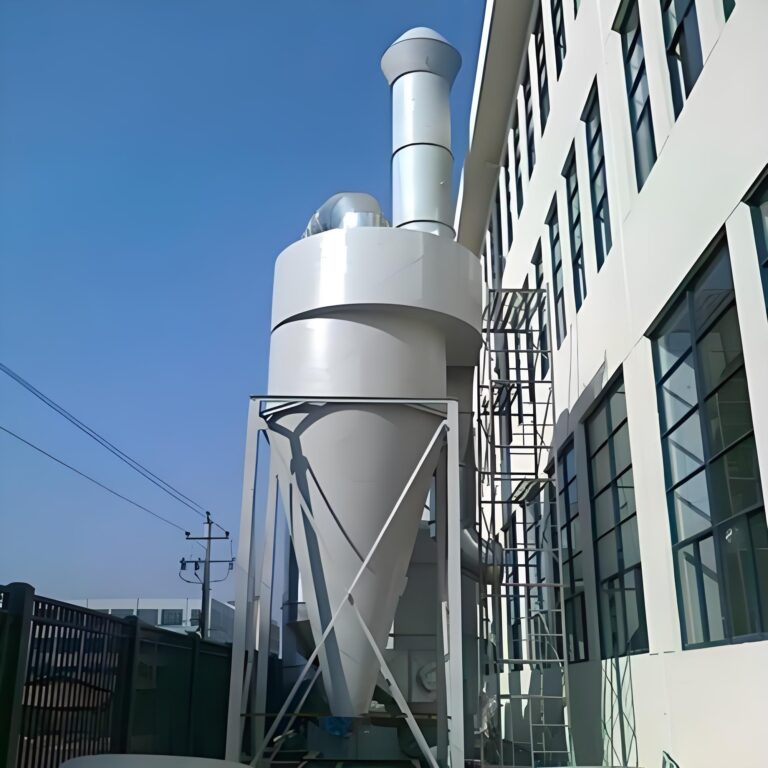
Pre-separation is often mistaken for a simple inlet baffle. Its true function is inertial separation: as gas velocity drops upon entering the collector, heavier particles cannot follow the gas stream’s turn and fall directly into the hopper. This stage handles the bulk material—the abrasive, coarse particles that cause the most mechanical wear on filter media. A well-designed pre-separation zone acts as a cost-saving pre-filter.
Direct Impact on Media Life and OpEx
The strategic value of effective pre-separation is its direct attack on operational costs. By reducing the particulate load reaching the filters, it decreases the frequency and intensity of cleaning pulses required. This extends media life and, most importantly, slows the rate of pressure drop increase. Since fan energy is the dominant cost, managing initial loading to control peak pressure drop is a primary efficiency lever. In our analysis of system failures, inadequate pre-separation for abrasive dusts is a leading cause of unscheduled bag replacement.
Functional Benefits of Pre-Separation
The operational impact of this first stage is multifaceted, as summarized below.
Table: Functions and Benefits of Pre-Separation
| Function | Benefit | Operational Impact |
|---|---|---|
| Removes coarse particles | Reduces media wear | Lower cleaning frequency |
| Lowers particulate load | Slows pressure drop rise | Decreased fan energy use |
| Protects filter media | Extends media life | Reduced replacement costs |
| Manages initial loading | Controls peak pressure drop | Major cost driver management |
Note: Fan energy constitutes 60-80% of operational expenses.
Source: Technical documentation and industry specifications.
Surface Filtration: How the Filter Cake Enables High Efficiency
From Depth to Surface Filtration
Initially, new filter media operate in a depth filtration mode, trapping particles within its fiber matrix. This is inefficient and creates high initial pressure drop. True high-efficiency operation begins once a stable dust cake forms on the media surface. This porous layer acts as a superior sieve, trapping sub-micron particles that would pass through the bare media. The system’s design aims to quickly establish and then carefully maintain this beneficial cake.
Understanding Pressure Drop Dynamics
Performance is quantified through three pressure drop parameters. The peak pressure drop is the maximum resistance reached before a cleaning pulse is triggered. The cake pressure drop is the component attributable solely to the dust layer. The residual pressure drop is the resistance across the media immediately after cleaning. A mature, stable system operates with a consistent difference between peak and residual pressure drop—this is the managed cake. Industry experts note that a common mistake is over-cleaning, which strips this cake and forces the system back into inefficient depth filtration, increasing emissions and energy use.
Pulse Jet Cleaning: Balancing Pressure Drop and Media Life
The Mechanics of Regeneration
Cleaning is triggered by a pressure drop setpoint or timer. A solenoid valve releases a short burst of compressed air (3-7 bar) from a reservoir tank into a blowpipe. The air exits through nozzles, injecting a high-velocity pulse into the clean-air side of the filter bag. This creates a reverse flow and a shockwave that travels down the bag, flexing the media and cracking the dust cake, which falls into the hopper. The entire event lasts 50-150 milliseconds.
The Pulse Pressure Dilemma
Pulse pressure is the primary adjustable parameter, but it presents a double-edged sword. Higher pressure more effectively controls operational pressure drop, saving fan energy. However, it also drives fine particles deeper into the media, increasing clean gas emissions and potentially causing permanent blinding. Furthermore, media selection dictates strategy. Finer-fiber media, chosen for high efficiency, often require higher pulse pressures to manage their inherently higher pressure drop, increasing compressed air costs.
Parameter Ranges and Effects
The interaction between cleaning parameters and media type is critical for system tuning.
Table: Pulse Jet Cleaning Parameters and Effects
| Parameter | Typical Range | Primary Effect |
|---|---|---|
| Pulse Pressure | 3 – 7 bar | Higher pressure reduces pressure drop |
| Pulse Duration | 50 – 150 ms | Cleans effectively, conserves air |
| Media Type (Fine) | Requires higher pressure | Manages drop, higher air cost |
| Media Type (Coarse) | Less pressure sensitive | Lower compressed air consumption |
Source: ISO 11057:2022 Air quality — Test method for filtration characterization of cleanable filter media. This standard provides the test method for evaluating cleanable filter media performance under cyclic loading and cleaning, directly relevant to pulse pressure and media interaction effects.
Key Factors Influencing Cleaning Performance and Cost
The Dominance of Dust Loading
While pulse pressure is adjustable, the dust loading rate has a greater influence on system pressure dynamics. A high loading rate forces more frequent cleaning and leads to a higher steady-state pressure drop. However, under these high-load conditions, increasing pulse pressure becomes significantly more effective at reducing both peak and cake pressure drop. This reveals the need for adaptive control systems that modulate cleaning intensity based on real-time inlet conditions, not just outlet pressure.
Residual Pressure Drop as a Prognostic Tool
The residual pressure drop is the most critical health indicator for the filter media. A clean, healthy bag will return to a stable baseline after each pulse. A steadily increasing residual pressure signals that fine particles are permanently embedded in the media matrix—a condition known as blinding. This trend is a reliable predictor of impending bag failure. Monitoring it enables predictive maintenance, allowing for scheduled replacement during planned downtime, avoiding catastrophic failure and unplanned stoppages.
Integrated System Factors
Optimization fails if components are tuned in isolation. The filter media, pre-separator, and cleaning system must be co-engineered. For example, selecting a high-efficiency nanofiber media without upgrading the cleaning system to a gentler, multi-mode sequence will lead to rapid media damage. The following table ranks the key influencing factors.
Table: Factors Affecting Cleaning Performance and Cost
| Factor | Influence Level | Impact on System |
|---|---|---|
| Dust Loading Rate | Highest on pressure drop | Dictates cleaning frequency |
| Pulse Pressure | High under heavy loading | Reduces all pressure parameters |
| Residual Pressure Drop | Critical health indicator | Predicts media blinding/failure |
| Component Integration | Essential for optimization | Sub-optimal if tuned in isolation |
Source: GB/T 6719-2023 Bag filter dust collector. This standard for bag filter dust collectors specifies performance testing and inspection, encompassing the integrated factors that influence cleaning efficacy and operational cost.
Hopper Design and Discharge for Reliable Dust Removal
Preventing Re-Entrainment
The hopper is not merely a dust bin; it is the final, critical stage ensuring captured dust is permanently removed. Poor hopper design—with inadequate slope angles or stagnant zones—allows dust to accumulate. This buildup can be re-entrained by incoming gas streams, effectively re-introducing dust into the filtration zone and undermining the efficiency of the entire preceding process. Its primary function is to facilitate first-in, first-out mass flow of material.
Ensuring Positive Material Evacuation
Effective hoppers are designed with steep slopes (often >60°) and may incorporate mechanical aids like vibrators, air fluidizers, or rappers to prevent bridging and rat-holing. Discharge is typically managed by an airlock device, such as a rotary valve or double-dump valve, which allows dust to exit while maintaining the system’s negative pressure. For continuous operation, a screw conveyor may transport dust to a central collection point. The choice of pulse jet dust collector design and discharge system must align with dust characteristics like cohesiveness and bulk density.
Optimizing the Three Stages for Your Specific Application
Tailoring the Sequence
Optimization begins with dust characterization: particle size distribution, moisture content, abrasiveness, and explosivity. A stream with heavy, abrasive dust demands a robust pre-separation stage. A process emitting fine, cohesive powders requires careful hopper design and possibly heating elements. The goal is to tailor each stage—pre-separation, filtration/cleaning, discharge—to handle the specific challenges of the dust, creating a seamless, efficient sequence.
Avoiding Component-Level Myopia
The strong interaction effects between stages mean optimizing one in isolation is ineffective. Selecting a high-efficiency, fine-fiber media increases the demand on the cleaning system (higher pulse pressure) and makes pre-separation even more critical to manage loading. This alters the total cost of ownership, trading lower media cost for higher compressed air consumption. The procurement strategy should favor vendors who co-engineer the entire system, not just supply components.
Maintenance and Monitoring for Long-Term System Health
From Reactive to Predictive
Proactive maintenance shifts from calendar-based bag replacement to condition-based action. The cornerstone is continuous monitoring of the three pressure drop parameters. Tracking trends in peak pressure drop indicates changes in dust loading or cleaning effectiveness. Monitoring cake pressure drop helps fine-tune cleaning cycles. Most importantly, as established, tracking residual pressure drop enables predictive replacement of filter media before failure.
Data-Driven Service Models
Real-time data acquisition transforms the relationship between operator and supplier. With IoT-enabled sensors capturing sub-second pressure data, maintenance can evolve into a performance-based service model. The operator’s goal shifts from simply replacing bags to stabilizing pressure drop, directly controlling the 60-80% fan energy cost. This data richness allows suppliers to potentially offer uptime or efficiency guarantees, moving toward a “filtration as a service” paradigm.
Key Monitoring Parameters
A focused maintenance program tracks specific parameters for diagnostic purposes.
Table: Maintenance Monitoring Parameters and Goals
| Monitored Parameter | Diagnostic Purpose | Maintenance Goal |
|---|---|---|
| Peak Pressure Drop | Indicates maximum load | Schedule cleaning cycles |
| Cake Pressure Drop | Measures dust layer burden | Optimize cleaning intensity |
| Residual Pressure Drop | Predicts bag lifespan | Enable predictive replacement |
| Real-time Data (IoT) | Enables performance-based service | Stabilize energy consumption |
Note: Stabilizing pressure drop is key as fan energy is 60-80% of OpEx.
Source: Technical documentation and industry specifications.
Superior pulse jet dust collector performance is not an accident; it is the result of deliberate optimization across three integrated stages. Prioritize understanding your dust characteristics to inform pre-separation and hopper design. Focus maintenance efforts on stabilizing system pressure drop, using residual pressure drop trends for predictive media replacement. Finally, recognize that component-level optimization is sub-optimal—seek integrated solutions where media, cleaning, and mechanical design are co-engineered.
Need professional analysis to optimize your dust collection system’s stages for peak efficiency and lowest total cost? The engineers at PORVOO specialize in designing and tuning integrated pulse jet systems that balance filtration performance with operational economics. Contact us to discuss a system audit or a tailored solution for your specific application.
Frequently Asked Questions
Q: How does the filter cake in a pulse jet collector affect both efficiency and operating costs?
A: The porous dust layer, or filter cake, that forms on the media surface is the primary mechanism for achieving >99.9% collection efficiency. However, this cake also increases system pressure drop, which directly drives the main operational cost: fan energy, accounting for 60-80% of expenses. This means facilities targeting strict emission compliance must carefully manage the cake’s stability to maintain efficiency without letting pressure drop escalate energy consumption.
Q: What is the most critical adjustable parameter for pulse jet cleaning, and what are its trade-offs?
A: Pulse pressure is the most impactful adjustable parameter, typically set between 3-7 bar. Higher pressure effectively lowers operational pressure drop for energy savings but risks driving fine particles deeper into the media, increasing clean gas emissions and accelerating media wear. For projects where energy costs are a primary concern, plan for a control system that can modulate pulse pressure based on real-time dust loading to optimize this balance.
Q: Which standard provides the test method for characterizing cleanable filter media used in pulse jet systems?
A: The performance of filter media under cyclic loading and cleaning is evaluated using ISO 11057:2022. This standard specifies how to measure pressure drop and particle collection efficiency as dust accumulates on the media. This means procurement teams should request ISO 11057 test data from media suppliers to make informed comparisons of long-term performance and cleaning characteristics.
Q: How can monitoring pressure drop predict filter bag failure and enable predictive maintenance?
A: Tracking the residual pressure drop—the pressure across the filter immediately after a cleaning pulse—serves as a key health indicator. A steady increase in this residual value signals permanent blinding or dust penetration within the media structure, forecasting imminent bag failure. If your operation requires high uptime, you should implement real-time pressure trend monitoring to schedule replacements proactively and avoid unplanned downtime.
Q: Why is pre-separation considered a critical first stage for system longevity and cost management?
A: Pre-separation removes heavier, coarse particles by gravity before they reach the filter media. This reduces the particulate load on the filters, decreasing the frequency of cleaning pulses and slowing abrasive wear. This directly addresses the insight that the dust loading rate dominates pressure dynamics. Facilities handling abrasive dust streams should prioritize robust inlet design or dedicated pre-separators to lower long-term media replacement and energy costs.
Q: What should you consider when selecting filter media for high-efficiency applications with nano-aerosols?
A: For capturing nano-aerosols, fine-fiber or nanofiber media are selected for superior efficiency but require a compatible cleaning strategy. Standard high-pressure pulses can damage these delicate media; a gentler, multi-mode sequence like hybrid backpulse-backblow may be necessary. This means pharmaceutical or high-tech facilities must ensure their vendor can co-engineer the entire system—media, pre-separation, and specialized cleaning—as an integrated unit.
Q: Which standard directly governs the technical requirements and testing of pulse jet dust collectors?
A: The design, manufacture, and performance verification of this equipment are specified in GB/T 17919-2021. This Chinese National Standard covers classification, technical requirements, and test methods for pulse jet dust collectors. For projects supplying or operating in relevant markets, compliance with GB/T 17919-2021 is a fundamental requirement for system acceptance and performance validation.