Specifying a filter press based on daily slurry volume is a common starting point, but it’s insufficient for accurate sizing. The critical challenge is translating a flow rate into a batch-based chamber volume requirement, a process complicated by variable solids concentration, target cake dryness, and slurry-specific characteristics. Misapplying generic rules-of-thumb here leads directly to capital waste or chronic underperformance.
Accurate capacity calculation is a non-negotiable prerequisite for procurement. It shifts the specification process from vendor-dependent estimates to a transparent, data-driven methodology. This foundational engineering work determines not only equipment size but also operational efficiency, chemical consumption, and total lifecycle cost, making it the most consequential step in system design.
Fundamental Concepts: Filter Press Capacity and Mass Balance
Defining Batch Capacity
Filter press capacity is not defined by continuous flow but by the volume of solids retained per batch cycle. The sizing goal is determining the total filter chamber volume needed to process a given daily solids load within an operational window. This chamber volume is the net space available for formed filter cake after the plates are closed.
The Mass Balance Principle
Sizing is fundamentally a mass balance calculation. The mass of dry solids entering with the slurry must equal the mass of dry solids discharged in the cake. The volume of that cake dictates the necessary chamber volume. This principle is paramount; overlooking it and sizing based solely on slurry volume ignores the transformative effect of dewatering, where volume reduction ratios of 10:1 are common.
From Theory to Specification
Understanding this mass balance empowers buyers to conduct independent validation of vendor proposals. It transforms the specification from a simple flow rate to a performance-based guarantee centered on cake dryness, which is the universal metric for dewatering success and disposal cost savings.
Step 1: Gather Your Essential Process Data
Core Process Variables
Accurate sizing begins with precise baseline data. You must establish the daily slurry volume (m³/day), the dry solids content of the inlet slurry (Cin) as a percentage by weight, and the target cake solids concentration (Cout). The operating schedule (available hours per day) and a target cycle time or desired number of daily cycles frame the operational capacity window.
The Criticality of Slurry Characterization
Relying on generic assumptions for key properties transfers significant performance risk to the purchaser. In my experience, the single most common cause of sizing error is using an assumed cake density or cycle time without slurry-specific validation. Investing in laboratory filterability tests or a pilot study is essential risk mitigation, providing empirical data for reliable calculations.
A Framework for Data Collection
Organizing your process parameters clarifies what is known and what must be tested. The following table outlines the essential variables and underscores which are core inputs versus slurry-specific variables that require characterization.
| Process Variable | Typical Range / Unit | Criticality |
|---|---|---|
| Daily Slurry Volume | Client-specific (m³/day) | Core input |
| Inlet Solids (C_in) | Percentage by weight | Core input |
| Target Cake Dryness (C_out) | Percentage by weight | Core performance metric |
| Operating Schedule | Hours per day | Defines capacity window |
| Target Cycle Time | 20 minutes to 8 hours | Primary capacity lever |
| Cake Density (ρ_cake) | 1120–1440 kg/m³ | Slurry-specific variable |
Source: Technical documentation and industry specifications.
Step 2: Perform the Mass Balance for Daily Cake Volume
Calculate Daily Dry Solids Mass
The first calculation anchors the entire mass balance. Determine the daily mass of dry solids entering the press: M_solids = V_slurry × Slurry Density × (C_in / 100). Slurry density can often be approximated as 1000-1100 kg/m³ for water-based slurries, but measured values are superior.
Determine Daily Wet Cake Mass
This mass of dry solids is constant, but its form changes. The target cake dryness (C_out) determines the daily mass of wet filter cake: M_cake = M_solids / (C_out / 100). This equation highlights the direct relationship: a higher target cake dryness (e.g., 40% vs. 30%) results in a lower wet cake mass for the same dry solids, enabling a smaller press or more cycles.
Translate to Daily Cake Volume
Finally, convert the wet cake mass into a volumetric requirement using the cake density: V_cake_daily = M_cake / ρ_cake. This sequence confirms that cake dryness is the universal performance metric, as it directly determines the volume reduction ratio and subsequent disposal cost savings. The calculations follow a logical, sequential mass balance.
| Calculation Step | Formula | Key Output |
|---|---|---|
| Daily Dry Solids Mass | V_slurry × Slurry Density × (C_in/100) | M_solids (kg/day) |
| Daily Wet Cake Mass | M_solids / (C_out/100) | M_cake (kg/day) |
| Daily Cake Volume | M_cake / ρ_cake | Vcakedaily (m³/day) |
Source: Technical documentation and industry specifications.
Step 3: Determine Required Chamber Volume Per Cycle
Establishing the Daily Cycle Count
The daily cake volume must be accommodated within a feasible number of batch cycles. Determine the number of cycles per day (N) by dividing available operating hours by the estimated total cycle time (filling, filtration, pressing, core blow, plate shift). Alternatively, set a practical target, such as 3 cycles per 8-hour shift.
Calculating Net Chamber Volume
The required net filter chamber volume per cycle is then a simple division: V_chamber = V_cake_daily / N. This result defines the actual cake-holding capacity needed each time the press is cycled. It is a net volume; total chamber volume in a plate-and-frame configuration is the sum of the voids between each plate when closed.
The Cycle Time Lever
Cycle time is the primary operational lever for daily capacity, as it directly dictates N. A press with a 2-hour cycle time completes 4 cycles in an 8-hour shift; optimizing filtration to achieve a 1.5-hour cycle boosts that to over 5 cycles, increasing daily throughput by 25% without changing the hardware. This makes effective sludge conditioning to optimize cycle time a critical focus.
| Variable | Definition | Impact on Sizing |
|---|---|---|
| Cycles Per Day (N) | Operating hours / Cycle time | Inversely affects chamber size |
| Required Chamber Volume | V_cake_daily / N | V_chamber (m³/cycle) |
| Cycle Time | 20 minutes to 8 hours | Primary daily capacity lever |
Source: Technical documentation and industry specifications.
Key Factors That Impact Your Capacity Calculation
Dynamic Material Properties
Cake density (ρ_cake) is not a constant. It varies significantly based on particle size distribution, shape, and compressibility. Municipal biological sludges typically form less dense cakes (1120-1280 kg/m³), while mineral slurries can exceed 1440 kg/m³. Using a generic value introduces major error in the volumetric calculation from Step 2.
Operational and Chemical Variables
Cycle time variability must be accounted for in planning; longer cycles reduce N. Chemical conditioning, using agents like lime or ferric chloride, is a major operational variable. It improves filterability and target cake dryness but introduces a predictable, ongoing cost driver. Total cost of ownership analyses must include these chemical expenses, which can rival capital costs over the equipment’s lifecycle.
The Concentration Advantage
A factor often overlooked is the impact of inlet solids concentration (Cin). A higher Cin dramatically reduces the slurry volume needed to deliver the same dry solids mass. Pre-thickening slurry from 2% to 4% solids effectively halves the volumetric load to the press, often enabling a smaller unit or providing significant capacity headroom.
| Factor | Typical Range / Effect | Consideration |
|---|---|---|
| Cake Density (ρ_cake) | 1120–1440 kg/m³ | Requires slurry-specific testing |
| Cycle Time Variability | 20 min – 8 hours | Major throughput determinant |
| Chemical Conditioning | Lime, ferric chloride | Key operational cost driver |
| Inlet Solids (C_in) | Higher concentration reduces V_slurry | Enables smaller press size |
Source: Technical documentation and industry specifications.
Practical Sizing: From Chamber Volume to Plate Count
Configuring the Plate Pack
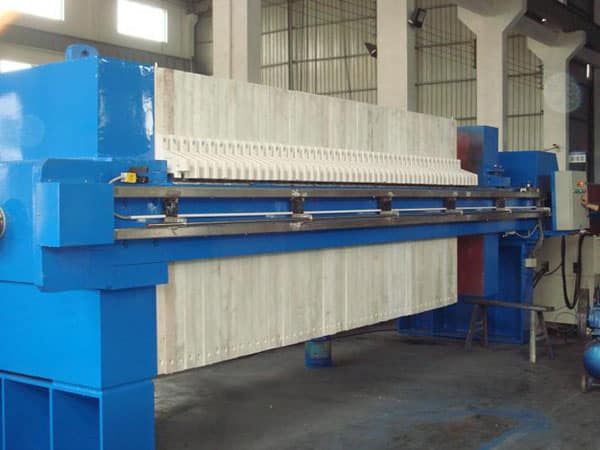
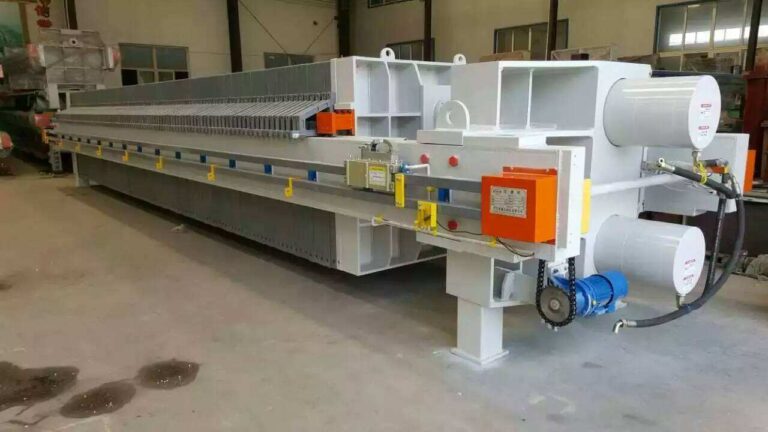
The calculated chamber volume (V_chamber) is used to select a press configuration. Total chamber volume is a function of the number of chambers and the volume per chamber. Chamber volume per plate is determined by plate size (e.g., 800mm, 1000mm, 1500mm) and chamber thickness (e.g., 25mm, 32mm, 40mm). Vendors use this to propose a specific plate count and size.
The Surface Area Trade-Off
Selecting this configuration involves a critical engineering trade-off. Using fewer, larger-chamber plates reduces capital cost but also reduces the total filtration surface area for a given chamber volume. For difficult, slow-filtering sludges, insufficient surface area can compromise dewatering performance, extending cycle times or reducing final cake dryness. This makes plate selection a technical-economic optimization problem, not just a volumetric fit.
Specifying for Performance
Therefore, procurement specifications should not stop at chamber volume. They must include guaranteed performance parameters—primarily cake dryness and cycle time—under defined feed conditions. This ensures the selected plate-and-frame filter press configuration has the necessary filtration area and mechanical capability to meet your process goals, not just hold the calculated volume.
Common Sizing Mistakes and How to Avoid Them
The Incomplete Mass Balance
The most prevalent mistake is sizing based solely on daily slurry volume. This ignores the mass balance and the volume reduction achieved through dewatering, leading to grossly oversized equipment. Conversely, focusing only on dry solids mass without properly accounting for cake density and target dryness can lead to an undersized press that cannot physically hold the wet cake produced.
Reliance on Unverified Assumptions
Using generic, unverified values for cake density, cycle time, or achievable dryness is a direct path to operational failure. To avoid this, mandate pilot testing with actual slurry as a contractual prerequisite for vendor proposals. This testing generates the specific data needed for your calculations and provides a benchmark for performance guarantees.
Neglecting System Integration
A filter press is the heart of an integrated dewatering system. A common pitfall is specifying the press in isolation, neglecting the harmonius design of ancillary systems like feed pumps, core blow, cake wash, and conveyors. Piecemeal procurement creates integration risks, flow mismatches, and control gaps that undermine overall performance. The press, feed system, and controls must be engineered as a single unit.
Next Steps: Validating Your Calculation and Selecting a Press
Engaging with Vendors
Use your derived chamber volume requirement to request preliminary proposals. However, anchor your formal procurement specification on guaranteed performance: a specific cake dryness (Cout) and maximum cycle time under defined feed conditions (Cin, slurry type). This shifts the conversation from equipment dimensions to process outcomes.
Aligning with Market Segments
Recognize that the market segments by solution sophistication. Needs range from basic manual presses for intermittent use to fully automated, membrane-equipped systems for continuous, high-volume operations. Align supplier selection with your process complexity, required reliability, and automation level. A basic press for a complex duty cycle will fail, and an overly complex system for a simple task wastes capital.
Evaluating Automation Strategically
Finally, evaluate automation levels—from manual plate shifting to fully automatic systems—as a strategic CAPEX vs. OPEX decision. This choice is heavily influenced by local labor costs, safety regulations, and desired operational intensity. Higher automation reduces direct labor but increases initial investment and maintenance sophistication. The optimal choice balances these factors over the system’s lifecycle.
Your calculated chamber volume is the starting point for specification, not the finish line. The next priority is validating these figures through testing and translating them into a performance-based procurement document that guarantees results. This disciplined approach mitigates risk and ensures the selected system meets both capacity and process goals.
Need professional support in specifying and validating a filter press solution for your specific slurry? The engineering team at PORVOO can assist with pilot testing and system design based on your mass balance and operational targets. For a detailed discussion of your application, Contact Us.
Frequently Asked Questions
Q: How do you determine the required chamber volume for a filter press based on daily slurry volume?
A: You calculate the required chamber volume through a mass balance that converts daily solids load into cake volume. First, compute the daily mass of dry solids from your slurry volume and inlet concentration. Then, determine the daily wet cake mass using your target cake dryness, and finally convert that to a daily cake volume using the measured cake density. This means facilities with high daily solids loads must accurately characterize cake density to avoid selecting an undersized press.
Q: Why is cake dryness the most critical performance metric for filter press specification?
A: Cake dryness directly dictates the volume reduction achieved and the subsequent cost of disposal or transport. In the mass balance calculation, the target cake solids percentage is the divisor that determines the final wet cake mass and volume from a fixed dry solids load. For projects where off-site disposal fees are high, plan for pilot testing to validate the achievable dryness, as this parameter has a greater financial impact than cycle time alone.
Q: What is the primary operational variable that controls daily throughput for a given filter press size?
A: Cycle time is the main lever for daily capacity, as it directly determines how many batches you can run within your operating window. A shorter cycle time increases the number of daily cycles, allowing a smaller chamber volume to process the same daily solids load. If your operation requires high throughput, you should prioritize effective sludge conditioning to optimize filterability and minimize this cycle time.
Q: How does the choice between fewer large plates or more small plates affect filter press performance?
A: Selecting a configuration with fewer, larger-chamber plates reduces capital cost but also decreases the total filtration surface area. This trade-off can compromise dewatering performance for difficult sludges, potentially leading to longer cycles or lower final cake dryness. This means facilities processing challenging, slow-filtering slurries should prioritize filtration area over chamber volume to maintain performance targets.
Q: What is the most common mistake in filter press sizing and how can it be avoided?
A: The prevalent error is sizing based solely on daily slurry volume without completing the full mass balance that accounts for inlet concentration, target dryness, and cake density. This leads to grossly mis-sized equipment. To avoid this, mandate pilot testing with your actual slurry as a contractual prerequisite to gather reliable data on cake density and achievable cycle time before finalizing equipment specifications.
Q: Should procurement specifications focus on chamber volume or a guaranteed performance parameter?
A: Anchor your procurement specifications on a guaranteed cake dryness under defined feed conditions, not just a chamber volume. While chamber volume is a necessary sizing output, it does not guarantee the final dewatering result. This means you should use your calculated volume to request proposals but make final payment and acceptance contingent on vendors meeting the guaranteed solids concentration in the discharged cake.
Q: How do chemical conditioning agents impact the total cost of filter press ownership?
A: Chemical conditioning, using agents like lime or ferric chloride, is a major operational cost driver that can rival capital expenses over the equipment’s lifecycle. These chemicals improve filterability and target cake dryness but introduce a predictable, ongoing expense. For operations focused on total cost of ownership, your financial analysis must include these recurring chemical costs alongside the initial equipment investment.